As you begin on your language learning journey, you will undoubtedly encounter numerous challenges that test your resolve and abilities. Your progress will be influenced by how you respond to these obstacles, and it is through overcoming them that you will experience significant growth. You will develop new strategies and approaches, adapting to the demands of language acquisition, and in doing so, you will refine your skills and deepen your understanding of the language, ultimately propelling your progress forward.
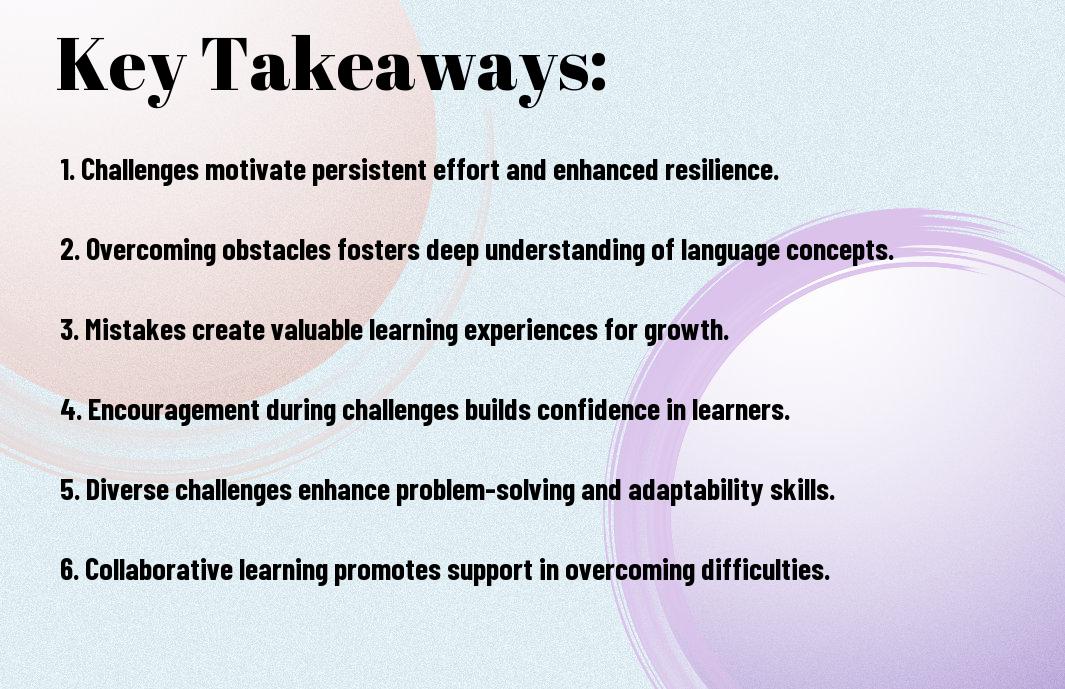
Key Takeaways:
- Overcoming language barriers is crucial for achieving fluency in a new language, as it helps to build confidence and improve communication skills.
- Challenging yourself with difficult vocabulary and grammar concepts can help to accelerate language learning progress and develop a deeper understanding of the language.
- Embracing errors and setbacks as opportunities for growth and improvement can help language learners to stay

Challenges in Language Acquisition
To overcome language learning challenges, you must first understand the obstacles that hinder your progress. As you begin on this journey, you will encounter various barriers that can impede your ability to acquire a new language.
Cognitive Barriers
With the complexities of language acquisition, you will face cognitive barriers that affect your ability to process and retain new information. Your brain’s ability to absorb and process new linguistic rules and patterns can be a significant hurdle.
Environmental Factors
At the outset, you are influenced by your surroundings, which can either facilitate or hinder your language learning process. You may encounter:
- Lack of exposure to native speakers
- Insufficient resources
- Distracting learning environments
Knowing your environmental factors can help you develop strategies to mitigate their impact.
Hence, as you navigate the challenges of language acquisition, you will find that environmental factors play a significant role in shaping your learning experience. You may encounter:
- Access to language learning tools
- Opportunities for practice
- Social support from peers and instructors
Knowing these factors will enable you to create a conducive learning environment that supports your language learning goals.
The Impact of Language Learning Challenges
There’s no denying that language learning challenges have a profound effect on your progression as a learner, pushing you to re-evaluate your approach and strive for improvement, which ultimately leads to growth.
On Personal Development
Besides the obvious benefits of language acquisition, overcoming challenges fosters resilience and adaptability, enabling you to tackle obstacles with confidence and persistence, which in turn enhances your overall personal development.
On Social Interactions
Above all, language learning challenges impact your ability to engage with others, as you navigate complex social situations and develop effective communication strategies, allowing you to build stronger relationships with native speakers and connect with diverse communities.
Language learning challenges, in the context of social interactions, present you with opportunities to engage in meaningful conversations, share your perspectives, and learn from others, thereby broadening your understanding of different cultures and ways of life, and enabling you to become a more empathetic and open-minded individual.
Overcoming Language Learning Obstacles
After encountering various hurdles, you can still make significant progress in language learning by persisted effort and dedication. You will find that your hard work pays off as you become more proficient in the language.
Effective Learning Strategies
Efficiently, you can develop strategies to tackle language learning challenges, such as setting achievable goals and practicing consistently, which will help you stay motivated and track your progress.
Technological Tools
Among the numerous resources available, you can utilize language learning apps, online courses, and podcasts to supplement your learning, making it more engaging and convenient.
Further, technological tools provide you with access to a vast array of learning materials, allowing you to practice at your own pace and focus on specific areas of improvement, thus enhancing your overall language learning experience.
Language Learning in Diverse Contexts
Not all language learning occurs in a traditional classroom setting. You will encounter diverse contexts that shape your learning experience, from informal conversations to formal instruction.
Cultural Influences
Akin to a key that unlocks new perspectives, cultural influences play a significant role in language learning, as you navigate different social norms and values that impact your communication style.
Institutional Support
Contextual factors, such as access to resources and instructional methods, affect your language learning journey, and you will find that institutional support can significantly impact your progress.
Another aspect of institutional support that you should consider is the quality of feedback and assessment, as constructive criticism and evaluation can help you refine your language skills and address areas that need improvement, allowing you to make informed decisions about your learning path.
The Role of Motivation in Language Learning
For effective language learning, you need to understand the factors that drive your progress, such as motivation, which you can explore further in Language learning: its challenges and rewards | EssayGenius.
Intrinsic Motivation
Beneath the surface of your language learning journey, you will find that intrinsic motivation, driven by personal interest and satisfaction, plays a significant role in your progress.
Extrinsic Motivation
After setting your language learning goals, you will likely encounter extrinsic motivation, driven by external factors such as rewards or social pressure, which can also impact your learning experience.
A closer examination of extrinsic motivation reveals that it can be a powerful tool to supplement your intrinsic motivation, helping you stay on track and achieve your language learning objectives, as you navigate the challenges and rewards that come with learning a new language, and you will find that understanding these motivations is crucial to your success.
Strategies for Success
Unlike other learning endeavors, language learning challenges require a unique set of strategies to overcome. You will need to develop a personalized approach to tackle difficulties and stay motivated.
Goal Setting
By establishing clear objectives, you can focus your efforts and track your progress, helping you to stay on course and make steady improvements in your language skills.
Feedback and Assessment
After receiving feedback on your language proficiency, you can identify areas for improvement and adjust your learning strategy accordingly, allowing you to refine your skills and move forward with confidence.
This process of feedback and assessment is crucial to your growth as a language learner, as it enables you to evaluate your strengths and weaknesses, and make informed decisions about your learning path, helping you to overcome challenges and achieve your goals in a more efficient and effective manner, and you will find that your language skills improve significantly as you continue to practice and refine your approach.
Final Words
With this in mind, you can now approach language learning with a newfound understanding of the challenges that lie ahead. As you tackle your linguistic goals, consider exploring 4 common language learning challenges to take on in class to enhance your skills. By acknowledging and overcoming these obstacles, you will ultimately refine your language proficiency and foster a deeper appreciation for the complexities of language learning, allowing your progress to flourish.
FAQ
Q: What is the significance of language learning challenges in measuring progress?
A: Language learning challenges play a significant role in measuring progress as they help learners assess their current level of proficiency, identify areas that require improvement, and set realistic goals for future development. By overcoming these challenges, learners can develop a sense of accomplishment and motivation, which can further enhance their language learning journey. Additionally, language learning challenges provide an opportunity for learners to develop problem-solving skills, think creatively, and learn from their mistakes.
Q: How do language learning challenges impact the development of language skills?
A: Language learning challenges have a profound impact on the development of language skills, including reading, writing, listening, and speaking. By engaging with challenging materials and tasks, learners can improve their comprehension, vocabulary, and grammar. Furthermore, language learning challenges encourage learners to practice active listening, speak confidently, and express themselves effectively in writing. As learners overcome these challenges, they develop a stronger foundation in the language, which enables them to communicate more effectively and accurately convey their intended message.
Q: What strategies can language learners use to overcome common language learning challenges and track their progress?
A: To overcome common language learning challenges and track their progress, learners can use several strategies, including setting achievable goals, creating a study schedule, and practicing consistently. Learners can also utilize language learning apps, join online communities, and engage with native speakers to stay motivated and receive feedback. Moreover, learners can track their progress by keeping a language learning journal, monitoring their test scores, and reflecting on their achievements. By adopting these strategies, learners can develop a growth mindset, stay focused, and make steady progress towards becoming proficient in the target language.

