As you begin on your own linguistic journey, you may wonder how language learning has evolved over time. You’ll discover that the art of acquiring a new tongue has been a cornerstone of human culture for centuries, with ancient civilizations employing innovative methods to master the languages of their peers. Your curiosity will be piqued as you research into the fascinating history of language learning, from traditional apprenticeships to modern technological advancements, and uncover the remarkable ways in which our ancestors learned to communicate across linguistic boundaries.
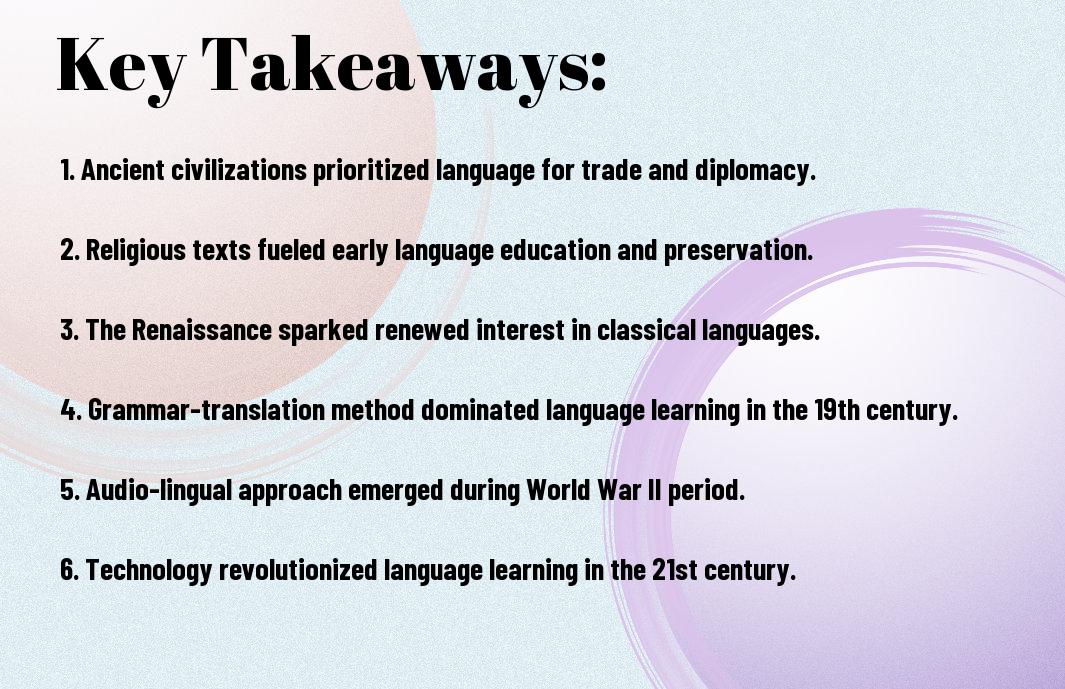
Key Takeaways:
To understand the evolution of language learning, it’s vital to explore its history and development over time. Here are the main points to consider:
- The ancient civilizations, such as Egypt, Greece, and Rome, laid the foundation for language education by developing writing systems and teaching methods that are still influential today.
- The Middle Ages saw the rise of Latin as a lingua franca, which dominated language instruction and literary works for centuries, shaping the cultural heritage of many countries.
- The Renaissance and Enlightenment periods brought significant advances in language teaching, with the introduction of new methods and materials that focused on conversation and practical application.
- The 20th century introduced modern language learning techniques, including the use of audio-visual materials, immersion programs, and computer-assisted language learning, which have revolutionized the way people learn languages.
- The digital age has further transformed language learning, with the rise of online courses, language learning apps, and social media, providing access to a wide range of resources and communities for language learners worldwide, emphasizing the importance of technology in language acquisition.

Ancient Civilizations
To explore the history of language learning, you must examine into the past, where ancient civilizations laid the groundwork for modern linguistic discoveries. You will find that language played a significant role in the development of these cultures.
Language Learning in Mesopotamia
Across the fertile plains of Mesopotamia, you will discover a rich history of language learning, where writing and speaking were highly valued skills, and you can see the influence of language on the region’s cultural and economic growth.
The Role of Language in Ancient Egypt
The sophistication of ancient Egyptian language is evident in its intricate hieroglyphics, which you can decipher to uncover the secrets of this enigmatic civilization, and you will appreciate the significance of language in their daily life and spiritual practices.
Ancient Egyptians, as you will notice, placed a high value on language, using it to convey complex ideas, tell stories, and pass down knowledge through generations, and you can learn much about their lives by studying the languages they spoke and wrote.
Classical Antiquity
Even as you investigate into the history of language learning, you’ll discover that the ancient civilizations laid the groundwork for modern methods. In this era, you’ll find the roots of language instruction, which would eventually influence the way you learn languages today.
The Emergence of Language Schools in Greece
Characteristically, the Greeks established language schools, where you could study rhetoric, philosophy, and poetry, laying the foundations for Western intellectual traditions. As you explore these schools, you’ll see how they emphasized the importance of language in shaping your thoughts and ideas.
Roman Language Learning and Rhetoric
Around the time of the Roman Empire, you’ll notice a significant emphasis on language learning, particularly in the art of rhetoric. As you examine Roman language instruction, you’ll find that it focused on persuasive speech and writing, skills that you still value today.
At the heart of Roman language learning was the practice of imitation, where you would study and mimic the styles of renowned orators and writers. As you look closer, you’ll see how this approach helped you develop your own voice and express your ideas with clarity and conviction, much like the great Roman statesmen and philosophers who came before you.
The Middle Ages
All throughout this period, you’ll discover that language learning was shaped by various factors, including a fascinating exploration of 2/27: A brief history of language learning, which informs your understanding of the subject.
Monastic Schools and Language Education
Before delving into the specifics, you’ll find that monastic schools played a significant role in language education, providing you with a foundation for further study.
The Influence of the Church on Language Learning
Around the time of the Middle Ages, you’ll notice that the Church’s influence on language learning was profound, shaping your perception of the subject.
Further investigation into the Church’s influence reveals that Latin was the dominant language, and you’ll see how it affected your understanding of language learning during this period, as you explore the ways in which the Church’s power and reach impacted the development of language education, shaping your knowledge of the subject.
The Renaissance and Beyond
For your journey through the history of language learning, the Renaissance marks a significant era. You can research into The History of Language Learning and Teaching I to explore this period in depth.
The Revival of Classical Languages
Upon entering this era, you’ll notice the resurgence of classical languages, which greatly influenced your understanding of language learning.
The Development of Modern Language Teaching Methods
On the heels of this revival, modern language teaching methods began to emerge, shaping your approach to language acquisition.
Another significant development in this area is the focus on pronunciation and conversation, allowing you to engage more effectively with the language you’re learning, and making your language learning journey more immersive and interactive.
Modern Era
Not surprisingly, the modern era has brought about significant advancements in language learning, and you are now spoiled for choice when it comes to methods and tools. You can learn a language at your own pace, in your own time, and in a way that suits your learning style.
The Rise of Language Laboratories and Audio-Visual Aids
For instance, you may have noticed that language laboratories and audio-visual aids have become increasingly popular, allowing you to practice your listening and speaking skills in a more immersive and interactive way. You can engage with native speakers, watch videos, and listen to podcasts, all of which help to bring the language to life.
The Impact of Technology on Language Learning
Learning a language has never been easier, thanks to the plethora of online resources and tools at your disposal. You can access language learning apps, websites, and social media platforms, all of which provide you with a wealth of information, exercises, and opportunities to practice your language skills.
But as you investigate deeper into the world of online language learning, you begin to realize the true extent of technology’s impact. You can connect with native speakers from all over the world, join online language exchange communities, and even take virtual classes with qualified teachers. You can also use speech recognition software to improve your pronunciation, and access a vast library of language learning materials, including e-books, videos, and podcasts, all of which can be tailored to your individual needs and learning style.
Contemporary Perspectives
Your understanding of language learning has evolved significantly over the years, and today, you have a plethora of resources at your disposal to learn any language you desire.
Globalization and Language Learning
By virtue of technological advancements, you can now access language learning materials from all over the world, making it easier for you to stay connected with diverse cultures and communities.
The Future of Language Education
On the cusp of a new era in language learning, you are poised to experience innovative methods and tools that will revolutionize the way you acquire new languages.
Language learning is becoming increasingly personalized, and you will soon have the ability to tailor your learning experience to your individual needs and preferences, making the process more enjoyable and effective, allowing you to explore the vast expanse of human expression and connect with people from all walks of life, as you continue to navigate the complex and fascinating world of languages.
Conclusion
Presently, as you reflect on the journey of language learning through the ages, you’ll find that your understanding of the subject has been enriched by the historical context. You’ve seen how various civilizations have contributed to the evolution of language instruction, shaping the methods and materials you use today. Your appreciation for the complexity and diversity of language learning has likely grown, and you may even find yourself pondering the future of this timeless pursuit.
FAQ
Q: What were the earliest methods of language learning, and how did they evolve over time?
A: The earliest methods of language learning date back to ancient civilizations, where languages were learned through immersion and apprenticeship. For example, in ancient Greece and Rome, language learning was deeply rooted in rhetoric and philosophy. As societies became more complex, language learning methods evolved to include written texts, such as the development of grammars and dictionaries in the Middle Ages. The modern era saw the introduction of new methodologies, including the direct method, which emphasized spoken language, and the grammar-translation method, which focused on reading and writing. Today, language learning incorporates a wide range of approaches, from technological tools to interactive classrooms, reflecting the diverse needs and preferences of learners worldwide.
Q: How did the invention of the printing press influence language learning, and what were its lasting impacts?
A: The invention of the printing press in the 15th century had a profound impact on language learning by making written materials, including textbooks, grammars, and dictionaries, widely available. This accessibility led to a standardization of languages, as common spellings and grammatical rules could be disseminated on a large scale. The printing press also enabled the mass production of language learning materials, such as phrasebooks and language manuals, which were used by travelers, traders, and diplomats. The spread of literature and educational materials contributed to the development of linguistic studies and helped establish language learning as a formal discipline. Furthermore, the printing press facilitated the creation of bilingual and multilingual texts, enhancing language learners’ access to authentic materials and contributing to linguistic and cultural exchange.
Q: What role has technology played in the evolution of language learning, and how is it shaping the future of this field?
A: Technology has revolutionized language learning by providing learners with unprecedented access to resources, tools, and communities. The advent of the internet, social media, and mobile devices has made it possible for people to learn languages at their own pace, anywhere, and at any time. Digital platforms offer a myriad of learning materials, including interactive lessons, language exchange opportunities, and real-time feedback mechanisms. Furthermore, advancements in artificial intelligence and machine learning are enabling the development of personalized learning pathways, adaptive assessments, and virtual language tutors. The integration of technology in language learning is not only enhancing the efficiency and effectiveness of the learning process but also expanding the reach of language education to underserved populations and contributing to the preservation of endangered languages through digital archiving and online learning resources.

