As you research into linguistic diversity, you begin to appreciate the significance of languages that are on the brink of extinction. Your understanding of the world is shaped by the languages you speak, and the loss of a language is a loss of a unique cultural perspective. You are likely aware that languages are not just a means of communication, but also a repository of traditions, customs, and histories. As you explore this topic, you will discover the profound impact of endangered languages on your perception of identity, community, and cultural heritage.
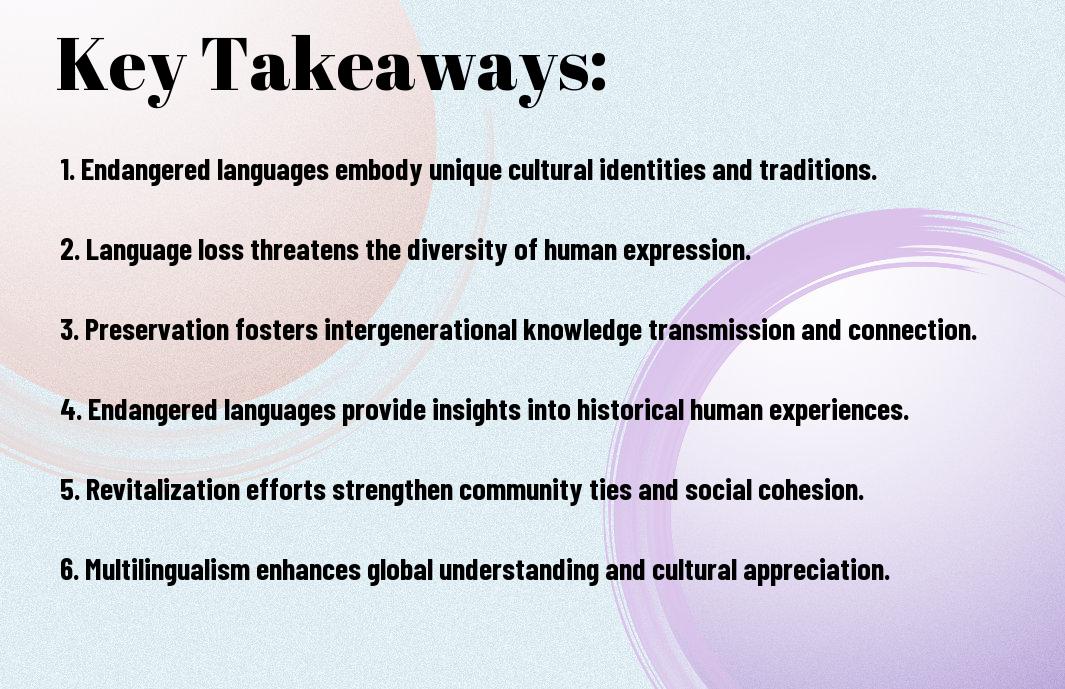
Key Takeaways:
- The preservation of endangered languages is important for maintaining cultural diversity and promoting linguistic heritage.
- Language loss can have significant socioeconomic and environmental impacts on communities, highlighting the need for conservation efforts.
- Endangered languages often possess unique traditional knowledge and cultural practices that are vital for the identity and wellbeing of their speakers.
- The documentation and revitalization of endangered languages require collaboration between language communities, researchers, and policy makers.
- Education and language planning are key strategies for promoting the use of endangered languages and supporting the linguistic rights of their speakers.
Significance of Language
Your understanding of the world is shaped by the language you speak, and the loss of a language can have a profound impact on your culture and identity. To learn more about the importance of preserving languages, you can visit Endangered languages: Why so important?, which provides valuable insights into this issue.
Role in Culture
Among the various aspects of a culture, language plays a vital role in shaping your traditions, customs, and values, all of which are vital to your heritage and the way you live your life.
Identity and Belonging
Language is closely tied to your sense of self and community, influencing your perceptions and interactions with the world around you, and it is this unique relationship that makes language preservation so vital to maintaining your cultural identity.
Hence, as you probe deeper into the significance of language, you will find that it is not just a means of communication, but a vital part of your being, connecting you to your history, your community, and your very sense of belonging, and it is this profound connection that makes the preservation of endangered languages a matter of great importance to you and your cultural heritage.

Threats to Endangered Languages
You are likely aware that endangered languages face numerous threats, and to Preserve Endangered Languages, it is important to understand these challenges. As you examine into the world of language preservation, you will find that the decline of endangered languages is a complex issue.
Globalization and Urbanization
Beneath the surface of modernization, globalization and urbanization are eroding the foundations of endangered languages, as you see the effects of cultural homogenization on your daily life.
Lack of Documentation
Besides the obvious obstacles, the lack of documentation of endangered languages poses a significant threat to their survival, as you consider the importance of written records in your own language.
And as you explore the issue of lack of documentation further, you will discover that the absence of written materials, such as dictionaries, grammars, and texts, hinders the ability to study and teach endangered languages, ultimately contributing to their decline, and you begin to appreciate the value of preserving your own language’s literary heritage.
Preserving Linguistic Diversity
Keep in mind that languages are an integral part of cultural heritage, and their loss can have severe consequences on your understanding of the world. As you investigate into the importance of linguistic diversity, you begin to appreciate the need for preservation.
Community Efforts
Toward this end, you will find that community-led initiatives are instrumental in promoting linguistic diversity, as you engage with local communities to document and teach endangered languages, thereby ensuring their continued use.
Technological Solutions
Following the advent of digital technology, you can now leverage various tools to aid in language preservation, such as language learning apps and online archives, which enable you to access and learn endangered languages with ease.
Preserving endangered languages through technology requires your careful consideration of the various methods available, including digital language repositories and speech recognition software, which can help you to analyze and learn from vast amounts of linguistic data, ultimately aiding in the development of more effective preservation strategies.
Educational Implications
Many educators are now recognizing the significance of incorporating endangered languages into your curriculum, as it not only promotes cultural diversity but also fosters a deeper understanding of the world’s linguistic heritage. By doing so, you can enrich your students’ educational experience and broaden their perspectives on the complexities of human communication.
Language Revitalization Programs
The development of language revitalization programs has become a vital step in preserving endangered languages, and you can play a significant role in supporting these initiatives by advocating for their inclusion in your educational institutions. These programs can help you and your community appreciate the importance of linguistic diversity and take action to protect it.
Cultural Sensitivity in Curriculum
To effectively incorporate endangered languages into your curriculum, you must consider the cultural context in which they are spoken, and be mindful of the historical and social factors that have contributed to their decline. By doing so, you can create a more inclusive and culturally sensitive learning environment that values the diversity of languages and cultures.
This approach to cultural sensitivity in curriculum design requires you to think critically about the ways in which language instruction can be tailored to meet the needs of diverse student populations, and to prioritize the development of materials and resources that reflect the cultural heritage of endangered languages. As you initiate on this endeavor, you will likely encounter a range of challenges and complexities, but the potential benefits to your students and the broader community make it a worthwhile pursuit.
Economic and Social Benefits
After considering the significance of endangered languages, you may wonder about their economic and social implications. You will find that preserving these languages can have numerous benefits, including the promotion of cultural diversity and community development, which can, in turn, foster economic growth and social cohesion.
Tourism and Cultural Exchange
On the one hand, the preservation of endangered languages can also facilitate tourism and cultural exchange, allowing you to engage with unique cultures and communities, and promoting cross-cultural understanding and exchange, which can be a valuable experience for you.
Language Preservation as a Resource
Any effort to preserve endangered languages can be seen as a valuable investment, as you will have access to a rich cultural heritage, and the opportunity to learn from the history and traditions of the community that speaks it, which can enrich your understanding of the world.
Understanding the value of language preservation as a resource, you can appreciate the importance of protecting endangered languages, and the role you can play in their preservation, by supporting language documentation and education initiatives, and promoting cultural exchange programs, which can help to ensure the long-term survival of these languages, and the cultures they represent, for your own benefit and the benefit of future generations.
Challenges and Opportunities
Unlike other cultural preservation efforts, saving endangered languages requires a multifaceted approach, and you will face numerous obstacles, including limited resources and lack of awareness, as you investigate into the complexities of language revitalization.
Funding and Support
Around the globe, you will find that financial backing for language preservation is scarce, and as you navigate the process, you will need to secure funding and support from various organizations and institutions to aid in your efforts.
Collaboration and Awareness
Above all, you must acknowledge the significance of cooperation between communities, researchers, and policymakers, as you work to promote the importance of endangered languages and develop strategies for their preservation, and you will find that this synergy is crucial in raising awareness about the value of linguistic diversity.
Indeed, as you engage in collaboration and awareness efforts, you will discover that the preservation of endangered languages is not only a matter of cultural significance but also a means of promoting intellectual and artistic expression, and you will come to understand that your role in this process is vital, as you contribute to the creation of a more inclusive and diverse cultural landscape, and you will be able to appreciate the value of linguistic heritage in all its complexity and richness.
To wrap up
So, as you consider the fate of endangered languages, you begin to grasp the profound implications of their loss on your understanding of the world. You see that each language carries a unique cultural heritage, and its disappearance would deprive you of a distinct perspective on human experience. As you reflect on this, you are compelled to acknowledge the significance of preserving these languages, for your own enrichment and the sake of cultural diversity.
FAQ
Q: What is the significance of preserving endangered languages in terms of cultural heritage?
A: Preserving endangered languages is important for maintaining the cultural diversity of communities around the world. Each language carries a unique perspective, history, and tradition that is woven into the fabric of a community’s identity. When a language disappears, the cultural practices, customs, and beliefs associated with it are also at risk of being lost. By preserving endangered languages, we can help safeguard the cultural heritage of these communities and ensure that their stories, myths, and histories continue to be passed down to future generations.
Q: How do endangered languages contribute to the rich tapestry of global cultural expression?
A: Endangered languages contribute significantly to the rich tapestry of global cultural expression by providing a window into the distinct experiences, worldviews, and traditions of their respective communities. These languages often have unique linguistic features, such as grammatical structures, vocabularies, and idiomatic expressions, that reflect the environmental, social, and historical contexts in which they evolved. Furthermore, endangered languages are frequently associated with vibrant cultural practices, including music, dance, art, and literature, which are an integral part of human cultural diversity. By promoting the use and preservation of endangered languages, we can foster a more inclusive and diverse cultural landscape that values and celebrates the contributions of all languages and cultures.
Q: What can be done to support the preservation and promotion of endangered languages, and why is it important for the global community?
A: To support the preservation and promotion of endangered languages, it is important to develop and implement language documentation and conservation programs, provide language education and training, and create cultural and economic opportunities that value and utilize endangered languages. This can involve collaborating with language communities, linguists, and cultural organizations to develop language curricula, create language learning materials, and support language-based cultural initiatives. Additionally, governments, NGOs, and international organizations can play a vital role in providing funding, resources, and policy support for language preservation efforts. The global community has a vested interest in preserving endangered languages, as language loss can have far-reaching consequences, including the erosion of cultural diversity, the loss of traditional knowledge, and the diminishment of community identity and social cohesion.

