simon weiner

The Best Languages for Travel Enthusiasts

Key Takeaways:

To commence on a journey around the world, it’s necessary to consider the languages that can facilitate communication and immersion in foreign cultures. Here are some key languages for travel enthusiasts:

  • The Spanish language is highly beneficial for traveling to Spain, Latin America, and the Caribbean, with over 460 million native speakers worldwide.
  • Mandarin Chinese is a valuable language to learn for travel, as it is spoken by over 1 billion people in China, Taiwan, and other countries with Chinese communities.
  • French is an official language in several international organizations and is spoken in many countries, including France, Canada, Belgium, and several African nations.
  • Arabic is a useful language for traveling to the Middle East and North Africa, with over 300 million native speakers across the region.
  • English is widely spoken and understood in many countries, making it an excellent language to know for international travel, business, and communication.

Language Preferences

For travel enthusiasts, choosing the right language to learn can be overwhelming. You’ll want to consider languages that are widely spoken and can help you navigate various cultures with ease.

Popular languages for travel

Above all, languages like Spanish, Mandarin, and Arabic are top choices, as they are spoken by millions of people worldwide, making your travels more enjoyable and interactive.

Language families for easy learning

After selecting a language, you’ll find that some language families, such as Romance languages, are easier to learn, as they share similarities in grammar and vocabulary, making it simpler for you to pick up.

Considering your goals and travel plans, you’ll likely find that learning a language from a family with many similarities, such as the Romance languages, can be incredibly beneficial, allowing you to communicate with locals and enhance your overall travel experience, as you’ll be able to understand and appreciate the culture more deeply, and you can even apply your knowledge to learn other related languages more quickly.
European Delights

Even if you’re a seasoned traveler, exploring Europe can be a thrilling experience, and speaking the local language can enhance your journey, as you’ll be able to connect with the culture and people on a deeper level, making your travels more enjoyable and allowing you to immerse yourself in the local way of life.

Spanish for the Mediterranean

With the warm climate and beautiful beaches of the Mediterranean, speaking Spanish will make your travels more enjoyable, as you’ll be able to communicate with locals, try delicious food, and explore historic sites, such as Barcelona and Madrid, that showcase the region’s rich history and culture, which will make your trip even more meaningful.

French for romantic getaways

An understanding of French will make your romantic getaway to Paris or the French Riviera even more unforgettable, as you’ll be able to appreciate the art, cuisine, and romantic atmosphere that these destinations have to offer, and you’ll be able to engage with the locals, making your experience more authentic and enjoyable.

And as you stroll along the Seine or visit the Eiffel Tower, you’ll find that speaking French allows you to fully appreciate the beauty and charm of these iconic destinations, and you’ll be able to navigate the city with ease, making the most of your time in France, and creating lasting memories of your romantic getaway, which will stay with you long after you leave.

Asian Adventures

Keep exploring the vibrant cultures of Asia, and you’ll discover a wealth of languages to learn. Your travels will take you to countries with rich histories and diverse traditions.

Mandarin for Chinese culture

Towards understanding the intricacies of Chinese culture, learning Mandarin will open doors to a world of ancient traditions and modern innovations, allowing you to fully immerse yourself in your travels.

Japanese for anime and tech

Just like Japanese enthusiasts, you can investigate into the fascinating world of anime, manga, and cutting-edge technology by learning the Japanese language, which will enhance your experience in this unique country.

Further into your exploration of Japanese culture, you’ll find that speaking the language will give you access to a wide range of experiences, from visiting famous anime and manga studios to attending tech conferences and festivals, making your travels even more memorable and enjoyable, and allowing you to connect with the locals on a deeper level, bringing your adventures to life.

Practical Considerations

All travelers should consider the feasibility of learning a new language while on the go. You can find helpful tips on what’s the best way to learn a language while traveling to make the most of your experience.

Language learning resources

Practically, you’ll need reliable resources to learn a language, such as language learning apps, phrasebooks, or online courses, to help you navigate your destination.

Immersion techniques

For an authentic experience, consider staying with a host family or participating in language exchange programs to improve your language skills.

Language immersion is key to becoming proficient in a new language, and as you surround yourself with native speakers, you’ll pick up nuances and expressions that will enhance your travel experience, allowing you to connect with locals and appreciate your destination on a deeper level, making your journey even more enjoyable and rewarding, and helping you to make the most of your time abroad.

Cultural Connections

Once again, you’ll find that learning a new language can deepen your understanding of the culture you’re visiting, allowing you to navigate everyday situations with ease and make meaningful connections with locals.

Language and customs

Among the many benefits of language learning, you’ll discover that it helps you appreciate the customs and traditions of the place you’re visiting, enabling you to engage with your surroundings in a more authentic way.

Body language and nonverbal cues

Between the lines of language, you’ll pick up on nonverbal cues that convey just as much meaning as spoken words, helping you navigate social situations with confidence and avoid unintended offense.

It is especially important to consider the nuances of body language and nonverbal cues, as they can vary significantly from one culture to another, and being aware of these differences will help you communicate more effectively and build stronger relationships with the people you meet during your travels, allowing you to fully immerse yourself in your new surroundings and make the most of your experience.

Specialized Languages

Despite the popularity of widely spoken languages, learning specialized languages can enhance your travel experiences. You can explore unique cultures and communicate with locals more effectively.

Arabic for Middle Eastern travels

For instance, learning Arabic will help you navigate the Middle East, enabling you to engage with your surroundings and interact with locals in a more meaningful way, making your travels more enjoyable and authentic.

Portuguese for Brazilian and African adventures

Eastern cultures, such as those in Brazil and Africa, will become more accessible as you learn Portuguese, allowing you to appreciate the local customs and traditions that make your travels so enriching.

Even with basic knowledge of Portuguese, you can examine deeper into the vibrant cultures of Brazil and Africa, as you explore the historic cities, stunning landscapes, and lively festivals, creating unforgettable experiences as you connect with the people and places you encounter on your travels.

To wrap up

With this in mind, you can now make an informed decision about the best languages for your travel endeavors. You can explore options like Spanish, Mandarin, or Arabic to enhance your travel experiences. For more insights, visit As a native English speaker, which two further languages would give me the most benefits to discover the perfect fit for your travel goals, and tailor your language learning to your needs, boosting your travel enjoyment.

FAQ

Q: What are the most useful languages for travel enthusiasts to learn for their trips to Europe?

A: For travel enthusiasts planning to explore Europe, learning languages such as Spanish, French, German, and Italian can be highly beneficial. Spanish is widely spoken in Spain, Mexico, and many countries in Central and South America, making it a great choice for those traveling to these regions. French is the official language in France, Belgium, Switzerland, and several African countries, allowing travelers to communicate effectively in these destinations. German is spoken in Germany, Austria, and parts of Switzerland, while Italian is the primary language in Italy. Knowing these languages can enhance the travel experience, facilitate interactions with locals, and provide a deeper understanding of the culture.

Q: Which languages are most useful for travel enthusiasts visiting Asia and how can they help?

A: For travel enthusiasts exploring Asia, learning languages such as Mandarin Chinese, Japanese, and Korean can be extremely helpful. Mandarin Chinese is the most widely spoken language in the world and is used in China, Taiwan, and other Chinese communities worldwide. Japanese is spoken in Japan, and Korean is the primary language in Korea. Knowing these languages can assist travelers in navigating through cities, trying local cuisine, and engaging with the unique cultures of these countries. Additionally, many Asian countries have English as a secondary language, but speaking the local language can lead to more authentic interactions and a more immersive experience.

Q: How can learning a new language benefit travel enthusiasts in terms of cultural immersion and personal growth?

A: Learning a new language can significantly benefit travel enthusiasts by allowing them to fully immerse themselves in the local culture. When travelers can communicate in the native language, they can engage with locals, understand cultural nuances, and appreciate the history and customs of the destination. This, in turn, can lead to a more meaningful and fulfilling travel experience. Moreover, learning a new language requires dedication and persistence, which can foster personal growth and a sense of accomplishment. As travel enthusiasts navigate through unfamiliar territories and communicate with people from diverse backgrounds, they can develop valuable skills such as adaptability, empathy, and open-mindedness, making their travels not only enjoyable but also transformative.

The Role of Culture in Learning a Language

As you begin on learning a new language, you will discover that your journey is not just about mastering grammar and vocabulary, but also about understanding the culture behind it. You will find that cultural nuances play a significant role in shaping your language skills, and learning about them can enhance your overall learning experience. To learn more about How Culture Impacts Language Learning, you can explore resources that highlight the importance of cultural awareness in language acquisition, helping you to become a more effective and engaged learner.

Key Takeaways:

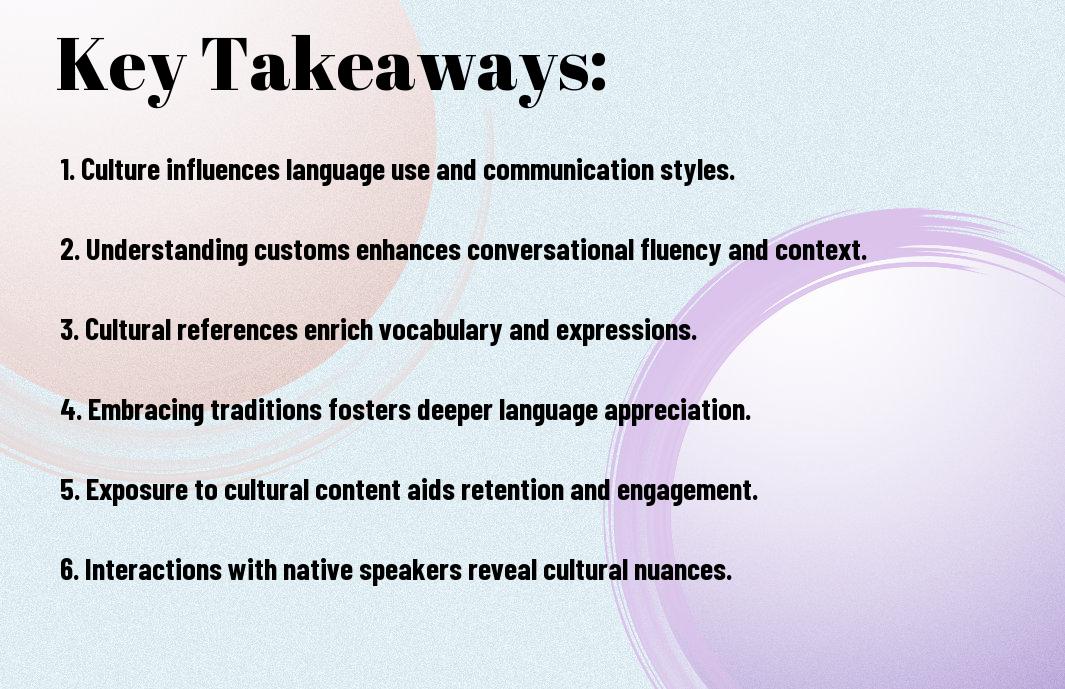
  • The language learning process is deeply influenced by the cultural context in which it takes place, as social interactions and environmental factors play a significant role in shaping the learning experience.
  • Cultural awareness and understanding are important for effective communication in a foreign language, as they enable learners to navigate social norms and customs associated with the target language.
  • The integration of cultural elements into language instruction can enhance learner motivation and engagement, as it provides a more authentic and meaningful learning experience.
  • Language learners who are exposed to diverse cultural practices and traditions tend to develop a more nuanced understanding of the target language and its linguistic variations.
  • Effective language teaching should incorporate cultural components that foster intercultural competence, enabling learners to navigate complex cultural situations and interact with native speakers in a confident and respectful manner.

Language Acquisition

The process of language acquisition is closely tied to culture, as you can learn more about Language: The Essence of Culture and how it shapes your understanding of the world.

The Impact of Cultural Background

Sociolinguistic Factors

  • Language norms and values
  • Cultural identity and belonging

    , After analyzing these factors, you can better navigate language acquisition in different cultural contexts.

  • Power dynamics and social status
  • Communication styles and pragmatics

    , After exploring these aspects, you will be better equipped to adapt to new linguistic and cultural environments.

    Cultural Influences

    Some cultural factors significantly impact your language learning experience, influencing the way you perceive and understand the language, and ultimately, the way you communicate with native speakers.

    Nonverbal Communication

    Culturally-based differences in nonverbal cues can affect your interactions, as you may unintentionally convey a different message than intended, highlighting the importance of understanding cultural context in communication.

    Idiomatic Expressions

    On a deeper level, idiomatic expressions can be particularly challenging, as their meanings often rely on cultural references and nuances that you may not be familiar with, requiring you to develop a deeper understanding of the culture behind the language.

    To master idiomatic expressions, you need to be aware of the cultural context in which they are used, and be able to apply this knowledge to your everyday conversations, allowing you to communicate more effectively and naturally with native speakers, and enhancing your overall language skills.

    Learning Strategies

    For effective language learning, you need to adopt strategies that work best for your learning style. Your approach to learning a language can greatly impact your progress and success.

    Immersion Techniques

    Beyond the classroom, you can use immersion techniques to surround yourself with the language you’re learning, such as watching TV shows or listening to music in the target language, which can help you pick up phrases and nuances more naturally.

    Cultural Adaptation

    Likewise, learning about cultural differences and adapting to them is important for successful language learning, as you will be able to understand the context and nuances of the language, and communicate more effectively with native speakers.

    In addition, as you probe deeper into cultural adaptation, you will find that your understanding of the language improves significantly, and you will be able to navigate different social situations with ease, making your language learning journey more enjoyable and rewarding, allowing you to connect with your target culture on a deeper level.

    Teaching Methods

    Keep in mind that effective teaching methods play a significant role in language learning. You can choose from various approaches, such as immersive, task-based, or communicative language teaching, to create an engaging learning environment.

    Cultural Sensitivity in the Classroom

    Above all, you should consider the cultural backgrounds of your students to create a comfortable and inclusive learning space. You will be able to foster a positive atmosphere by being aware of cultural differences and adapt your teaching methods accordingly.

    Incorporating Cultural Elements

    At the heart of language learning is the incorporation of cultural elements that enable you to connect with the language on a deeper level. You can use authentic materials, such as videos, images, and texts, to introduce cultural aspects and make learning more engaging.

    Incorporating cultural elements into your language learning process allows you to gain a more comprehensive understanding of the language and its usage in different contexts. You can explore various cultural practices, traditions, and customs associated with the language, which will enable you to communicate more effectively and avoid unintended offense or misunderstandings.

    Challenges and Opportunities

    Your ability to learn a language is influenced by cultural factors, which can either hinder or help your progress, presenting you with challenges and opportunities for growth.

    Overcoming Cultural Barriers

    Against the backdrop of cultural differences, you will encounter obstacles that test your language skills, but with persistence and the right approach, you can overcome these barriers and improve your understanding of the language.

    Leveraging Cultural Diversity

    Between the lines of cultural nuances, you will discover a wealth of knowledge that can enhance your language learning experience, allowing you to tap into the diversity of cultures and broaden your perspective.

    Cultural diversity offers a unique chance for you to engage with different customs, traditions, and ways of life, enabling you to develop a deeper understanding of the language and its context, which in turn will help you to become a more effective and fluent communicator.

    Effective Communication

    After acquiring basic language skills, you will begin to understand the importance of cultural nuances in effective communication, enabling you to convey your message accurately and avoid misunderstandings.

    Developing Cultural Awareness

    By immersing yourself in the culture, you become more sensitive to the values and customs of the community, allowing you to interact more effectively with native speakers and navigate complex social situations.

    Improving Language Skills

    Across various language learning contexts, you will discover that cultural knowledge enhances your ability to understand and use language appropriately, facilitating more natural and fluent communication.

    The improvement in your language skills will become evident as you apply cultural insights to your interactions, enabling you to better comprehend subtle cues, idiomatic expressions, and context-dependent language, ultimately leading to more effective and engaging communication with native speakers, and a deeper understanding of the language as a whole, which will aid you in your journey to mastering the language.

    To wrap up

    The role of culture in learning a language is a significant aspect you should consider as you commence on your language learning journey. You will find that understanding the cultural context enhances your learning experience. For more insights, visit The delicious role of culture in language learning to discover how your cultural awareness can boost your language skills and broaden your perspective, making you a more effective communicator in your new language.

    FAQ

    Q: What is the significance of culture in language learning, and how does it impact the learning process?

    A: The culture of a language plays a vital role in language learning as it provides context and depth to the learning experience. Understanding the cultural nuances, customs, and values associated with a language helps learners to better comprehend the language’s idiomatic expressions, colloquialisms, and non-verbal communication. This, in turn, enables them to communicate more effectively and avoid unintended offense or misunderstandings. By integrating cultural knowledge into language instruction, learners can develop a more holistic understanding of the language and its native speakers.

    Q: How can language learners effectively incorporate cultural learning into their study routine, and what resources are available to support this process?

    A: Language learners can incorporate cultural learning into their study routine by exploring authentic materials such as movies, TV shows, music, and literature from the target culture. They can also engage with native speakers, either in person or through online platforms, to gain insights into cultural practices and traditions. Additionally, learners can utilize online resources, such as cultural blogs, podcasts, and language learning apps, that provide cultural lessons and explanations. Many language courses and textbooks also include cultural components, and learners can supplement their studies with these resources to deepen their cultural understanding.

    Q: Can cultural differences hinder the language learning process, and if so, how can learners overcome these challenges to achieve their language goals?

    A: Cultural differences can indeed pose challenges for language learners, as they may encounter unfamiliar customs, norms, and expectations that can lead to confusion or miscommunication. To overcome these challenges, learners can develop an awareness of potential cultural differences and approach them with an open mind and a willingness to learn. They can also seek guidance from language instructors, tutors, or mentors who are familiar with the target culture and can provide valuable insights and advice. Furthermore, learners can focus on building their cultural competence by developing skills such as empathy, flexibility, and critical thinking, which can help them navigate cultural differences and achieve their language learning objectives.

  • Top Languages to Learn for Career Advancement

    As you consider expanding your skill set to boost your career, learning a new language can be a valuable investment. You may be wondering which languages will give you the most return on your investment. Your career goals and industry play a significant role in determining the best language for you to learn. You can enhance your job prospects and increase your earning potential by acquiring the right language skills, so it’s necessary to choose wisely.

    Key Takeaways:

    To advance in your career, it’s important to have a strong foundation in programming languages that are in high demand. Here are the top languages to learn:

    • Learning Python can open doors to various career opportunities, including data science, machine learning, and web development, due to its simplicity and versatility.
    • Java is a popular choice for Android app development, web development, and enterprise software development, making it a valuable skill to have in the industry.
    • JavaScript is a must-know language for front-end web development, and its popularity extends to back-end development, mobile app development, and game development, with frameworks like React and Node.js.
    • SQL is a fundamental language for data analysis and management, and proficiency in it can lead to career advancement in data science, business intelligence, and database administration.
    • Knowledge of Cloud Computing platforms like AWS or Azure, and languages like Go or Rust, can give you a competitive edge in the job market, especially in the fields of cloud engineering, DevOps, and cybersecurity.

      Benefits of Learning a New Language

      While learning a new language can be a challenging task, it offers numerous benefits that can enhance your career prospects and personal growth. You will gain a competitive edge in the job market and open yourself up to new cultural experiences.

      Career Opportunities

      Among the many advantages of language learning, you will find that it significantly expands your career opportunities, allowing you to work with international companies, travel, and connect with people from diverse backgrounds, thereby broadening your professional network and possibilities.

      Increased Earning Potential

      On top of the personal satisfaction you derive from learning a new language, you can also expect an increase in your earning potential, as your skillset becomes more valuable to potential employers, giving you a significant advantage in terms of career advancement and higher salary expectations.

      Potential career advancements and increased financial rewards are directly tied to your ability to communicate effectively in a globalized economy. As you acquire language skills, you become a more attractive candidate to multinational corporations and organizations, which often offer higher salaries and better benefits to employees who can bridge cultural and linguistic gaps, ultimately leading to a more successful and fulfilling career for you.

      Top Languages for Career Advancement

      Even if you’re already established in your career, learning a new language can open up new opportunities for you. You can expect increased job prospects and higher earning potential as a result of your new skill.

      English as a Global Language

      To take your career to the next level, you should consider learning English, as it is widely recognized as the language of international business and communication, allowing you to connect with clients and colleagues from around the world.

      Mandarin for Business and Trade

      With the rise of China as a global economic power, learning Mandarin can give you a significant advantage in your career, particularly in fields such as trade, finance, and international business, as you will be able to communicate effectively with Chinese clients and business partners.

      Advancement in your career is likely to follow as you become proficient in Mandarin, allowing you to tap into the vast Chinese market and take advantage of new business opportunities, you will be able to negotiate, network, and build relationships with Chinese colleagues and clients, giving you a competitive edge in your industry.

      Language Skills in Demand

      After identifying your career goals, you need to consider the language skills that are in high demand. Knowing the right languages can give you a competitive edge in the job market and open up new opportunities for advancement.

      Programming Languages for Tech Careers

      Skills in programming languages like Java, Python, and JavaScript are highly valued in the tech industry, and you can gain a significant advantage by learning them. You can leverage these skills to enhance your career prospects and stay ahead in the field.

      Spanish for International Business

      Behind the growing importance of Spanish language skills is the increasing economic influence of Spanish-speaking countries. You can benefit from learning Spanish to expand your career opportunities in international business and connect with a vast market.

      In fact, as you explore the benefits of learning Spanish, you will discover that it can significantly enhance your career prospects in fields like trade, commerce, and diplomacy, allowing you to communicate effectively with clients, colleagues, and partners from Spanish-speaking countries, and giving you a competitive edge in the global job market.

      Industries that Value Language Skills

      To succeed in today’s globalized economy, you can benefit from learning a foreign language, as discussed on What foreign languages are most beneficial to one’s career in America. This can open doors to new career opportunities.

      International Finance and Banking

      By mastering a foreign language, you can gain a competitive edge in international finance and banking, where communication with global clients is key.

      Tourism and Hospitality

      To cater to diverse clients, you can leverage language skills in tourism and hospitality, enhancing your career prospects in these sectors.

      In addition, as you work with tourists and travelers from around the world, your ability to communicate in multiple languages will enable you to provide better services, resolve issues efficiently, and create a positive experience for your clients, ultimately boosting your career advancement in the tourism and hospitality industry.

      How to Get Started

      All you need to do is set your goals and start exploring language learning options. Visit The 8 Most Useful Languages for Your Career to learn more about the most in-demand languages.

      Language Learning Resources

      Behind every successful language learner is a wealth of resources. You will find numerous online courses, language learning apps, and tutoring services to help you get started.

      Immersion Programs

      The most effective way to learn a language is by immersing yourself in it. You can travel to a foreign country, attend language exchange events, or participate in cultural activities to improve your language skills.

      Resources like language exchange websites, online forums, and social media groups can help you find immersion programs tailored to your needs and goals, allowing you to practice your language skills with native speakers and gain a deeper understanding of the culture, which will enhance your career prospects.

      Overcoming Language Learning Challenges

      Your language learning journey will inevitably encounter obstacles, but with the right mindset and strategies, you can overcome them and achieve your goals.

      Setting Realistic Goals

      Language acquisition requires a well-planned approach, and you should set achievable targets to stay motivated and track your progress.

      Practicing Consistency

      Adept learners understand the importance of regular practice, and you should allocate time each day to reinforce your language skills.

      Plus, as you make language learning a habit, you will find that your comprehension and communication skills improve significantly, allowing you to tackle more complex topics and engage in conversations with native speakers, which will help you to stay motivated and committed to your language learning journey, and you will be able to apply your new skills in your career advancement.

      Summing up

      Summing up, you can accelerate your career advancement by learning the most in-demand languages. You will enhance your job prospects and gain a competitive edge in the global market. To learn more about the top languages, visit 5 Most Useful Languages for Getting Hired and discover your path to success, tailoring your language skills to your career goals and opening doors to new opportunities for your professional growth.

      FAQ

      Q: What are the top programming languages to learn for career advancement in the field of data science and machine learning?

      A: For career advancement in data science and machine learning, the top languages to learn include Python, R, and SQL. Python is widely used in machine learning and deep learning, while R is preferred for statistical analysis. SQL is vital for managing and analyzing large datasets. Additionally, knowledge of Java, Julia, and MATLAB can also be beneficial for specific applications and industries.

      Q: How do I choose the best language to learn for web development and career growth in the IT industry?

      A: For web development and career growth in the IT industry, it’s vital to consider the type of applications you want to develop and the industry you’re targeting. JavaScript, HTML/CSS, and PHP are popular choices for front-end and back-end development. However, for mobile app development, Java or Kotlin for Android, and Swift or Objective-C for iOS are more suitable. Knowing the demand of the industry and the specific job you’re applying for can help you decide which language to prioritize.

      Q: What are the benefits of learning multiple programming languages for career advancement, and how can it impact my salary and job prospects?

      A: Learning multiple programming languages can significantly enhance your career prospects and salary potential. It demonstrates versatility, adaptability, and a willingness to learn, making you a more attractive candidate to potential employers. Knowing multiple languages can open up more job opportunities, as you can work on a variety of projects and contribute to different teams. Additionally, it can lead to higher salary ranges, as companies are often willing to pay more for developers who can handle multiple languages and technologies, thus increasing their productivity and value to the organization.

    How to Overcome Fear of Speaking a New Language

    As you initiate on learning a new language, you may encounter a common obstacle: fear of speaking. You worry about making mistakes, being judged, or not being understood. However, with practice and dedication, you can overcome this fear. To start, The simplest way to get over your fear of speaking a foreign language is to focus on building your confidence. You can begin by speaking with native speakers, practicing regularly, and taking small steps outside your comfort zone, which will help you make progress and become a more confident language speaker.

    Key Takeaways:

    To overcome the fear of speaking a new language, consider the following points:

    • Practice consistently to build confidence in your language skills, focusing on pronunciation and vocabulary to improve your overall communication abilities.
    • Immerse yourself in the language by listening to music, watching movies, and engaging in conversations with native speakers to become more familiar with the language.
    • Focus on your progress, not perfection, and don’t be too hard on yourself when making mistakes, as they are an necessary part of the learning process.
    • Find a language exchange partner or join a language learning community to get support and motivation from others who are going through the same experience.
    • Set achievable goals and reward yourself for reaching them, which will help you stay motivated and encouraged to continue improving your language skills.

    Embracing the Challenge

    A major step in overcoming your fear of speaking a new language is to view it as an opportunity for growth and development, rather than an insurmountable obstacle, and you will start to feel more confident in your abilities.

    Recognizing the Source of Fear

    Around the time you begin to learn a new language, you may start to feel anxious about speaking, and understanding the root of your fear is necessary to overcoming it, as you can then address it directly and work to build your confidence.

    Setting Language Learning Goals

    The key to making progress and staying motivated is to set achievable goals for your language learning, and you should start by identifying what you want to accomplish, whether it’s holding basic conversations or reading complex texts, and create a plan to get there.

    Consequently, as you work towards your goals, you will begin to notice significant improvements in your language skills, and your fear of speaking will start to dissipate, replaced by a growing sense of confidence and ability, allowing you to engage more effectively with native speakers and immerse yourself in the language, which will further accelerate your progress and help you to reach your full potential as a language learner.

    Building Confidence

    Now that you’ve decided to overcome your fear of speaking a new language, it’s time to focus on building your confidence. You can achieve this by setting achievable goals and celebrating your progress along the way. Your confidence will grow as you become more comfortable with the language.

    Starting Small with Basic Phrases

    Before venturing into complex conversations, you start with basic phrases and vocabulary. You begin with simple greetings and introductions, and gradually move on to more complex phrases. Your goal is to build a strong foundation in the language, and you do this by mastering the basics.

    Practicing with Native Speakers

    Starting with small conversations with native speakers, you can improve your pronunciation and get used to the rhythm of the language. You find native speakers through language exchange programs or online platforms, and you practice speaking with them regularly.

    Phrases that you’ve learned become more natural as you practice with native speakers. You learn to express yourself in different situations, and you receive feedback on your pronunciation and grammar. As you continue to practice, you become more confident in your ability to communicate in the new language, and your fear of speaking starts to fade away.

    Overcoming Self-Doubt

    Unlike many other challenges, overcoming self-doubt when speaking a new language requires a gentle and supportive approach. You need to acknowledge your fears and doubts, and then work on building your confidence.

    Reframing Negative Thoughts

    Self-doubting tendencies can hold you back, but by reframing negative thoughts, you can start to build confidence in your language skills. You can replace negative self-talk with positive affirmations, focusing on your strengths and accomplishments.

    Focusing on Progress, Not Perfection

    Self-consciousness about making mistakes can be overwhelming, but by focusing on progress, not perfection, you can start to see improvements in your language skills. You will begin to notice your growth and development, which will help you stay motivated and engaged.

    Considering your goals and motivations, you can create a plan to track your progress, celebrating small victories along the way. You can use a language learning journal or app to monitor your development, and adjust your approach as needed. By focusing on progress, not perfection, you will be able to overcome self-doubt and become a more confident language speaker, able to express yourself effectively and engage with others in your new language.

    Developing a Growth Mindset

    To overcome your fear of speaking a new language, you need to develop a growth mindset. This means believing that your language skills can be improved with practice and dedication. You will be more confident in your ability to learn and improve, and you will be more likely to take risks and try new things.

    Embracing Mistakes as Learning Opportunities

    For instance, when you make a mistake, you can learn from it and use it as an opportunity to improve your language skills. You will become more comfortable with the idea of making mistakes and will be more willing to speak and practice your new language.

    Celebrating Small Victories

    Gaining confidence in your language skills is a process, and you should celebrate your small victories along the way. You can start by acknowledging and celebrating your achievements, no matter how small they may seem. This will help you stay motivated and encouraged to continue practicing and improving your language skills.

    In fact, celebrating small victories is an necessary part of the learning process, as it helps you to see progress and stay positive. You can celebrate your small victories by treating yourself to something special, sharing your achievements with a friend or family member, or simply taking a moment to reflect on how far you have come. By acknowledging and celebrating your progress, you will be more likely to stay motivated and encouraged to continue practicing and improving your language skills, which will help you to overcome your fear of speaking a new language.

    Creating a Supportive Environment

    Despite the initial anxiety you may feel, creating a supportive environment is vital to overcoming your fear of speaking a new language. You can start by surrounding yourself with language-learning materials, such as books, podcasts, and videos, to immerse yourself in the language.

    Finding a Language Learning Community

    Against all odds, finding a community of fellow language learners can be a game-changer. You can join online forums, social media groups, or language exchange websites to connect with others who share your goals and interests.

    Using Language Learning Apps and Resources

    Before you begin your language learning journey, consider the numerous apps and resources available to support you. You can explore language learning platforms, such as Duolingo, Babbel, or Rosetta Stone, to find the one that suits your learning style.

    Language learning apps and resources can help you track your progress, practice speaking and listening skills, and access a wealth of educational content. You can use these tools to supplement your language learning, stay motivated, and build confidence in your ability to speak a new language. By leveraging these resources, you can create a personalized learning plan that fits your needs and helps you achieve your goals.

    Staying Motivated

    After establishing a routine, you’ll need to maintain your enthusiasm for speaking a new language. This is where motivation plays a significant role in your progress, helping you to stay on track and achieve your goals.

    Setting Achievable Milestones

    Normally, you will find that breaking down your goals into smaller, manageable tasks helps you stay focused and motivated, allowing you to celebrate your successes along the way.

    Rewarding Progress and Persistence

    Similarly, you will find that acknowledging and rewarding your efforts, no matter how small, will help to reinforce positive learning habits and motivate you to continue improving your language skills.

    Indeed, as you progress and see the results of your efforts, you will begin to feel a sense of accomplishment and pride in your ability to communicate in a new language, which will, in turn, motivate you to continue pushing beyond your comfort zone and striving for further improvement, helping you to overcome your fear of speaking a new language.

    Conclusion

    On the whole, you have the power to overcome your fear of speaking a new language. By practicing consistently, focusing on your strengths, and being kind to yourself, you can build confidence in your language skills. As you progress, your comfort level will increase, and you will become a more fluent speaker, able to express yourself effectively in your new language, and unlock your full potential.

    FAQ

    Q: What is the first step to overcome the fear of speaking a new language?

    A: The first step to overcome the fear of speaking a new language is to set achievable goals for yourself. Start by identifying your motivation for learning the language, whether it’s for travel, work, or personal enrichment. Break down your goal into smaller, manageable tasks, such as having a 10-minute conversation with a native speaker or speaking in front of a small group. As you accomplish these tasks, you’ll build confidence and become more comfortable speaking the language.

    Q: How can I practice speaking a new language without feeling embarrassed or intimidated?

    A: Practicing speaking a new language can be daunting, but there are several ways to do so without feeling embarrassed or intimidated. Consider finding a language exchange partner, either in person or online, who is fluent in the language you’re trying to learn. You can also practice speaking with a tutor or language instructor who can provide feedback and guidance. Additionally, try speaking in low-stakes situations, such as ordering food at a restaurant or asking for directions, to build your confidence and get used to the sounds and rhythm of the language.

    Q: What are some strategies to help manage anxiety and self-doubt when speaking a new language?

    A: Managing anxiety and self-doubt is a common challenge when speaking a new language. One strategy is to focus on communication rather than perfection. Instead of worrying about making mistakes, try to concentrate on conveying your message and understanding the other person. Another strategy is to use positive self-talk and encourage yourself to take risks. You can also try relaxation techniques, such as deep breathing or visualization, to help calm your nerves before speaking. Finally, try to learn from your mistakes and view them as opportunities for growth and improvement, rather than as failures.

    The Easiest Languages for English Speakers to Learn

    As you consider expanding your linguistic skills, you’ll find that some languages are more accessible to English speakers than others. Your native language provides a solid foundation for learning, and certain languages share similarities with English, making them easier to pick up. You’ll be surprised at how quickly you can become proficient in languages like Spanish, French, or Italian, which have many cognates and grammatical structures similar to English, allowing you to learn and communicate effectively in a short amount of time.

    Key Takeaways:

    To learn a new language efficiently, it’s helpful to understand which languages are more accessible to English speakers. Here are some key points to consider:

    • Spanish and French are often considered the easiest languages for English speakers to learn due to their similarities in grammar and vocabulary.
    • Italian is another popular choice because of its phonetic nature, meaning words are pronounced as they are written, making it easier for English speakers to learn and pronounce words correctly.
    • Portuguese shares many cognates with English, especially in fields like law, government, and technology, which can facilitate the learning process for English speakers.
    • Swedish and other Scandinavian languages have a relatively simple grammar system and a significant number of cognates, making them more accessible to English speakers.
    • Language learning apps and immersion programs can significantly aid in the learning process by providing interactive lessons and practical experience with the language.

    Criteria for Ease of Learning

    The ease of learning a language depends on various factors, including grammar, vocabulary, and pronunciation. You will find that some languages are more similar to English, making them easier to pick up. As you consider which language to learn, think about what will make the process simplest for you.

    Grammar and Syntax

    For instance, languages with similar grammatical structures to English will be easier for you to learn. You will find that your understanding of English grammar will help you navigate these languages more quickly.

    Vocabulary and Pronunciation

    Any language with vocabulary and pronunciation similar to English will be easier for you to learn. You will pick up words and sounds more quickly if they are familiar to your ear.

    Another aspect of vocabulary and pronunciation to consider is the use of cognates, or words that are similar in both languages. You will find that many languages have borrowed words from English, making it easier for you to understand and communicate in your new language.

    Romance Languages

    Some of the easiest languages for you to learn are Romance languages, as they share similarities with English. You can learn more about language learning at The 5 Easiest Languages for English Speakers to Learn guide.

    Spanish

    Around 460 million native speakers worldwide speak Spanish, making it a valuable language for you to learn, as it can open doors to new cultures and opportunities.

    French

    About 274 million people speak French, and as an English speaker, you’ll find that French and English share many cognates, making it easier for you to pick up.

    And as you probe deeper into French, you’ll discover that its grammar and pronunciation rules, although challenging, are consistent, allowing you to improve your language skills quickly, and enhancing your travel and career prospects, making it an excellent choice for you to learn.

    Germanic Languages

    Once again, you can find many similarities between Germanic languages and English, making them easier to learn. You can check out what are the easiest languages to learn and discover the benefits of learning Germanic languages.

    Swedish

    Like many other Germanic languages, Swedish is relatively easy for you to pick up, with simple grammar and pronunciation. You will find that Swedish and English share many cognates, making it easier for you to learn and understand.

    Norwegian

    Before submerging into Norwegian, you should know that it’s closely related to English, with many similar words and phrases. You will find that Norwegian is a phonetic language, meaning words are pronounced as they are written.

    Norwegian is a great language for you to learn, with its simple grammar and pronunciation making it accessible to English speakers. You will find that Norwegian and English share many similarities, and you can quickly pick up the language with the right resources and practice.

    Language Learning Tips

    Not all language learning methods are created equal. You can try:

    • setting achievable goals

    or check out The 10 Easiest Languages to Learn, as Rated by Unbabel. The most effective approach will depend on your learning style.

    Immersion and Practice

    Immersing yourself in the language is key to learning. You can practice by listening to music, watching TV shows, and speaking with native speakers to improve your skills.

    Language Learning Resources

    On top of traditional classroom learning, you have access to numerous online resources to aid in your language learning journey.

    It is worth exploring different language learning platforms, such as language exchange websites and mobile apps, to find the one that best fits your needs and helps you stay motivated to continue learning.

    Most Similar to English

    To learn a new language quickly, you can start with languages that are similar to English. You will notice that many words are cognates, making it easier for you to pick up the language.

    Dutch

    Around 80% of Dutch words are similar to English words, making it easier for you to learn. You can start with basic phrases and build your vocabulary quickly.

    Frisian

    Only one language is closer to English than Dutch, and that is Frisian. You will find many similarities in grammar and vocabulary, making it an ideal language for you to learn.

    The Frisian language has several dialects, and you can choose the one that interests you the most. You will notice that Frisian is spoken by a small group of people, but it is still an officially recognized language in the Netherlands. You can learn Frisian to connect with the culture and people who speak it, and you will find that it is a rewarding experience.

    Final Words

    Upon reflecting on your language learning journey, you will find that certain languages are more accessible to you as an English speaker. You can leverage your existing knowledge to learn languages like Spanish, French, or Italian, which share similarities with English. Your ability to pick up these languages will depend on your dedication and the resources you utilize, but with the right approach, you can quickly become proficient in your chosen language.

    FAQ

    Q: What are the easiest languages for English speakers to learn?

    A: The easiest languages for English speakers to learn are typically those that are closely related to English, such as Spanish, French, Italian, and Portuguese. These languages are all part of the Romance language family and share many cognates with English, meaning that they have similar vocabulary and grammar structures. For example, Spanish and English share around 30% of their vocabulary, making it easier for English speakers to pick up Spanish words and phrases. Additionally, the grammar and sentence structure of these languages are also relatively similar to English, making them more accessible to English speakers.

    Q: How long does it take to become proficient in one of these easy-to-learn languages?

    A: The amount of time it takes to become proficient in a language depends on various factors, including the individual’s language learning ability, the amount of time devoted to studying, and the quality of instruction. However, with consistent practice and dedication, English speakers can typically reach a basic level of proficiency in one of these languages within a few months. For example, the US Foreign Service Institute estimates that it takes around 24-30 weeks (600-750 class hours) to reach a basic level of proficiency in Spanish, while French and Italian may take around 30-36 weeks (750-900 class hours). With more intense study and practice, English speakers can become proficient in these languages within a year or less.

    Q: What are some tips for English speakers to learn one of these easy-to-learn languages quickly and effectively?

    A: To learn one of these easy-to-learn languages quickly and effectively, English speakers can start by focusing on common vocabulary and phrases, and practicing pronunciation regularly. Listening to native speakers, watching TV shows and movies in the target language, and speaking with language exchange partners can also help improve listening and speaking skills. Additionally, using language learning apps, such as Duolingo, Babbel, or Rosetta Stone, can provide a structured and interactive learning experience. It’s also helpful to immerse oneself in the language by reading books, articles, and newspapers in the target language, and trying to think and speak in the language as much as possible. By following these tips and staying motivated, English speakers can quickly and effectively learn one of these easy-to-learn languages.

    Skip to content