You strive to express yourself effectively in a foreign language, but often find yourself struggling to convey your thoughts. Your attempts at communication are hindered by language barriers, leading to frustration and misunderstandings. As you navigate unfamiliar linguistic terrain, you face challenges in making yourself understood. This article will guide you through the process of improving your communication skills in foreign languages, helping you to overcome these obstacles and convey your message with clarity and confidence.
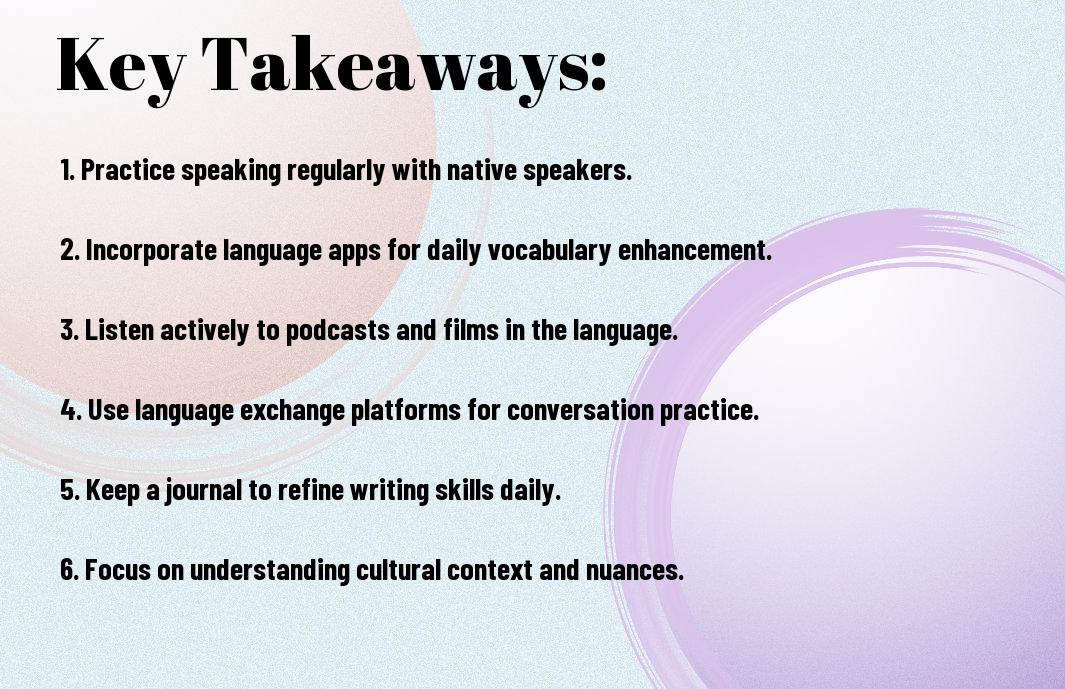
Key Takeaways:
To enhance your ability to communicate effectively in foreign languages, consider the following points:
- Improve your listening skills by regularly listening to native speakers, podcasts, and audio materials in the target language to get accustomed to its rhythm and pronunciation.
- Enhance your vocabulary by reading books, articles, and news in the foreign language, which will help you learn new words and phrases in context, making them easier to memorize.
- Practice speaking and writing in the foreign language as often as possible, whether through language exchange programs, writing journals, or engaging in conversations with native speakers, to develop your fluency and confidence.
Language Learning Fundamentals
While learning a foreign language, you will encounter various challenges that can hinder your progress, but understanding the basics is imperative to improve your communication skills.
Setting Realistic Goals
Achieving a decent level of proficiency in a foreign language requires you to set attainable objectives, allowing you to track your progress and stay motivated throughout the learning process.
Immersing Yourself in the Language
Authentic exposure to the language is vital, and surrounding yourself with native speakers, watching TV shows, and listening to music in the target language will significantly enhance your comprehension and pronunciation.
But as you examine deeper into immersing yourself in the language, you will find that consistency is key; making language learning a part of your daily routine, even if it’s just for a few minutes, will help you develop a natural flow and eventually, you will be able to express yourself effortlessly in the foreign language, enabling you to communicate effectively with native speakers.
Effective Communication Techniques
Now that you are aware of the importance of communication in foreign languages, it is time to explore some effective techniques to improve your skills. You will learn how to convey your message clearly and understand others in a more efficient manner.
Active Listening
To become a better communicator, you must start by paying attention to the person speaking, focusing on their words, tone, and body language, and responding thoughtfully to show you are engaged in the conversation.
Clear and Concise Speaking
On the other hand, when speaking, you should try to express your thoughts in a straightforward and simple way, avoiding unnecessary complexity and using visual aids to support your message when possible.
Effective communication is heavily reliant on your ability to speak clearly and concisely, allowing your audience to easily understand your point of view, so you should practice articulating your thoughts in a logical and well-structured manner, using everyday language that is easy to comprehend.
Overcoming Language Barriers
Many language learners face difficulties when communicating in a foreign language, but with practice and patience, you can improve your skills and overcome these barriers, enabling you to express your thoughts and ideas effectively.
Dealing with Accent and Pronunciation Issues
Accentuating the importance of correct pronunciation, you should focus on listening to native speakers and mimicking their intonation, which will help you to improve your accent and speak more confidently in your target language.
Managing Idiomatic Expressions
For instance, mastering idiomatic expressions is imperative to sound natural in a foreign language, and you can achieve this by learning common phrases and practicing their usage in different contexts, which will help you to convey your message more effectively.
Considering the complexities of idiomatic expressions, you will need to explore deeper into the language and explore its nuances, which will enable you to use them accurately and appropriately, making your communication more engaging and fluent, and allowing you to express your thoughts and ideas with greater precision and clarity.
Building Vocabulary and Grammar
Keep in mind that expanding your vocabulary and understanding grammar rules are necessary steps in improving your communication in foreign languages. You will need to dedicate time to learning new words, phrases, and grammar structures to enhance your language skills.
Learning Common Phrases and Expressions
Verbalizing your thoughts in a foreign language starts with learning common phrases and expressions. You should focus on phrases used in everyday conversations, such as greetings, introductions, and basic questions, to help you communicate effectively.
Practicing Grammar Rules
Besides learning vocabulary, practicing grammar rules is vital to your language development. You must apply grammar rules in context to improve your comprehension and expression, which will help you to convey your thoughts and ideas accurately.
Considering your progress in practicing grammar rules, you will find that your language skills are improving significantly. As you continue to practice, you will become more comfortable using grammar rules in your conversations, allowing you to express yourself more clearly and confidently in the foreign language. Your ability to apply grammar rules correctly will also enhance your writing skills, enabling you to write coherent and well-structured texts.
Improving Pronunciation and Intonation
After dedicating time to learning a foreign language, you will need to focus on improving your pronunciation and intonation to communicate effectively. This involves practicing the sounds, rhythm, and stress patterns of the language, which can be achieved through listening to native speakers and mimicking their speech.
Recording Yourself
Alike a mirror reflection, recording yourself speaking can help you identify areas that need improvement, allowing you to adjust your pronunciation and intonation accordingly, and track your progress over time.
Seeking Feedback from Native Speakers
Beneath the surface of language learning lies the importance of seeking feedback from native speakers, who can pinpoint your mistakes and provide valuable corrections, enabling you to refine your pronunciation and intonation.
In fact, seeking feedback from native speakers can be done in various ways, such as language exchange programs, online forums, or social media groups, where you can engage in conversations, share your recordings, and ask for constructive criticism to help you improve your spoken language skills, and you will find that your communication skills in the foreign language will greatly benefit from this practice.
Engaging in Conversations
Despite the challenges you may face, engaging in conversations is a key aspect of improving your communication skills in a foreign language. You will learn to express your thoughts and ideas, and to understand different perspectives and opinions.
Finding Language Exchange Partners
Alongside other methods, finding a language exchange partner can be an effective way to practice your speaking skills, as you will have the opportunity to engage in regular conversations with a native speaker, helping you to improve your pronunciation and grammar.
Participating in Group Conversations
Conversely, participating in group conversations can be a great way to improve your communication skills, as you will be exposed to different speaking styles and vocabulary, allowing you to learn from others and adapt to various situations.
Hence, as you participate in group conversations, you will find that your ability to understand and contribute to discussions will improve, enabling you to express your thoughts and opinions with greater confidence and clarity, which in turn will help you to become a more effective communicator in your target language.
To wrap up
With these considerations, you will be well on your way to improving your communication in foreign languages. You can put your skills to the test by exploring 11 Unique Ways to Practice Speaking a Foreign Language and find what works best for you, enhancing your ability to effectively express yourself in a new language.
FAQ
Q: What are the most effective ways to improve communication in foreign languages?
A: To improve communication in foreign languages, it is necessary to practice consistently. This can be achieved by engaging in conversations with native speakers, either in person or through online platforms. Additionally, listening to and watching media in the target language, such as TV shows, movies, podcasts, and music, can help improve comprehension and pronunciation. Furthermore, using language learning apps and enrolling in language courses can provide structured learning and feedback.
Q: How can I overcome the barrier of pronunciation and accent when communicating in a foreign language?
A: Overcoming the barrier of pronunciation and accent requires patience and dedication. One effective way is to mimic native speakers by listening to and repeating their intonation, rhythm, and individual sounds. Recording yourself speaking and comparing it to native speakers can help identify areas for improvement. Moreover, practicing with a language exchange partner or tutor who can correct your pronunciation and provide feedback is highly beneficial. Regular practice of speaking and listening will also help your brain and mouth get used to the new sounds and rhythms of the language.
Q: What role does cultural understanding play in improving communication in foreign languages, and how can I develop it?
A: Cultural understanding plays a significant role in effective communication in foreign languages. It involves being aware of the customs, traditions, and nuances of the culture associated with the language. Developing cultural understanding can be achieved by learning about the history, social norms, and values of the culture. Engaging with authentic materials such as news, literature, and social media from the target culture can provide insights into the daily life and perspectives of native speakers. Moreover, participating in cultural events and interacting with people from the culture can offer firsthand experiences and opportunities to observe and practice appropriate communication behaviors.

