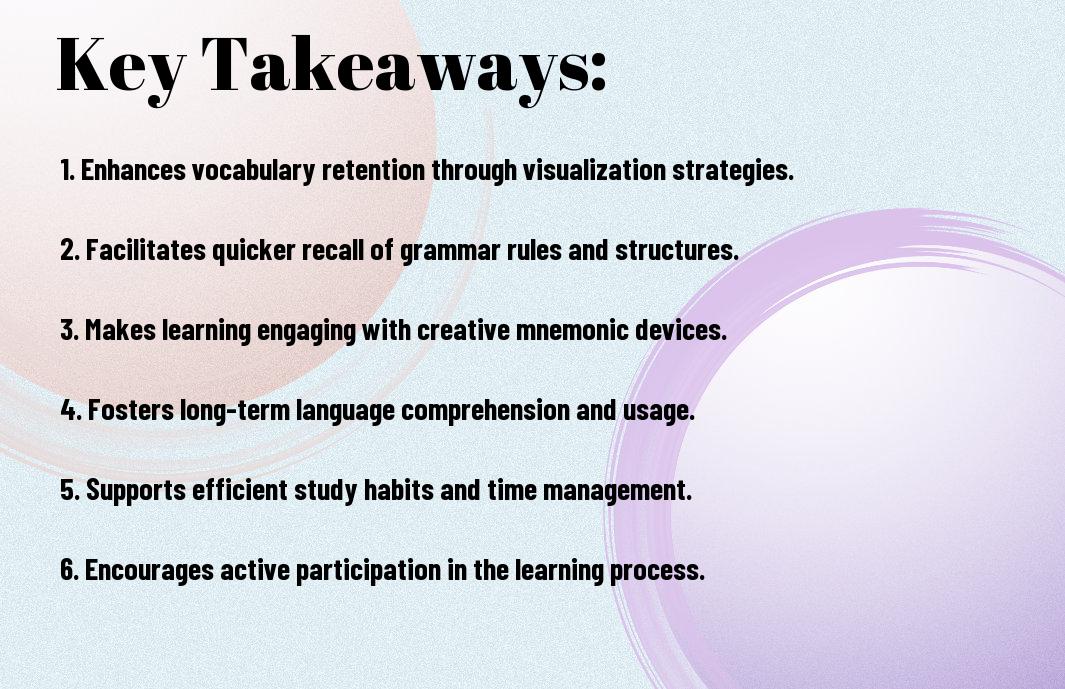
- Effective use of mnemonic devices can significantly improve language learners’ ability to retain new vocabulary and grammar rules, leading to better overall language proficiency.
- Association techniques, such as linking new words to personal experiences or emotions, can help learners to connect new language information to their existing knowledge and experiences, making it easier to recall.
- Developing a range of repetition strategies, including spaced repetition and active recall, can help language learners to consolidate new language information in their long-term memory, allowing for more efficient and effective language learning.
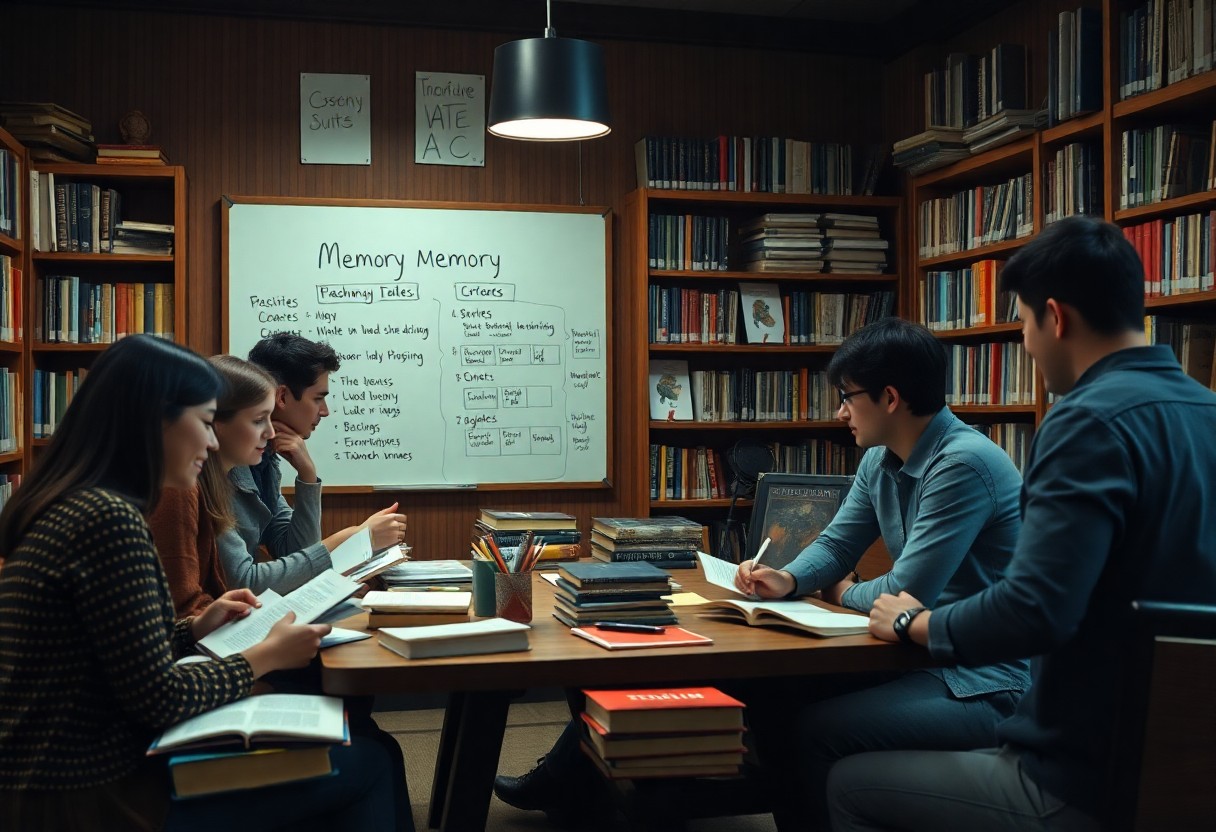
The Power of Memory
Before you commence on your language learning journey, it’s imperative to understand the significance of memory techniques in acquiring and retaining new information, and you’ll soon discover how it can elevate your learning experience.
Improving Vocabulary Retention
Retention of new words and phrases is key to language learning, and you’ll find that using memory aids like flashcards and association can significantly improve your ability to recall vocabulary, making your learning process more efficient and enjoyable for you.
Enhancing Language Comprehension
Powering your way through language barriers, you’ll discover that memory techniques can help you grasp complex grammar rules, idiomatic expressions, and nuances of the language, allowing you to communicate more effectively and confidently, as you progress in your learning journey.
This ability to comprehend and engage with the language on a deeper level will enable you to navigate real-life situations with ease, understand various contexts, and even pick up on subtle cues, all of which will make you a more proficient and expressive language user, capable of conveying your thoughts and ideas with precision and clarity.
Effective Memory Techniques
Even the most avid language learners can struggle to commit new information to long-term memory. You’ll find that employing memory techniques can greatly enhance your ability to absorb and retain new language skills.
Association and Visualization
Around the time you start learning a new language, you’ll discover that linking new words to vivid mental images or personal experiences helps solidify them in your mind, making recall easier for you.
Repetition and Spaced Repetition
About the most effective way to reinforce new language skills is through repetition, where you revisit and practice new words or phrases at increasingly longer intervals, allowing you to gradually build a strong foundation.
Due to the way your brain processes and retains information, spaced repetition can be particularly helpful in language learning, as it helps prevent the forgetting curve and allows you to focus on the most challenging material, ultimately making your learning process more efficient and effective for you.
Language Learning Strategies
Unlike other skills, language learning requires a combination of cognitive and memorization techniques. You will find that using the right strategies can greatly enhance your ability to absorb and retain new information, making the learning process more efficient and effective.
Using Mnemonics and Acronyms
After experimenting with different methods, you’ll discover that mnemonics and acronyms can be powerful tools in your language learning arsenal, helping you to associate new words and phrases with memorable images or sounds.
Creating Mental Maps and Chains
Among the various techniques at your disposal, creating mental maps and chains can be a particularly effective way to organize and connect new information, allowing you to visualize relationships between words and concepts.
Maps of your mental landscape can become increasingly complex as you learn more, but this is a good thing – it means you’re building a rich and interconnected web of knowledge that you can draw upon as you continue to learn and grow, and you’ll find that your ability to recall and use new language improves dramatically as a result.
Overcoming Language Barriers
Despite the challenges you face in learning a new language, you can overcome them by utilizing effective memory techniques. You can learn more about how working memory impacts language acquisition by reading The Role of Working Memory in SLA, which sheds light on this fascinating topic.
Building Confidence and Fluency
Fluidly, you’ll start to notice improvements in your language skills as you practice consistently, and your confidence will grow, allowing you to express yourself more effectively in your new language.
Practicing Active Recall and Summarization
Linguistically, you’ll find that active recall and summarization are powerful tools to reinforce your learning, helping you to better understand and retain new information.
Understanding how to apply these techniques can make a significant difference in your language learning journey, as you’ll be able to engage more actively with the material, testing your knowledge and identifying areas where you need more practice, and you’ll find that your progress will accelerate as you continue to challenge yourself in this way.
The Role of Technology
After delving into the world of memory techniques, you’ll find that technology plays a significant role in enhancing your language learning experience. You can utilize various digital tools to aid in your learning journey, making the process more engaging and effective.
Utilizing Language Learning Apps
The advent of language learning apps has revolutionized the way you learn a new language, providing you with a wealth of resources at your fingertips, from interactive lessons to speech recognition tools.
Leveraging Digital Flashcards and Quizzes
The digital equivalent of traditional flashcards and quizzes offers you a convenient way to test your knowledge and track your progress, helping you identify areas where you need to focus your attention.
With digital flashcards and quizzes, you can create customized learning materials tailored to your needs, allowing you to practice vocabulary and grammar in a fun and interactive way, and you’ll find that your language skills improve significantly as you continue to use these tools to reinforce your learning.
Maintaining Motivation
All language learners face the challenge of staying motivated, and you are no exception. You’ll encounter obstacles, but with the right mindset, you can overcome them and achieve your goals.
Setting Realistic Goals and Rewards
Motivated by your desire to learn, you set achievable targets and reward yourself for each milestone reached, keeping your enthusiasm high.
Finding a Language Learning Community
Between the lines of language learning books and online resources, you discover the value of connecting with fellow learners, sharing experiences, and gaining new insights.
For instance, joining a language exchange program or online forum can provide you with a sense of belonging and accountability, as you engage with others who are on a similar journey, helping you stay motivated and inspired to continue improving your language skills.
Summing up
Presently, you’ve seen how memory techniques can be a powerful ally in your language learning journey. You’ve discovered that by using these techniques, you can improve your ability to absorb and retain new information, making your learning process more efficient. As you continue to hone your skills, you’ll find that your mind becomes a sharper tool, capable of picking up nuances and details that once seemed elusive, and your grasp of the language will become more confident and intuitive, drawing you deeper into the world of communication.
FAQ
Q: What is the significance of memory techniques in language learning, and how do they impact the learning process?
A: Memory techniques play a vital role in language learning as they enable learners to effectively encode, store, and retrieve vocabulary, grammar rules, and other important language components. By utilizing methods such as mnemonics, visualization, and chunking, learners can improve their ability to absorb and apply new language information, leading to enhanced fluency and accuracy in communication. These techniques also help to alleviate the cognitive load associated with language learning, allowing learners to focus on higher-level skills such as comprehension and expression.
Q: How can memory techniques be applied to vocabulary acquisition in language learning, and what are some effective methods for learners to try?
A: Memory techniques can be applied to vocabulary acquisition through various methods, including the use of flashcards, word associations, and mind maps. Learners can also employ techniques such as spaced repetition, where vocabulary is reviewed at increasingly longer intervals to help solidify it in long-term memory. Additionally, learners can use visual imagery to associate new words with memorable images or scenarios, making them easier to recall. By incorporating these methods into their study routine, learners can expand their vocabulary and improve their ability to use new words in context.
Q: Can memory techniques be used to improve grammar and sentence structure in language learning, and if so, how can learners effectively utilize them?
A: Yes, memory techniques can be used to improve grammar and sentence structure in language learning. Learners can use techniques such as rhymes, songs, or chants to help them internalize grammar rules and patterns, making them easier to apply in sentence construction. Additionally, learners can create mental frameworks or diagrams to organize and visualize grammar concepts, such as verb conjugations or sentence diagrams. By using these techniques, learners can develop a deeper understanding of how the language works and improve their ability to express themselves accurately and effectively in writing and speaking.

