As you consider expanding your linguistic abilities, you’ll face a daunting question: which language is right for you? With so many options available, selecting the perfect fit can be overwhelming. You’ll want to think about your motivations, goals, and interests when deciding. For guidance on narrowing down your options, you can explore resources like How to Decide Which Languages to Learn Next to inform your decision and choose a language that aligns with your needs and aspirations.
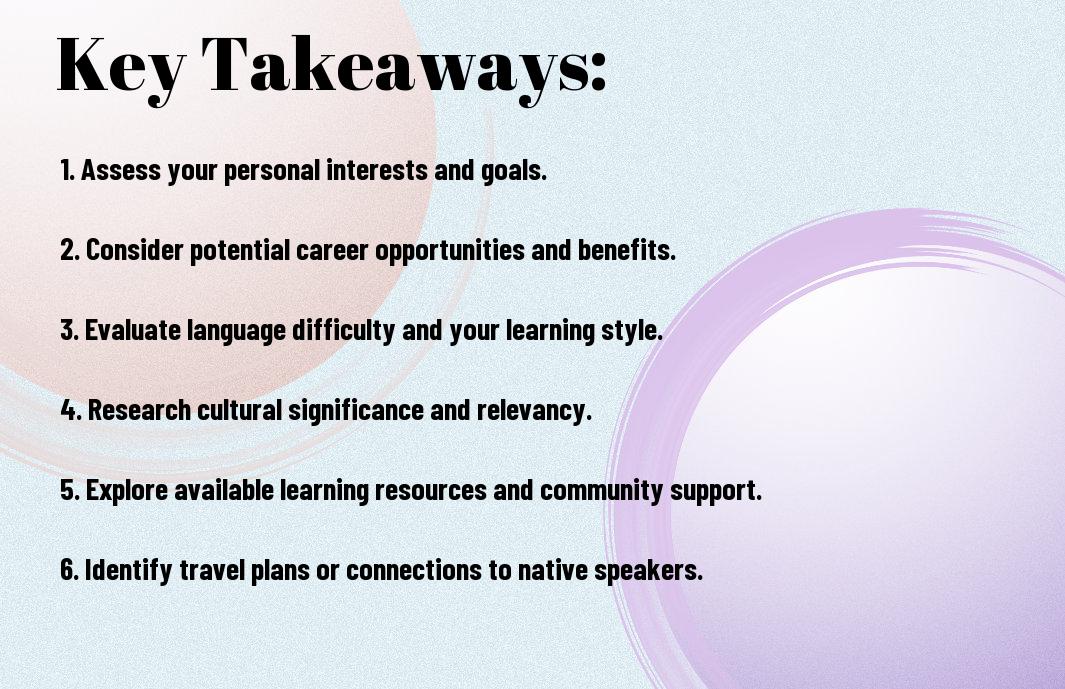
Key Takeaways:
- Define your motivation for learning a new language, as it will help you stay focused and directed throughout the learning process.
- Consider the practicality of the language you want to learn, including the number of native speakers, its use in international business, and its cultural significance.
- Assess your learning style and choose a language that fits your preferences, such as a language with a simple grammar system or a language with a wide range of learning resources.
- Evaluate the level of difficulty of the language you want to learn, taking into account factors such as grammar, vocabulary, and pronunciation.
- Explore the resources available for learning the language, including language courses, textbooks, and online tools, to ensure you have the support you need to succeed.

Setting Goals
A clear understanding of your objectives is vital when choosing a language to learn. You need to consider what you want to achieve with your new language skills, whether it’s for personal or professional purposes.
Defining Motivation
After establishing your goals, you’ll need to reflect on what drives your motivation to learn a new language. You should ask yourself what sparked your interest in learning a new language and what you hope to gain from the experience.
Identifying Interests
One key factor in choosing the right language is identifying your interests and hobbies. You should consider which languages are spoken in the countries or cultures that fascinate you, as this can help you stay motivated and engaged in the learning process.
Setting your sights on a language that aligns with your passions and interests can make learning more enjoyable and effective. You will be more likely to dedicate time and effort to learning a language that has personal significance, allowing you to stay focused and driven throughout your learning journey. As you consider your interests, you can explore the languages spoken in the countries or cultures that resonate with you, and immerse yourself in the language and culture to gain a deeper understanding and connection.
Evaluating Options
If you’re considering learning a new language, you’ll need to evaluate your options carefully. You’ll want to think about your motivations, goals, and learning style to narrow down your choices.
Popular Languages
Contrary to what you might think, popular languages like Spanish, Mandarin, and Arabic may not be the best fit for you. You should consider what you want to achieve with your new language skills and whether a popular language aligns with your goals.
Language Families
Assessing language families can help you make a more informed decision. You can look at the grammar, syntax, and pronunciation of languages within a family to determine which one might be easiest for you to learn.
In addition, understanding language families can help you identify similarities and differences between languages, making it easier to choose one that suits your needs and interests. You can explore the Romance languages, Germanic languages, or Slavic languages, among others, to find the one that resonates with you and your learning style.
Considering Difficulty
Your language learning journey will be smoother if you consider the difficulty level of the language you want to learn. This includes grammar, writing systems, and pronunciation.
Grammar Complexity
Grammatically, some languages have simpler structures, while others have more complex rules, which can affect your learning pace. You need to evaluate how different grammar systems will impact your progress.
Writing Systems
Beneath the surface of a language lies its writing system, which can be alphabetic, logographic, or syllabic. You should consider how familiar you are with the writing system of your desired language.
Consequently, you will find that some writing systems are more intuitive for you to learn, while others may require more time and effort to master. You can start by looking at the scripts and characters of your target language to get an idea of what to expect, and plan your learning strategy accordingly, taking into account your own strengths and weaknesses.
Exploring Resources
For your language learning journey, you’ll need to explore various resources. You can start by reading articles like How to Choose a Language to Learn to get an idea of what to expect.
Language Courses
Between the numerous options available, you’ll find that language courses are an excellent way to start learning, offering structured lessons and a clear learning path tailored to your needs.
Study Materials
For your study materials, you’ll have a wide range of options, including textbooks, language learning apps, and online resources that cater to your learning style and goals.
Another aspect of study materials to consider is the level of interactivity they offer, as engaging with the language through practice exercises and quizzes can significantly enhance your learning experience, allowing you to practice your skills and track your progress effectively, helping you stay motivated and focused on your language learning journey.
Assessing Opportunities
Unlike other factors, assessing opportunities is a significant step in choosing a language to learn, as it affects your future prospects and interests.
Career Prospects
Along the lines of your profession, you should consider the languages spoken in your industry and the countries you’d like to work with, as this will enhance your career opportunities and increase your market value.
Cultural Immersion
Above all, you may find that learning a language allows you to connect with a new culture, and as a result, you’ll have the chance to immerse yourself in customs, traditions, and ways of life that are different from your own.
Further exploration of cultural immersion will lead you to discover that speaking the local language is key to truly experiencing a culture, as you’ll be able to engage with locals, understand their perspectives, and appreciate the nuances of their customs and traditions, ultimately enriching your travel experiences and broadening your understanding of the world.
Making a Decision
Many factors will influence your choice of language to learn, and you can find helpful guidance at What language should I learn? Here’s how to decide. ‹ GO Blog.
Weighing Factors
Weighting the pros and cons, you’ll consider several aspects, including:
- personal interests
- career goals
The decision will ultimately depend on your priorities.
Trusting Instincts
Betwixt the various options, you may feel drawn to a particular language, and it’s necessary to consider this instinct.
But as you trust your instincts, you’ll also want to think about how they align with your motivations for learning a language, and whether your gut feeling is supported by practical considerations, such as the availability of resources to help you learn, and the potential opportunities that speaking the language could bring to your life.
Conclusion
Following this guide, you can make an informed decision about which language to learn. You will consider your goals, interests, and learning style to choose the right language for your needs. By weighing the factors discussed, you can set yourself up for success and enjoy the process of learning a new language, ultimately achieving your goals and expanding your linguistic and cultural knowledge, and enhancing your personal and professional opportunities with your new language skills.
FAQ
Q: What factors should I consider when choosing a language to learn?
A: When choosing a language to learn, consider your personal interests, career goals, and the language’s relevance to your future plans. Think about the cultures and countries you’re interested in, as well as the languages spoken in your desired field of work. Additionally, evaluate the difficulty level of the language and the resources available for learning it, such as language courses, tutors, and study materials. Assessing these factors will help you make an informed decision and increase your motivation to learn the language.
Q: How do I determine the difficulty level of a language and its suitability for me as a beginner?
A: To determine the difficulty level of a language, analyze its grammar, syntax, and pronunciation in comparison to your native language. You can find numerous language learning resources and studies that categorize languages by difficulty for English speakers. For instance, the US Foreign Service Institute (FSI) provides a language difficulty ranking. Moreover, consider factors such as the availability of language learning materials, the similarity of the language to your native language, and the language’s writing system. As a beginner, it’s advisable to start with a language that has a relatively simpler grammar system and is widely spoken, ensuring you have access to various learning tools and communities.
Q: What role does personal interest play in choosing a language to learn, and how can it impact my learning experience?
A: Personal interest plays a significant role in choosing a language to learn, as it can greatly impact your motivation and enjoyment throughout the learning process. Learning a language can be a long and challenging journey, and having a genuine interest in the language and its associated culture can make it more engaging and rewarding. When you’re interested in a language, you’re more likely to stay motivated, explore various aspects of the language, and practice consistently. This, in turn, can lead to faster progress, a deeper understanding of the language, and a more enjoyable learning experience. Therefore, it’s important to choose a language that aligns with your hobbies, passions, or career aspirations to ensure a positive and successful learning experience.