You want to improve your language skills to engage in everyday conversations with ease. Your goal is to express yourself clearly and confidently. Learning phrases for real-life conversations is an effective way to achieve this. You will discover how to build your vocabulary and practice your speaking skills, enabling you to communicate effectively in various situations, from casual conversations to formal discussions, and enhance your overall language proficiency.
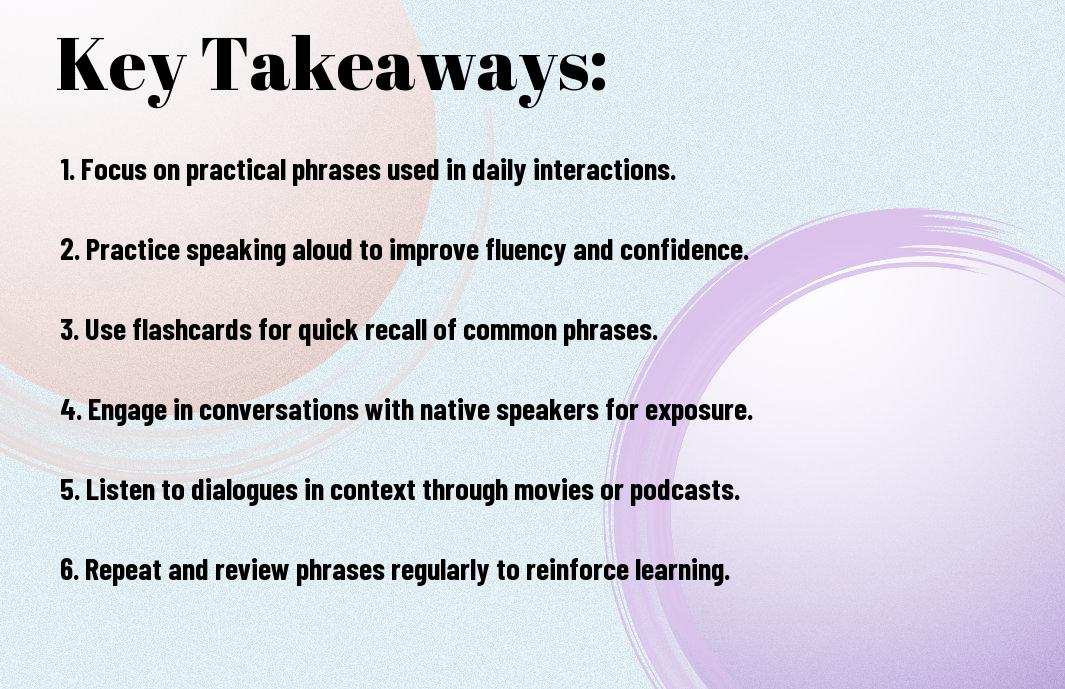
Key Takeaways:
To improve your ability to learn phrases for real-life conversations, consider the following points:
- Focus on Contextual Learning, which involves studying phrases within the context of actual conversations to better understand their usage and application in different situations.
- Develop a habit of Active Listening by paying close attention to how native speakers use phrases in everyday conversations, and try to mimic their pronunciation and intonation.
- Practice Conversational Role-Playing to apply learned phrases in simulated conversations, helping you to build confidence and fluency in using new phrases in Real-Life Interactions.
Setting Goals
A well-defined goal is imperative for learning phrases in a foreign language, as it helps you stay focused and motivated throughout the learning process. You need to determine what you want to achieve and set specific, attainable objectives.
Identifying your language needs
Linguistic proficiency is key to effective communication, and you must assess your current level and identify areas that need improvement, considering the situations and contexts in which you will use the language.
Creating a realistic plan
Beneath the surface of language learning lies a complex process, and you should break down your goal into smaller, manageable tasks, allowing you to track progress and make adjustments as needed.
Your plan should be tailored to your learning style, schedule, and resources, taking into account the time and effort required to achieve your objectives, and you should establish a routine that includes regular practice and review to reinforce new language skills.
Choosing the Right Resources
Clearly, selecting the most effective tools is vital for learning phrases in real-life conversations. You will need to explore various options to find what works best for your learning style and goals.
Language learning apps and software
Right from the start, you should consider language learning apps and software that offer interactive lessons and exercises to help you learn phrases in context. You can try out a few to see which one suits your needs.
Phrasebooks and language exchange websites
Beneath the surface of traditional learning methods, you can find phrasebooks and language exchange websites that provide valuable resources for learning phrases. You can use these to supplement your learning and get feedback from native speakers.
Indeed, phrasebooks and language exchange websites can be extremely helpful in your journey to learn phrases for real-life conversations. You can use phrasebooks to learn common expressions and phrases, while language exchange websites connect you with native speakers who can help you practice your speaking skills and get feedback on your pronunciation and grammar.
Practicing Active Listening
All language learners can benefit from practicing active listening to improve their conversation skills. You will be able to pick up phrases and expressions more easily by paying attention to how native speakers communicate.
Paying attention to native speakers
Around every conversation, you have the chance to learn something new by observing how native speakers interact with each other. You can do this by watching TV shows, listening to podcasts, or engaging in conversations with native speakers.
Repeating and memorizing phrases
Actively repeating phrases out loud will help you memorize them more effectively. You can practice repeating phrases in front of a mirror or with a language exchange partner to get feedback on your pronunciation.
At this stage, you should focus on repeating phrases in context to help you understand how they are used in real-life conversations. You can try to recall phrases from your favorite TV show or movie and use them in your own conversations to make them sound more natural and authentic. As you practice, you will start to feel more confident in your ability to use phrases correctly and engage in meaningful conversations with native speakers.
Building Vocabulary
Keep in mind that learning phrases is not just about memorizing words, but also about understanding their context and usage in real-life conversations. You will need to learn how to use vocabulary in a way that sounds natural and fluent.
Learning idiomatic expressions
Prior to exploring into complex conversations, you should focus on learning idiomatic expressions that are commonly used in everyday dialogue. You will find that these expressions can help you convey your thoughts and ideas more effectively.
Expanding your phrase repertoire
Among the many ways to improve your conversation skills, learning new phrases and expressions is one of the most effective. You can start by learning phrases that are relevant to your daily life and interests, and then gradually move on to more complex topics.
The key to expanding your phrase repertoire is to practice consistently and engage in conversations with native speakers. You can also listen to podcasts, watch TV shows, and read books to get a better sense of how phrases are used in context. As you continue to learn and practice, you will find that your ability to express yourself in conversations will improve significantly, and you will be able to communicate more confidently and effectively.

Engaging in Conversations
Despite the challenges, engaging in conversations is a key part of learning phrases for real-life conversations. You will learn to express yourself and understand others, which will help you to improve your language skills and build confidence.
Finding language exchange partners
Above all, finding someone to practice with is important. You can look for language exchange partners online or in your local community, and practice speaking with them regularly to improve your conversation skills.
Starting with simple conversations
Below the surface of complex conversations, simple ones are the foundation. You start with basic phrases and gradually move to more complex ones, allowing you to build your skills and confidence.
This approach will help you to develop a strong foundation in conversational skills, and as you progress, you will be able to handle more complex conversations with ease, enabling you to express yourself effectively and understand others in various social situations, which is your ultimate goal when learning a new language.
Overcoming Challenges
To learn phrases for real-life conversations, you will inevitably face obstacles. You must be prepared to tackle these challenges head-on, using persistence and dedication to improve your language skills.
Dealing with language barriers
At times, you will encounter words or phrases that are difficult to understand or pronounce. Around these obstacles, you will find that practice and repetition are key to overcoming language barriers and becoming proficient in your target language.
Staying motivated and consistent
With a well-structured study plan, you will be able to stay on track and make steady progress in your language learning journey. You will find that setting achievable goals and tracking your progress helps to maintain your motivation and enthusiasm.
Indeed, staying motivated and consistent is vital to your success in learning phrases for real-life conversations. You will need to continuously challenge yourself to learn new phrases and engage in conversations with native speakers to improve your language skills and build confidence in your ability to communicate effectively.
Conclusion
As a reminder, you can effectively learn phrases for real-life conversations by practicing consistently. You will find numerous resources online, such as Basic English Learning: Phrases to Instantly Improve Your English, to help you improve your skills. By applying these tips, you will enhance your ability to engage in conversations with confidence and precision, ultimately achieving your language learning goals.
FAQ
Q: What is the best way to start learning phrases for real-life conversations?
A: To start learning phrases for real-life conversations, begin by identifying the situations you encounter most frequently, such as ordering food, asking for directions, or introducing yourself. Focus on learning phrases that are relevant to these situations, and practice them in context. You can use language learning apps, watch videos, or listen to podcasts that provide conversations and phrases for different scenarios. Start with basic phrases and gradually move on to more complex ones, and try to practice speaking and listening as much as possible to improve your pronunciation and comprehension.
Q: How can I improve my pronunciation when learning phrases for real-life conversations?
A: Improving your pronunciation when learning phrases for real-life conversations requires consistent practice and exposure to native speakers. Listen to how native speakers pronounce words and phrases, and try to mimic their intonation, rhythm, and stress patterns. You can practice speaking in front of a mirror, record yourself, or speak with a language exchange partner. Pay attention to the individual sounds, syllable stress, and word linking, as these are necessary for clear and accurate pronunciation. Additionally, practice speaking at a natural pace, rather than slowing down or speeding up, to sound more natural and fluent.
Q: Can I learn phrases for real-life conversations without being fluent in the language?
A: Yes, you can learn phrases for real-life conversations without being fluent in the language. Focus on learning phrases that are commonly used in everyday situations, and practice them in context. You can start with basic phrases like greetings, introductions, and basic questions, and gradually move on to more complex phrases. Use visual aids like flashcards, diagrams, or videos to help you associate phrases with their meanings, and practice speaking and listening as much as possible. Even with limited language proficiency, learning key phrases can help you navigate everyday situations and communicate effectively with native speakers, making your interactions more enjoyable and rewarding.