Fluency

The Role of Pronunciation Practice in Fluency

As you strive to improve your language skills, you’ll find that pronunciation practice plays a significant role in achieving fluency. Your ability to pronounce words correctly is important to effective communication, and regular practice helps you develop a more natural flow. By focusing on your pronunciation, you’ll enhance your overall language proficiency, enabling you to express yourself more confidently and accurately in your target language.

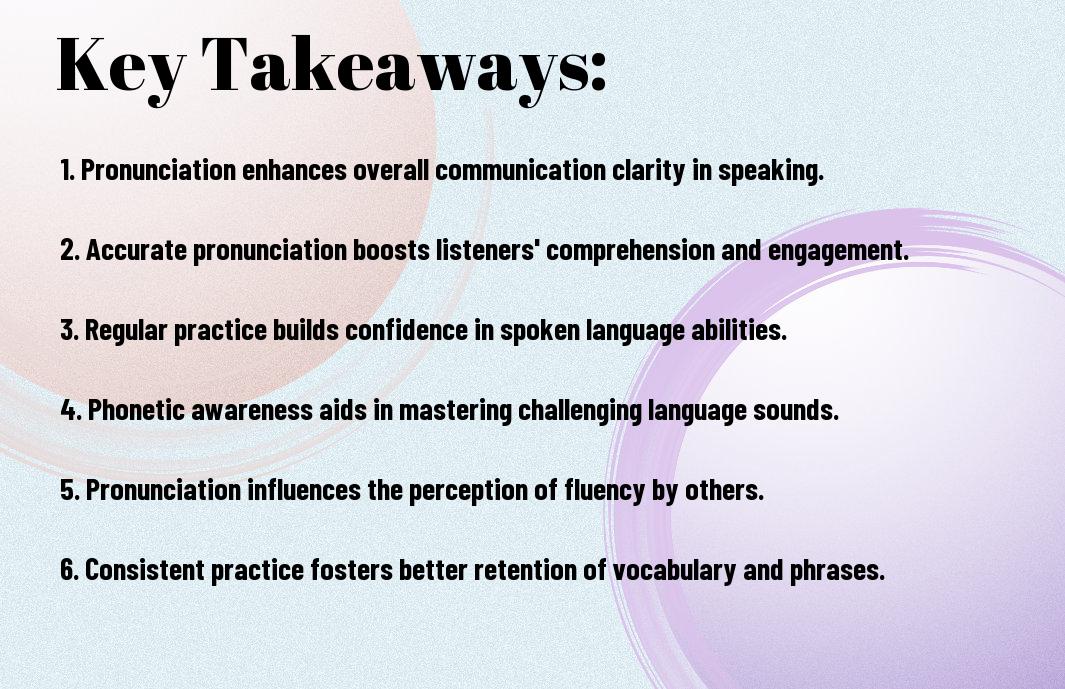
Key Takeaways:

  • Effective pronunciation practice plays a significant role in achieving fluency in a language, as it enables learners to communicate clearly and confidently.
  • Regular practice helps to develop muscle memory, allowing learners to focus on the content of their message rather than the individual sounds and intonation patterns.
  • Authentic materials, such as videos and podcasts, can be used to provide learners with opportunities to practice listening and speaking in a more engaging and motivating way.
  • Focused pronunciation practice can help learners to overcome barriers to communication, such as accents and intonation patterns that may be difficult for native speakers to understand.
  • Technology, such as speech recognition software and mobile apps, can provide learners with personalized feedback and targeted practice opportunities to improve their pronunciation and overall fluency.

Importance of Pronunciation

A key aspect of language learning is pronunciation practice, as it enables you to communicate effectively and be understood by others, making it an imperative part of your language development.

Fundamentals of Clear Speech

Between the sounds, rhythm, and pacing of speech, you will find that clear speech is rooted in the consistent practice of pronunciation, allowing you to articulate your thoughts and ideas with precision and clarity.

Role of Intonation and Stress

Alongside the development of your pronunciation skills, you will discover that intonation and stress play a significant role in conveying meaning and context, helping you to express your intentions and attitudes in your speech.

Achieving mastery over intonation and stress patterns will enable you to convey subtle nuances in your speech, allowing you to express yourself with greater precision and authenticity, and you will find that your listeners are more likely to understand your intended meaning, making your communication more effective and engaging.
Effective Pronunciation Practice

One of the most effective ways to improve your pronunciation is through regular practice. You can start by practicing individual sounds, then move on to words and sentences. As you practice, you will become more aware of your own pronunciation and be able to make adjustments to improve your speaking skills.

Techniques for Improving Articulation

Any effort you put into practicing pronunciation will help you improve your articulation. You can try speaking in front of a mirror, recording yourself, or practicing with a language exchange partner to identify areas that need improvement. This will help you develop your skills and sound more natural when speaking.

Using Audio and Visual Aids

One of the best ways to improve your pronunciation is by using audio and visual aids. You can use videos, podcasts, and language learning apps to listen to native speakers and practice mimicking their pronunciation. This will help you get used to the sounds and rhythms of the language.

For instance, you can watch TV shows or movies in the target language with subtitles, and then try to repeat the sentences out loud. You can also use apps that provide audio clips and ask you to repeat what you hear, giving you feedback on your pronunciation. By using these tools, you will be able to improve your pronunciation and sound more like a native speaker. As you continue to practice, you will become more confident in your ability to communicate effectively in your target language.

Language Learning and Fluency

For language learners, achieving fluency is a primary goal, and pronunciation practice plays a significant role in this process, as it enables you to communicate effectively and efficiently in your target language.

Connection between Pronunciation and Comprehension

Previously, you may have noticed that improving your pronunciation helps you better understand native speakers, as clear pronunciation facilitates comprehension and enhances your overall language learning experience.

Building Confidence in Speaking

Properly, pronunciation practice helps you build confidence in speaking, allowing you to express yourself more comfortably and accurately in your target language, which in turn enhances your ability to engage in conversations with native speakers.

Hence, as you continue to practice pronunciation, you will find that your confidence in speaking grows, enabling you to participate more freely in discussions and conversations, and your ability to communicate effectively in your target language will significantly improve, allowing you to achieve your language learning goals and become a more proficient speaker.

Common Challenges and Solutions

Now that you’ve started practicing pronunciation, you’ll encounter challenges that can hinder your fluency. You’ll need to address these issues to improve your speaking skills.

Overcoming Accent and Dialect Barriers

With consistent practice, you can overcome accent and dialect barriers that affect your pronunciation. You’ll become more aware of your own speech patterns and learn to adapt to different accents and dialects.

Strategies for Self-Improvement

For effective pronunciation practice, you’ll need to develop strategies that work for you. You can start by recording yourself, listening to native speakers, and mimicking their intonation and rhythm.

Common strategies for self-improvement include setting achievable goals, practicing regularly, and seeking feedback from others. As you work on your pronunciation, you’ll find that your fluency improves, and you’ll become a more confident speaker, able to express yourself more clearly and effectively in your target language. You’ll be able to identify areas that need improvement and make adjustments to your practice routine accordingly.

Technology and Pronunciation Practice

After exploring various methods for improving pronunciation, you can leverage technology to enhance your practice. You can access numerous digital tools and resources to help you develop your speaking skills and achieve fluency.

Online Resources and Tools

Beneath the surface of language learning, you’ll find a wealth of online resources and tools that can aid your pronunciation practice. You can utilize websites, videos, and podcasts to improve your listening and speaking skills.

Mobile Apps for Language Learners

Parallel to traditional learning methods, pronunciation practice can be facilitated through mobile apps designed for language learners. You can use these apps to access interactive exercises, audio recordings, and pronunciation guides tailored to your needs.

In addition, many mobile apps offer features such as speech recognition, recording capabilities, and personalized feedback, allowing you to track your progress and refine your pronunciation skills. You can explore various apps to find the one that best suits your learning style and goals, and incorporate it into your daily practice routine to enhance your fluency.

Teaching Pronunciation in the Classroom

Despite the challenges, you can effectively teach pronunciation in the classroom by incorporating various techniques and resources, such as referring to The Role of Pronunciation in a Foreign Language Program for guidance.

Methods for Instructors and Educators

Pronouncing words correctly is key to effective communication, and as you teach, you will find that using audio and video recordings can help your students improve their pronunciation skills.

Creating a Supportive Learning Environment

Instructively, you should create an environment where your students feel comfortable practicing their pronunciation without fear of judgment, allowing them to build confidence in their language skills.

Methods such as providing feedback, encouraging self-recording, and using pronunciation learning apps can help you create a supportive learning environment, where you can help your students overcome their pronunciation challenges and achieve fluency in the target language, enabling you to tailor your teaching to meet their individual needs.

Summing up

To wrap up, you now understand the significance of pronunciation practice in achieving fluency. As you strive to improve your language skills, you can Learn English pronunciation to develop fluency and enhance your overall communication. By focusing on your pronunciation, you will be able to express yourself more effectively and confidently, taking your language skills to the next level, and achieving your goals.

FAQ

Q: What is the significance of pronunciation practice in achieving fluency in a foreign language?

A: Pronunciation practice plays a vital role in achieving fluency in a foreign language as it enables learners to communicate effectively and confidently. When learners practice pronunciation regularly, they develop the ability to produce words and sentences with accurate intonation, stress, and rhythm, which is important for conveying their intended message. Moreover, good pronunciation helps learners to sound more natural and native-like, making it easier for them to engage in conversations and interact with native speakers.

Q: How can pronunciation practice improve fluency in terms of speaking and listening skills?

A: Pronunciation practice can significantly improve fluency in speaking and listening skills by enhancing a learner’s ability to articulate words and sentences clearly and accurately. When learners practice pronunciation, they develop their ability to produce speech sounds, intonation patterns, and rhythm, which helps them to speak more smoothly and coherently. Additionally, pronunciation practice also improves listening skills, as learners become more attuned to the sounds and rhythms of the language, enabling them to better understand native speakers and follow conversations with greater ease.

Q: What are some effective ways to incorporate pronunciation practice into a language learning routine to enhance fluency?

A: There are several effective ways to incorporate pronunciation practice into a language learning routine to enhance fluency. One approach is to practice speaking and listening regularly, using audio and video materials such as podcasts, videos, and language learning apps. Learners can also practice shadowing, where they repeat what a native speaker is saying, trying to mimic their intonation, stress, and rhythm. Another approach is to engage in conversations with native speakers, either in person or online, to practice speaking and listening in a more interactive and dynamic way. Furthermore, learners can use pronunciation-focused exercises and activities, such as tongue twisters, pronunciation drills, and audio description exercises, to target specific sounds and intonation patterns.
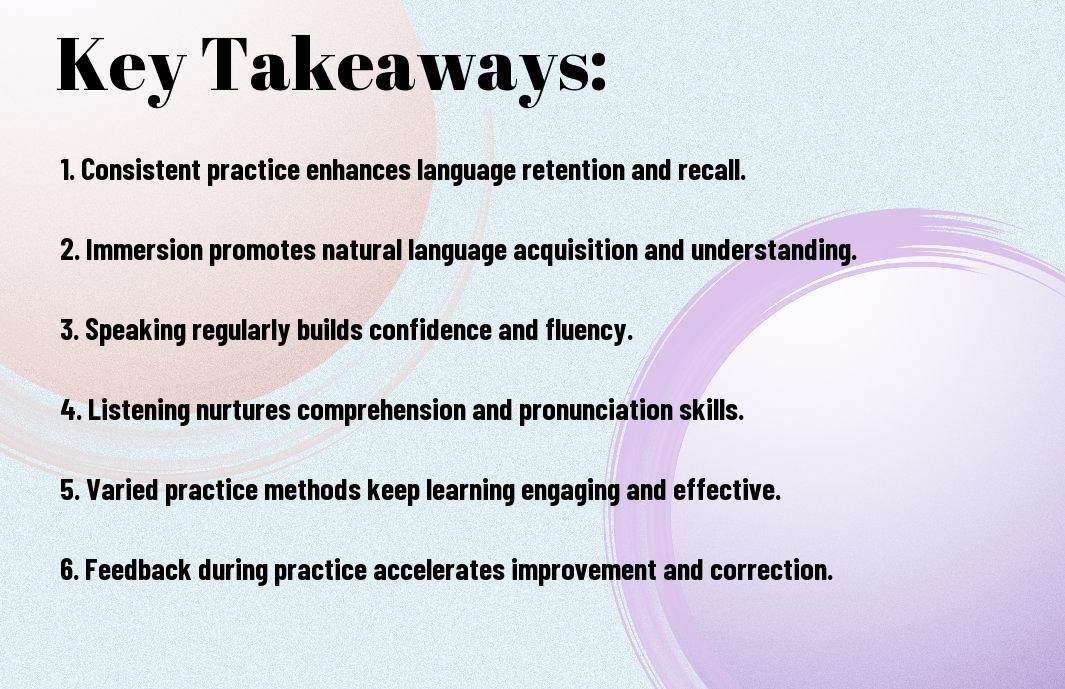

The Role of Practice in Achieving Language Fluency

As you commence on the journey to master a new language, you will inevitably encounter the notion that practice is crucial to achieving fluency. Your progress will depend on the consistent effort you put into practicing your language skills, and your ability to apply what you have learned in real-life situations. By dedicating time to regular practice, you will be able to develop a deeper understanding of the language and improve your proficiency over time, ultimately aiding you in your pursuit of language mastery.

Key Takeaways:

To achieve language fluency, consistent practice is necessary. Here are some key points to consider:

  • Regular immersion in the language is vital, which can be achieved through activities such as reading, writing, speaking, and listening to native speakers.
  • Consistent practice helps to develop muscle memory, allowing language learners to instinctively use correct grammar and vocabulary in context.
  • Active engagement with the language, such as participating in conversations and using language learning apps, can help learners stay motivated and track their progress.
  • Feedback from native speakers, language instructors, or peers is necessary to identify areas of improvement and refine language skills.
  • Persistence and patience are necessary to overcome language barriers and achieve fluency, as language learning is a long-term process that requires dedication and effort.

Fundamentals of Language Fluency

Achieving language fluency requires a deep understanding of its components, and you can start by exploring the various aspects of language learning, such as how to Practice and Improve Your Proficiency in a Target Language, which will guide you in your journey to language mastery.

Defining Language Fluency

Delving into the concept of language fluency, you will discover that it encompasses various skills, including speaking, reading, writing, and listening, all of which you must develop to effectively communicate in your target language.

Importance of Practice in Fluency

Language acquisition is heavily reliant on consistent practice, as you need to apply your knowledge of grammar, vocabulary, and pronunciation to improve your overall language skills and move closer to fluency.

Achieving fluency also depends on your ability to think critically and apply your language skills in context, allowing you to express yourself clearly and accurately, which in turn, will help you to better understand the language and its nuances, enabling you to communicate effectively with native speakers, and you will find that your language skills will continue to improve as you practice and engage with the language in a more meaningful way.

Effective Practice Techniques

You will find that consistent practice is key to improving your language skills, and learning how to reach advanced language proficiency requires a strategic approach. By focusing on your weaknesses and building on your strengths, you can create a personalized practice plan that suits your needs.

Immersive Learning Methods

Beyond the classroom, you can surround yourself with the language you want to learn, using media and conversation to immerse yourself in the culture. This approach helps you pick up nuances and colloquialisms that might be missed in a traditional learning setting.

Interactive Language Exercises

Across various platforms, you can engage in activities that challenge your language skills, such as speaking, writing, and listening exercises. These interactive tools help you stay motivated and track your progress.

Due to the wide range of interactive language exercises available, you can tailor your practice to fit your learning style and interests. Whether through language exchange websites, mobile apps, or online courses, you can find opportunities to engage in conversations, complete quizzes, and participate in discussions, all of which help you refine your language skills and build confidence in your ability to communicate effectively.

Role of Consistency in Practice

Many language learners underestimate the importance of consistent practice in achieving fluency. You will find that regular practice helps to reinforce new language skills and build confidence in your abilities. By making language practice a habitual part of your daily routine, you will be able to track your progress and identify areas that need improvement.

Creating a Study Schedule

Among the most effective ways to ensure consistency is to establish a study schedule. You will benefit from setting aside a specific time each day to practice speaking, writing, and listening to the target language. This will help you stay organized and focused, allowing you to make the most of your practice time.

Overcoming Procrastination

Constructing a plan to overcome procrastination is important to maintaining consistency in your practice. You will need to identify the obstacles that prevent you from practicing regularly and develop strategies to overcome them. This may involve breaking your practice sessions into shorter, more manageable chunks, or finding a study partner to provide motivation and support.

Further, overcoming procrastination requires a great deal of self-discipline and motivation. You will need to be honest with yourself about your goals and the steps you need to take to achieve them. By setting realistic targets and celebrating your progress, you can stay motivated and focused, even when faced with the inevitable setbacks and challenges that arise during the language learning process. You will find that with persistence and dedication, you can overcome procrastination and make consistent progress towards achieving language fluency.

Measuring Progress and Improvement

For any language learner, tracking progress is crucial to staying motivated and focused. You need to evaluate your language skills regularly to identify areas that require improvement.

Assessing Language Proficiency

Around the time you start learning a language, you will need to assess your proficiency level. You can use standardized tests or language assessments to determine your current level and set a benchmark for future progress.

Setting Achievable Goals

Monitoring your progress helps you set realistic targets. You can break down your long-term goals into smaller, manageable objectives, allowing you to celebrate your successes and adjust your strategy as needed.

Language learners like you often find that setting achievable goals helps to maintain momentum and motivation. You can use the SMART criteria – specific, measurable, achievable, relevant, and time-bound – to create a clear plan for your language learning journey, enabling you to make steady progress towards fluency.

Common Challenges and Solutions

Once again, you will encounter obstacles on your path to language fluency, but with the right strategies, you can overcome them. You will face difficulties, such as grammar rules and vocabulary, but consistent practice will help you improve.

Overcoming Language Barriers

Against all odds, you must persevere and seek out opportunities to practice speaking and listening, such as language exchange programs or online resources, to improve your skills.

Managing Motivation and Burnout

Against the temptation to give up, you must find ways to stay motivated, such as setting achievable goals and rewarding yourself for progress, to maintain your enthusiasm for learning.

Common pitfalls, such as burnout and frustration, can be avoided by taking regular breaks and practicing self-care, allowing you to recharge and approach your language learning with renewed energy and dedication, helping you to stay focused on your goal of achieving language fluency.

Technology and Practice

After immersing yourself in a new language, you will find that technology can be a valuable tool to aid in your practice. You can utilize various digital resources to enhance your language skills, making the learning process more efficient and engaging.

Language Learning Apps and Software

Beneath the surface of language learning lies a wealth of apps and software designed to facilitate your progress. You will discover that these tools offer interactive lessons, quizzes, and exercises tailored to your needs, allowing you to track your development and identify areas for improvement.

Online Resources and Communities

Alongside traditional learning methods, you will find that online resources and communities provide a platform for you to engage with native speakers, access language learning materials, and share your experiences with fellow learners, fostering a sense of camaraderie and motivation.

Practice with online resources and communities enables you to refine your language skills in a more dynamic and immersive environment. You will be able to participate in discussions, listen to podcasts, and watch videos, all of which will help you develop a more nuanced understanding of the language and its cultural context, allowing you to communicate more effectively and confidently.

To wrap up

Following this discussion, you see that practice plays a significant role in achieving language fluency. As you apply yourself, your skills will improve, and your command of the language will become more nuanced. By dedicating time to practice, you will find that your ability to communicate effectively in the target language grows, allowing you to express your thoughts and ideas with greater precision and clarity. Your progress will be evident, and your confidence in using the language will increase.

FAQ

Q: What is the significance of practice in achieving language fluency, and how does it impact my language learning journey?

A: The role of practice in achieving language fluency cannot be overstated. Consistent practice helps learners develop a deeper understanding of the language, including its nuances and exceptions. Through practice, individuals can improve their listening, speaking, reading, and writing skills, leading to enhanced overall language proficiency. Moreover, regular practice reinforces learning, builds confidence, and enables learners to apply language skills in real-life situations, making it an vital component of the language learning process.

Q: How can I effectively incorporate practice into my daily routine to improve my language fluency, especially if I have a busy schedule?

A: Incorporating practice into a busy schedule requires creativity and commitment. One approach is to allocate a specific time slot each day, even if it’s just 15-20 minutes, dedicated to language practice. This could involve speaking with a language exchange partner, listening to podcasts or audiobooks, writing in a journal, or using language learning apps. Additionally, leveraging downtime, such as during commutes or breaks, can provide opportunities for language practice. Setting achievable daily goals and tracking progress can also motivate consistent practice and contribute to achieving language fluency.

Q: Are there different types of practice that can contribute to language fluency, and how can I tailor my practice to focus on areas where I need improvement?

A: Yes, there are various types of practice that can contribute to language fluency, including active practice (such as speaking and writing) and passive practice (such as listening and reading). To tailor practice to areas needing improvement, learners should first identify their weaknesses through self-assessment or feedback from instructors or peers. Then, they can focus their practice on those specific areas. For example, if someone struggles with speaking, they might engage in conversations with native speakers, participate in language exchange programs, or record themselves speaking to improve pronunciation and fluency. Similarly, for reading comprehension, they could read a variety of texts, summarize what they’ve read, and discuss the content with others.

The Role of Vocabulary Expansion in Language Fluency

As you strive to improve your language skills, you’ll find that expanding your vocabulary is crucial to achieving fluency. Your ability to express yourself effectively depends on the words at your disposal. Research, such as the study on Effects of Language Skills and Strategy Use on Vocabulary Acquisition, highlights the significance of vocabulary in language learning. By broadening your vocabulary, you’ll enhance your overall language proficiency and be able to communicate more confidently.

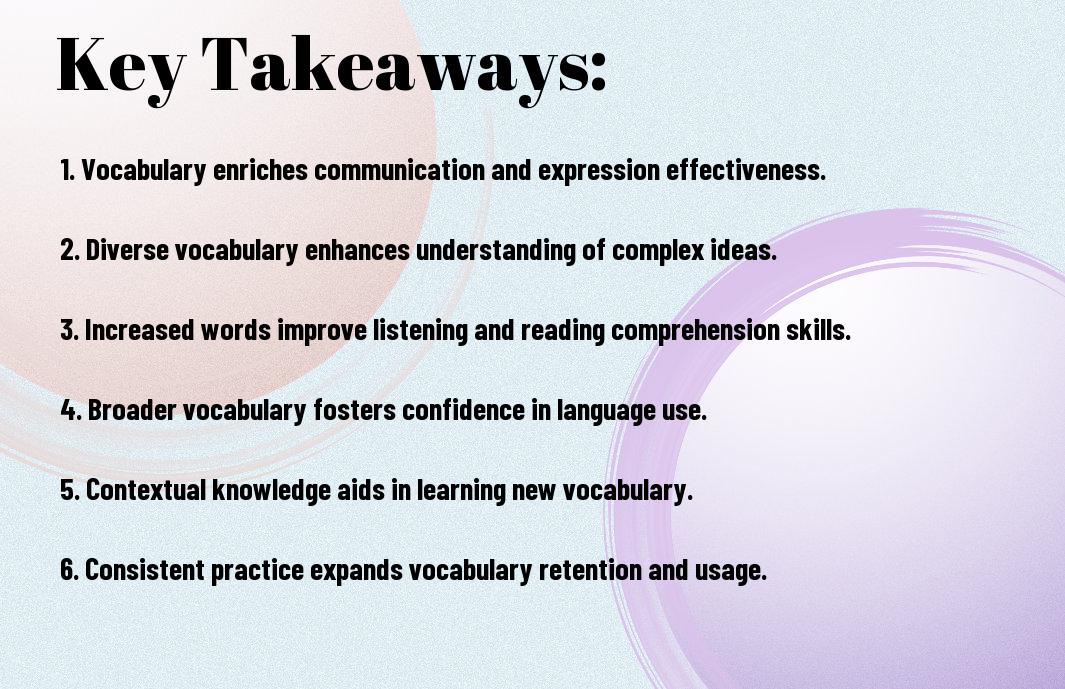
Key Takeaways:

To achieve language fluency, vocabulary expansion plays a significant role. Here are some key points to consider:

  • Expanding vocabulary helps to improve communication skills, enabling individuals to express themselves more effectively and accurately convey their thoughts and ideas.
  • Contextual learning is crucial for vocabulary expansion, as it allows individuals to understand how words are used in different situations and develop a deeper understanding of linguistic nuances.
  • Consistent practice and exposure to various language sources, such as books, media, and conversations, can help individuals develop a more extensive vocabulary range and enhance their overall language proficiency.

Foundations of Language Fluency

To establish a strong command of a language, you need to understand the significance of vocabulary expansion. As you explore into the world of language learning, you will discover that vocabulary plays a vital role in your journey, and you can find more information on Why Vocabulary Matters in Language Learning to improve your skills.

The Importance of Vocabulary

Fluently, you will notice that a robust vocabulary is vital for effective communication, enabling you to express your thoughts and ideas with clarity and precision, which in turn will enhance your overall language proficiency.

Language Acquisition and Development

Against the backdrop of language learning, you will encounter various challenges, but developing a strong vocabulary will help you overcome them, and as you progress, you will find that your language skills improve significantly.

Considering your language learning goals, you should focus on acquiring new words and phrases, practicing them in context, and reviewing them regularly to reinforce your learning, and you will see that your language acquisition and development will become more effortless and natural, allowing you to communicate more confidently and accurately in your target language.

Vocabulary Expansion Techniques

The key to improving your language fluency lies in expanding your vocabulary, and there are several techniques to achieve this. You can use flashcards, vocabulary apps, and language learning software to learn new words and phrases.

Reading and Exposure

Prior to developing a strong vocabulary, you need to expose yourself to various texts, such as books, articles, and news. You will encounter new words and phrases, which will help you understand their context and usage.

Practice and Reinforcement

Between learning new words and using them in conversation, you need to practice consistently. You can practice by speaking with native speakers, writing journal entries, or using language exchange websites.

A significant aspect of practice and reinforcement is to use your new vocabulary in context. As you try to use the words and phrases you have learned, you will find that your language skills improve dramatically, and you will become more confident in your ability to express yourself effectively. You will be able to convey your thoughts and ideas with precision, and your communication will become more nuanced and sophisticated.

Effective Strategies for Vocabulary Building

Keep in mind that expanding your vocabulary is an ongoing process that requires consistent practice and dedication. You will need to incorporate various techniques into your daily routine to achieve language fluency.

Contextual Learning

Around you, there are numerous opportunities to learn new words in context, such as reading books, watching movies, or engaging in conversations with native speakers, which will help you understand how to use vocabulary in different situations.

Active Recall and Review

Revisiting previously learned vocabulary on a regular basis is vital to reinforce your understanding and retention of new words, allowing you to apply them more effectively in your communication.

Effective use of active recall and review involves setting aside time to regularly test yourself on newly acquired vocabulary, using flashcards or quizzes to assess your knowledge, and identifying areas where you need additional practice, enabling you to refine your skills and develop a more sophisticated command of language, as you progress towards achieving your goal of language fluency.

Overcoming Language Barriers

Not being able to communicate effectively in a foreign language can be frustrating. You may struggle to express your thoughts and ideas, leading to feelings of isolation. However, with vocabulary expansion, you can overcome language barriers and enhance your language fluency.

Language Immersion and Surroundings

Among the most effective ways to learn a language is to surround yourself with it. You can do this by watching TV shows or movies, listening to music, and speaking with native speakers. This immersion will help you pick up new vocabulary and phrases, making you more fluent in the language.

Technology and Language Tools

Any language learner can benefit from the numerous tools and resources available online. You can use apps, language learning software, and online courses to improve your vocabulary and language skills. These tools can be accessed from anywhere, making it easier for you to learn a language at your own pace.

Immersion through technology can be a powerful way to learn a language. You can use virtual reality to practice conversations, play language learning games, and engage with native speakers online. As you explore these tools, you will find that your vocabulary expands, and your language fluency improves, allowing you to communicate more effectively in the language you are learning.

Measuring Language Fluency

Despite the complexity of language fluency, it can be measured through various assessments. You will find that language proficiency tests, such as TOEFL or IELTS, evaluate your reading, writing, speaking, and listening skills.

Assessment and Evaluation

Across different linguistic backgrounds, you will encounter various evaluation methods. You can assess your language skills through self-assessment, peer review, or standardized tests, which help identify areas for improvement.

Progress Tracking and Adjustment

Alteration of your learning strategy is necessary as you track your progress. You will adjust your approach based on your performance, focusing on areas where you need improvement, and this helps you refine your language skills over time.

Measuring your progress in language fluency involves tracking your performance over time, and you will use this information to refine your learning strategy. As you monitor your development, you can identify patterns and trends, allowing you to make informed decisions about your language learning approach, and you will find that this leads to more effective language acquisition.

Implementing Vocabulary Expansion in Education

Your approach to implementing vocabulary expansion in education should be multifaceted, involving various strategies to enhance language learning. This can be achieved through a combination of curriculum design, teacher training, and support, ultimately leading to improved language fluency.

Curriculum Design and Planning

The development of a well-structured curriculum is important for effective vocabulary expansion. You will need to consider the needs and abilities of your students, incorporating a range of vocabulary-building activities and materials into your lesson plans.

Teacher Training and Support

By providing teachers with the necessary training and resources, you can ensure that they are equipped to deliver high-quality vocabulary instruction. This enables them to create an engaging and supportive learning environment, fostering students’ language development.

With comprehensive training, you will be better positioned to assess your students’ progress, identifying areas where they may require additional support. This allows you to tailor your teaching approach to meet the unique needs of your students, ultimately enhancing their vocabulary expansion and language fluency. As you implement these strategies, you will be able to observe significant improvements in your students’ ability to communicate effectively.

Conclusion

Taking this into account, you will find that vocabulary expansion plays a significant role in enhancing your language fluency. As you continue to learn and practice, your ability to express yourself effectively improves. Your comprehension and communication skills become more refined, allowing you to engage in complex conversations with ease. By prioritizing vocabulary expansion, you can take your language skills to the next level and become a more confident communicator.

FAQ

Q: What is the significance of vocabulary expansion in achieving language fluency?

A: Vocabulary expansion plays a vital role in language fluency as it enables individuals to express themselves more effectively and accurately. A broader vocabulary range allows learners to understand and convey complex ideas, nuances, and subtleties of the language, thereby enhancing their overall communication skills. As vocabulary grows, so does the ability to engage in more sophisticated conversations, comprehend various texts, and articulate thoughts with precision.

Q: How does vocabulary expansion impact reading comprehension and writing skills in language learning?

A: The impact of vocabulary expansion on reading comprehension and writing skills is profound. When learners have a larger vocabulary, they are better equipped to decipher unfamiliar words from context, deduce meaning, and grasp the overall message of a text. This, in turn, improves reading comprehension. Similarly, in writing, an expanded vocabulary allows for more varied and precise expression of ideas, leading to clearer, more engaging, and articulate writing. It also enables the use of more complex sentence structures and the conveyance of subtle shades of meaning, significantly enhancing writing skills.

Q: What strategies can language learners employ to effectively expand their vocabulary?

A: Language learners can employ several strategies to expand their vocabulary effectively. One of the most effective methods is through extensive reading, where learners are exposed to new words in context. Keeping a vocabulary notebook to jot down new words and their meanings is also highly beneficial. Engaging in conversations with native speakers, using flashcards, and learning prefixes, suffixes, and roots can also significantly aid in vocabulary expansion. Furthermore, learners can utilize online resources, vocabulary building apps, and play word games to make the process more engaging and fun, thereby accelerating their language learning journey.

The Role of Daily Practice in Language Fluency

As you commence on the journey to master a new language, your daily routine plays a significant role in determining your progress. You will find that consistent practice is imperative to develop the skills and confidence needed to communicate effectively. By incorporating language practice into your daily schedule, you can improve your fluency and enhance your understanding of the language, allowing you to express yourself more accurately and effectively in various contexts.

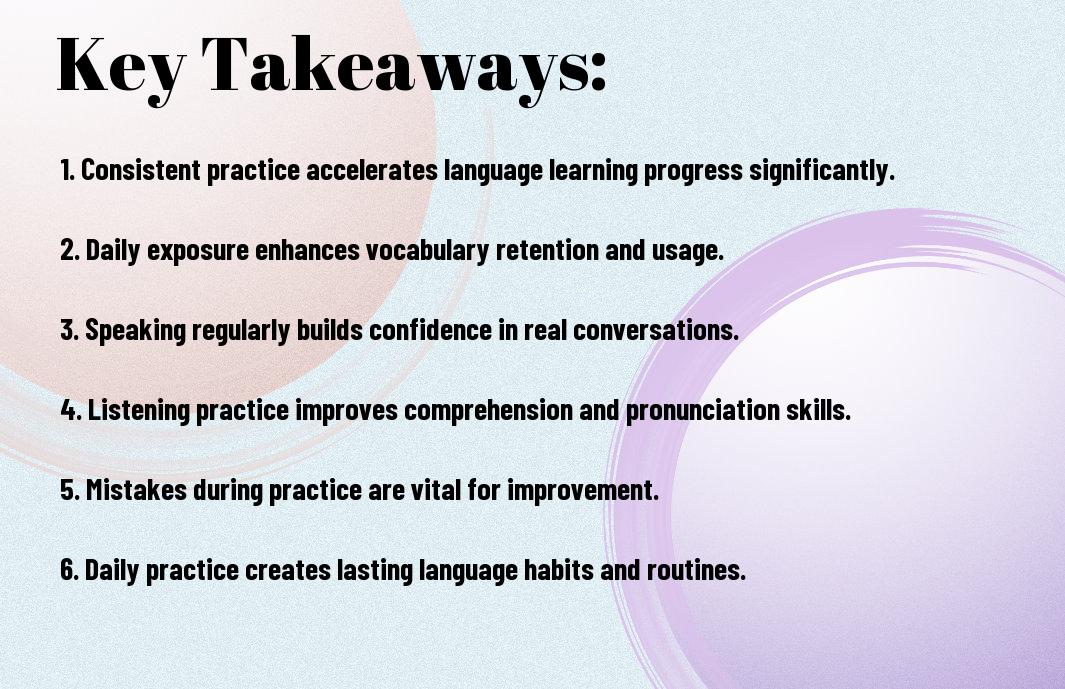
Key Takeaways:

To achieve language fluency, daily practice is vital. Here are the main points to consider:

  • Consistent exposure to the language helps to develop a sense of familiarity and understanding, making it easier to learn and retain new vocabulary and grammar rules.
  • Regular practice of speaking, writing, and listening skills is necessary to improve pronunciation, vocabulary, and comprehension, allowing learners to become more confident in their language abilities.
  • Developing a daily routine that incorporates language learning activities, such as reading, journaling, or conversing with a native speaker, can help to accelerate the learning process and enhance overall fluency.

Setting Goals

For achieving language fluency, setting clear goals is imperative. You need to define what you want to accomplish and by when. This will help you stay focused and motivated on your journey to language mastery.

Defining Language Fluency

Before you begin, consider what language fluency means to you. You must understand that it involves not only speaking, but also listening, reading, and writing skills. Your definition will serve as a foundation for your practice.

Creating a Practice Schedule

Fluently navigating a new language requires consistent practice. You should set aside a specific time each day to practice, whether it’s speaking, writing, or listening. Your schedule will help you make steady progress.

Defining your daily practice schedule is vital to making progress in your language learning journey. You will need to assess your availability and commitment level to determine how much time you can dedicate to practice each day. By doing so, you will be able to create a routine that works for you and helps you stay on track with your language learning goals.

Building Vocabulary

You can improve your language skills by practicing vocabulary daily. Consistent practice helps you learn and retain new words, enabling you to express yourself more effectively.

Learning New Words

Contrary to what you might think, learning new words can be straightforward. You can start by reading books, articles, and other materials in the target language, making notes of unfamiliar words and their meanings.

Using Flashcards and Other Tools

Utilizing digital flashcards and language learning apps can facilitate your vocabulary building process. You can create your own flashcards or use pre-made ones, and access them anytime, making it easy to practice anywhere.

This approach allows you to quiz yourself and track your progress, identifying areas where you need more practice. By incorporating these tools into your daily routine, you can efficiently expand your vocabulary and enhance your overall language fluency.

Improving Grammar

All language learners strive for accuracy and fluency in their grammar skills. Daily practice helps you develop a strong foundation, enabling your language to sound more natural and coherent.

Practicing Sentence Structure

Besides regular exercises, you can improve your sentence structure by analyzing the grammar of native speakers, which will help you understand how to construct sentences in a more organic way, making your language sound authentic.

Overcoming Common Mistakes

Enhancing your awareness of typical errors will allow you to avoid them in your daily practice, thus refining your grammar skills and enabling you to express yourself more effectively in the target language.

Mistakes are an inevitable part of the learning process, and by acknowledging and learning from them, you can identify patterns and areas where you need to focus your practice, leading to noticeable improvements in your grammar and overall language proficiency.

Enhancing Listening and Speaking Skills

Now, as you strive to improve your language skills, daily practice plays a significant role in enhancing your listening and speaking abilities, allowing you to better comprehend and communicate with native speakers.

Listening to Native Speakers

Naturally, listening to native speakers helps you become familiar with the rhythm, intonation, and pronunciation of the language, enabling you to improve your own speaking skills and understand various accents and dialects that you may encounter.

Engaging in Conversations

Conversely, conversations with native speakers or language exchange partners provide you with opportunities to practice your speaking skills, receive feedback, and learn new expressions and vocabulary in context, which helps you to sound more natural and fluent.

Another aspect of engaging in conversations is that it allows you to develop your ability to think on your feet and respond spontaneously, which is important for effective communication in your daily life, and as you continue to practice, you will notice significant improvements in your language fluency and confidence.

Reading and Writing

Not only does daily practice improve your speaking and listening skills, but it also enhances your reading and writing abilities, allowing you to grasp complex texts and express your thoughts more effectively.

Reading Comprehension

Alongside consistent practice, your ability to understand various texts improves significantly, enabling you to decipher meanings and contexts with greater ease, as you become familiar with different writing styles and vocabulary.

Writing Regularly

Writing your thoughts and ideas down daily helps you to develop a clear and concise writing style, allowing you to articulate your opinions and perspectives with precision and clarity, which in turn, enhances your overall language fluency.

Reading through your own writing, you can identify areas that need improvement, making adjustments to syntax, grammar, and vocabulary, thereby refining your writing skills and solidifying your grasp of the language, as you progress in your daily writing practice, you will notice significant improvements in your ability to express yourself effectively.

Staying Motivated

Many language learners face the challenge of maintaining their motivation over time. You will encounter obstacles and setbacks, but your daily practice will help you stay focused on your goals. By prioritizing your language learning, you will be able to overcome these challenges and continue making progress.

Tracking Progress

Around the time you start to feel like you’re not improving, take a step back and assess your progress. You will see that your daily practice has led to significant improvements in your language skills, and this will help motivate you to continue.

Overcoming Plateaus

Around the midpoint of your language learning journey, you may encounter a plateau where you feel like you’re not improving. You will need to adjust your strategy and try new approaches to overcome this hurdle.

The key to overcoming plateaus is to identify the areas where you’re struggling and develop a plan to address them. You can try changing your study materials, seeking out new language exchange partners, or focusing on a specific skill, such as speaking or writing. By taking a proactive approach, you will be able to break through the plateau and continue making progress towards your goal of achieving language fluency.

Summing up

Following this discussion, you can see that daily practice plays a significant role in achieving language fluency. As you continue to practice, your language skills will improve, and you will become more confident in your ability to communicate effectively. By incorporating daily practice into your routine, you will be able to develop a deeper understanding of the language and enhance your overall proficiency, allowing you to express yourself more accurately and effortlessly. This, in turn, will help you to reach your full potential as a language learner.

FAQ

Q: What is the significance of daily practice in achieving language fluency?

A: Daily practice plays a vital role in language fluency as it helps to reinforce previously learned material, build new skills, and develop a consistent learning habit. By setting aside time each day to practice speaking, listening, reading, and writing in the target language, individuals can accelerate their progress, improve their comprehension, and enhance their ability to communicate effectively. Regular practice also allows learners to track their progress, identify areas for improvement, and make adjustments to their study routine as needed.

Q: How can daily practice help to improve pronunciation and intonation in a foreign language?

A: Daily practice is vital for improving pronunciation and intonation in a foreign language. Consistent practice helps to develop muscle memory, allowing learners to produce sounds, intonation patterns, and rhythms more accurately and naturally. By listening to and mimicking native speakers, either through audio or video recordings, language learners can train their ears to recognize and replicate the correct pronunciation and intonation. Additionally, practicing speaking and recording oneself can help identify areas for improvement and track progress over time, leading to more confident and fluent communication.

Q: Can daily practice be tailored to fit individual learning styles and schedules, and what are some effective ways to incorporate practice into a busy daily routine?

A: Daily practice can be adapted to suit various learning styles and schedules, making it accessible to learners with different preferences and time constraints. For example, some individuals may prefer to practice speaking with a language exchange partner or tutor, while others may enjoy listening to podcasts or watching TV shows in the target language. To incorporate practice into a busy routine, learners can try breaking their practice into shorter sessions, using language learning apps or flashcards during commutes, or scheduling practice at the same time each day to make it a habit. By finding a practice routine that works for them, individuals can make steady progress towards achieving language fluency, even with a busy schedule.

The Role of Language Schools in Fluency Development

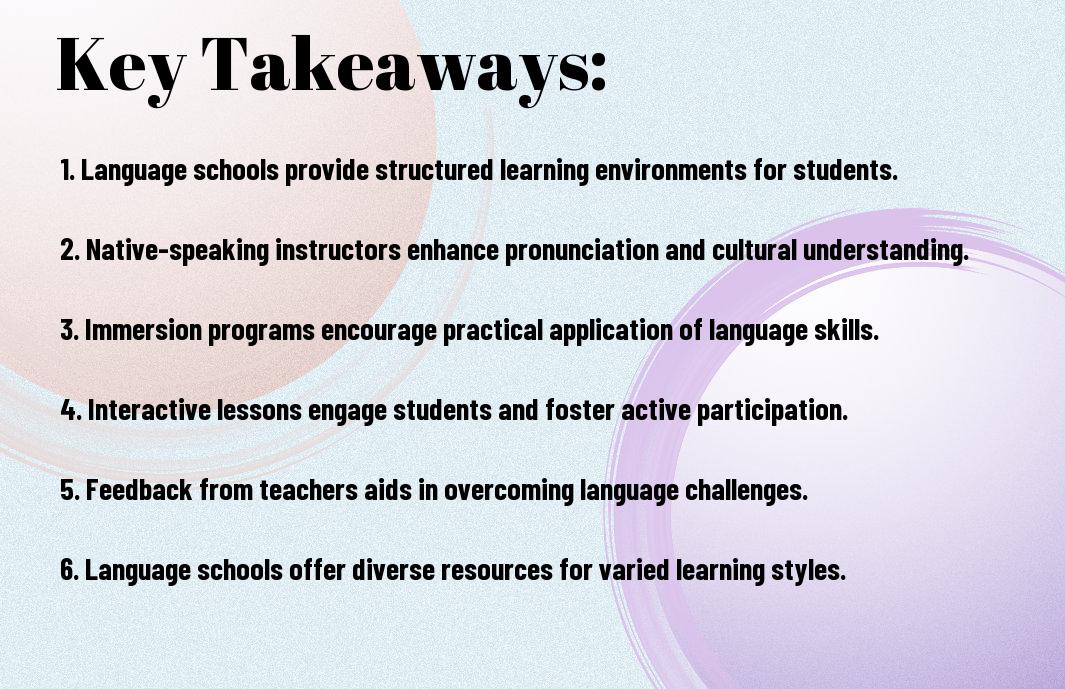
Key Takeaways:
  • The immersion provided by language schools plays a significant role in fluency development, as it allows students to engage with the language in a more authentic way, surrounded by native speakers and real-life situations.
  • Language schools offer a variety of teaching methods and resources that cater to different learning styles, helping students to develop their listening, speaking, reading, and writing skills.
  • The supportive environment of language schools, which often includes feedback from instructors and interaction with peers, helps students build confidence in their language abilities and stay motivated to continue improving their fluency.

Importance of Language Schools

Before enrolling in a language school, you should understand the significance of language development. You can learn more about The importance of Language development in early childhood and its impact on your future. This understanding will help you make informed decisions about your language learning journey.

Role in Language Foundation

To build a strong language foundation, you need a solid understanding of the language’s grammar, vocabulary, and pronunciation. You will learn these fundamentals in a language school, which will help you develop your language skills and improve your communication abilities.

Qualified Instructors and Resources

Around the world, language schools offer qualified instructors and resources to support your language learning. You will have access to experienced teachers, language learning materials, and technology to enhance your learning experience.

Role of qualified instructors and resources is significant in your language development. You will benefit from their expertise and guidance, which will help you overcome language barriers and achieve your fluency goals. As you progress in your language learning journey, you will appreciate the value of qualified instructors and resources in a language school.

Language Immersion Programs

Some language schools offer language immersion programs that allow you to surround yourself with the language you’re learning, helping you to develop your fluency more effectively.

Cultural Exchange Opportunities

Along with language instruction, you’ll have opportunities to engage with native speakers and experience the culture, which will enhance your understanding of the language and its nuances, enabling you to communicate more confidently.

Interactive Learning Methods

The interactive learning methods used in language schools, such as role-plays and group discussions, help you to practice your language skills in a supportive environment, allowing you to build your fluency and improve your pronunciation.

It is through these interactive learning methods that you can develop a deeper understanding of the language, as you’re able to apply what you’ve learned in real-life situations, and your progress will be evident as you become more comfortable expressing yourself in the target language.

Fluency Development Strategies

Once again, you find yourself at the forefront of learning, and language schools play a significant role in this process, helping you enhance your language skills and achieve fluency.

Conversational Practice

For instance, engaging in conversations with native speakers or language exchange partners helps you develop your speaking skills and build confidence in using the language.

Grammar and Vocabulary Building

Strategies such as immersive learning, contextual learning, and spaced repetition can aid in building your grammar and vocabulary, enabling you to express yourself more effectively in the target language.

To further develop your grammar and vocabulary, you can focus on learning idiomatic expressions, phrasal verbs, and collocations, which are vital for sounding natural and fluent in your speech and writing, and language schools can provide you with the necessary guidance and support to achieve this goal, helping you to improve your overall language proficiency and communicate effectively in various social and professional contexts.

Overcoming Language Barriers

After breaking down the initial barriers, you can explore resources like A Comprehensive Guide to Language Fluency for Educators to further your understanding. This will help you navigate the complexities of language learning and develop effective strategies for your students.

Language School Support Systems

An vital aspect of language schools is the support system they provide, which enables you to address your students’ unique needs and foster a conducive learning environment.

Student Motivation and Engagement

The key to successful language acquisition lies in maintaining your students’ motivation and engagement, as this directly impacts their progress and overall fluency development.

With a well-structured approach to student motivation, you can create an environment that encourages active participation, boosts confidence, and helps your students stay focused on their goals, ultimately leading to improved language skills and a higher level of fluency.

Evaluation and Assessment

For effective fluency development, evaluation and assessment play a significant role in language schools. You will be able to track your progress and identify areas for improvement, allowing you to adjust your learning strategy.

Progress Monitoring

To monitor your progress, language schools use various assessment tools, enabling you to see how far you have come and what you need to work on, helping you stay motivated and focused on your goals.

Feedback and Improvement

Around the time of assessments, you can expect to receive constructive feedback from your instructors, which will help you refine your language skills and address any weaknesses, ultimately enhancing your overall fluency.

Further, when you receive feedback, you will be able to pinpoint specific areas that need improvement, and with the help of your instructors, you can develop a plan to tackle these challenges, leading to significant advancements in your language proficiency and fluency development.

Challenges and Future Directions

All language schools face challenges in balancing instruction with real-world application, and you will encounter various obstacles in your language learning journey. You can prepare yourself by understanding the potential hurdles and staying adaptable.

Accessibility and Affordability

Albeit language schools strive to be inclusive, you may find that certain programs are out of your budget or not easily accessible. Alongside these challenges, you will need to consider your own financial situation and location when selecting a language school.

Technological Integration

Accessible digital tools are becoming increasingly prevalent in language instruction, and you will likely encounter various technologies in your language learning process. Accessing these tools will help you stay connected with your instructors and peers, facilitating a more immersive experience.

This technological integration can greatly enhance your learning experience, as you will have the opportunity to engage with interactive materials, practice speaking with native speakers, and track your progress more efficiently. You can leverage these tools to supplement your in-class instruction and accelerate your fluency development, giving you a competitive edge in your language learning journey.

Final Words

Presently, you can see that language schools play a significant role in your fluency development. You will find that enrolling in a language school helps you achieve your goals, as your skills improve with practice and interaction. Your progress is supported by qualified instructors and a structured curriculum, allowing you to become a proficient speaker. By leveraging these resources, you can enhance your language skills and move closer to fluency.

FAQ

Q: What is the primary role of language schools in fluency development?

A: The primary role of language schools in fluency development is to provide students with a structured and supportive environment where they can learn and practice a new language. Language schools offer a range of programs and courses designed to help students improve their listening, speaking, reading, and writing skills, and to achieve fluency in the target language. Through a combination of classroom instruction, interactive activities, and real-life practice, language schools help students build confidence and develop the skills they need to communicate effectively in the target language.

Q: How do language schools help students develop fluency in a new language?

A: Language schools help students develop fluency in a new language by providing them with opportunities to practice speaking, listening, reading, and writing in the target language. Language schools offer a variety of activities and exercises designed to help students improve their pronunciation, vocabulary, and grammar, and to develop their ability to communicate effectively in real-life situations. Additionally, language schools often provide students with access to language exchange programs, conversation partners, and other resources that can help them practice their language skills and develop fluency. Language schools also use technology, such as language learning software and online resources, to support language learning and fluency development.

Q: What are the benefits of attending a language school for fluency development?

A: The benefits of attending a language school for fluency development are numerous. Language schools provide students with a comprehensive language learning experience that includes instruction, practice, and feedback from experienced teachers. Attending a language school can help students improve their language skills quickly and effectively, and can provide them with the confidence and fluency they need to communicate in the target language. Additionally, language schools offer students the opportunity to meet and practice with other language learners, which can be a fun and motivating way to learn a new language. Overall, attending a language school can be an excellent way to develop fluency in a new language and to achieve language learning goals.

Skip to content