Grammar

The Importance of Grammar in Language Mastery

As you strive to become proficient in a language, you will realize that your understanding and use of grammar is vital to effective communication. Your ability to construct sentences, convey meaning, and express yourself accurately depends on your grasp of grammatical rules and principles. You will find that mastering grammar helps you to better comprehend and appreciate the language, enabling you to express your thoughts and ideas with clarity and precision, which is vital for successful communication in both personal and professional settings.

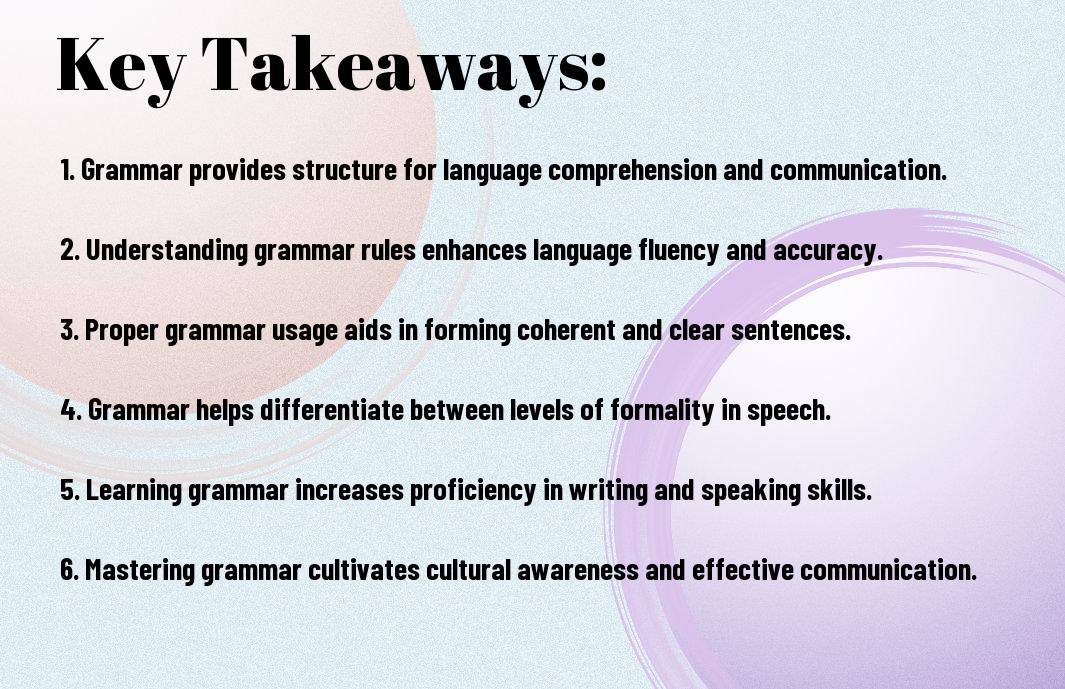
Key Takeaways:

To achieve language mastery, understanding the role of grammar is important. Here are some key points to consider:

  • Effective Communication is greatly influenced by the correct application of grammar rules, as it helps convey meaning and context accurately in written and spoken language.
  • Clear Expression of thoughts and ideas depends on a strong foundation in grammar, allowing individuals to articulate their opinions and engage in meaningful discussions.
  • Language Precision is enhanced by the knowledge of grammatical structures, enabling speakers and writers to distinguish between subtle shades of meaning and convey nuances effectively.
  • Cohesive Writing and speaking are supported by grammar, as it provides the framework for organizing ideas, linking sentences, and creating a logical flow of information.
  • Language Learning is facilitated by a solid understanding of grammatical principles, which serves as a building block for further language development and fluency in communication.

Foundations of Language

Your understanding of language begins with its fundamental elements, and to investigate deeper, you can explore The Importance of Grammar in Language Teaching and Learning research for more insights.

Role of Grammar in Communication

Anyone familiar with language learning knows that grammar plays a significant role in effective communication, enabling you to express your thoughts clearly and correctly.

Importance of Syntax and Semantics

Before exploring advanced linguistic concepts, you must grasp the basics of syntax and semantics, which form the core of language structure and meaning.

At this stage, you are building a strong foundation in language mastery, and understanding syntax and semantics is imperative to convey your intended message accurately, as it helps you comprehend how words are arranged to form meaningful sentences and how meaning is derived from these sentences, allowing you to communicate effectively and efficiently in your target language.
Effective Expression

Some of the most significant benefits of strong grammar skills are seen in your ability to express yourself effectively. When you use grammar correctly, your message is conveyed clearly and concisely, allowing your audience to understand your intended meaning.

Clarity and Precision in Writing

Following proper grammar rules, you ensure that your writing is free of errors, making it easier for your readers to follow your train of thought and grasp your ideas.

Avoiding Ambiguity and Confusion

Across various forms of communication, good grammar helps you avoid misunderstandings and misinterpretations, which can lead to confusion and conflict.

Effective communication is the foundation of building strong relationships, and grammar plays a significant role in achieving this. When you use grammar correctly, you can convey your thoughts and ideas with precision, avoiding ambiguity and confusion, and ensuring that your message is understood as intended, which is crucial for your personal and professional success.

Language Mastery

All language learners strive for language mastery, and grammar is a fundamental component of achieving this goal. You will be able to effectively communicate your thoughts and ideas when you have a strong grasp of grammar. Your language skills will improve significantly as you continue to practice and refine your grammar.

Developing Grammar Skills

Prior to becoming proficient in a language, you need to develop your grammar skills. You can do this by immersing yourself in the language, practicing with native speakers, and studying grammar rules. Your grammar skills will improve as you continue to practice and learn from your mistakes.

Overcoming Common Grammar Mistakes

Generally, grammar mistakes can hinder your ability to communicate effectively. You can overcome these mistakes by being aware of common errors and practicing correct grammar usage. Your language skills will become more sophisticated as you learn to avoid common grammar mistakes.

For instance, when you learn to identify and correct common grammar mistakes, such as subject-verb agreement and tense consistency, you will be able to express yourself more clearly and confidently. You will be able to communicate more effectively in writing and speaking, and your overall language proficiency will improve significantly as you continue to practice and refine your grammar skills.

Language in Context

Keep in mind that grammar is vital to understanding language in its social and cultural context. As you explore the role of grammar, you can learn more about The Importance & Benefits of English Grammar and its significance in effective communication.

Grammar in Different Cultures

Along with variations in language, grammar rules also differ across cultures, and you will encounter unique characteristics as you explore each one, discovering how grammar shapes your understanding of diverse cultural contexts.

Adapting Grammar to Audience and Purpose

Language usage varies depending on your audience and purpose, and you need to consider these factors when communicating to ensure your message is conveyed effectively, taking into account the level of formality and the relationship with your listeners or readers.

A key aspect of mastering grammar is adapting it to your audience and purpose, and as you develop your skills, you will learn to adjust your language to suit different situations, using your knowledge of grammar to convey your message with clarity and precision, making your communication more engaging and effective, and allowing you to connect with your audience on a deeper level, thereby achieving your desired outcome.

Improving Language Skills

Despite the challenges, you can improve your language skills by learning more about grammar, as discussed in The Importance of Grammar in English Language. This will help you to communicate effectively and accurately express your thoughts.

Practice and Reinforcement

Among the various methods to improve your language skills, consistent practice is key to mastering grammar rules and applying them in your daily conversations. You will see significant improvement in your language skills as you practice regularly.

Using Grammar Resources and Tools

For instance, you can utilize online resources and tools to learn and practice grammar rules, which will help you to identify and correct your mistakes, making you a proficient user of the language.

Reinforcement of grammar rules through practice exercises and quizzes will help you to develop a strong foundation in language, enabling you to express your thoughts and ideas with clarity and precision, which is necessary for effective communication, and you will be able to apply this in your daily life, making your language skills more proficient.

Advanced Grammar Techniques

Many language learners strive to improve their grammar skills. You can achieve this by:

  1. Studying verb tenses
  2. Practicing sentence structure
Grammar Concept Description
Conditional sentences Used to express uncertain events

Nuances of Language and Idioms

Beneath the surface of language lies a complex web of nuances. You will discover that mastering idioms and expressions is key to sounding natural in your speech and writing.

Mastering Complex Grammar Concepts

By dedicating time to practice, you will be able to tackle complex grammar concepts with ease. You can start by focusing on one concept at a time, and gradually build your way up to more challenging topics.

Due to the complexity of grammar, you will need to be patient and persistent in your studies. As you examine deeper into the world of grammar, you will find that your understanding of language becomes more sophisticated, and your ability to express yourself improves significantly. You will be able to convey your thoughts and ideas with precision and clarity, and your communication skills will become more effective.

To wrap up

Taking this into account, you now understand the significance of grammar in language mastery. You see, your ability to communicate effectively depends on your grasp of grammar rules. As you continue to learn and practice, your language skills will improve, enabling you to express yourself with confidence and clarity. By prioritizing grammar, you will enhance your overall language proficiency, unlocking new opportunities for personal and professional growth. Your efforts will pay off, and you will become a proficient language user.

FAQ

Q: What role does grammar play in effective communication?

A: Grammar serves as the foundation of language, enabling individuals to express themselves clearly and convey their intended message. It provides the rules and structures that govern how words are used to form meaningful sentences, facilitating comprehension and avoiding misunderstandings. By mastering grammar, individuals can enhance their ability to communicate complex ideas, nuances, and subtleties, ultimately leading to more effective and efficient interaction with others.

Q: How does grammar impact the accuracy and clarity of written and spoken language?

A: Grammar has a significant impact on the accuracy and clarity of both written and spoken language. Proper grammar ensures that the intended meaning is conveyed, and the message is free from ambiguity. Correct use of grammar helps to avoid confusion, misinterpretation, and errors, which can lead to misunderstandings and miscommunications. Moreover, good grammar skills contribute to the overall coherence and logical flow of language, making it easier for the audience to follow and understand the message being conveyed.

Q: Can mastering grammar improve overall language proficiency and open up new opportunities?

A: Mastering grammar can significantly enhance overall language proficiency, as it provides a solid base for language learning and usage. When individuals have a strong grasp of grammar, they are better equipped to understand, interpret, and produce language in various contexts. This, in turn, can open up new opportunities, both personally and professionally. For instance, proficient grammar skills can improve writing and speaking abilities, increase confidence in communication, and even enhance career prospects, as clear and effective communication is highly valued in most industries and social interactions.

Top Strategies for Mastering Language Grammar

You are about to unlock the secrets to perfecting your language skills by focusing on grammar. As you investigate into the world of language learning, you will discover that mastering grammar is vital to effective communication. Your ability to express yourself clearly and accurately depends on your understanding of grammatical rules and concepts. By applying the right strategies, you can improve your language proficiency and enhance your overall learning experience, allowing you to convey your thoughts and ideas with confidence and precision.

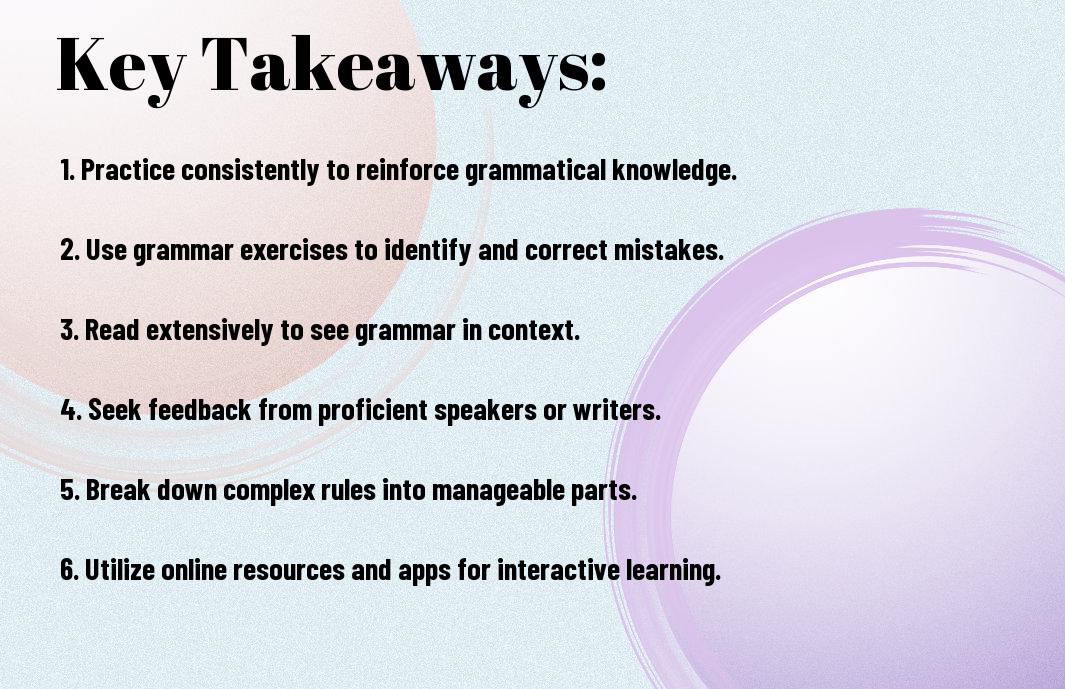
Key Takeaways:

To improve your language skills, consider the following strategies for mastering language grammar:

  • Focus on understanding the rules and exceptions of the language to develop a strong foundation in grammar.
  • Practice consistent exposure to the language through reading, writing, and speaking to reinforce your knowledge of grammar.
  • Use contextual learning methods, such as immersion and real-life examples, to help you apply grammatical concepts in practical situations.
  • Develop a routine of regular practice and review to reinforce your understanding of grammar and identify areas for improvement.
  • Utilize resources such as language learning apps, tutors, and study groups to provide support and feedback on your grammar skills.

Fundamentals of Grammar

The foundation of language learning is built on understanding the basics of grammar, and you can find valuable resources, such as 10 Tips for Mastering English Grammar, to help you get started.

Parts of Speech

Beneath the surface of language lies the parts of speech, which you will need to familiarize yourself with in order to construct meaningful sentences and convey your thoughts effectively.

Sentence Structure

Among the key elements of grammar, sentence structure stands out as a fundamental aspect that you must grasp to communicate clearly and accurately.

Structure is imperative to forming sentences that convey your intended message, and as you explore deeper into the world of grammar, you will discover that understanding sentence structure is vital to enhancing your language skills, allowing you to express yourself with precision and confidence, and enabling you to navigate complex linguistic situations with ease, which is something you will find indispensable in your journey to master language grammar.

Building Blocks of Language

Any language learner knows that understanding the basics is key to mastering a language. You can find useful Tips for Mastering English Grammar for New Learners to improve your language skills.

Verbs and Tenses

Constructing sentences with verbs and tenses helps you express yourself effectively, and as you learn, you will see improvement in your language proficiency.

Nouns and Pronouns

Surrounding your language learning with knowledge of nouns and pronouns will help you to better understand sentence structure and grammar rules.

Plus, as you research deeper into nouns and pronouns, you will discover how they work together to create meaningful expressions, enabling you to communicate your thoughts and ideas with clarity and precision, which will help you to enhance your overall language skills and become a more confident learner.

Mastering Clauses and Phrases

Keep in mind that mastering clauses and phrases is imperative to constructing effective sentences. You will be able to express your thoughts more clearly and accurately, which is key to improving your language skills.

Independent and Dependent Clauses

By understanding the difference between independent and dependent clauses, you can create more complex and nuanced sentences, allowing you to convey your ideas with precision and clarity.

Phrase Structure and Usage

Before submerging into phrase structure, you should familiarize yourself with the various types of phrases, including noun phrases and verb phrases, to improve your sentence construction.

Phrases are groups of words that function as a unit, and you can use them to add depth and variety to your writing and speaking, helping you to convey your intended meaning and engage your audience more effectively.

Effective Sentence Construction

Unlike other aspects of language learning, mastering sentence construction is a skill that takes time and practice to develop. You will need to understand the rules of grammar and syntax to construct sentences that are clear and effective in conveying your message.

Active and Passive Voice

Efficiently using active and passive voice is necessary to create sentences that are engaging and easy to understand. You can use active voice to convey a sense of action and responsibility, while passive voice can be used to emphasize the recipient of the action.

Sentence Variation and Style

Altogether, varying your sentence structure and style is key to keeping your writing or speech interesting. You can use short and long sentences, as well as different grammatical structures, to create a sense of rhythm and flow.

And as you experiment with different sentence variations, you will find that your writing and speech become more engaging and effective in conveying your message. You will be able to convey complex ideas in a clear and concise manner, and your audience will appreciate the effort you put into crafting your sentences.

Common Grammar Mistakes

Now that you’re on your way to mastering language grammar, it’s important to identify the common mistakes that can hinder your progress. You’ll encounter various errors, but being aware of them is the first step to improvement.

Errors in Subject-Verb Agreement

At this stage, you need to ensure that your subjects and verbs agree in number, as inconsistencies can lead to confusing sentences. You should pay close attention to pronoun and verb endings to avoid these errors.

Misuse of Modals and Conditionals

Among the various grammar mistakes, the incorrect use of modals and conditionals is prevalent. You often struggle with using the correct modal verbs, such as “can,” “could,” and “may,” in context, which can alter the sentence’s meaning.

Common mistakes in using modals and conditionals can significantly impact your ability to express yourself effectively. You need to understand the nuances of each modal and conditional, and practice using them in different contexts to improve your grammar skills and convey your intended message accurately. As you practice, you’ll become more comfortable using modals and conditionals correctly, enhancing your overall language proficiency.

Advanced Grammar Techniques

Despite the challenges, you can master advanced grammar techniques by following these steps:

  1. Practice consistently
  2. Focus on nuances
Technique Description
Clause structure Study complex sentence structures

Subjunctive Mood and Conditional Tenses

Betwixt the lines of language, you’ll find subtleties that set your writing apart, such as mastering the subjunctive mood and conditional tenses to convey nuance.

Idiomatic Expressions and Colloquialisms

Any effort you put into learning idiomatic expressions and colloquialisms will enhance your language skills, allowing you to communicate more effectively.

This understanding of idiomatic expressions and colloquialisms will help you to better comprehend native speakers and express yourself more naturally, making your language more engaging and authentic, as you become more familiar with your chosen language’s unique expressions and idioms.

To wrap up

As a reminder, you now have the tools to improve your language grammar skills. You can enhance your understanding by practicing consistently and applying your knowledge in context. By following the top strategies, you will be able to refine your grammar and take your language skills to the next level, making your communication more effective and effortless, and allowing you to express your thoughts with clarity and precision in your writing and speech.

FAQ

Q: What are the most effective ways to improve my language grammar skills?

A: To master language grammar, it is crucial to practice consistently and immerse yourself in the language. Start by reading books, articles, and news in the target language to get a feel for how grammar is used in context. Listening to podcasts, audiobooks, or watching TV shows and movies with subtitles can also help you understand how native speakers use grammar in everyday conversations. Additionally, practice writing and speaking as much as possible, and seek feedback from language exchange partners or tutors to identify and correct your mistakes.

Q: How can I overcome common grammar mistakes and develop a solid understanding of language rules?

A: Overcoming common grammar mistakes requires a combination of knowledge and practice. Begin by studying the grammar rules of the language, focusing on the most common mistakes made by learners. Use online resources, such as grammar guides and exercises, to practice and reinforce your understanding of these rules. It is also helpful to keep a journal or log of your mistakes, tracking the errors you make and reviewing them regularly to avoid repetition. Moreover, engaging in conversations with native speakers or language exchange partners can help you identify areas where you need improvement and provide you with opportunities to practice using grammar correctly in context.

Q: What role does practice and consistency play in mastering language grammar, and how can I stay motivated?

A: Practice and consistency are key to mastering language grammar. Setting aside time each day to practice, even if it’s just for a few minutes, is more effective than practicing for long periods once a week. Create a study routine that includes a mix of reading, writing, listening, and speaking, and stick to it as much as possible. To stay motivated, set achievable goals and track your progress, celebrating your successes along the way. Find a language learning community or partner to share tips and advice, and don’t be afraid to make mistakes – they are an integral part of the learning process. By staying committed and consistent, you will see significant improvement in your grammar skills over time.

How to Learn Grammar Without Getting Overwhelmed

As you initiate on your journey to learn grammar, you may feel overwhelmed by the numerous rules and Exceptions. Your goal is to become proficient, but the task seems daunting. You can start by breaking it down into manageable chunks, focusing on one aspect at a time. For guidance, you can visit tips to Study English Grammar Without Getting Bored and discover ways to make your learning process more enjoyable and effective.

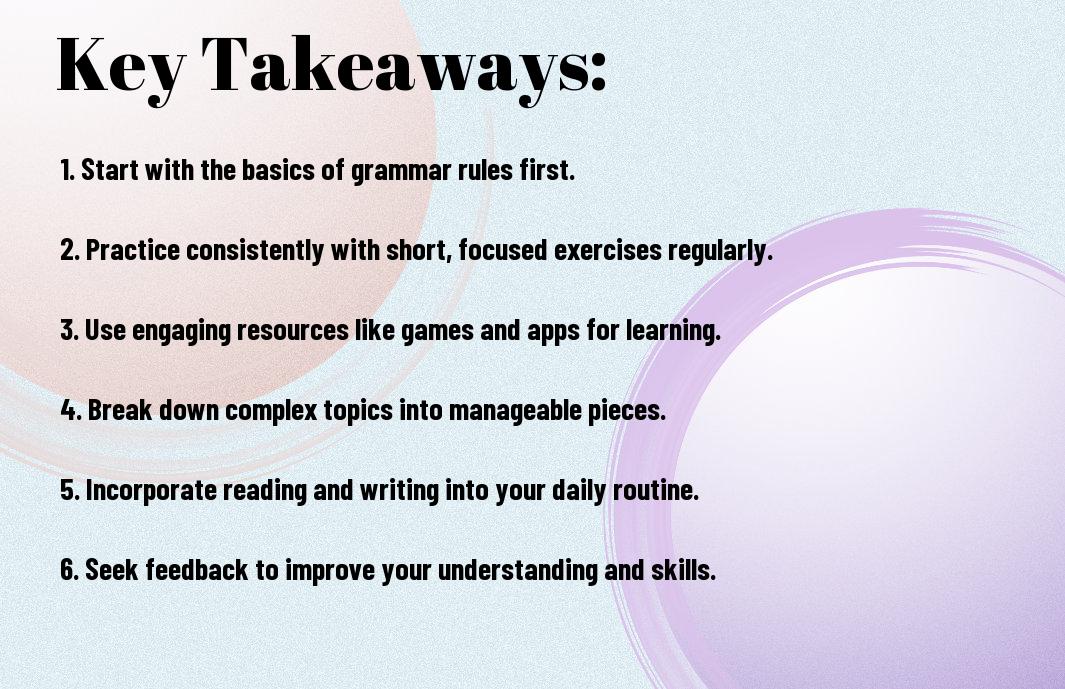
Key Takeaways:

To learn grammar effectively without feeling overwhelmed, consider the following points:

  • Focus on mastering the basics first, such as verb tenses, nouns, and sentence structure, before moving on to more complex grammar rules.
  • Use practical exercises and real-life examples to practice grammar, making it more engaging and easier to understand, rather than just memorizing rules.
  • Break down your learning into manageable chunks, setting achievable goals and tracking your progress, to help you stay motivated and avoid feeling overwhelmed by the amount of grammar to learn.

Setting Goals

Your approach to learning grammar should begin with a clear idea of what you want to achieve, allowing you to focus your efforts and track your progress.

Defining Objectives

Establishing a clear set of objectives helps you understand what you need to learn, enabling you to direct your attention to specific areas of grammar that require improvement.

Creating a Study Plan

To develop an effective study routine, you will need to break down your goals into manageable tasks, allocating time for each activity and setting realistic deadlines for completion.

Defining a study schedule that suits your needs and learning style is vital, as it enables you to make steady progress and maintain motivation, knowing that you are moving closer to your objectives with each passing day, and you can adjust your plan as you learn and grow.

Building Foundations

Some of the most effective methods for learning grammar involve starting with the basics and gradually building your knowledge. You will need to understand the fundamental principles of grammar, including parts of speech, verb tenses, and sentence structure. By establishing a solid foundation, you will be better equipped to tackle more complex concepts.

Learning Basic Rules

Previously, you may have found grammar rules to be confusing, but now you can approach them in a methodical way. You start by learning the basic rules, such as subject-verb agreement and noun declension, and then apply them to simple sentences. As you progress, you will become more comfortable with the rules and be able to use them in context.

Practicing Exercises

Meanwhile, as you learn the rules, you should also practice applying them through exercises. You can find many online resources that offer grammar exercises tailored to your level, from beginner to advanced. Between these resources, you will be able to practice your grammar skills in a variety of contexts.

Indeed, practicing exercises is vital to reinforcing your understanding of grammar rules. You will find that the more you practice, the more comfortable you become with using grammar in context. Your ability to apply the rules to real-life situations will improve, and you will start to develop your own writing style, using grammar to convey meaning and nuance in your writing.

Immersing in Language

Not long after you start learning grammar, you will find that immersing yourself in the language is necessary to your progress. You can do this by surrounding yourself with the language as much as possible, whether through TV shows, music, or conversations with native speakers.

Reading and Listening

One of the most effective ways to immerse yourself is by reading and listening to content in the target language. You can start with simple texts and podcasts, gradually increasing the difficulty level as your skills improve, allowing you to get used to the language’s rhythm and structure.

Speaking and Writing

Speaking directly to native speakers and writing in the target language will help you to practice your grammar skills. You will be able to test your understanding of grammar rules and get feedback on your mistakes, which is vital for your improvement.

Immersing yourself in speaking and writing activities forces you to think in the target language, applying grammar rules naturally. As you engage in conversations and write texts, you will develop your ability to use grammar correctly, and your communication skills will become more spontaneous and fluent, helping you to express your thoughts and ideas more effectively.

Overcoming Challenges

Many learners face difficulties when trying to learn grammar, but with persistence and the right approach, you can overcome these obstacles and achieve your goals. You will encounter challenges, but by acknowledging and addressing them, you can continue to make progress and improve your understanding of grammar.

Identifying Common Mistakes

Behind every mistake lies an opportunity to learn and improve, so take note of your errors and use them as a chance to refine your skills. You will begin to notice patterns in your mistakes, allowing you to focus your efforts on areas where you need the most improvement.

Seeking Help and Resources

Above all, do not be afraid to ask for help when you need it, as seeking guidance is a key part of the learning process. You can find numerous resources available to support your learning, from online tutorials to language exchange partners, to help you navigate difficult concepts and stay motivated.

Common challenges that you may face when seeking help and resources include finding reliable and engaging materials, as well as staying committed to your learning goals. You can address these challenges by exploring different types of resources, such as podcasts, videos, and language learning apps, to find what works best for you and your learning style. By doing so, you will be able to overcome obstacles and continue making progress in your grammar learning journey.

Staying Motivated

Keep your goals in mind and celebrate small victories to maintain enthusiasm for learning grammar. You will encounter challenges, but persistence is key to making progress. Stay focused on your objectives and you will be more likely to stay motivated throughout the learning process.

Finding Study Groups

Among the most effective ways to learn grammar is to join a study group, where you can engage with others who share your interests and goals. You can learn from one another, share tips, and stay accountable, making the learning process more enjoyable and interactive.

Tracking Progress

About the most significant aspect of learning grammar is monitoring your development, which helps you identify areas that need improvement. You can use various tools, such as journals or mobile apps, to track your progress and adjust your approach as needed.

This process of tracking your progress allows you to reflect on your strengths and weaknesses, enabling you to make informed decisions about your learning strategy. By regularly evaluating your progress, you can refine your approach, set realistic targets, and make steady progress towards mastering grammar, which in turn will help you stay motivated and engaged in the learning process.

Advanced Techniques

Once again, you will find that mastering grammar requires dedication and persistence. Consider the following:

  1. Practice consistently
  2. Review regularly
Technique Description
Drills Repetitive exercises

Analyzing Grammar Structures

Among the various methods, you will discover that analyzing grammar structures is vital. You will break down sentences to understand how they work, and this will help you to identify patterns and improve your overall grasp of grammar.

Applying Grammar in Context

Around the time you start applying grammar in context, you will notice significant improvement in your language skills. You will learn to use grammar in real-life situations, making your learning more effective.

It is at this stage that you will start to see the benefits of your hard work, as you begin to apply grammar rules in your writing and conversation, and your communication becomes more accurate and fluent. You will be able to express yourself with confidence, and your language skills will improve dramatically.

To wrap up

As a reminder, you have the power to learn grammar at your own pace. You can break down complex rules into manageable chunks, focus on your weaknesses, and practice consistently. By doing so, you will gradually build your confidence and develop a solid understanding of grammar, making your learning journey less daunting and more enjoyable, allowing you to improve your language skills effectively. Your progress will be steady, and your grasp of grammar will become more secure over time.

FAQ

Q: What is the best way to start learning grammar without feeling overwhelmed by the numerous rules and exceptions?

A: To begin learning grammar without feeling overwhelmed, it’s important to start with the basics. Begin by understanding the parts of speech, such as nouns, verbs, adjectives, and adverbs. Focus on one topic at a time, and make sure you have a solid grasp of each concept before moving on to the next. Utilize online resources, grammar workbooks, or language learning apps that provide interactive and engaging lessons. Breaking down your learning process into manageable chunks will help you stay focused and motivated.

Q: How can I practice grammar effectively without getting bored or overwhelmed by the complexity of the rules?

A: Practicing grammar can be engaging and fun if you incorporate it into your daily activities. Try to read books, articles, or news in the language you’re learning, and pay attention to how grammar is used in context. Watching TV shows or movies with subtitles can also help you see grammar in action. Additionally, speaking with native speakers or language exchange partners can provide you with opportunities to practice your grammar skills in conversations. You can also use language learning apps that offer interactive exercises, quizzes, and games to make grammar practice more enjoyable and challenging.

Q: Are there any resources or tools that can help me learn grammar in a structured and organized manner without feeling overwhelmed by the amount of information?

A: Yes, there are many resources and tools available to help you learn grammar in a structured and organized way. Grammar textbooks, online courses, and language learning platforms often provide a step-by-step approach to learning grammar, with lessons and exercises that build on each other. You can also use flashcards to help you memorize grammar rules and exceptions, and create a schedule to track your progress and stay on track. Furthermore, joining a language learning community or finding a study buddy can provide you with support and motivation, and help you stay engaged and focused on your grammar learning journey.

What role does grammar play in mastering a new language

There’s a pivotal role that grammar plays in your journey to mastering a new language. Understanding the rules and structure of grammar not only helps you construct meaningful sentences but also allows you to effectively communicate thoughts and ideas. By grasping grammar, you cultivate a strong foundation for language proficiency, enabling you to navigate conversations with clarity and precision. Embrace the intricacies of grammar as a tool to unlock the full potential of your linguistic abilities.

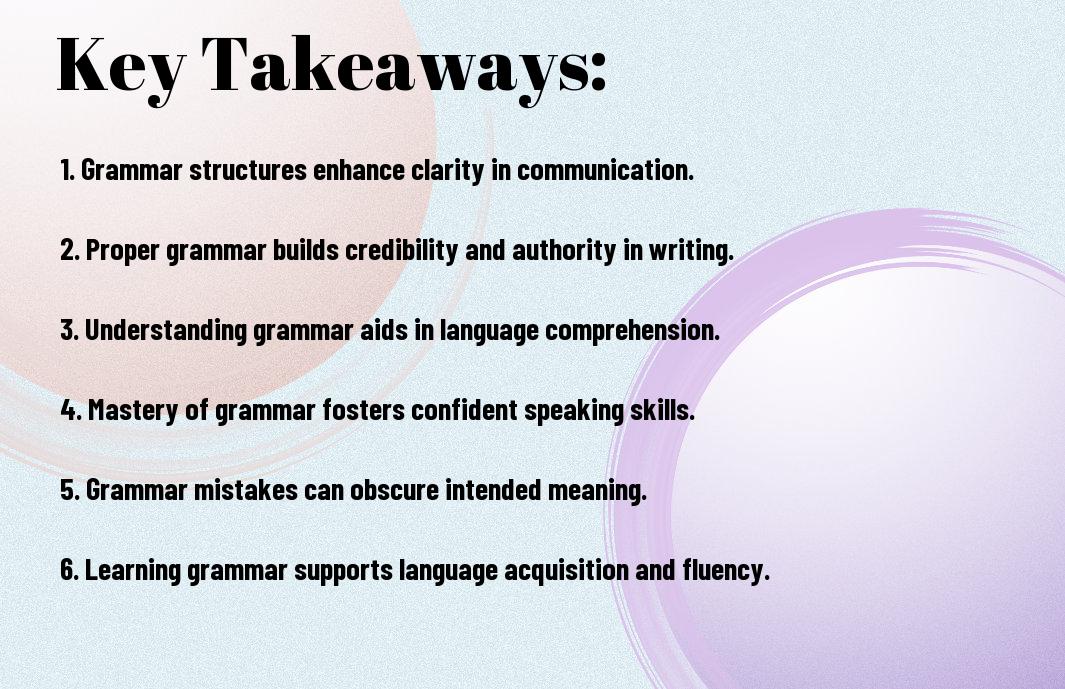
Key Takeaways:

  • Grammar is the backbone: Understanding grammar rules is crucial in mastering a new language as it provides the structure for meaningful communication.
  • Ensures clarity and accuracy: Proper grammar usage helps in conveying thoughts accurately and clearly, minimizing misunderstandings in conversations.
  • Boosts confidence: Proficiency in grammar gives language learners confidence in expressing themselves fluently and effectively in the target language.

The Foundation of Language

Grammar as the Building Blocks

For you to master a new language, you must understand that grammar serves as the foundation of any language. Just like building a house requires a strong foundation, mastering a language requires a solid understanding of grammar. Grammar provides the structure and rules that govern how words are put together to form sentences. By learning grammar, you will be able to construct meaningful and coherent sentences in the new language.

When you grasp the basic grammar rules, such as verb conjugation, sentence structure, and word order, you will be equipped with the building blocks needed to communicate effectively in the new language. While grammar may seem daunting at first, remember that it is imperative for you to progress and become fluent in the language.

The Importance of Syntax and Semantics

For you to truly master a new language, you must also understand the importance of syntax and semantics. Syntax refers to the arrangement of words in a sentence to convey meaning, while semantics focuses on the meaning of words and how they contribute to the overall understanding of a sentence. By grasping syntax and semantics, you will be able to express your thoughts clearly and accurately in the new language.

The way words are organized in a sentence can completely change the meaning of what you are trying to say. By paying attention to syntax and semantics, you will avoid misunderstandings and effectively convey your message to others. Understanding how syntax and semantics work together will make your language learning journey smoother and more successful.

The Role of Grammar in Communication

Clearly, grammar plays a crucial role in communication when mastering a new language. It serves as the foundation for effectively conveying your thoughts and ideas to others. By understanding the rules of grammar, you can structure your sentences in a way that makes sense and is coherent to the listener or reader.

Effective Expression of Ideas

An necessary aspect of grammar in communication is the effective expression of ideas. When you have a strong grasp of grammar, you can articulate your thoughts clearly and succinctly. Knowing how to use different tenses, word order, and sentence structure allows you to express yourself accurately, making it easier for others to understand you.

Avoiding Miscommunication

Miscommunication can easily arise when grammar rules are not followed correctly. Incorrect verb conjugation, misuse of punctuation, or improper word choice can lead to misunderstandings. By mastering grammar, you can minimize the risk of miscommunication and ensure that your message is conveyed accurately.

Miscommunication can hinder effective communication and create confusion between you and the listener. By paying attention to grammar rules, you can avoid potential pitfalls that may lead to misinterpretation of your intended meaning.

Grammar and Vocabulary Acquisition

All language learners have pondered the importance of grammar rules in the process of mastering a new language. Some argue that grammar rules serve as the backbone of a language, facilitating better understanding and communication. On the other hand, there are those who believe in a more natural approach, focusing on vocabulary acquisition and immersion. If you’re still unsure about the role grammar plays in your language learning journey, you can explore different perspectives on How important are grammar rules when learning a new language?

How Grammar Aids in Learning New Words

An vital aspect of grammar in language learning is its role in helping you understand and remember new words. Grammar rules provide a framework within which new vocabulary can be learned and applied correctly. For example, knowing the grammatical rules related to verb conjugation can help you understand how different words are used in various contexts, thus expanding your vocabulary more effectively.

The Interplay between Grammar and Lexicon

The relationship between grammar and vocabulary is symbiotic. While grammar rules offer the structure for language usage, vocabulary enriches the language with meaning. The interplay between grammar and lexicon is crucial for achieving fluency in a new language. By grasping grammar principles, you can better comprehend the nuances of vocabulary usage, and by expanding your lexicon, you enhance your ability to apply grammar rules accurately. This dynamic interaction between grammar and vocabulary is fundamental in your language acquisition journey.

Another important aspect to consider is that grammar provides the rules that govern how words are combined to form meaningful sentences. Without a solid understanding of grammar, it can be challenging to convey your thoughts accurately or comprehend the messages conveyed by others. Therefore, mastering grammar alongside vocabulary acquisition is vital for becoming proficient in a new language.

The Impact of Grammar on Reading and Writing Skills

Despite the challenges that grammar rules may present, mastering them is crucial for enhancing your reading and writing skills in a new language. Understanding grammar plays a significant role in both decoding and encoding text, which are important aspects of language acquisition.

Decoding and Encoding Text

Encoding text involves your ability to express your thoughts and ideas clearly in writing. By applying grammar rules correctly, you can construct sentences that effectively convey your message. Understanding the structure of a language, such as word order and verb conjugation, is vital for producing coherent written text.

Improving Comprehension and Fluency

Grammar also plays a crucial role in improving your comprehension and fluency when reading in a new language. By grasping grammar rules, you can better understand the relationships between words in a sentence and interpret the meaning of the text more accurately. This, in turn, enhances your reading fluency and overall language proficiency.

To enhance your reading and writing skills in a new language, it is important to dedicate time and effort to mastering grammar rules. By consistently practicing and applying these rules in your language learning journey, you will gradually improve your ability to decode and encode text effectively, as well as enhance your comprehension and fluency in the language.

Grammar and Cultural Nuances

Unlike The Importance of Grammar in English Language, where grammar is mainly viewed as a structural component of language, mastering grammar in a new language goes beyond just rules and syntax. It also involves understanding the cultural nuances that are embedded in the language.

Idiomatic Expressions and Colloquialisms

For a language learner, grasping idiomatic expressions and colloquialisms is crucial for effective communication. These expressions are unique to each language and often carry different meanings than their literal translations. By mastering these nuances, you not only blend in better with native speakers but also gain insights into the cultural context and humor of the language.

Cultural References and Allusions

For language mastery, it’s vital to probe into the cultural references and allusions present in the language. Understanding these references not only improves your language skills but also broadens your cultural knowledge. It enables you to connect more deeply with native speakers and facilitates a more nuanced understanding of the language.

Expressions that carry cultural significance may not have direct equivalents in your native language, so learning them expands your cultural literacy and enhances your ability to communicate effectively in a foreign language.

Overcoming Grammar Challenges

Common Pitfalls and Errors

To master a new language, you must be aware of common pitfalls and errors that learners often face when it comes to grammar. One of the most frequent mistakes is trying to translate directly from your native language, leading to awkward phrasing and incorrect word order. Additionally, incorrect verb conjugations and misuse of articles are common issues that can hinder your language learning progress.

Strategies for Improvement

For overcoming these challenges, it is important to immerse yourself in the language as much as possible. Practice regularly with native speakers or language exchange partners to get real-time feedback on your grammar usage. Additionally, utilizing language learning apps and resources that focus on grammar exercises can help you reinforce your understanding and application of grammar rules.

An effective strategy for improving your grammar skills is to break down complex grammar rules into smaller, more manageable parts. Instead of trying to learn everything at once, focus on one grammar concept at a time and practice it until you feel comfortable. This approach can prevent overwhelm and help you gradually build your grammatical proficiency.

Understanding

Understanding the importance of grammar in mastering a new language is crucial. Grammar serves as the foundation of a language, providing you with the structure and rules needed to effectively communicate. By identifying common pitfalls, implementing strategies for improvement, and breaking down complex grammar concepts, you can overcome grammar challenges and enhance your language learning journey.

Summing up

As a reminder, grammar plays a crucial role in mastering a new language. It provides you with the rules and structure necessary to communicate effectively and understand the language in its entirety. By familiarizing yourself with grammar rules, you can enhance your language skills and become more proficient in speaking, writing, and comprehending a new language.

Q: Why is grammar important when mastering a new language?

A: Grammar is crucial in language learning as it provides the structure and rules needed to form correct sentences and communicate effectively.

Q: How can grammar help in improving language skills?

A: Understanding grammar helps learners to construct sentences correctly, convey their thoughts accurately, and enhance their overall language proficiency.

Q: What are the consequences of neglecting grammar in language learning?

A: Neglecting grammar can lead to confusion, miscommunication, and inaccuracies in language usage, hindering the ability to fully grasp and master a new language.

Jhere Skip to content