As you initiate on the journey of acquiring a new language, you begin to unravel the intricacies of your own identity. Your sense of self is woven into the fabric of the words you speak, and the languages you know. Delving into the depths of linguistic expression, you may wonder, how does the language you speak influence your perception of yourself? For insight, you can explore How Much Does the Language We Speak Shape Our Identity, and discover the profound impact it has on your inner world, as your newfound language skilfully reshapes your thoughts, emotions, and ultimately, your very being.
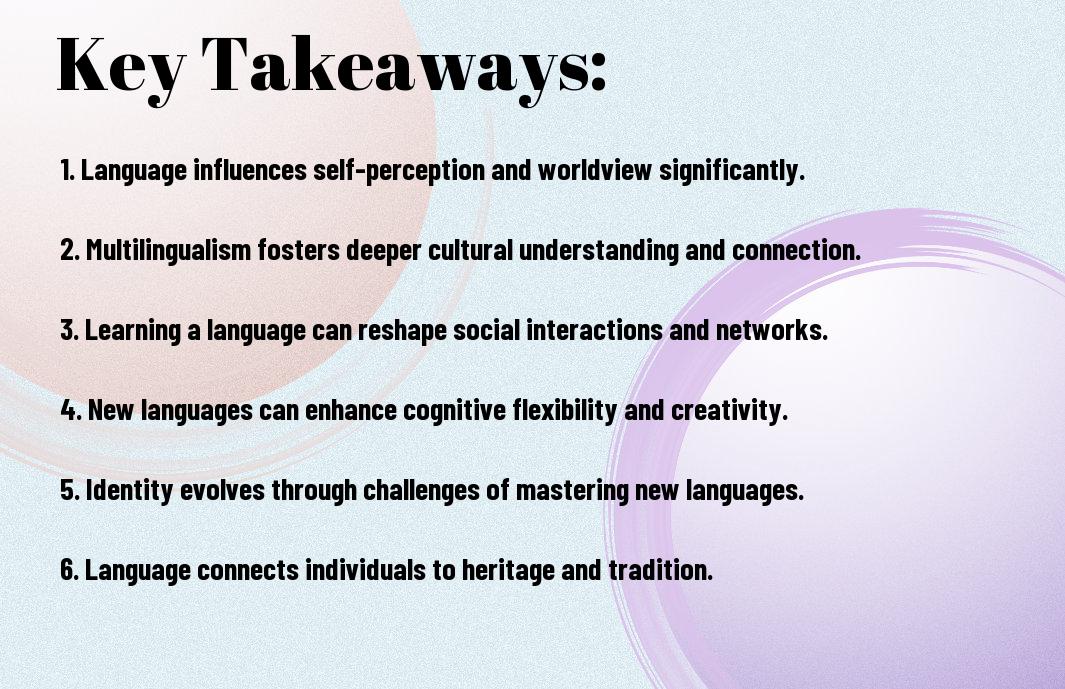
Key Takeaways:
- Learning a new language can significantly influence an individual’s self-perception and identity formation, as it exposes them to new cultural norms and ways of thinking that can shape their worldview and behavior.
- The process of acquiring a new language can lead to a shift in perspective, enabling individuals to see themselves and their place in the world from a different linguistic lens, and potentially altering their sense of belonging to a particular community or culture.
- As individuals become proficient in a new language, they may experience a redefinition of self, as they navigate the complexities of communicating in a new linguistic context and form new social connections that can, in turn, impact their overall identity and personal growth.
The Linguistic Self
To research into language and identity, you must consider how your sense of self is intertwined with the words you speak. Your language shapes your perceptions, influences your thoughts, and molds your understanding of the world.
Language as a Reflection of Identity
Before you acquire a new language, your identity is already embedded in your native tongue, with its nuances and expressions that define your cultural background and personal experiences. Your language is a mirrored reflection of your soul, revealing your values, beliefs, and attitudes towards life.
The Impact of Language on Thought Patterns
At the heart of language lies the power to shape your thought patterns, as the words you use influence the way you think, categorize, and make sense of the world. Your language can expand or limit your cognitive horizons, depending on its grammatical structures, vocabulary, and idiomatic expressions.
Also, as you learn a new language, you begin to notice how your thoughts are reshaped by the linguistic frameworks you acquire, allowing you to perceive your surroundings from novel perspectives, and to develop a more nuanced understanding of yourself and your place in the world, as your linguistic self evolves and adapts to the new linguistic landscape.

Cultural Immersion
Any journey into a new language is a journey into the depths of your own identity, as you navigate the complexities of a foreign culture and find yourself reflected in its nuances. As you examine deeper into the language, you begin to uncover the intricacies of your own self, and the boundaries between your native and adopted cultures start to blur.
Acquiring a New Language as a Rite of Passage
Beneath the surface of language acquisition lies a transformative process, one that reshapes your perspective and redefines your sense of self. As you initiate on this journey, you are forced to confront your own limitations and biases, and to adapt to new ways of thinking and being.
Navigating Cultural Nuances and Norms
Above language lies a complex web of cultural norms and nuances, which you must learn to navigate in order to truly master the language. As you immerse yourself in the culture, you begin to develop a heightened sense of awareness, one that allows you to pick up on subtle cues and nuances that would have otherwise gone unnoticed.
Consequently, as you continue to navigate the complexities of cultural nuances and norms, you find that your sense of identity begins to shift and evolve. You start to see yourself as a multifaceted being, with multiple layers and dimensions, and your understanding of the world and your place within it becomes more nuanced and sophisticated. Your experiences, perceptions, and interactions with others are filtered through the lens of your new language, and you begin to develop a deeper appreciation for the richness and diversity of human culture, and the many ways in which it can shape and transform your sense of self.
Identity Formation
Now, as you launch on the journey of learning a new language, you begin to uncover the intricate dynamics of identity formation, where the boundaries of self and culture blur, and your sense of being evolves.
The Role of Language in Shaping Self-Perception
The more you immerse yourself in a new language, the more you become aware of the subtle ways it influences your thoughts, emotions, and perceptions, gradually reshaping your self-image and your place within the world.
Language and Belonging: Finding One’s Place
Like a thread weaving through the fabric of your existence, language connects you to a community, a culture, and a history, allowing you to find your footing in unfamiliar territory and to claim your space within a new social landscape.
Understanding the profound impact of language on your sense of belonging, you start to see how it facilitates your navigation of complex social dynamics, enabling you to forge meaningful connections with others and to cultivate a deeper appreciation for the cultural nuances that surround you, as you continue to grow and evolve in your newfound linguistic skin.
Language and Memory
For you, the process of language acquisition is intricately tied to the unfolding of your personal narrative, as the words and phrases you learn become an integral part of your identity and inform your perception of the world around you.
The Intersection of Language and Personal History
Across the landscape of your life, language has played a significant role in shaping your experiences, influencing the way you perceive and interpret the world, and informing your sense of self, as the nuances of language weaving a complex tapestry of meaning and significance.
How Language Influences Recall and Nostalgia
By virtue of its capacity to evoke powerful emotions and associations, language has the ability to transport you back to moments from your past, conjuring feelings of nostalgia and wistfulness, as the sounds and rhythms of a language become inextricably linked to your personal history.
Another notable aspect of the relationship between language and memory is the way in which your native language can influence your recollection of events, with certain words and phrases serving as triggers that unlock a floodgate of memories, allowing you to relive moments from your past with vivid clarity, and inviting you to reflect on the ways in which language has shaped your understanding of yourself and your place in the world.
The Bilingual Mind
Unlike the monolingual mind, your bilingual mind is a dynamic, ever-changing entity, shaped by the constant interplay between two languages, influencing your thoughts, emotions, and perceptions in profound ways.
Cognitive Benefits of Language Acquisition
Cognitively, you will develop enhanced executive control, as your brain navigates the complexities of multiple languages, allowing you to switch between them with greater ease and flexibility, ultimately improving your problem-solving skills and mental agility.
The Complexities of Multilingual Identity
Linguistically, your multilingual identity is a rich tapestry, woven from the threads of different languages, cultures, and experiences, shaping your sense of self and informing your interactions with the world around you, as you navigate the nuances of multiple linguistic and cultural contexts.
In addition, as you probe deeper into the complexities of your multilingual identity, you will begin to uncover the subtle ways in which language influences your thoughts, feelings, and behaviors, and how your multiple languages intersect and interact, creating a unique and ever-evolving sense of self, one that is both deeply personal and profoundly shaped by the languages you speak.
Societal Implications
Your new language becomes a part of your social fabric, influencing how you interact with others and perceive yourself within the community.
Language as a Social Construct
To understand the role of language in shaping identity, you must consider its social context, where language is constructed and negotiated among individuals and groups, reflecting and influencing societal norms and values.
The Politics of Language and Identity
After acquiring a new language, you begin to see how language and identity are intertwined, with language policies and practices often reinforcing social hierarchies and power dynamics, affecting how you position yourself within the social landscape.
Identity, in this sense, becomes a complex interplay of language, culture, and power, as you navigate the nuances of your new language and its associated cultural norms, values, and beliefs, which in turn shapes your sense of self and your place within the larger societal framework, inviting you to ponder the intricate relationships between language, identity, and the social world you inhabit.
Summing up
Summing up, as you research into a new language, you begin to unravel the intricacies of your own identity. Your sense of self evolves, like a tapestry woven with new threads of thought and expression. You find that your perceptions, values, and beliefs are reshaped, as the language seeps into your being, transforming your very understanding of the world and your place within it.
FAQ
Q: How does learning a new language influence one’s sense of identity?
A: Learning a new language has a profound impact on one’s sense of identity. As individuals acquire a new language, they are not only gaining a new means of communication but also adopting a new cultural perspective. This newfound understanding and connection to a different culture can broaden one’s worldview, allowing them to see things from multiple angles and fostering a more nuanced sense of self. Furthermore, being able to communicate in a new language can grant access to previously inaccessible communities and networks, potentially leading to new friendships, relationships, and a sense of belonging to these groups, which in turn can shape and expand one’s identity.
Q: Can learning a new language change one’s perception of their native culture and identity?
A: Yes, learning a new language can significantly alter one’s perception of their native culture and identity. Through the process of learning, individuals are often prompted to compare and contrast the new language and culture with their own, leading to a deeper understanding and appreciation of their native culture. This comparative analysis can highlight aspects of one’s native culture that were previously taken for granted, fostering a new sense of pride and connection to one’s heritage. Moreover, the experience of being an outsider in a new linguistic and cultural context can provide a unique perspective on one’s own identity, encouraging self-reflection and potentially leading to a reevaluation of one’s values, beliefs, and cultural practices.
Q: How does bilingualism or multilingualism affect one’s overall identity and sense of belonging in different cultural contexts?
A: Bilingualism or multilingualism can have a profound effect on one’s overall identity, particularly in terms of sense of belonging. Individuals who speak multiple languages often find themselves navigating between different cultural identities, depending on the context in which they are communicating. This navigational ability can lead to a flexible and adaptive sense of identity, as bilingual or multilingual individuals learn to switch between languages and cultural norms. This flexibility can be both empowering, as it allows for a deeper connection to multiple cultures, and challenging, as it may lead to feelings of not fully belonging to any one culture. Nonetheless, the ability to communicate across linguistic and cultural boundaries can enrich one’s identity, offering a unique position of cultural mediation and understanding, and often leading to a rich and multifaceted sense of self and belonging.