Language

How Language Learning Improves Cognitive Skills

As you launch on learning a new language, you’ll notice improvements in your cognitive skills. Your brain will become more adept at processing information, enhancing your problem-solving abilities and memory. You’ll develop a stronger ability to focus and concentrate, allowing you to tackle complex tasks with ease. By challenging your brain with a new language, you’ll experience significant cognitive benefits that extend beyond language proficiency, influencing your overall mental agility and sharpness.

Key Takeaways:

  • Learning a new language can significantly enhance cognitive flexibility, allowing individuals to switch between different mental tasks more efficiently and adapt to new situations.
  • Memory improvement is another significant benefit of language learning, as it requires the ability to absorb and retain new vocabulary, grammar rules, and sentence structures.
  • Language learning can also boost problem-solving skills by promoting analytical thinking and the ability to approach problems from different angles.
  • The process of learning a new language can delay the onset of cognitive decline and even prevent age-related memory loss by building cognitive reserve.
  • Additionally, language learning can improve multitasking abilities by enabling individuals to process and integrate multiple sources of information simultaneously, leading to better overall cognitive performance.

Enhancing Memory

The process of learning a new language has a significant impact on your cognitive skills, particularly when it comes to memory. As you learn new vocabulary, grammar rules, and sentence structures, your brain creates new connections and strengthens existing ones, leading to improved memory retention.

Improving Vocabulary Retention

Along with the benefits of enhanced memory, you will also experience improved vocabulary retention. As you learn and practice new words, you will find that you are better able to recall and use them in context, helping to expand your language skills.

Developing Better Learning Strategies

Adeptly, you will develop better learning strategies as you navigate the challenges of language learning. You will learn to approach problems from different angles, analyze complex information, and adapt to new situations, all of which will serve you well in your language learning journey.

At this point, you will start to notice that your ability to learn and absorb new information is improving, and you will be able to apply these skills to other areas of your life. As you continue to develop better learning strategies, you will become a more effective and efficient learner, able to tackle complex tasks with confidence and accuracy.
Boosting Problem-Solving Skills

If you learn a new language, you’ll improve your problem-solving abilities. As you navigate unfamiliar grammar and vocabulary, you’ll develop your analytical mind. For more information on how language learning affects brain development, visit How learning a new language helps brain development to discover the benefits for yourself.

Analyzing Language Patterns

Similar skill sets are required to analyze language patterns, as you identify and apply grammatical rules to communicate effectively. Your brain becomes adept at recognizing patterns, making connections between words and ideas, and applying this knowledge to solve problems.

Enhancing Critical Thinking

Skillful thinkers are developed through language learning, as you evaluate information, consider different perspectives, and make informed decisions. You become a more discerning and nuanced thinker, able to approach problems from multiple angles.

Hence, as you develop your critical thinking skills through language learning, you’ll become more adept at tackling complex problems and finding innovative solutions. You’ll be able to break down complex information, identify key issues, and develop well-reasoned arguments, making you a more effective problem-solver in all areas of your life.

Improving Concentration

Many language learners experience improved concentration as they progress in their studies. You will find that focusing on language learning requires attention to detail, which can enhance your overall ability to concentrate.

Focusing on Language Structure

Enhancing your understanding of language structure helps you develop your cognitive skills, including concentration. You will learn to identify patterns and relationships between words, which can improve your ability to focus.

Reducing Distractions

Around the time you start language learning, you may notice that you become more aware of your surroundings and better at filtering out distractions. You will be able to concentrate more effectively, even in noisy environments.

Also, as you continue to learn a new language, you will develop strategies to minimize distractions and stay focused on your goals. You will learn to prioritize tasks, manage your time, and create a conducive learning environment, all of which will help you improve your concentration and achieve your language learning objectives.

Developing Multitasking Abilities

Not only does language learning improve your focus, but it also enhances your ability to switch between tasks efficiently. As you become more proficient in a new language, you’ll find that your brain becomes better at handling multiple tasks simultaneously, making you a more effective multitasker.

Balancing Language and Non-Language Tasks

With newfound language skills, you’ll be able to balance language-related tasks, such as reading and writing, with non-language tasks, like problem-solving and decision-making, more effectively, allowing you to tackle complex projects with ease.

Enhancing Overall Productivity

Productively, you’ll find that language learning helps you prioritize tasks and manage your time more efficiently, leading to increased productivity in all areas of your life, including work, study, and personal projects.

Plus, as your multitasking abilities improve, you’ll be able to take on more responsibilities and achieve your goals faster, which will have a positive impact on your overall well-being and confidence, enabling you to tackle even more challenging tasks and continue growing as a person.

Enhancing Creativity

To improve your cognitive skills, learning a new language can have a significant impact on your creative abilities, allowing you to think outside the box and explore new ideas.

Exploring Linguistic Expression

Along with acquiring new vocabulary, you will discover various linguistic expressions that can broaden your perspective, enabling you to convey your thoughts and ideas more effectively.

Fostering Innovative Thinking

Enhancing your language skills can also stimulate your mind, encouraging you to approach problems from unique angles and develop innovative solutions, which can benefit your personal and professional life.

Due to the complex nature of language learning, you will develop your ability to think creatively, making connections between seemingly unrelated concepts and ideas, and applying this skill to various aspects of your life, leading to increased innovative thinking and problem-solving capabilities.

Supporting Academic Achievement

For students, learning a new language can have a significant impact on academic performance, as you can discover more about the Cognitive Benefits of Learning a Second Language. This skill can enhance your overall learning experience.

Improving Test Scores

Before you take any exam, your language skills can help you better understand the questions and answer them more accurately, leading to improved test scores and a stronger academic record.

Enhancing Research Skills

Below the surface of language learning lies a wealth of research opportunities, as you learn to analyze and evaluate information in multiple languages, expanding your knowledge and understanding of various subjects.

Achievement in language learning can also enhance your research skills by allowing you to access a broader range of academic resources, including books, articles, and primary sources in the target language, thereby deepening your understanding of the subject matter and enabling you to produce more informed and nuanced work.

Summing up

From above, you can see that learning a new language enhances your cognitive abilities, improving your memory, problem-solving skills, and concentration. As you acquire a new language, your brain develops neuroplasticity, allowing you to adapt to new situations and process information more efficiently. This, in turn, boosts your overall cognitive function, enabling you to tackle complex tasks with greater ease and precision, ultimately benefiting your personal and professional life. You will find that your mental agility and focus improve significantly.

FAQ

Q: How does language learning impact cognitive abilities in adults?

A: Language learning has been shown to have a profound impact on cognitive abilities in adults, improving memory, attention, and problem-solving skills. As adults learn a new language, they exercise their brain, building cognitive reserve and developing a stronger ability to focus and multitask. This, in turn, can lead to improved performance in various aspects of life, including work and personal relationships. Furthermore, language learning has been linked to a delayed onset of age-related cognitive decline, making it an excellent activity for adults looking to stay mentally agile.

Q: Can language learning improve cognitive skills in children, and if so, how?

A: Yes, language learning can significantly improve cognitive skills in children. When children learn a new language, they develop their brains’ ability to process and analyze complex information, leading to enhanced cognitive flexibility and adaptability. Language learning also fosters improved metalinguistic awareness, enabling children to better understand the structure and nuances of language, which can transfer to improved performance in other subjects, such as reading and writing. Additionally, bilingual or multilingual children often exhibit advanced social and emotional intelligence, as they learn to navigate different cultural contexts and communicate effectively with diverse groups of people.

Q: What specific cognitive skills are improved through language learning, and how can these skills be applied in everyday life?

A: Language learning improves a range of cognitive skills, including executive functions, such as planning, decision-making, and error correction. It also enhances linguistic skills, like phonological awareness, syntax, and semantics, which are important for effective communication. These skills can be applied in everyday life in various ways, such as improved public speaking, enhanced writing abilities, and more effective communication in personal and professional settings. Moreover, the cognitive skills developed through language learning can transfer to other areas, such as improved mathematical problem-solving, increased creativity, and better time management, making language learners more well-rounded and competent individuals.

How to Practice Speaking a New Language Daily

You are about to initiate on a journey to improve your language skills, and your daily practice will be the key to success. Your ability to speak a new language confidently hinges on consistent effort. As you start this process, you will find that your pronunciation, vocabulary, and grammar will gradually improve. You will learn how to make speaking a new language a part of your daily routine, helping you to stay motivated and achieve your goals.

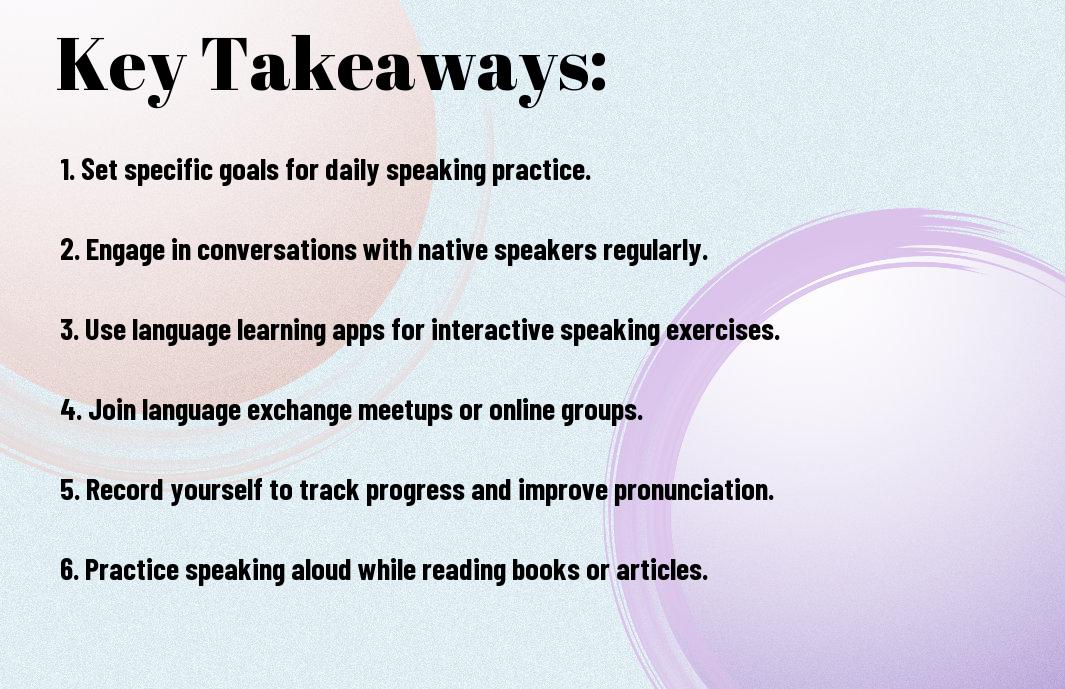
Key Takeaways:

To improve your speaking skills in a new language, follow these daily practice tips:

  • Set aside a dedicated time each day to practice speaking, even if it’s just for a few minutes, to build consistency and make it a habit.
  • Use language learning apps or online resources to access a variety of speaking exercises, such as audio recordings, videos, and interactive conversations, to improve your pronunciation and intonation.
  • Practice speaking with a language exchange partner or tutor to get feedback on your speaking skills and to learn from a native speaker, which can help you improve your fluency and confidence.
  • Listen to native speakers and try to mimic their speech patterns, including their tone, pitch, and rhythm, to improve your accent and comprehension.
  • Record yourself speaking and listen to the recordings to identify areas that need improvement, such as grammar, vocabulary, and pronunciation, and to track your progress over time.

Setting Goals

A key aspect of improving your language skills is to establish a clear plan, which begins with setting achievable goals. You need to determine what you want to accomplish and how you intend to get there. This will help you stay focused and motivated throughout your language learning journey.

Defining Language Learning Objectives

To tailor your approach, you should define your language learning objectives, considering what aspects of the language you want to improve, such as speaking, writing, or listening. You will then be able to design a strategy that meets your specific needs.

Creating a Daily Practice Schedule

Beside mapping out your long-term goals, you must create a daily practice schedule to ensure consistent progress. You should allocate a specific time each day to practice speaking, even if it’s just for a few minutes.

Goals for your daily practice schedule should be specific, measurable, and attainable. You will find that dedicating a few minutes each day to speaking practice, whether through speaking with a language exchange partner, using a language learning app, or watching TV shows in the target language, will significantly enhance your speaking skills over time. As you follow your schedule, you will become more confident in your ability to express yourself in the new language.

Immersion Techniques

If you want to improve your speaking skills, surrounding yourself with the language is imperative. You can do this by incorporating immersion techniques into your daily routine, such as listening to native speakers and watching foreign language media.

Listening to Native Speakers

Natively spoken language can be found in various forms of media, and you can use it to your advantage by listening to podcasts, radio shows, or audiobooks in your target language.

Watching Foreign Language Media

Between TV shows and movies, there are plenty of options to choose from, and you can start with subtitles in your native language to help you understand the dialogue, then gradually switch to subtitles in the target language.

Watching foreign language media can be an entertaining way to improve your listening and comprehension skills, and you can even pause and replay scenes to catch any phrases or words you didn’t understand, allowing you to learn at your own pace and repeat phrases to practice your pronunciation.

Speaking Exercises

For effective language practice, you should engage in speaking exercises daily. This can be done by speaking with native speakers, recording yourself, or using online resources. Your goal is to improve your pronunciation, intonation, and fluency in the target language.

Finding a Language Partner

Almost anyone can find a language partner through local language exchange events or online communities. You can practice speaking with your partner for a set amount of time each day, discussing various topics and correcting each other’s mistakes. Your language partner can provide you with valuable feedback on your pronunciation and grammar.

Using Online Language Learning Platforms

Almost anything you need to learn a language can be found on online platforms. You can use these platforms to access language lessons, practice speaking with native speakers, and track your progress. Your online language learning experience can be tailored to your needs and goals.

Plus, many online language learning platforms offer interactive speaking exercises, such as voice recordings and conversations with chatbots or real people. You can use these resources to practice your speaking skills at any time, from anywhere, and receive instant feedback on your performance. This will help you to identify areas for improvement and work on developing your speaking skills more effectively.

Vocabulary Building

Unlike other aspects of language learning, vocabulary building requires consistent practice to see significant improvement. You will need to make a conscious effort to learn new words daily and use them in context to reinforce your understanding.

Learning New Words Daily

To take your language skills to the next level, you should strive to learn a set number of new words each day, using them in sentences to help solidify their meaning and usage in your mind.

Using Flashcards and Language Learning Apps

For effective vocabulary building, you can utilize flashcards and language learning apps, which provide an efficient way to learn and revise new words, phrases, and their meanings, allowing you to track your progress and identify areas for improvement.

Learning a new language with the help of flashcards and apps can be an engaging experience, as you can access a vast library of words, phrases, and expressions, and practice them at your own pace, helping you develop a robust vocabulary and enhance your communication skills in the target language, enabling you to express yourself more confidently and accurately, and you will find that your vocabulary expands rapidly as you continue to practice and learn new words daily.

Pronunciation Practice

Keep practicing your pronunciation by listening to native speakers and mimicking their intonation and rhythm. You can find numerous resources online, including audio clips and videos, to help you improve your pronunciation skills.

Recording Yourself

One effective way to track your progress is by recording yourself speaking the new language. You can use your smartphone or computer to record your voice and identify areas that need improvement, allowing you to adjust your pronunciation accordingly.

Receiving Feedback from Others

Feedback from others is vital to enhancing your pronunciation. You can join language exchange programs or practice with a language partner who can provide you with constructive feedback on your pronunciation.

In fact, receiving feedback from others can help you pinpoint specific sounds or intonations that you struggle with, enabling you to focus your practice on those areas and make significant improvements in your pronunciation over time, as you continue to work on your language skills, you will find that your ability to communicate effectively in the new language will greatly improve.

Overcoming Challenges

After encountering obstacles, you will find that learning a language requires perseverance. You can find helpful tips on learning a new language efficiently to aid in your progress.

Dealing with Self-Doubt and Fear

Against the feeling of uncertainty, you must push forward and focus on your goals, allowing yourself to make mistakes and learn from them.

Staying Motivated and Consistent

Across the journey of language learning, you will face various challenges, but maintaining a consistent practice routine will help you stay on track.

Due to the complexity of language learning, it is necessary to break down your goals into smaller, achievable tasks, and celebrate your progress along the way, which will help you stay motivated and committed to your daily practice, ultimately leading to significant improvement in your speaking skills over time, as you continue to challenge yourself and push beyond your comfort zone, adapting to new situations and conversations with increased confidence and fluency.

Final Words

Now that you have learned various methods to practice speaking a new language daily, you can start implementing them in your routine. You will see improvement in your speaking skills if you consistently practice using your target language in daily conversations, whether with native speakers or language exchange partners. Your dedication and persistence will ultimately lead to confidence in speaking your new language.

FAQ

Q: What are some effective ways to practice speaking a new language daily?

A: Practicing speaking a new language daily can be achieved through various methods. One way is to engage in conversations with native speakers, either in person or online, for at least 15-20 minutes. Another method is to use language learning apps that offer speaking exercises and interactive lessons. Additionally, watching TV shows or movies in the target language with subtitles, speaking with yourself in the mirror, or recording yourself and listening to the recordings can also help improve your speaking skills.

Q: How can I overcome my fear of speaking a new language and improve my pronunciation?

A: To overcome the fear of speaking a new language, start by practicing in low-stakes situations, such as speaking with a language exchange partner or recording yourself. Focus on listening to native speakers and try to mimic their pronunciation, intonation, and rhythm. You can also listen to podcasts, radio shows, or audiobooks in the target language to get accustomed to its sound and structure. Furthermore, try to speak as much as possible, even if it’s just for a few minutes a day, and don’t be afraid to make mistakes – it’s a natural part of the learning process.

Q: What are some tips for creating a daily routine to practice speaking a new language consistently?

A: To create a daily routine, set a specific time and goal for speaking practice, such as 30 minutes in the morning or 15 minutes during your lunch break. Use a planner, calendar, or app to schedule your practice sessions and track your progress. You can also find a language learning buddy or accountability partner to motivate you and provide feedback. Consistency is key, so try to practice at the same time every day, even if it’s just for a short period. Additionally, mix up your practice activities, such as switching between speaking, listening, and reading, to keep your routine engaging and prevent boredom.

The Most Common Mistakes in Language Learning

As you launch on your language learning journey, you’ll inevitably encounter obstacles that hinder your progress. Your efforts to communicate effectively can be thwarted by simple, yet persistent mistakes. To avoid falling into these traps, it’s worth exploring the pitfalls that many learners face. For instance, you can find insights into 10 Common Mistakes ESL Students Make, which can serve as a cautionary guide to help you navigate the complexities of language acquisition and improve your skills more efficiently.

Key Takeaways:

The process of learning a language can be complex and nuanced, with various pitfalls that can hinder progress. Here are some key points to consider:

  • Insufficient Practice is a major obstacle for many language learners, as consistent application and reinforcement are necessary for long-term retention and fluency.
  • Grammar rules and exceptions can be overwhelming, but understanding the underlying structure of the language is vital for effective communication and expression.
  • Focusing too much on Vocabulary acquisition without contextual understanding can lead to a lack of comprehension and application in real-world scenarios.
  • Neglecting to develop Listening and Speaking skills can result in a significant imbalance in language abilities, making it difficult to engage in conversations and understand native speakers.
  • Setting unrealistic Goals and expectations can lead to frustration and burnout, as language learning is a gradual process that requires patience, dedication, and persistence.

Preparation Mistakes

The path to language learning is often paved with good intentions, but poor planning can lead to frustration and stagnation. As you begin on this journey, it’s crucial to be aware of the pitfalls that can hinder your progress.

Lack of Clear Goals

Across the spectrum of language learners, a common mistake is failing to define what you want to achieve, making it difficult to focus your efforts and measure success.

Insufficient Resource Allocation

The scarcity of quality resources, such as textbooks, tutors, or language exchange partners, can severely impede your progress, leaving you struggling to find adequate support.

To effectively allocate your resources, you should prioritize your needs, considering factors like budget, time commitment, and learning style, to ensure you’re getting the most out of your language learning experience, and avoiding the frustration that comes with inadequate support, allowing you to make steady progress towards your goals.

Learning Process Errors

One of the most significant hurdles you’ll face in language learning is falling into common pitfalls. To avoid this, it’s advisable to familiarize yourself with the Top 5 Language Learning Mistakes that can hinder your progress.

Ineffective Immersion Techniques

Among the various strategies you might employ, ineffective immersion techniques can be particularly detrimental. You may find yourself struggling to make progress if your approach to immersion is flawed.

Poor Practice Habits

Techniques such as inconsistent practice and poor time management can severely impede your language learning journey. You must be diligent in your approach to practice.

In addition, your practice habits can make or break your language learning experience. You should strive to create a schedule that allows for consistent and engaging practice, incorporating a variety of activities to keep your learning fresh and exciting, and preventing the stagnation that can occur with dull, repetitive exercises, which will help you to stay motivated and make steady progress in your language learning endeavors.

Grammar and Vocabulary Mistakes

To master a language, you must pay attention to grammar and vocabulary. Your understanding of these elements will make or break your proficiency.

Common Grammar Errors

Around the time you start learning, you will notice that grammar mistakes are abundant. You will struggle with verb tenses, subject-verb agreement, and sentence structure, but practice will help you improve.

Vocabulary Building Pitfalls

Following your initial progress, you will encounter pitfalls in vocabulary building. You might find it challenging to learn new words and phrases, and your progress may slow down.

The vocabulary building process can be daunting, but you can overcome the challenges by developing a study routine and immersing yourself in the language. You should focus on learning words in context, rather than just memorizing lists of words, and engage in conversations with native speakers to improve your understanding and usage of vocabulary.

Pronunciation and Fluency Issues

Despite your best efforts, you may still struggle with pronunciation and fluency issues in your target language. This can hinder your ability to communicate effectively and undermine your confidence in speaking.

Accent and Intonation Problems

Prior to mastering the nuances of language, you will likely encounter accent and intonation problems that can significantly impact your overall pronunciation.

Fluency Practice Mistakes

Before you achieve fluency, you will need to avoid common mistakes such as speaking too slowly or hesitantly, which can impede your progress and make you feel self-conscious about your language skills.

A key aspect of overcoming fluency practice mistakes is to engage in regular, spontaneous conversations with native speakers or fellow learners, allowing you to develop your ability to think and express yourself quickly and naturally in your target language, and you will find that your fluency and confidence will improve over time with consistent practice and dedication.

Motivation and Consistency

For language learners, motivation and consistency are imperative to achieving fluency. You must find ways to maintain your enthusiasm and dedication, as these factors greatly impact your progress.

Maintaining Motivation

About the time you start learning a language, you are likely to feel a surge of excitement and motivation. You should harness this energy to set realistic goals and celebrate your achievements, no matter how small.

Consistency in Practice

Similar to motivation, drive is what propels you to practice regularly. You need to establish a routine that works for you, allowing your brain to absorb and process new information effectively.

Understanding that consistency is key to language learning, you should prioritize making practice a habitual part of your daily routine. As you progress, you will find that consistent practice helps solidify new language skills, making them feel more natural and intuitive, and this, in turn, will help you stay motivated to continue learning.

Technology and Resource Utilization

Now, as you explore into the world of language learning, you’ll encounter numerous resources, including a LinkedIn article on The Most Common Mistakes Language Learners Make and How to Avoid Them. This highlights the importance of utilizing technology effectively.

Underutilization of Language Learning Apps

Underestimating the potential of language learning apps can hinder your progress, as you may miss out on valuable practice exercises and interactive lessons that can enhance your skills.

Misuse of Online Resources

Behind the vast array of online resources lies a potential pitfall: relying too heavily on a single method, such as watching videos without engaging in speaking or writing activities, can lead to an imbalance in your language skills.

Also, as you navigate the multitude of online resources, be cautious not to waste time on defeating or old-fashioned methods that may not cater to your learning style, and instead, focus on finding a balanced approach that suits your needs and complements your learning journey.

Conclusion

Upon reflecting on your language learning journey, you will likely identify patterns of mistakes that hindered your progress. You may have prioritized grammar over vocabulary or neglected to practice speaking and listening. Your approach, though well-intentioned, may have been misdirected, leading to frustration and stagnation. By acknowledging these common pitfalls, you can adjust your strategy and forge a more effective path to language mastery, one that leverages your strengths and addresses your weaknesses with clarity and purpose.

FAQ

Q: What is the most common mistake language learners make when starting to learn a new language?

A: One of the most common mistakes language learners make is setting unrealistic goals and expecting to become fluent in a short amount of time. This can lead to frustration and disappointment when they do not see progress as quickly as they had hoped. Setting achievable goals and celebrating small milestones along the way can help to stay motivated and focused throughout the learning process.

Q: How can language learners avoid the mistake of not practicing consistently?

A: To avoid the mistake of not practicing consistently, language learners can create a schedule and stick to it, setting aside a specific time each day or week to practice speaking, writing, and listening in the target language. Additionally, using language learning apps, joining a language exchange program, or finding a language learning partner can provide accountability and help to stay on track. Consistency is key to developing language skills and making progress over time.

Q: What is the mistake of not immersing oneself in the language, and how can language learners avoid it?

A: The mistake of not immersing oneself in the language refers to not surrounding oneself with the target language as much as possible, which can limit opportunities for practice and exposure. To avoid this mistake, language learners can try watching TV shows or movies in the target language, listening to music or podcasts, reading books or articles, and speaking with native speakers as much as possible. Immersion helps to get used to the sounds, rhythms, and grammar of the language, making it easier to learn and retain new vocabulary and phrases.

The Role of Culture in Learning a Language

As you begin on learning a new language, you will discover that your journey is not just about mastering grammar and vocabulary, but also about understanding the culture behind it. You will find that cultural nuances play a significant role in shaping your language skills, and learning about them can enhance your overall learning experience. To learn more about How Culture Impacts Language Learning, you can explore resources that highlight the importance of cultural awareness in language acquisition, helping you to become a more effective and engaged learner.

Key Takeaways:

  • The language learning process is deeply influenced by the cultural context in which it takes place, as social interactions and environmental factors play a significant role in shaping the learning experience.
  • Cultural awareness and understanding are important for effective communication in a foreign language, as they enable learners to navigate social norms and customs associated with the target language.
  • The integration of cultural elements into language instruction can enhance learner motivation and engagement, as it provides a more authentic and meaningful learning experience.
  • Language learners who are exposed to diverse cultural practices and traditions tend to develop a more nuanced understanding of the target language and its linguistic variations.
  • Effective language teaching should incorporate cultural components that foster intercultural competence, enabling learners to navigate complex cultural situations and interact with native speakers in a confident and respectful manner.

Language Acquisition

The process of language acquisition is closely tied to culture, as you can learn more about Language: The Essence of Culture and how it shapes your understanding of the world.

The Impact of Cultural Background

Sociolinguistic Factors

  • Language norms and values
  • Cultural identity and belonging

    , After analyzing these factors, you can better navigate language acquisition in different cultural contexts.

  • Power dynamics and social status
  • Communication styles and pragmatics

    , After exploring these aspects, you will be better equipped to adapt to new linguistic and cultural environments.

    Cultural Influences

    Some cultural factors significantly impact your language learning experience, influencing the way you perceive and understand the language, and ultimately, the way you communicate with native speakers.

    Nonverbal Communication

    Culturally-based differences in nonverbal cues can affect your interactions, as you may unintentionally convey a different message than intended, highlighting the importance of understanding cultural context in communication.

    Idiomatic Expressions

    On a deeper level, idiomatic expressions can be particularly challenging, as their meanings often rely on cultural references and nuances that you may not be familiar with, requiring you to develop a deeper understanding of the culture behind the language.

    To master idiomatic expressions, you need to be aware of the cultural context in which they are used, and be able to apply this knowledge to your everyday conversations, allowing you to communicate more effectively and naturally with native speakers, and enhancing your overall language skills.

    Learning Strategies

    For effective language learning, you need to adopt strategies that work best for your learning style. Your approach to learning a language can greatly impact your progress and success.

    Immersion Techniques

    Beyond the classroom, you can use immersion techniques to surround yourself with the language you’re learning, such as watching TV shows or listening to music in the target language, which can help you pick up phrases and nuances more naturally.

    Cultural Adaptation

    Likewise, learning about cultural differences and adapting to them is important for successful language learning, as you will be able to understand the context and nuances of the language, and communicate more effectively with native speakers.

    In addition, as you probe deeper into cultural adaptation, you will find that your understanding of the language improves significantly, and you will be able to navigate different social situations with ease, making your language learning journey more enjoyable and rewarding, allowing you to connect with your target culture on a deeper level.

    Teaching Methods

    Keep in mind that effective teaching methods play a significant role in language learning. You can choose from various approaches, such as immersive, task-based, or communicative language teaching, to create an engaging learning environment.

    Cultural Sensitivity in the Classroom

    Above all, you should consider the cultural backgrounds of your students to create a comfortable and inclusive learning space. You will be able to foster a positive atmosphere by being aware of cultural differences and adapt your teaching methods accordingly.

    Incorporating Cultural Elements

    At the heart of language learning is the incorporation of cultural elements that enable you to connect with the language on a deeper level. You can use authentic materials, such as videos, images, and texts, to introduce cultural aspects and make learning more engaging.

    Incorporating cultural elements into your language learning process allows you to gain a more comprehensive understanding of the language and its usage in different contexts. You can explore various cultural practices, traditions, and customs associated with the language, which will enable you to communicate more effectively and avoid unintended offense or misunderstandings.

    Challenges and Opportunities

    Your ability to learn a language is influenced by cultural factors, which can either hinder or help your progress, presenting you with challenges and opportunities for growth.

    Overcoming Cultural Barriers

    Against the backdrop of cultural differences, you will encounter obstacles that test your language skills, but with persistence and the right approach, you can overcome these barriers and improve your understanding of the language.

    Leveraging Cultural Diversity

    Between the lines of cultural nuances, you will discover a wealth of knowledge that can enhance your language learning experience, allowing you to tap into the diversity of cultures and broaden your perspective.

    Cultural diversity offers a unique chance for you to engage with different customs, traditions, and ways of life, enabling you to develop a deeper understanding of the language and its context, which in turn will help you to become a more effective and fluent communicator.

    Effective Communication

    After acquiring basic language skills, you will begin to understand the importance of cultural nuances in effective communication, enabling you to convey your message accurately and avoid misunderstandings.

    Developing Cultural Awareness

    By immersing yourself in the culture, you become more sensitive to the values and customs of the community, allowing you to interact more effectively with native speakers and navigate complex social situations.

    Improving Language Skills

    Across various language learning contexts, you will discover that cultural knowledge enhances your ability to understand and use language appropriately, facilitating more natural and fluent communication.

    The improvement in your language skills will become evident as you apply cultural insights to your interactions, enabling you to better comprehend subtle cues, idiomatic expressions, and context-dependent language, ultimately leading to more effective and engaging communication with native speakers, and a deeper understanding of the language as a whole, which will aid you in your journey to mastering the language.

    To wrap up

    The role of culture in learning a language is a significant aspect you should consider as you commence on your language learning journey. You will find that understanding the cultural context enhances your learning experience. For more insights, visit The delicious role of culture in language learning to discover how your cultural awareness can boost your language skills and broaden your perspective, making you a more effective communicator in your new language.

    FAQ

    Q: What is the significance of culture in language learning, and how does it impact the learning process?

    A: The culture of a language plays a vital role in language learning as it provides context and depth to the learning experience. Understanding the cultural nuances, customs, and values associated with a language helps learners to better comprehend the language’s idiomatic expressions, colloquialisms, and non-verbal communication. This, in turn, enables them to communicate more effectively and avoid unintended offense or misunderstandings. By integrating cultural knowledge into language instruction, learners can develop a more holistic understanding of the language and its native speakers.

    Q: How can language learners effectively incorporate cultural learning into their study routine, and what resources are available to support this process?

    A: Language learners can incorporate cultural learning into their study routine by exploring authentic materials such as movies, TV shows, music, and literature from the target culture. They can also engage with native speakers, either in person or through online platforms, to gain insights into cultural practices and traditions. Additionally, learners can utilize online resources, such as cultural blogs, podcasts, and language learning apps, that provide cultural lessons and explanations. Many language courses and textbooks also include cultural components, and learners can supplement their studies with these resources to deepen their cultural understanding.

    Q: Can cultural differences hinder the language learning process, and if so, how can learners overcome these challenges to achieve their language goals?

    A: Cultural differences can indeed pose challenges for language learners, as they may encounter unfamiliar customs, norms, and expectations that can lead to confusion or miscommunication. To overcome these challenges, learners can develop an awareness of potential cultural differences and approach them with an open mind and a willingness to learn. They can also seek guidance from language instructors, tutors, or mentors who are familiar with the target culture and can provide valuable insights and advice. Furthermore, learners can focus on building their cultural competence by developing skills such as empathy, flexibility, and critical thinking, which can help them navigate cultural differences and achieve their language learning objectives.

  • How to Overcome Fear of Speaking a New Language

    As you initiate on learning a new language, you may encounter a common obstacle: fear of speaking. You worry about making mistakes, being judged, or not being understood. However, with practice and dedication, you can overcome this fear. To start, The simplest way to get over your fear of speaking a foreign language is to focus on building your confidence. You can begin by speaking with native speakers, practicing regularly, and taking small steps outside your comfort zone, which will help you make progress and become a more confident language speaker.

    Key Takeaways:

    To overcome the fear of speaking a new language, consider the following points:

    • Practice consistently to build confidence in your language skills, focusing on pronunciation and vocabulary to improve your overall communication abilities.
    • Immerse yourself in the language by listening to music, watching movies, and engaging in conversations with native speakers to become more familiar with the language.
    • Focus on your progress, not perfection, and don’t be too hard on yourself when making mistakes, as they are an necessary part of the learning process.
    • Find a language exchange partner or join a language learning community to get support and motivation from others who are going through the same experience.
    • Set achievable goals and reward yourself for reaching them, which will help you stay motivated and encouraged to continue improving your language skills.

    Embracing the Challenge

    A major step in overcoming your fear of speaking a new language is to view it as an opportunity for growth and development, rather than an insurmountable obstacle, and you will start to feel more confident in your abilities.

    Recognizing the Source of Fear

    Around the time you begin to learn a new language, you may start to feel anxious about speaking, and understanding the root of your fear is necessary to overcoming it, as you can then address it directly and work to build your confidence.

    Setting Language Learning Goals

    The key to making progress and staying motivated is to set achievable goals for your language learning, and you should start by identifying what you want to accomplish, whether it’s holding basic conversations or reading complex texts, and create a plan to get there.

    Consequently, as you work towards your goals, you will begin to notice significant improvements in your language skills, and your fear of speaking will start to dissipate, replaced by a growing sense of confidence and ability, allowing you to engage more effectively with native speakers and immerse yourself in the language, which will further accelerate your progress and help you to reach your full potential as a language learner.

    Building Confidence

    Now that you’ve decided to overcome your fear of speaking a new language, it’s time to focus on building your confidence. You can achieve this by setting achievable goals and celebrating your progress along the way. Your confidence will grow as you become more comfortable with the language.

    Starting Small with Basic Phrases

    Before venturing into complex conversations, you start with basic phrases and vocabulary. You begin with simple greetings and introductions, and gradually move on to more complex phrases. Your goal is to build a strong foundation in the language, and you do this by mastering the basics.

    Practicing with Native Speakers

    Starting with small conversations with native speakers, you can improve your pronunciation and get used to the rhythm of the language. You find native speakers through language exchange programs or online platforms, and you practice speaking with them regularly.

    Phrases that you’ve learned become more natural as you practice with native speakers. You learn to express yourself in different situations, and you receive feedback on your pronunciation and grammar. As you continue to practice, you become more confident in your ability to communicate in the new language, and your fear of speaking starts to fade away.

    Overcoming Self-Doubt

    Unlike many other challenges, overcoming self-doubt when speaking a new language requires a gentle and supportive approach. You need to acknowledge your fears and doubts, and then work on building your confidence.

    Reframing Negative Thoughts

    Self-doubting tendencies can hold you back, but by reframing negative thoughts, you can start to build confidence in your language skills. You can replace negative self-talk with positive affirmations, focusing on your strengths and accomplishments.

    Focusing on Progress, Not Perfection

    Self-consciousness about making mistakes can be overwhelming, but by focusing on progress, not perfection, you can start to see improvements in your language skills. You will begin to notice your growth and development, which will help you stay motivated and engaged.

    Considering your goals and motivations, you can create a plan to track your progress, celebrating small victories along the way. You can use a language learning journal or app to monitor your development, and adjust your approach as needed. By focusing on progress, not perfection, you will be able to overcome self-doubt and become a more confident language speaker, able to express yourself effectively and engage with others in your new language.

    Developing a Growth Mindset

    To overcome your fear of speaking a new language, you need to develop a growth mindset. This means believing that your language skills can be improved with practice and dedication. You will be more confident in your ability to learn and improve, and you will be more likely to take risks and try new things.

    Embracing Mistakes as Learning Opportunities

    For instance, when you make a mistake, you can learn from it and use it as an opportunity to improve your language skills. You will become more comfortable with the idea of making mistakes and will be more willing to speak and practice your new language.

    Celebrating Small Victories

    Gaining confidence in your language skills is a process, and you should celebrate your small victories along the way. You can start by acknowledging and celebrating your achievements, no matter how small they may seem. This will help you stay motivated and encouraged to continue practicing and improving your language skills.

    In fact, celebrating small victories is an necessary part of the learning process, as it helps you to see progress and stay positive. You can celebrate your small victories by treating yourself to something special, sharing your achievements with a friend or family member, or simply taking a moment to reflect on how far you have come. By acknowledging and celebrating your progress, you will be more likely to stay motivated and encouraged to continue practicing and improving your language skills, which will help you to overcome your fear of speaking a new language.

    Creating a Supportive Environment

    Despite the initial anxiety you may feel, creating a supportive environment is vital to overcoming your fear of speaking a new language. You can start by surrounding yourself with language-learning materials, such as books, podcasts, and videos, to immerse yourself in the language.

    Finding a Language Learning Community

    Against all odds, finding a community of fellow language learners can be a game-changer. You can join online forums, social media groups, or language exchange websites to connect with others who share your goals and interests.

    Using Language Learning Apps and Resources

    Before you begin your language learning journey, consider the numerous apps and resources available to support you. You can explore language learning platforms, such as Duolingo, Babbel, or Rosetta Stone, to find the one that suits your learning style.

    Language learning apps and resources can help you track your progress, practice speaking and listening skills, and access a wealth of educational content. You can use these tools to supplement your language learning, stay motivated, and build confidence in your ability to speak a new language. By leveraging these resources, you can create a personalized learning plan that fits your needs and helps you achieve your goals.

    Staying Motivated

    After establishing a routine, you’ll need to maintain your enthusiasm for speaking a new language. This is where motivation plays a significant role in your progress, helping you to stay on track and achieve your goals.

    Setting Achievable Milestones

    Normally, you will find that breaking down your goals into smaller, manageable tasks helps you stay focused and motivated, allowing you to celebrate your successes along the way.

    Rewarding Progress and Persistence

    Similarly, you will find that acknowledging and rewarding your efforts, no matter how small, will help to reinforce positive learning habits and motivate you to continue improving your language skills.

    Indeed, as you progress and see the results of your efforts, you will begin to feel a sense of accomplishment and pride in your ability to communicate in a new language, which will, in turn, motivate you to continue pushing beyond your comfort zone and striving for further improvement, helping you to overcome your fear of speaking a new language.

    Conclusion

    On the whole, you have the power to overcome your fear of speaking a new language. By practicing consistently, focusing on your strengths, and being kind to yourself, you can build confidence in your language skills. As you progress, your comfort level will increase, and you will become a more fluent speaker, able to express yourself effectively in your new language, and unlock your full potential.

    FAQ

    Q: What is the first step to overcome the fear of speaking a new language?

    A: The first step to overcome the fear of speaking a new language is to set achievable goals for yourself. Start by identifying your motivation for learning the language, whether it’s for travel, work, or personal enrichment. Break down your goal into smaller, manageable tasks, such as having a 10-minute conversation with a native speaker or speaking in front of a small group. As you accomplish these tasks, you’ll build confidence and become more comfortable speaking the language.

    Q: How can I practice speaking a new language without feeling embarrassed or intimidated?

    A: Practicing speaking a new language can be daunting, but there are several ways to do so without feeling embarrassed or intimidated. Consider finding a language exchange partner, either in person or online, who is fluent in the language you’re trying to learn. You can also practice speaking with a tutor or language instructor who can provide feedback and guidance. Additionally, try speaking in low-stakes situations, such as ordering food at a restaurant or asking for directions, to build your confidence and get used to the sounds and rhythm of the language.

    Q: What are some strategies to help manage anxiety and self-doubt when speaking a new language?

    A: Managing anxiety and self-doubt is a common challenge when speaking a new language. One strategy is to focus on communication rather than perfection. Instead of worrying about making mistakes, try to concentrate on conveying your message and understanding the other person. Another strategy is to use positive self-talk and encourage yourself to take risks. You can also try relaxation techniques, such as deep breathing or visualization, to help calm your nerves before speaking. Finally, try to learn from your mistakes and view them as opportunities for growth and improvement, rather than as failures.

    Jhere Skip to content