languages

Top Languages to Learn for Career Advancement

As you consider expanding your skill set to boost your career, learning a new language can be a valuable investment. You may be wondering which languages will give you the most return on your investment. Your career goals and industry play a significant role in determining the best language for you to learn. You can enhance your job prospects and increase your earning potential by acquiring the right language skills, so it’s necessary to choose wisely.

Key Takeaways:

To advance in your career, it’s important to have a strong foundation in programming languages that are in high demand. Here are the top languages to learn:

  • Learning Python can open doors to various career opportunities, including data science, machine learning, and web development, due to its simplicity and versatility.
  • Java is a popular choice for Android app development, web development, and enterprise software development, making it a valuable skill to have in the industry.
  • JavaScript is a must-know language for front-end web development, and its popularity extends to back-end development, mobile app development, and game development, with frameworks like React and Node.js.
  • SQL is a fundamental language for data analysis and management, and proficiency in it can lead to career advancement in data science, business intelligence, and database administration.
  • Knowledge of Cloud Computing platforms like AWS or Azure, and languages like Go or Rust, can give you a competitive edge in the job market, especially in the fields of cloud engineering, DevOps, and cybersecurity.

    Benefits of Learning a New Language

    While learning a new language can be a challenging task, it offers numerous benefits that can enhance your career prospects and personal growth. You will gain a competitive edge in the job market and open yourself up to new cultural experiences.

    Career Opportunities

    Among the many advantages of language learning, you will find that it significantly expands your career opportunities, allowing you to work with international companies, travel, and connect with people from diverse backgrounds, thereby broadening your professional network and possibilities.

    Increased Earning Potential

    On top of the personal satisfaction you derive from learning a new language, you can also expect an increase in your earning potential, as your skillset becomes more valuable to potential employers, giving you a significant advantage in terms of career advancement and higher salary expectations.

    Potential career advancements and increased financial rewards are directly tied to your ability to communicate effectively in a globalized economy. As you acquire language skills, you become a more attractive candidate to multinational corporations and organizations, which often offer higher salaries and better benefits to employees who can bridge cultural and linguistic gaps, ultimately leading to a more successful and fulfilling career for you.
    Top Languages for Career Advancement

    Even if you’re already established in your career, learning a new language can open up new opportunities for you. You can expect increased job prospects and higher earning potential as a result of your new skill.

    English as a Global Language

    To take your career to the next level, you should consider learning English, as it is widely recognized as the language of international business and communication, allowing you to connect with clients and colleagues from around the world.

    Mandarin for Business and Trade

    With the rise of China as a global economic power, learning Mandarin can give you a significant advantage in your career, particularly in fields such as trade, finance, and international business, as you will be able to communicate effectively with Chinese clients and business partners.

    Advancement in your career is likely to follow as you become proficient in Mandarin, allowing you to tap into the vast Chinese market and take advantage of new business opportunities, you will be able to negotiate, network, and build relationships with Chinese colleagues and clients, giving you a competitive edge in your industry.

    Language Skills in Demand

    After identifying your career goals, you need to consider the language skills that are in high demand. Knowing the right languages can give you a competitive edge in the job market and open up new opportunities for advancement.

    Programming Languages for Tech Careers

    Skills in programming languages like Java, Python, and JavaScript are highly valued in the tech industry, and you can gain a significant advantage by learning them. You can leverage these skills to enhance your career prospects and stay ahead in the field.

    Spanish for International Business

    Behind the growing importance of Spanish language skills is the increasing economic influence of Spanish-speaking countries. You can benefit from learning Spanish to expand your career opportunities in international business and connect with a vast market.

    In fact, as you explore the benefits of learning Spanish, you will discover that it can significantly enhance your career prospects in fields like trade, commerce, and diplomacy, allowing you to communicate effectively with clients, colleagues, and partners from Spanish-speaking countries, and giving you a competitive edge in the global job market.

    Industries that Value Language Skills

    To succeed in today’s globalized economy, you can benefit from learning a foreign language, as discussed on What foreign languages are most beneficial to one’s career in America. This can open doors to new career opportunities.

    International Finance and Banking

    By mastering a foreign language, you can gain a competitive edge in international finance and banking, where communication with global clients is key.

    Tourism and Hospitality

    To cater to diverse clients, you can leverage language skills in tourism and hospitality, enhancing your career prospects in these sectors.

    In addition, as you work with tourists and travelers from around the world, your ability to communicate in multiple languages will enable you to provide better services, resolve issues efficiently, and create a positive experience for your clients, ultimately boosting your career advancement in the tourism and hospitality industry.

    How to Get Started

    All you need to do is set your goals and start exploring language learning options. Visit The 8 Most Useful Languages for Your Career to learn more about the most in-demand languages.

    Language Learning Resources

    Behind every successful language learner is a wealth of resources. You will find numerous online courses, language learning apps, and tutoring services to help you get started.

    Immersion Programs

    The most effective way to learn a language is by immersing yourself in it. You can travel to a foreign country, attend language exchange events, or participate in cultural activities to improve your language skills.

    Resources like language exchange websites, online forums, and social media groups can help you find immersion programs tailored to your needs and goals, allowing you to practice your language skills with native speakers and gain a deeper understanding of the culture, which will enhance your career prospects.

    Overcoming Language Learning Challenges

    Your language learning journey will inevitably encounter obstacles, but with the right mindset and strategies, you can overcome them and achieve your goals.

    Setting Realistic Goals

    Language acquisition requires a well-planned approach, and you should set achievable targets to stay motivated and track your progress.

    Practicing Consistency

    Adept learners understand the importance of regular practice, and you should allocate time each day to reinforce your language skills.

    Plus, as you make language learning a habit, you will find that your comprehension and communication skills improve significantly, allowing you to tackle more complex topics and engage in conversations with native speakers, which will help you to stay motivated and committed to your language learning journey, and you will be able to apply your new skills in your career advancement.

    Summing up

    Summing up, you can accelerate your career advancement by learning the most in-demand languages. You will enhance your job prospects and gain a competitive edge in the global market. To learn more about the top languages, visit 5 Most Useful Languages for Getting Hired and discover your path to success, tailoring your language skills to your career goals and opening doors to new opportunities for your professional growth.

    FAQ

    Q: What are the top programming languages to learn for career advancement in the field of data science and machine learning?

    A: For career advancement in data science and machine learning, the top languages to learn include Python, R, and SQL. Python is widely used in machine learning and deep learning, while R is preferred for statistical analysis. SQL is vital for managing and analyzing large datasets. Additionally, knowledge of Java, Julia, and MATLAB can also be beneficial for specific applications and industries.

    Q: How do I choose the best language to learn for web development and career growth in the IT industry?

    A: For web development and career growth in the IT industry, it’s vital to consider the type of applications you want to develop and the industry you’re targeting. JavaScript, HTML/CSS, and PHP are popular choices for front-end and back-end development. However, for mobile app development, Java or Kotlin for Android, and Swift or Objective-C for iOS are more suitable. Knowing the demand of the industry and the specific job you’re applying for can help you decide which language to prioritize.

    Q: What are the benefits of learning multiple programming languages for career advancement, and how can it impact my salary and job prospects?

    A: Learning multiple programming languages can significantly enhance your career prospects and salary potential. It demonstrates versatility, adaptability, and a willingness to learn, making you a more attractive candidate to potential employers. Knowing multiple languages can open up more job opportunities, as you can work on a variety of projects and contribute to different teams. Additionally, it can lead to higher salary ranges, as companies are often willing to pay more for developers who can handle multiple languages and technologies, thus increasing their productivity and value to the organization.

The Easiest Languages for English Speakers to Learn

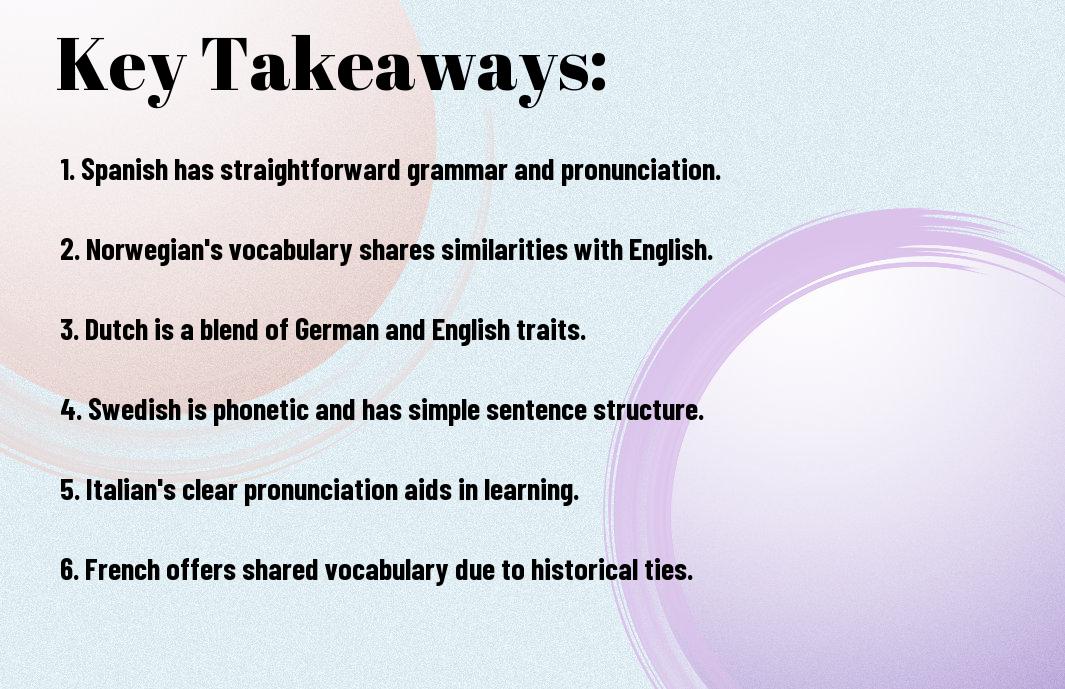
As you consider expanding your linguistic skills, you’ll find that some languages are more accessible to English speakers than others. Your native language provides a solid foundation for learning, and certain languages share similarities with English, making them easier to pick up. You’ll be surprised at how quickly you can become proficient in languages like Spanish, French, or Italian, which have many cognates and grammatical structures similar to English, allowing you to learn and communicate effectively in a short amount of time.

Key Takeaways:

To learn a new language efficiently, it’s helpful to understand which languages are more accessible to English speakers. Here are some key points to consider:

  • Spanish and French are often considered the easiest languages for English speakers to learn due to their similarities in grammar and vocabulary.
  • Italian is another popular choice because of its phonetic nature, meaning words are pronounced as they are written, making it easier for English speakers to learn and pronounce words correctly.
  • Portuguese shares many cognates with English, especially in fields like law, government, and technology, which can facilitate the learning process for English speakers.
  • Swedish and other Scandinavian languages have a relatively simple grammar system and a significant number of cognates, making them more accessible to English speakers.
  • Language learning apps and immersion programs can significantly aid in the learning process by providing interactive lessons and practical experience with the language.

Criteria for Ease of Learning

The ease of learning a language depends on various factors, including grammar, vocabulary, and pronunciation. You will find that some languages are more similar to English, making them easier to pick up. As you consider which language to learn, think about what will make the process simplest for you.

Grammar and Syntax

For instance, languages with similar grammatical structures to English will be easier for you to learn. You will find that your understanding of English grammar will help you navigate these languages more quickly.

Vocabulary and Pronunciation

Any language with vocabulary and pronunciation similar to English will be easier for you to learn. You will pick up words and sounds more quickly if they are familiar to your ear.

Another aspect of vocabulary and pronunciation to consider is the use of cognates, or words that are similar in both languages. You will find that many languages have borrowed words from English, making it easier for you to understand and communicate in your new language.

Romance Languages

Some of the easiest languages for you to learn are Romance languages, as they share similarities with English. You can learn more about language learning at The 5 Easiest Languages for English Speakers to Learn guide.

Spanish

Around 460 million native speakers worldwide speak Spanish, making it a valuable language for you to learn, as it can open doors to new cultures and opportunities.

French

About 274 million people speak French, and as an English speaker, you’ll find that French and English share many cognates, making it easier for you to pick up.

And as you probe deeper into French, you’ll discover that its grammar and pronunciation rules, although challenging, are consistent, allowing you to improve your language skills quickly, and enhancing your travel and career prospects, making it an excellent choice for you to learn.

Germanic Languages

Once again, you can find many similarities between Germanic languages and English, making them easier to learn. You can check out what are the easiest languages to learn and discover the benefits of learning Germanic languages.

Swedish

Like many other Germanic languages, Swedish is relatively easy for you to pick up, with simple grammar and pronunciation. You will find that Swedish and English share many cognates, making it easier for you to learn and understand.

Norwegian

Before submerging into Norwegian, you should know that it’s closely related to English, with many similar words and phrases. You will find that Norwegian is a phonetic language, meaning words are pronounced as they are written.

Norwegian is a great language for you to learn, with its simple grammar and pronunciation making it accessible to English speakers. You will find that Norwegian and English share many similarities, and you can quickly pick up the language with the right resources and practice.

Language Learning Tips

Not all language learning methods are created equal. You can try:

  • setting achievable goals

or check out The 10 Easiest Languages to Learn, as Rated by Unbabel. The most effective approach will depend on your learning style.

Immersion and Practice

Immersing yourself in the language is key to learning. You can practice by listening to music, watching TV shows, and speaking with native speakers to improve your skills.

Language Learning Resources

On top of traditional classroom learning, you have access to numerous online resources to aid in your language learning journey.

It is worth exploring different language learning platforms, such as language exchange websites and mobile apps, to find the one that best fits your needs and helps you stay motivated to continue learning.

Most Similar to English

To learn a new language quickly, you can start with languages that are similar to English. You will notice that many words are cognates, making it easier for you to pick up the language.

Dutch

Around 80% of Dutch words are similar to English words, making it easier for you to learn. You can start with basic phrases and build your vocabulary quickly.

Frisian

Only one language is closer to English than Dutch, and that is Frisian. You will find many similarities in grammar and vocabulary, making it an ideal language for you to learn.

The Frisian language has several dialects, and you can choose the one that interests you the most. You will notice that Frisian is spoken by a small group of people, but it is still an officially recognized language in the Netherlands. You can learn Frisian to connect with the culture and people who speak it, and you will find that it is a rewarding experience.

Final Words

Upon reflecting on your language learning journey, you will find that certain languages are more accessible to you as an English speaker. You can leverage your existing knowledge to learn languages like Spanish, French, or Italian, which share similarities with English. Your ability to pick up these languages will depend on your dedication and the resources you utilize, but with the right approach, you can quickly become proficient in your chosen language.

FAQ

Q: What are the easiest languages for English speakers to learn?

A: The easiest languages for English speakers to learn are typically those that are closely related to English, such as Spanish, French, Italian, and Portuguese. These languages are all part of the Romance language family and share many cognates with English, meaning that they have similar vocabulary and grammar structures. For example, Spanish and English share around 30% of their vocabulary, making it easier for English speakers to pick up Spanish words and phrases. Additionally, the grammar and sentence structure of these languages are also relatively similar to English, making them more accessible to English speakers.

Q: How long does it take to become proficient in one of these easy-to-learn languages?

A: The amount of time it takes to become proficient in a language depends on various factors, including the individual’s language learning ability, the amount of time devoted to studying, and the quality of instruction. However, with consistent practice and dedication, English speakers can typically reach a basic level of proficiency in one of these languages within a few months. For example, the US Foreign Service Institute estimates that it takes around 24-30 weeks (600-750 class hours) to reach a basic level of proficiency in Spanish, while French and Italian may take around 30-36 weeks (750-900 class hours). With more intense study and practice, English speakers can become proficient in these languages within a year or less.

Q: What are some tips for English speakers to learn one of these easy-to-learn languages quickly and effectively?

A: To learn one of these easy-to-learn languages quickly and effectively, English speakers can start by focusing on common vocabulary and phrases, and practicing pronunciation regularly. Listening to native speakers, watching TV shows and movies in the target language, and speaking with language exchange partners can also help improve listening and speaking skills. Additionally, using language learning apps, such as Duolingo, Babbel, or Rosetta Stone, can provide a structured and interactive learning experience. It’s also helpful to immerse oneself in the language by reading books, articles, and newspapers in the target language, and trying to think and speak in the language as much as possible. By following these tips and staying motivated, English speakers can quickly and effectively learn one of these easy-to-learn languages.

The Role of Music in Learning New Languages

As you initiate on learning a new language, you may find yourself exploring various methods to enhance your understanding and retention. Your approach to language learning can be significantly influenced by the tools you use, and music is one such tool that can have a profound impact. You will discover that music can facilitate your language learning process, making it more enjoyable and effective, and this article will probe into the ways music can aid in your linguistic development.

Key Takeaways:

  • The connection between music and language learning is deeply rooted in the way our brains process rhythms and melodies, making music an effective tool for language acquisition.
  • Listening to music in the target language can help learners develop their phonological awareness and improve their pronunciation skills.
  • Singing songs in the target language can aid in vocabulary acquisition and grammar practice, as it provides a fun and engaging way to memorize new words and phrases.
  • The use of lyrics and music videos can provide valuable contextual information and help learners understand the cultural nuances of the target language.
  • Music-based language learning activities can increase motivation and engagement among learners, leading to a more enjoyable and effective language learning experience.

    The Cognitive Benefits of Music in Language Learning

    Your brain is wired to respond to music, and research has shown that it can have a significant impact on your ability to learn new languages. Music can aid in language acquisition by stimulating your cognitive abilities and improving your focus.

    Enhanced Memory and Recall

    Following the initial exposure to a new language, subsequent listening to music in that language can enhance your memory and facilitate recall of new vocabulary and grammar rules.

    Improved Language Processing

    Along with the benefits of enhanced memory, music can also improve your language processing skills, allowing you to better understand and interpret the nuances of the language.

    This improvement in language processing is largely due to the fact that music helps you develop your phonological awareness, which is crucial for distinguishing between similar sounds and intonations in the new language, enabling you to communicate more effectively and accurately express your thoughts and ideas.

    The Role of Rhythm and Melody in Language Acquisition

    Clearly, rhythm and melody play a significant role in language acquisition, as they help you internalize the sound and structure of a new language. You can learn more about how music aids in language learning by visiting 6 Ways Music Can Help You Learn A Foreign Language, which provides valuable insights into this topic.

    Phonological Awareness and Intonation

    About the connection between music and phonological awareness, you’ll find that melody and rhythm help your brain recognize patterns and intonation in speech, making it easier to understand and mimic native speakers.

    Syllable Stress and Pronunciation

    Stress patterns in music can aid your pronunciation skills, as you learn to emphasize the correct syllables in words, improving your overall speech.

    This understanding of syllable stress and pronunciation can be further developed by listening to songs and repeating the lyrics, allowing you to practice your language skills in a more engaging and effective way, and as you progress, you’ll notice improvements in your ability to communicate in your target language.

    Music as a Tool for Vocabulary Building

    After learning a new language, you can use music to build your vocabulary. You can listen to songs, identify unfamiliar words, and look them up in a dictionary to learn their meanings. This method helps you learn new words in context, making it easier to understand and use them in your own sentences.

    Lyrical Analysis and Contextual Learning

    Analyzing song lyrics helps you learn vocabulary in context. You can break down the lyrics, look up unfamiliar words, and understand how they are used in different sentences. This approach enables you to learn vocabulary naturally, as you would in a conversation.

    Musical Genre and Cultural Immersion

    Along with vocabulary building, music can also help you learn about different cultures. You can listen to traditional music from the country where your target language is spoken, and learn about the customs and traditions associated with it. This approach helps you develop a deeper understanding of the language and its cultural context.

    At this point, you may be wondering how to choose the right music for language learning. You can start by selecting songs with clear lyrics and a slow tempo, making it easier to follow and understand the words. You can also explore different musical genres, such as folk or pop, to find the style that suits your taste and learning preferences. By doing so, you can create a personalized playlist that helps you learn your target language in a fun and engaging way.

    The Impact of Music on Language Motivation and Engagement

    Not surprisingly, music has a profound effect on your motivation to learn a new language, making the process more enjoyable and increasing your engagement with the material.

    Emotional Connection and Enjoyment

    Beneath the surface of language learning, you will find that music helps create an emotional connection, making the experience more enjoyable and increasing your willingness to participate in language learning activities.

    Social Interaction and Community Building

    Surrounding yourself with others who share your interest in music and language can facilitate social interaction, helping you build a community of fellow learners who support and motivate you in your language learning journey.

    Considering the social aspect of music in language learning, you will find that singing along to your favorite songs or participating in music-based language exchange events can help you meet new people and practice your language skills in a more relaxed and informal setting, which can be highly beneficial for your language development and motivation to continue learning.

    The Neuroscience of Music and Language Learning

    Unlike other methods, music-based language learning taps into your brain’s ability to process multiple stimuli simultaneously, making it an effective tool for language acquisition. As you engage with music, your brain creates connections between sounds, rhythm, and meaning, which can aid in language learning.

    Brain Plasticity and Neurological Connections

    At the heart of music’s impact on language learning lies your brain’s ability to reorganize itself in response to new experiences. As you learn a new language through music, your brain forms new neurological connections, strengthening your ability to process and retain language information.

    The Role of Dopamine and Reward Systems

    Against the backdrop of language learning, music activates your brain’s reward system, releasing dopamine and motivating you to continue learning. This feedback loop of pleasure and reward helps solidify language patterns in your mind, making it easier to recall and use them in context.

    Learning a new language through music can have a profound impact on your brain’s reward system. As you begin to grasp the rhythms and melodies of a new language, your brain releases dopamine, reinforcing the behavior and motivating you to continue practicing. This can lead to a snowball effect, where your progress in language learning fuels your desire to learn more, and your brain’s reward system responds in kind, releasing more dopamine and solidifying the new language patterns in your mind. You will find that the more you engage with music-based language learning, the more your brain adapts and grows, ultimately leading to greater language proficiency and a deeper understanding of the language and its cultural context.

    Practical Applications of Music in Language Instruction

    All language learners can benefit from music-based instruction, as you can discover more about Learning Language through Music: Science and Songs to enhance your learning experience.

    Song-Based Lesson Plans and Activities

    Actions like singing and dancing can engage you in the learning process, making it more enjoyable and interactive, as you explore song-based lesson plans and activities to improve your language skills.

    Technology-Integrated Music Learning Tools

    Instructional methods that incorporate music and technology can facilitate your language learning, providing you with a wide range of resources and tools to practice and improve your language proficiency.

    In addition, you can utilize various online platforms and apps that offer music-based language lessons, allowing you to access a vast library of songs, lyrics, and interactive exercises tailored to your language level and interests, helping you to develop your listening, speaking, reading, and writing skills in a more engaging and effective way.

    Conclusion

    Taking this into account, you can see how music facilitates your language learning process. As you engage with songs and melodies in your target language, your brain absorbs grammar and vocabulary more effortlessly. Your comprehension and pronunciation improve, making you a more confident learner. By leveraging music, you enhance your overall learning experience, making it more enjoyable and effective.

    FAQ

    Q: How can music enhance the learning experience for individuals trying to acquire a new language?

    A: Music plays a significant role in language learning as it helps to create a multisensory experience, engaging both the auditory and visual senses. By incorporating songs, rhymes, and melodies into the learning process, individuals can improve their pronunciation, intonation, and comprehension skills. Music also has the ability to evoke emotions and create a positive association with the language, making the learning process more enjoyable and increasing motivation. Additionally, music can aid in memory consolidation, with catchy tunes and rhythms helping to encode new vocabulary and grammatical structures in the brain.

    Q: What are some effective ways to use music in language learning, and how can learners apply these methods in their daily practice?

    A: There are several ways to utilize music in language learning, including listening to songs in the target language, singing along to improve pronunciation, and using music-based language learning apps. Learners can also create playlists of songs that correspond to specific grammar or vocabulary topics, and use the lyrics to practice reading and listening comprehension. Furthermore, music can be used as a tool for pronunciation practice, with learners mimicking the intonation and rhythm of native speakers. By incorporating music into their daily routine, learners can make language practice more engaging, interactive, and fun, and can ultimately improve their overall language proficiency.

    Q: Can music help learners overcome language barriers and cultural differences, and how can it facilitate communication with native speakers?

    A: Music has the power to transcend language barriers and cultural differences, providing a universal means of communication and expression. By exploring music from the target culture, learners can gain insight into the customs, traditions, and values of the native speakers, and develop a deeper understanding of the language in context. Music can also serve as a common ground for communication, allowing learners to connect with native speakers through a shared interest or passion. Additionally, music can help learners to develop their speaking skills, with conversations about music providing a natural and authentic context for practicing language exchange. By leveraging the power of music, learners can break down cultural and linguistic barriers, and build bridges of understanding with native speakers.

The Most Beautiful Languages in the World

As you wander through the labyrinth of human communication, you may find yourself enchanted by the melodic sounds and poetic rhythms of certain languages. Your ears may perk up at the sound of a softly spoken phrase, and your heart may skip a beat at the beauty of a well-crafted sentence. In this exploration, you will begin on a journey to discover the languages that are often regarded as the most beautiful, and you will find that the concept of beauty is as subjective as it is captivating.

Key Takeaways:

  • The melody and phonetics of a language play a significant role in determining its beauty, with languages like Italian and Spanish being known for their musical quality.
  • Cultural and historical context can greatly influence the perception of a language’s beauty, with languages like Arabic and Chinese being highly valued for their rich cultural heritage.
  • Linguistic diversity and complexity can also contribute to a language’s beauty, with languages like Japanese and Korean having unique grammatical structures and writing systems.
  • The sound and rhythm of a language can be highly subjective, with different people finding different languages beautiful based on their personal preferences and experiences.
  • Ultimately, the beauty of a language is a matter of personal taste and can vary greatly from person to person, making it a fascinating and multifaceted topic to explore.

Sonic Beauty

For you, the sound of a language can be a powerful trigger, evoking emotions and memories that linger long after the words have faded away. As you listen to the melodic rhythms and cadences of different languages, you may find yourself drawn to certain sounds and accents that resonate with your own sense of beauty and harmony.

The Music of Italian

Beneath the surface of Italian lies a rich tapestry of sound, with its soft consonants and melodic vowels weaving a sonic spell that is hard to resist. As you listen to the musicality of Italian, you may find yourself enchanted by the way the words seem to sing and dance on the tongue.

The Cadence of Spanish

Around the world, you may have noticed the distinctive cadence of Spanish, with its rising and falling intonations that give the language a unique sense of passion and expressiveness. As you listen to the rhythmic flow of Spanish, you may find yourself swept up in the emotional tide of the language.

For instance, as you immerse yourself in the sounds and rhythms of Spanish, you may begin to appreciate the way the language seems to embody the fiery spirit of its native speakers, with its sharp consonants and melodic vowels conveying a sense of energy and vitality that is hard to match. As you listen to the cadence of Spanish, you may find yourself drawn into a world of passion and beauty, where the sounds and rhythms of the language seem to come alive in your very being.

Structural Elegance

One of the key aspects that makes a language beautiful is its structural elegance, which can evoke a sense of wonder in you as you research deeper into its intricacies, and you begin to appreciate the unique characteristics that set it apart from other languages.

The Grammar of Arabic

Prior to exploring the vast array of languages, you will find that the grammar of Arabic, with its complex system of consonants and vowels, presents a fascinating case, as you notice the way it weaves together to form a rich tapestry of sound and meaning that is distinctly its own.

The Syntax of Japanese

Elegant in its simplicity, the syntax of Japanese offers you a glimpse into a world where the placement of words can dramatically alter the meaning of a sentence, and you start to see the beauty in the subtle nuances of this language.

Considering the syntax of Japanese, you will discover that it is a language that values context and implication, often relying on the listener’s ability to infer meaning from the situation, and as you explore this language further, you will find that its unique blend of simplicity and complexity makes it a truly beautiful language to explore and understand.

Expressive Depth

Many languages boast a profound ability to convey complex emotions and ideas, drawing you into a world of nuanced expression. As you examine into the rhythms and cadences of these languages, you begin to appreciate the richness they bring to your understanding of the human experience.

The Idioms of French

Fascinatingly, French idioms often rely on poetic metaphors, allowing you to grasp the subtle shades of meaning that underlie everyday conversations, and inviting you to explore the cultural heritage that shapes your perception of the world.

The Nuances of Portuguese

Authentically, an appreciation for the melodic intonations of Portuguese can transport you to a realm of sonic beauty, where your senses are heightened and your emotional response is deeply felt, as you begin to unravel the intricate web of meanings that underlie this captivating language.

Idioms in Portuguese, as you will discover, are often imbued with a unique blend of passion and lyricism, enabling you to tap into the very essence of the culture, and to experience the full depth of your own emotional landscape, as you navigate the twists and turns of this expressive language.

Cultural Significance

Unlike other aspects of language, cultural significance is deeply personal, and you may find yourself drawn to a language for reasons that are unique to your experiences. As you explore the world of languages, you can visit what are the top ten most beautiful languages to discover the diversity of opinions on this topic.

The History of Mandarin

With the complexity of Chinese characters, you will find that Mandarin has a rich history that spans thousands of years, influencing your perception of its beauty and significance.

The Symbolism of Russian

For you, the Cyrillic alphabet may evoke a sense of mystery, and as you explore deeper, you will discover the intricate symbolism woven into the language, reflecting your own associations with Russian culture.

Symbolism in Russian is multifaceted, and as you explore its nuances, you will uncover the ways in which it resonates with your own emotional and aesthetic responses, drawing you into a world of depth and meaning that is uniquely your own, shaping your appreciation for the language’s beauty and significance.

Phonetic Appeal

Now, as you investigate into the world of languages, you’ll find that some have a certain melodic quality that sets them apart. The way words sound can be just as beautiful as the way they look on paper. Your ears will pick up on the rhythm and cadence of a language, and some will undoubtedly strike a chord with you.

The Sounds of Swedish

Beneath the surface of Swedish lies a treasure trove of sounds that will enchant your senses. You’ll discover a language that sings with a gentle lilt, its words tumbling out in a smooth, musical flow that’s a joy to listen to.

The Intonations of Greek

Among the languages that boast a rich phonetic heritage, Greek stands out for its distinctive intonations. You’ll notice how the pitch and stress of words convey meaning and emotion, drawing you into a world of expressive nuance.

But as you explore the intonations of Greek further, you’ll begin to appreciate the subtlety and complexity that underlies this beautiful language. You’ll find that the rise and fall of pitch, the emphasis on certain syllables, all combine to create a sense of drama and passion that’s hard to resist, and you’ll be swept up in the expressive power of Greek.

Linguistic Diversity

After exploring the world’s languages, you’ll discover a rich tapestry of sounds, structures, and expressions. Your journey will take you through a kaleidoscope of dialects, each with its unique character and beauty.

The Variations of English

For instance, as you probe into the English language, you’ll find a plethora of variations, from the Queen’s English to American slang, each with its own rhythm and cadence, shaping your perception of the world.

The Dialects of German

Between the standard German and its dialects, you’ll notice a fascinating spectrum of differences, with regional accents and vocabulary that reflect the country’s history and culture, inviting you to explore and appreciate its nuances.

Diversity is what makes the dialects of German so compelling, as you’ll encounter a wide range of expressions, from the melodic sound of Bavarian to the guttural tone of Hamburgisch, each one a testament to the language’s adaptability and your ability to connect with its speakers.

Final Words

Conclusively, as you ponder the melodic sounds and linguistic nuances, you’ll find that the most beautiful languages in the world are a matter of personal preference. You can explore more about the harmony of languages at And the most beautiful languages in the world are… ‹ GO Blog, and perhaps, you’ll discover the one that resonates with your soul, leaving an indelible mark on your perception of beauty.

FAQ

Q: What makes a language considered one of the most beautiful in the world?

A: A language can be considered one of the most beautiful in the world due to various factors such as its melodic sound, grammatical complexity, and cultural significance. For instance, languages like Italian and Spanish are often praised for their musicality and expressive nature, while languages like Arabic and Chinese are admired for their unique writing systems and historical importance. The beauty of a language is subjective, but it is often characterized by its ability to evoke emotions, convey complex ideas, and connect people across cultures.

Q: Which languages are commonly regarded as the most beautiful in the world?

A: There are several languages that are frequently considered to be among the most beautiful in the world, including French, known for its romantic connotations and poetic sound; Japanese, admired for its unique blend of simplicity and complexity; and Portuguese, praised for its melodic rhythm and expressive intonation. Other languages, such as Russian, Hindi, and Swedish, are also often cited as being particularly beautiful due to their distinctive grammatical structures, phonetic sounds, and cultural associations. Ultimately, the perception of a language’s beauty depends on personal taste and cultural context.

Q: Can learning a beautiful language have any benefits beyond its aesthetic appeal?

A: Yes, learning a language considered to be one of the most beautiful in the world can have numerous benefits beyond its aesthetic appeal. For example, learning a new language can improve cognitive abilities, enhance career opportunities, and broaden cultural understanding. Additionally, studying a language like Mandarin Chinese or Arabic can provide access to a vast array of literary and cultural works, while learning a language like French or Italian can facilitate travel and communication in diverse regions. Moreover, the process of learning a language can be a rewarding and enriching experience in itself, allowing individuals to develop new skills, challenge themselves, and connect with others who share similar interests and passions.

How Social Media Can Help You Learn Languages

You can leverage social media to enhance your language learning experience. Your social media platforms can be a valuable resource, providing you with a wide range of language learning tools and opportunities. You will discover how to utilize social media to access language lessons, connect with native speakers, and practice your language skills, making your learning journey more engaging and effective.

Key Takeaways:

  • Using language learning apps on social media platforms can provide an interactive and engaging way to learn a new language, with features such as gamification, quizzes, and interactive lessons.
  • Native speaker connections can be made through social media, allowing learners to practice their language skills with fluent speakers and gain insights into cultural nuances and expressions.
  • Language exchange websites and social media groups can connect learners with others who share similar interests and language goals, facilitating practice and improvement through regular conversations.
  • Social media platforms can offer a wide range of authentic materials, such as videos, podcasts, and articles, which can help learners improve their listening and reading comprehension skills.
  • Joining online communities and forums related to language learning can provide learners with and support, as well as access to valuable resources and tips from experienced language learners.

Language Learning Basics

For beginners, understanding the fundamentals of language learning is crucial to make the most of social media resources. You need to know your learning style, goals, and the type of resources that suit you best.

Setting Goals

Basically, establishing clear objectives helps you stay focused and motivated throughout your language learning journey. You can set achievable goals, such as dedicating a certain amount of time each day to practice or reaching a specific level of proficiency.

Finding Resources

Beneath the surface of social media platforms, you can discover a wealth of language learning materials, including podcasts, videos, and language exchange communities. You can explore these resources to find what works best for your learning style and goals.

This wealth of resources can be overwhelming, but you can start by searching for hashtags related to your target language, following language learning accounts, and joining online communities to connect with other learners and native speakers, which can help you stay motivated and engaged in your language learning process.

Social Media as a Learning Tool

You can leverage social media to enhance your language learning experience, and as discussed in The Role of Social Media in Online Languages Learning, it offers numerous resources to support your journey. By utilizing social media platforms, you can access a vast array of language learning materials and connect with native speakers.

Online Communities

Online, you can find various social media groups dedicated to language learners, where you can practice your language skills, ask questions, and get feedback from others. These communities provide a supportive environment for you to learn and improve your language abilities.

Language Exchange Platforms

After joining language exchange platforms, you can connect with native speakers of your target language and practice your speaking and writing skills. This will help you to improve your pronunciation, grammar, and vocabulary, and you can also help others learn your native language in return.

Communities like these provide you with opportunities to engage in conversations, share resources, and learn from others. As you participate in language exchange platforms, you can track your progress, set goals, and stay motivated to continue learning and improving your language skills, making the most out of your social media language learning experience.

Effective Strategies

Your approach to learning a language on social media can make all the difference, and with the right techniques, you can improve your skills significantly.

Immersion Techniques

Previously, language learners had to rely on traditional methods, but now you can immerse yourself in a new language by following native speakers and joining language groups on social media.

Interactive Practices

Efficiently, you can practice your language skills by engaging with others on social media, such as participating in discussions and sharing your thoughts and opinions.

The interactive nature of social media allows you to get feedback on your language skills, helping you to identify areas for improvement and track your progress over time, enabling you to refine your skills and become a more confident language user.

Popular Social Media Platforms

All social media platforms can be used to learn languages, as you can find language learning resources and communities on most of them. You can visit Using Social Media to Boost Students’ Understanding of World Languages to learn more.

Facebook Groups

One of the most effective ways to use social media for language learning is by joining Facebook groups dedicated to language learners, where you can practice with other learners and native speakers.

Twitter Chats

Against the backdrop of a busy online environment, Twitter chats offer a focused space for language learners to engage with each other and practice their language skills in real-time.

Even if you’re a beginner, you can benefit from participating in Twitter chats, as you can learn from others, get feedback on your language usage, and stay motivated to continue learning, which can help you achieve your language learning goals.

Overcoming Challenges

To effectively learn a language using social media, you need to be aware of the potential obstacles that may hinder your progress and have strategies in place to overcome them.

Staying Motivated

Between social media platforms and language learning apps, you have access to a wide range of tools to help keep you motivated and engaged in the learning process, allowing you to track your progress and set achievable goals.

Dealing with Distractions

Any language learner knows that social media can be a significant distraction, but with discipline and the right mindset, you can use these platforms to your advantage and minimize distractions that might hinder your learning.

Challenges such as procrastination and lack of focus can be overcome by setting specific study schedules, using website blockers, and joining online language learning communities that provide support and accountability, helping you stay on track and achieve your language learning goals.

Implementation and Consistency

Keep in mind that consistent practice is key to language learning. You can use social media to create a schedule and stick to it, making language learning a part of your daily routine.

Creating a Routine

Regularly, you will need to set aside time to practice your language skills, and social media can help you do so by providing you with a variety of resources and tools to stay on track.

Tracking Progress

Besides using social media to learn a language, you can also use it to track your progress, by joining language learning groups or using language learning apps that allow you to monitor your progress.

Tracking your progress is an vital part of the language learning process, and social media can help you do so by providing you with a variety of tools and resources, such as language learning apps, podcasts, and videos, that allow you to monitor your progress and adjust your learning strategy accordingly, helping you to stay motivated and focused on your language learning goals, and you can use this information to make adjustments to your learning strategy and achieve your goals more effectively.

Final Words

Taking this into account, you can leverage social media to enhance your language learning experience. You can engage with native speakers, access a wealth of language resources, and track your progress. By utilizing social media effectively, you can make your language learning journey more engaging, interactive, and successful, helping you to achieve your goals and improve your language skills, making you a proficient communicator in your target language.

FAQ

Q: How can social media platforms assist in language learning?

A: Social media can help you learn languages by providing a vast array of language learning resources, including online courses, language exchange websites, and educational videos. Additionally, social media platforms allow you to connect with native speakers, practice your language skills, and get feedback on your pronunciation and grammar. You can also follow language learning accounts and join online communities to stay motivated and engaged in the learning process.

Q: What are some effective ways to use social media for language learning?

A: To effectively use social media for language learning, you can start by following language learning accounts and influencers who share tips, resources, and language lessons. You can also participate in online language exchange groups, where you can practice speaking and writing with native speakers. Moreover, you can use social media to listen to podcasts, watch educational videos, and access online language courses. Another effective way is to change your social media settings to the target language, which can help you get used to seeing and reading the language in context.

Q: Can social media be a replacement for traditional language learning methods, or is it better used as a supplement?

A: While social media can be a valuable tool for language learning, it is generally best used as a supplement to traditional language learning methods. Social media can provide additional practice, exposure to the language, and opportunities to connect with native speakers, but it may not provide the structured learning and feedback that a traditional language course or tutor can offer. A combination of both traditional methods and social media can help you stay engaged, motivated, and consistent in your language learning journey, leading to more effective and efficient progress.

Jhere Skip to content