languages

How to Perfect Accent and Intonation in Languages

Key Takeaways:

To improve your language skills, focus on the following points:

  • Develop your listening skills by exposing yourself to native speakers, podcasts, and audio materials to get accustomed to the natural intonation and accent of the language.
  • Practice pronunciation regularly by recording yourself and comparing your speech with native speakers to identify areas that need improvement, focusing on stress and pitch patterns.
  • Immerse yourself in the language by watching TV shows and movies, engaging in conversations with native speakers, and using language learning apps to develop a more natural flow and fluency in your speech.

Developing Accent

The key to mastering a language lies in its accent, and you’ll need to dedicate time to perfecting yours. Your goal is to sound as natural as possible, and this requires a lot of practice and patience. You’ll need to focus on intonation, rhythm, and individual sounds to develop an authentic accent.

Identifying Key Sounds

Anyway, you should start by identifying the key sounds that are unique to the language you’re learning. You’ll need to pay close attention to how native speakers pronounce certain words and phrases, and try to mimic them as closely as possible. Your listening skills will be imperative in this process.

Practicing Pronunciation

Anyway, you can practice your pronunciation by listening to native speakers and trying to repeat what they say. You’ll find that the more you practice, the more comfortable you’ll become with the sounds and rhythm of the language. Your pronunciation will improve significantly with consistent practice.

Developing your pronunciation skills takes time and effort, but it’s worth it in the end. You’ll be able to express yourself more clearly and confidently, and you’ll sound more like a native speaker. As you continue to practice, you’ll notice significant improvements in your ability to communicate effectively in the language, and you’ll be able to hold conversations with native speakers without struggling to make yourself understood.
Mastering Intonation

If you want to sound like a native speaker, you need to work on your intonation. This involves understanding the rise and fall of your voice when speaking, which can completely change the meaning of a sentence. You’ll need to practice consistently to develop an ear for intonation.

Recognizing Patterns

For instance, you’ll notice that different languages have distinct intonation patterns. You’ll start to pick up on these patterns as you listen to native speakers and practice speaking yourself. Your ability to recognize these patterns will help you improve your overall intonation.

Improving Inflection

Similarly, patterns of inflection will become clearer as you practice speaking. You’ll start to notice how your voice rises and falls when asking questions or making statements. This awareness will help you improve your inflection and sound more natural.

Hence, as you work on improving your inflection, you’ll find that your speech becomes more engaging and expressive. You’ll be able to convey subtle shades of meaning and emotion, drawing your listeners in and keeping them interested. This, in turn, will help you communicate more effectively and build stronger connections with others.

Language Immersion

For effective language learning, surround yourself with the language you want to master, and you’ll find that your accent and intonation will improve dramatically as you absorb the sounds and rhythms of the language.

Surrounding Yourself with the Language

With constant exposure to your target language, you’ll start to pick up on nuances that might have otherwise gone unnoticed, and your brain will begin to mimic the patterns and intonations you hear.

Engaging with Native Speakers

Native to the language, speakers will help you refine your accent and intonation, offering you a unique opportunity to learn from those who have spoken the language their entire lives, and you’ll find that your language skills will improve rapidly.

It is through these interactions that you’ll be able to practice your language skills in a real-world setting, and you’ll gain valuable feedback from native speakers, allowing you to tweak your accent and intonation to sound more natural and fluent, drawing you closer to your goal of perfecting your language skills.

Effective Listening

Unlike other language skills, listening requires patience and dedication to master, and you’ll find that your accent and intonation improve dramatically as you tune in to the sounds and rhythms of the language you’re learning.

Paying Attention to Rhythm

After you’ve started listening regularly, you’ll begin to pick up on the rhythm of the language, and you’ll notice that your own pronunciation is becoming more natural and fluid, allowing you to express yourself with greater confidence and precision.

Imitating Native Speakers

The key to perfecting your accent and intonation is to immerse yourself in the sounds and rhythms of native speakers, and you’ll find that mimicking their pronunciation helps you develop a more authentic tone and style.

Rhythm is what sets native speakers apart from non-native ones, and as you work on imitating the rhythm of native speakers, you’ll notice that your accent and intonation become more nuanced and expressive, allowing you to convey subtle shades of meaning and emotion in your speech, and you’ll be amazed at how much more effectively you can communicate in the language you’re learning.

Recording and Feedback

Keep in mind that perfecting your accent and intonation requires practice and self-assessment, as discussed in If you already speak a foreign language with a good accent, how do you develop a perfect accent. This will help you identify areas that need improvement.

Recording Yourself

By taking the time to record yourself speaking, you’ll be able to pinpoint the nuances of your accent and intonation that need work, allowing you to make adjustments and track your progress over time.

Analyzing Your Progress

Your ability to analyze your own recordings will help you develop a more discerning ear for the sounds and rhythms of the language, enabling you to make targeted improvements.

This process of analysis is where the real growth happens, as you’ll be able to identify patterns and habits that are holding you back, and make conscious efforts to break them, ultimately leading to a more natural and authentic accent and intonation.

Overcoming Challenges

Now that you’ve started working on your accent and intonation, you’ll encounter obstacles that test your dedication. You’ll face setbacks, but don’t let them discourage you. Your progress may be slow, but with persistence, you’ll overcome these challenges and improve your language skills.

Managing Accent Interference

Around the time you start to develop your new accent, your native accent may interfere. About this issue, it’s vital to practice consistently, focusing on reproducing the correct sounds and intonation of the target language. You’ll need to develop an awareness of your own speech patterns to minimize interference.

Building Confidence

Ironically, as you progress, self-doubt may creep in. Interfering thoughts can hinder your ability to speak confidently. You must push past these doubts and focus on your strengths, using them to build your confidence in speaking the language.

At this stage, you’ll need to challenge yourself to speak in front of others, whether it’s with a language exchange partner or in a classroom setting. As you continue to practice and receive feedback, you’ll become more comfortable with your accent and intonation, and your confidence will grow, allowing you to express yourself more effectively in the language.

Conclusion

Drawing together the threads of accent and intonation, you’ll find that your journey to mastering a language is almost complete. As you practice, your ear will become attuned to the subtleties of native speech, and your own voice will begin to echo with authenticity. With dedication and persistence, you’ll unlock the doors to fluent communication, and your words will flow with the rhythm and music of your chosen language, allowing you to express yourself with confidence and precision.

FAQ

Q: What are the best ways to improve my accent in a foreign language?

A: To perfect your accent in a foreign language, it’s crucial to immerse yourself in the language as much as possible. Listen to native speakers, watch TV shows and movies in the target language, and try to mimic the sounds and intonation patterns you hear. You can also practice speaking with native speakers, either in person or through online language exchange platforms. Additionally, consider working with a language teacher or tutor who can provide personalized feedback on your pronunciation and help you identify areas for improvement. Regular practice and consistent exposure to the language will help you develop a more authentic accent over time.

Q: How can I work on intonation patterns in a foreign language?

A: Intonation patterns can be challenging to master, but there are several strategies that can help. Start by listening to native speakers and paying close attention to the rise and fall of their pitch when they speak. Try to identify the stressed and unstressed syllables in words and the overall rhythm of the language. You can also practice speaking in front of a mirror, recording yourself, or working with a language exchange partner to get feedback on your intonation. Another helpful technique is to practice repeating phrases and sentences after native speakers, focusing on mimicking their intonation patterns as closely as possible. With consistent practice, you can develop a more natural-sounding intonation in the target language.

Q: Are there any specific exercises or techniques that can help me improve my accent and intonation in a short amount of time?

A: Yes, there are several exercises and techniques that can help you improve your accent and intonation quickly. One effective method is to practice tongue twisters, which can help you develop the muscle memory needed to pronounce words and sounds correctly. You can also try Shadowing, a technique where you repeat what a native speaker is saying, trying to mimic their pronunciation, intonation, and rhythm exactly. Another helpful exercise is to practice speaking in different emotions and contexts, such as acting out a scene or role-playing a conversation. This can help you develop a more nuanced understanding of the language and improve your accent and intonation in a variety of situations. With consistent practice and dedication, you can see significant improvement in your accent and intonation in a relatively short period of time.

The Best Languages to Learn for Global Travelers

As you plan your next international trip, you may wonder which languages will help you navigate foreign countries with ease. Your language skills can greatly impact your travel experience, enabling you to connect with locals and appreciate cultural nuances. You will find that learning the right languages can unlock new destinations and experiences, making your travels more enjoyable and immersive.

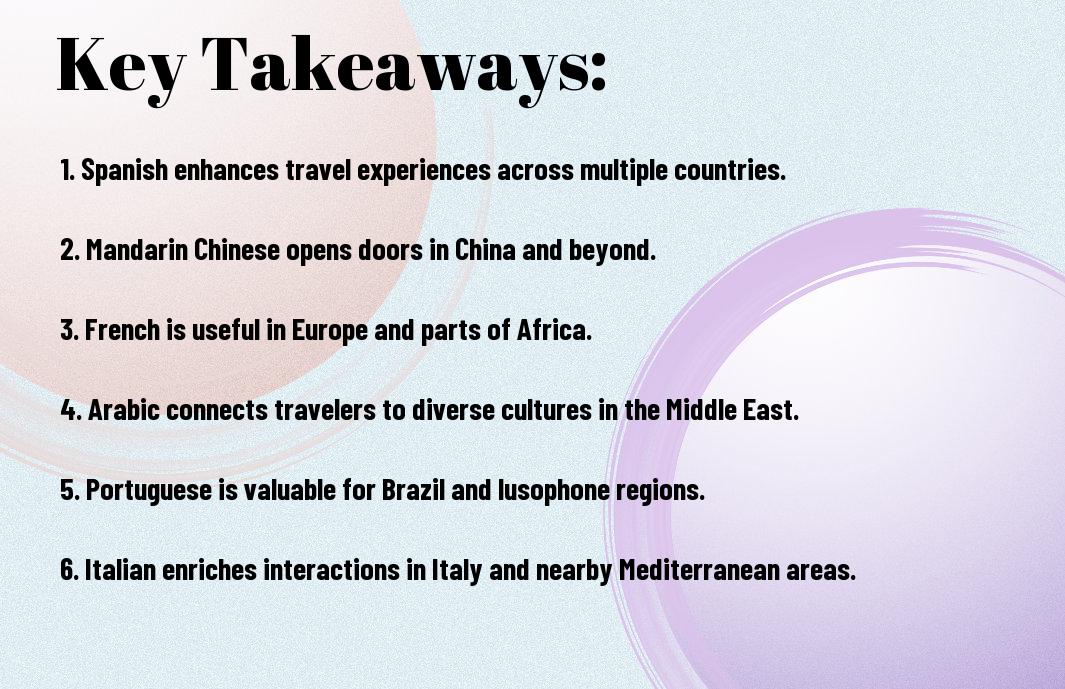
Key Takeaways:

To thrive as a global traveler, it’s important to understand the most effective languages to learn. Here are three key points to consider:

  • Learning Spanish can significantly enhance travel experiences in Central and South America, as well as Europe, due to its widespread use and cultural significance.
  • Understanding Mandarin Chinese can provide global travelers with a competitive edge, particularly in Asia, where it is the most widely spoken language and a key component of international business.
  • Becoming proficient in Arabic can open doors to Middle Eastern and North African cultures, offering travelers unparalleled opportunities to engage with local communities and appreciate the region’s rich heritage.

    Essential Languages for Globetrotters

    Your travel experiences can be greatly enhanced by learning the local languages of the countries you visit, allowing you to connect with the culture and people on a deeper level.

    Spanish for South America and Europe

    Around 460 million people speak Spanish, making it a valuable language to learn for travel to South America and Europe, enabling you to communicate effectively and navigate your way through these regions with ease.

    Arabic for the Middle East and North Africa

    African and Asian countries have a significant number of Arabic speakers, and learning this language will open doors to rich cultural experiences and history in the Middle East and North Africa, allowing you to engage with the local population.

    Languages like Arabic can be challenging to learn, but the benefits of speaking it will make your travels to the Middle East and North Africa much more enjoyable, as you’ll be able to appreciate the local customs, read signs and menus, and interact with the friendly locals who will appreciate your effort to communicate in their language.

    Languages for the Asian Trail

    Clearly, Asia offers a diverse array of languages to learn, each with its own unique benefits for travelers. You can navigate multiple countries with knowledge of a single language, making your journey more enjoyable and immersive.

    Mandarin Chinese for China and Taiwan

    Between the lines of cultural and linguistic heritage, you’ll find Mandarin Chinese to be an invaluable asset for your travels in China and Taiwan, enabling you to connect with locals and explore hidden gems.

    Japanese for Japan and East Asia

    Comparable to Chinese in terms of its complexity and beauty, Japanese is a highly sought-after language for travelers visiting Japan and other parts of East Asia, where you can discover vibrant cities and traditional landscapes.

    Asian cultures are notoriously polite and respectful, and as you examine into the world of Japanese language, you’ll find that learning key phrases and vocabulary will enhance your travel experience, allowing you to engage with your surroundings and the people you meet, making your journey even more unforgettable and personally fulfilling for you.

    European Languages for the mains

    Unlike other continents, Europe offers a diverse array of languages, making it crucial to choose the right one for your travels. You’ll find that speaking the local language can enhance your experience and allow you to connect with the culture on a deeper level.

    French for Western Europe

    Beneath the surface of Western Europe lies a rich cultural heritage, and learning French will give you access to this world. You’ll be able to navigate France, Belgium, and Switzerland with ease, and your language skills will be appreciated by the locals.

    German for Central and Eastern Europe

    Among the languages spoken in Central and Eastern Europe, German stands out as a valuable asset for travelers. You’ll find that speaking German will open doors to Austria, Germany, and parts of Switzerland, allowing you to explore these regions with confidence.

    Considering your travel plans, learning German will also give you a deeper understanding of the history and culture of Central and Eastern Europe. You’ll be able to engage with the locals, try authentic cuisine, and visit popular attractions without language barriers, making your travel experience even more enjoyable and rewarding.

    Language Learning Tips for Travelers

    Many travelers find language learning to be a challenging task. Here are some tips:

    • Set achievable goals
    • Practice consistently

    . Knowing your learning style will help you choose the most effective method.

    Immersion and Language Schools

    Towards improving your language skills, consider enrolling in a language school or immersing yourself in the local culture, which will help you learn faster and more effectively.

    Online Resources and Language Apps

    Between language learning apps and online courses, you have a wide range of options to choose from, allowing you to learn at your own pace and convenience.

    Even with the numerous online resources available, you can still find the most suitable one for your needs by trying out a few and selecting the one that best fits your learning style and goals, helping you to stay motivated and engaged throughout your language learning journey.

    Cultural Insights and Language Nuances

    After immersing yourself in a new language, you’ll discover the nuances that shape your interactions with locals, revealing a richer travel experience as you navigate unfamiliar territories.

    Non-Verbal Communication and Customs

    Around every corner, you’ll encounter unique non-verbal cues and customs that can significantly impact your interactions, and being aware of these differences will help you communicate more effectively and avoid unintentionally offending locals.

    Local Dialects and Slang

    Similarly to customs, local dialects and slang can vary greatly, and understanding these variations will enhance your travel experience, allowing you to connect with locals on a deeper level and appreciate the diversity of the language you’re learning.

    But as you research deeper into local dialects and slang, you’ll find that they often convey subtle shades of meaning and context that can completely change the tone of a conversation, and being able to pick up on these nuances will make you a more confident and engaging traveler, capable of navigating even the most unfamiliar situations with ease and poise, and you’ll be better equipped to express yourself and understand the culture in a more authentic way.

    Language Challenges and Rewards

    Despite the difficulties, learning a new language can be rewarding. You can discover the 14 Best Languages to Learn for Travel and enhance your travel experiences.

    Overcoming Language Barriers

    Besides the initial struggles, you will find that learning a language helps you navigate foreign countries with ease, allowing you to engage with locals and immerse yourself in their culture.

    Enhancing Travel Experiences through Language

    Linguistically, you will be able to appreciate the nuances of foreign cultures, from reading signs and menus to understanding the history and customs of the places you visit.

    Barriers to communication will fade away as you learn to speak and understand the local language, enabling you to have a more authentic and enjoyable travel experience, and you will be able to make the most of your time abroad, exploring new destinations and forming meaningful connections with the people you meet along the way.

    Final Words

    Hence, as you initiate on your global travels, you’ll find that learning the best languages will enhance your experience. You can discover the Most Useful Languages for World Travel to better navigate foreign lands. Your language skills will bridge cultural gaps, allowing you to fully immerse yourself in your destinations and create lasting connections with the people you meet.

    FAQ

    Q: What are the most widely spoken languages that I should consider learning for global travel?

    A: As a global traveler, learning languages such as English, Mandarin Chinese, Spanish, Arabic, and French can significantly enhance your travel experiences. English is widely spoken in many countries and is often the language of international communication. Mandarin Chinese is the most spoken language in the world, with a large number of native speakers, while Spanish and Arabic are official languages in many countries across the globe. French is also widely spoken, particularly in Europe and parts of Africa. Learning any of these languages will facilitate communication and deepen your cultural connections during your travels.

    Q: How can learning a foreign language impact my travel experiences and interactions with local cultures?

    A: Learning a foreign language can profoundly impact your travel experiences by allowing you to engage more deeply with local cultures. When you speak the local language, you can navigate more easily, read signs and menus, and communicate with locals, which can lead to more authentic interactions and a richer cultural understanding. It also shows respect for the culture and people you are visiting, often leading to warmer welcomes and more meaningful connections. Furthermore, language skills can open up opportunities for unique experiences, such as homestays, local volunteer work, or participation in cultural events, which might not be accessible otherwise.

    Q: Are there any language learning resources or tips that can help me learn a language quickly and effectively for my travels?

    A: Yes, there are numerous resources and tips that can help you learn a language quickly and effectively for travel. Utilizing language learning apps like Duolingo, Rosetta Stone, or Babbel can provide structured lessons and interactive exercises. Immersion is also a powerful tool; watch local movies, listen to music, and try to find a language exchange partner. Focus on learning key phrases and vocabulary related to travel, such as directions, food, and basic greetings. Additionally, consider enrolling in a language course or hiring a tutor for personalized feedback. Lastly, practice consistently, even if it’s just for a few minutes each day, to build your language skills and confidence before your trip.

How Learning Languages Encourages Cross-Cultural Understanding

As you explore the world, you’ll discover that language is a key to unlocking diverse cultures. Learning a new language enables you to connect with people from different backgrounds, fostering a deeper understanding of their customs and traditions. Your ability to communicate in another language will broaden your perspective, allowing you to navigate cultural nuances and appreciate the unique aspects of each community, ultimately enriching your interactions with people from around the globe.

Key Takeaways:

To improve global communication and foster international relationships, it’s necessary to understand the impact of language learning on cultural awareness. Here are the main points:

  • Learning languages promotes empathy and tolerance by exposing individuals to different perspectives and traditions, ultimately leading to a more harmonious global community.
  • Studying a new language encourages exploration of historical and social contexts, allowing learners to better understand the values and beliefs of other cultures.
  • Language learning facilitates effective communication across linguistic and cultural boundaries, enabling individuals to engage in meaningful interactions and build stronger relationships with people from diverse backgrounds.

    Language as a Bridge

    Before you begin on learning a new language, consider the potential it holds in connecting you to diverse cultures. Language serves as a powerful tool, allowing you to transcend cultural boundaries and foster meaningful relationships with people from various backgrounds.

    Breaking Cultural Barriers

    Bridging the gap between cultures, you’ll find that language is key to unlocking a deeper understanding of customs, traditions, and values. As you learn to communicate in a new language, you’ll become more aware of the nuances that shape your interactions with people from different cultural backgrounds.

    Fostering Global Communication

    Anyway, as you acquire new language skills, you’ll be able to engage with a broader audience, exchanging ideas and perspectives on a global scale. Your ability to communicate across languages will open doors to new experiences, allowing you to navigate diverse cultural contexts with confidence.

    Understanding the complexities of global communication, you’ll appreciate how language learning enables you to connect with people from different parts of the world, fostering greater empathy and cooperation. As you navigate your way through diverse cultural landscapes, you’ll develop a more nuanced understanding of the world, and your place within it, ultimately enriching your personal and professional life.

    Cultural Immersion

    Any attempt to learn a language is a step towards cultural immersion, allowing you to gain a deeper understanding of the customs, traditions, and values of the culture associated with the language you are learning.

    Language Learning and Cultural Awareness

    Awareness of cultural nuances is developed as you learn a language, enabling you to better understand the perspectives and behaviors of people from different cultural backgrounds, and fostering greater empathy and tolerance in your interactions with them.

    The Importance of Context

    Against the backdrop of language learning, context plays a significant role in shaping your understanding of cultural references, idioms, and expressions, helping you to interpret and use language in a way that is appropriate and respectful.

    At the heart of effective communication is the ability to understand the context in which language is used, and as you learn a language, you will begin to appreciate the complexities of cultural context and how it influences the way people interact with each other, allowing you to navigate different social situations with greater ease and confidence.

    Historical Context

    Keep in mind that language learning has been a cornerstone of cross-cultural understanding throughout history, enabling you to communicate and connect with people from diverse backgrounds, fostering global relationships and cooperation.

    Language and Cultural Exchange Throughout History

    Besides being a means of communication, language has played a significant role in shaping your understanding of other cultures, as you explore the historical context of language exchange and its impact on societal development.

    The Impact of Language on Cultural Relationships

    Culturally sensitive language skills allow you to navigate complex social dynamics, facilitating your interactions with people from different cultural backgrounds and enabling you to build stronger, more meaningful relationships.

    The impact of language on cultural relationships is multifaceted, as you research deeper into the nuances of language and culture, you will discover how language influences your perceptions, behaviors, and interactions with people from diverse cultural backgrounds, ultimately shaping your understanding of the world and your place within it.

    Personal Growth

    Despite the many benefits of language learning, one of the most significant advantages is the impact it has on your personal growth. As you learn a new language, you develop new skills, challenge yourself, and gain a fresh perspective on the world.

    Language Learning and Personal Development

    Personally, learning a language is a transformative experience that helps you develop a greater understanding of yourself and your place in the world. You become more self-aware, confident, and open to new experiences, which in turn enhances your personal development.

    Broadening One’s Perspective

    Likewise, learning a language broadens your perspective, allowing you to see the world from different cultural viewpoints. You gain a deeper understanding of the customs, traditions, and values of other societies, which helps you become more empathetic and tolerant.

    Development of your cultural awareness is a significant aspect of broadening your perspective. As you learn about different cultures, you begin to appreciate the diversity of human experience and develop a more nuanced understanding of the world. You start to see that your own culture is just one of many, and that there are many ways to live, think, and interact with others. This newfound understanding can have a profound impact on your life, helping you to become a more open-minded and engaged global citizen.

    Social Benefits

    Not only does learning a language broaden your cultural knowledge, but it also enhances your social skills. You can gain insights into the role of culture in language learning by Reviewing the role of culture in English language learning, which can help you navigate diverse social situations.

    Language and Social Connections

    Behind the scenes of language learning, you’ll discover that it fosters deeper social connections. You’ll be able to communicate with people from diverse backgrounds, fostering meaningful relationships and a sense of community.

    Building Bridges Between Communities

    Before you know it, your language skills will enable you to connect with people across cultural divides. You’ll be able to build bridges between communities, promoting mutual understanding and respect.

    Understanding the intricacies of language and culture, you’ll become a catalyst for positive change, helping to break down social barriers and foster global unity. As you continue to learn and grow, you’ll find that your language skills will open doors to new experiences, allowing you to make a lasting impact on the world around you.

    Challenges and Opportunities

    Unlike other skills, learning a language opens doors to new cultures, as you discover that Cultivating Cross‐Cultural Connections through Language Learning is a valuable asset in today’s globalized world, enabling your participation in diverse communities.

    Overcoming Language Barriers

    Above all, your ability to communicate in multiple languages helps break down cultural barriers, allowing you to engage with people from different backgrounds and foster meaningful relationships.

    The Future of Language Learning and Cultural Exchange

    Alongside the rise of digital technologies, your opportunities for language learning and cultural exchange are expanding, enabling you to connect with language learners and native speakers worldwide.

    To take full advantage of these opportunities, you can explore various online platforms and language learning tools, which will help you develop your language skills and deepen your understanding of diverse cultures, ultimately enriching your personal and professional life as you navigate an increasingly interconnected world.

    Summing up

    Upon reflecting on your journey to learn a new language, you realize that it not only enhances your communication skills, but also fosters cross-cultural understanding. As you explore into a new language, you gain insight into the customs, traditions, and values of the corresponding culture. This, in turn, broadens your perspective, allowing you to appreciate your own culture and others, while navigating the complexities of global interactions with confidence and sensitivity, ultimately enriching your personal and professional relationships.

    FAQ

    Q: What role does language learning play in promoting cross-cultural understanding?

    A: Learning languages plays a significant role in promoting cross-cultural understanding by allowing individuals to communicate effectively with people from diverse linguistic and cultural backgrounds. When we learn a new language, we gain insight into the customs, traditions, and values of the culture associated with that language. This helps to break down cultural barriers and fosters greater empathy and understanding between different communities. By studying a language, we can investigate into the literature, history, and daily life of the target culture, which enriches our perspective and encourages us to appreciate the diversity of human experience.

    Q: How does language learning help to dispel cultural stereotypes and misconceptions?

    A: Language learning is an effective tool for dispelling cultural stereotypes and misconceptions because it provides firsthand exposure to the authentic voices and stories of the target culture. Through language, we can access a wide range of cultural artifacts, including films, music, literature, and news, which offer nuanced portrayals of the culture. By engaging with these materials, we can develop a more balanced understanding of the culture, moving beyond simplistic or inaccurate representations often found in media or popular discourse. Furthermore, language learning facilitates direct communication with native speakers, allowing for personal connections and exchanges that can challenge and correct preconceived notions about a culture.

    Q: Can language learning contribute to global citizenship and international cooperation?

    A: Yes, language learning can significantly contribute to global citizenship and international cooperation. By acquiring the ability to communicate in multiple languages, individuals can participate more fully in global discussions, collaborations, and problem-solving efforts. Language proficiency enables us to navigate international contexts with greater ease, understand different perspectives, and contribute our own insights to a global dialogue. This skill is especially valuable in professional and academic settings, where international cooperation is necessary for addressing global challenges such as environmental sustainability, economic development, and peacebuilding. Moreover, language learning fosters a sense of global responsibility and citizenship, encouraging individuals to engage with and respect the diversity of cultures that comprise our interconnected world.

How to Learn Niche Languages for Specific Professions

As you consider expanding your professional horizons, you may wonder if learning a niche language can give you an edge. You can explore the benefits of studying a lesser-known language by visiting Is it a better career strategy to study a niche language like Burmese or Mongolian and discovering how it can enhance your career prospects. Your decision to learn a niche language can lead to unique opportunities in your chosen field, and this article will guide you through the process.

Key Takeaways:

To effectively learn niche languages for specific professions, consider the following points:

  • Focus on industry-specific vocabulary and terminology to enhance your understanding and communication skills in the desired field.
  • Utilize authentic materials such as documents, videos, and podcasts related to the profession to improve your comprehension and pronunciation.
  • Practice specialized language skills with native speakers or mentors in the industry to gain practical experience and build a strong foundation for your career.

Identifying Niche Languages

While exploring niche languages, you’ll find that various professions require specific dialects. Your goal is to identify the languages that align with your career aspirations.

Researching Profession-Specific Languages

Alongside your profession, you should investigate the languages that are commonly used in your field. You can start by looking at job postings, industry reports, and professional networks to get an idea of the language requirements.

Determining Language Requirements

Linguistic demands vary across professions, and you need to determine the specific language skills required for your desired career. You should consider the geographic location, industry, and job role to understand the language needs.

At this stage, you will need to investigate deeper into the language requirements for your profession. You can consult with professionals in your desired field, attend industry events, or join online forums to gain insights into the linguistic demands of your career. By doing so, you will be able to identify the niche languages that are imperative for your professional growth and success.

Language Learning Strategies

Now that you’ve decided to learn a niche language for your profession, it’s time to develop a tailored approach. Your goal is to acquire language skills that cater to your specific needs, and this requires a strategic plan.

Immersion Techniques

On the path to language proficiency, surrounding yourself with the language is important. You can listen to podcasts, watch videos, and engage in conversations with native speakers to immerse yourself in the language and get accustomed to its nuances.

Language Courses and Resources

After identifying your language learning goals, you can explore various courses and resources available to you. You will find numerous online platforms, language learning apps, and textbooks that cater to your specific needs and profession.

With the abundance of language courses and resources at your disposal, you can select the ones that best fit your learning style and profession. You can enroll in online courses that focus on medical terminology, legal jargon, or business communication, depending on your field of work, and utilize language learning apps to practice your skills on-the-go.

Industry-Specific Language Skills

Keep in mind that industry-specific language skills are imperative for your professional development. You will need to learn specialized vocabulary and terminology to communicate effectively in your field. This will help you to better understand your colleagues, clients, and industry norms.

Medical Terminology

Opposite to what you might think, learning medical terminology is not as daunting as it seems. You can start by familiarizing yourself with common medical terms, prefixes, and suffixes, and then gradually move on to more complex terminology.

Technical Vocabulary

Besides the basic language skills, you will also need to acquire technical vocabulary related to your profession. You can start by reading industry publications, attending seminars, and engaging in online forums to get familiar with the technical terms and jargon used in your field.

Technical language skills are vital for your success in any profession. You will need to learn to understand and use technical terms, abbreviations, and acronyms correctly to communicate effectively with your colleagues and clients. As you progress in your career, you will find that technical vocabulary becomes second nature to you, and you will be able to express yourself with clarity and precision.

Language Learning Tools

Despite the challenges of learning a niche language, you have a wide range of resources at your disposal. You can utilize various tools to aid in your language learning journey, from textbooks to online platforms.

Online Resources and Apps

Alongside traditional learning methods, you can use online resources and apps to supplement your learning, accessing a vast array of language learning materials tailored to your profession.

Language Exchange Programs

Acquiring a niche language can be facilitated through language exchange programs, which allow you to practice with native speakers and gain insight into your desired profession.

Considering your goal of learning a niche language for a specific profession, language exchange programs can be particularly beneficial, as they provide you with opportunities to engage in conversations related to your field, helping you to develop a more nuanced understanding of the vocabulary and terminology used in your profession, and enabling you to apply your language skills in a practical context.

Overcoming Language Barriers

Many professionals face language barriers when working in niche fields, but with dedication, you can overcome them. You will encounter various challenges, but your persistence will pay off, enabling you to communicate effectively in your chosen profession.

Cultural Adaptation

Culturally sensitive approaches are important when learning a niche language for your profession. You must understand the customs and nuances of the language to communicate effectively and avoid misunderstandings, allowing you to build strong relationships with your colleagues and clients.

Communication Strategies

Beyond the language itself, developing effective communication strategies is vital. You need to focus on understanding the specific terminology and jargon used in your profession, as well as the appropriate tone and style of communication, to convey your message clearly.

Indeed, as you explore deeper into your niche language, you will find that communication strategies play a significant role in your success. You will need to practice active listening, ask clarifying questions, and use visual aids to support your message, ensuring that your communication is clear and effective in your professional context.

Staying Motivated

For your niche language learning journey to be successful, you need to maintain a high level of motivation. You will encounter obstacles, but with the right mindset, you can overcome them and stay focused on your goals.

Setting Goals and Deadlines

With a clear plan in place, you can set achievable goals and deadlines, helping you to track your progress and stay motivated. You will be able to see your improvement and adjust your strategy as needed.

Finding Language Learning Communities

The key to language learning is practice, and finding a community of like-minded individuals can help you stay engaged. You can learn from others, share your experiences, and get feedback on your progress.

Language learning communities can be found online or in-person, and they offer a wealth of resources and support. You can participate in discussions, attend events, and connect with native speakers, all of which will help you to improve your language skills and stay motivated to continue learning. Your progress will be facilitated by the collective enthusiasm and expertise of the community, and you will be more likely to achieve your goals.

Summing up

Summing up, you now have a clearer understanding of how to learn niche languages for specific professions. You can tailor your approach to your career goals, using targeted resources and practice to master the language skills you need. As you progress, your proficiency will open doors to new opportunities, allowing you to communicate effectively in your field and advance your career. With dedication and the right approach, you can become proficient in a niche language and enhance your professional prospects.

FAQ

Q: What are the best resources for learning niche languages for specific professions, such as medical or legal terminology?

A: For learning niche languages for specific professions, it’s necessary to utilize a combination of specialized textbooks, online courses, and professional dictionaries. Websites like Coursera, Udemy, andLinkedIn Learning offer a wide range of courses tailored to various professions. Additionally, subscribing to industry-specific journals and participating in professional forums can help learners stay updated on the latest terminology and practices. Another valuable resource is language learning apps, such as Duolingo, which occasionally features niche language courses.Lastly, connecting with professionals in the desired field through networking events or mentorship programs can provide firsthand insights and guidance.

Q: How can one effectively practice and apply niche language skills in real-world scenarios to improve proficiency?

A: Practicing and applying niche language skills in real-world scenarios is vital for improving proficiency. One effective method is to engage in role-playing exercises with colleagues or language exchange partners, simulating conversations that occur in the specific profession. Another approach is to participate in internships or volunteer work, where learners can apply their language skills in a practical setting. Furthermore, creating a portfolio of translations or interpretations of industry-specific texts can help learners demonstrate their skills to potential employers. Watching industry-related videos, podcasts, or TED talks with subtitles in the target language and taking notes on new vocabulary and concepts can also enhance comprehension and retention.

Q: What are the most significant challenges faced by learners of niche languages for specific professions, and how can they overcome them?

A: Learners of niche languages for specific professions often face challenges such as limited resources, specialized vocabulary, and the need for domain-specific knowledge. To overcome these challenges, learners should start by building a strong foundation in the general language and then gradually move on to specialized terminology. It’s also beneficial to join online communities or forums related to the profession, where learners can ask questions, share resources, and connect with experts in the field. Moreover, setting realistic goals and tracking progress can help learners stay motivated and focused. Finally, seeking feedback from professionals in the field on language usage and cultural nuances can help learners refine their skills and sound more natural in professional settings.

The Best Languages to Learn for Competitive Exams

As you prepare for competitive exams, you may be wondering which languages will give you an edge. Your language skills can set you apart from others, and learning the right ones can boost your chances of success. You will discover that certain languages are in high demand and can open doors to new opportunities. By choosing the right languages, you can enhance your career prospects and stay ahead of the competition, making your language learning journey a valuable investment in your future.

Key Takeaways:

To succeed in competitive exams, choosing the right languages to learn is important. Here are the key points to consider:

  • Focus on popular languages such as English, Spanish, and Mandarin, as they are widely used and can open up more job opportunities.
  • Learning languages like French, German, or Italian can also be beneficial, as they are highly valued in international business and diplomacy.
  • Developing programming skills in languages like Python, Java, or C++ can be advantageous, as they are in high demand in the tech industry and can give you a competitive edge.

Benefits of Learning Languages for Competitive Exams

While preparing for competitive exams, learning languages can give you an edge over others. It not only enhances your understanding of different cultures but also improves your overall performance.

Enhanced Career Opportunities

By acquiring language skills, you open yourself up to a world of job opportunities, increasing your chances of getting hired by multinational companies and organizations that value language proficiency.

Improved Cognitive Skills

Skills such as memory, attention, and problem-solving are improved when you learn a new language, which can help you perform better in your exams and other areas of life.

And as you continue to learn and practice a new language, you will notice significant improvements in your cognitive abilities, allowing you to approach problems from different angles and think more critically, which will benefit you in all aspects of your competitive exams and beyond.

Most In-Demand Languages for Competitive Exams

There’s a growing need to learn new languages to stay competitive in exams, and you can boost your chances by choosing the right ones, as it will help you to achieve your goals, you can prepare yourself for a wide range of opportunities.

English

Examinations often require proficiency in English, and you will find that it is a common language used in many competitive exams, so it’s important to focus on improving your English skills to perform well in your exams, and you will increase your chances of getting selected.

Spanish

Above all, Spanish is a highly valued language, and you will benefit from learning it, as it is becoming increasingly popular, and you can take advantage of this trend to enhance your language skills, which can give you an edge over others in competitive exams.

Languages like Spanish can open doors to new opportunities for you, and you can explore various career options, as Spanish is widely spoken in many countries, and you will find that knowing Spanish can help you to communicate effectively with people from diverse backgrounds, and you can make the most of your language skills to achieve success in competitive exams.

Language Skills Required for Competitive Exams

To excel in competitive exams, you need to possess strong language skills, which are imperative for scoring well in various sections of the exams, including verbal ability and comprehension.

Reading Comprehension

Contrary to popular belief, reading comprehension is not just about reading a passage, but also about understanding the context, tone, and vocabulary used, which you will need to master to answer questions correctly.

Writing Abilities

Regarding your writing skills, you should be able to express your thoughts clearly and concisely, using proper grammar, syntax, and vocabulary, which will help you to score well in the writing section of the exams.

It is also important to note that your writing abilities will be tested in various formats, such as essays, letters, and summaries, so you need to be well-versed in different writing styles and formats to perform well in the exams.

Tips for Learning Languages for Competitive Exams

For effective language learning, you’ll need a solid strategy. Consider the following:

  • Set achievable goals
  • Use language learning apps
  • Thou shalt see improvement in your language skills with dedication and persistence.

    Immersive Learning

    Similarly, one of the best ways to learn a language is through immersion, surrounding yourself with the language you want to learn, which will help you to pick up the language quickly.

    Consistent Practice

    Likewise, languages require regular practice to master, and you should make it a part of your daily routine to see significant improvement in your language skills.

    Practice is key to language learning, and you should aim to practice consistently, even if it’s just for a few minutes each day, to develop a strong foundation in the language and improve your chances of success in competitive exams, and you will be able to use your language skills effectively in your exam.

    Popular Language Learning Resources

    After deciding on a language to learn, you’ll need to find the right resources to help you prepare for competitive exams. You can choose from a variety of options, including online courses, language learning apps, and study materials.

    Online Courses

    One of the most effective ways to learn a language is through online courses, which provide you with structured lessons and expert instructors to guide you through your learning journey. You can find online courses on platforms like Coursera, Udemy, and edX.

    Language Learning Apps

    Onwards with technology, you can access language learning apps that offer interactive lessons and exercises to help you improve your language skills. You can download apps like Duolingo, Babbel, and Rosetta Stone to get started.

    Further, language learning apps provide you with the flexibility to learn at your own pace, anytime and anywhere, making it easier to fit language learning into your busy schedule. You can track your progress, set goals, and practice speaking, writing, and listening skills with these apps, helping you to stay motivated and focused on your language learning goals.

    Common Challenges in Learning Languages for Competitive Exams

    Not all students find it easy to learn a new language, especially when preparing for competitive exams. You can find more information on The 12 Most Important Languages To Learn For Success to help you get started.

    Limited Time

    Competitively, you will face challenges with limited time to learn a language, making it important to prioritize your study schedule and focus on the most important aspects of the language.

    Difficulty in Pronunciation

    With the complexity of languages, you may struggle with pronunciation, which can hinder your progress and make it difficult to communicate effectively.

    Further, difficulty in pronunciation can be attributed to the differences in sound, intonation, and rhythm between your native language and the target language, making it important to practice regularly and seek feedback from native speakers or language instructors to improve your pronunciation skills.

    To wrap up

    Hence, you can maximize your chances of success in competitive exams by choosing the right languages to learn. You can select from a variety of languages, considering your interests and career goals. For more information, you can visit The 7 Best Languages To Learn (and Why They’re Useful) to make an informed decision about your language learning journey, enhancing your skills and boosting your prospects.

    FAQ

    Q: What are the most beneficial languages to learn for competitive exams in terms of career opportunities?

    A: Learning languages such as English, Spanish, Mandarin, Arabic, and French can significantly enhance your career opportunities in fields like international business, diplomacy, and education. English is widely used in global communication, while Spanish and Mandarin offer access to large and growing economies. Arabic is important for careers in international relations and diplomacy in the Middle East, and French is valuable for those interested in working with French-speaking countries or international organizations like the United Nations.

    Q: How can learning a foreign language impact one’s performance in competitive exams, especially in fields like international relations and global business?

    A: Mastering a foreign language can greatly improve your performance in competitive exams by opening up more job opportunities, enhancing cultural understanding, and demonstrating your ability to adapt to new environments. In fields like international relations and global business, proficiency in a foreign language can be a key differentiator, allowing you to communicate effectively with clients, colleagues, and stakeholders from diverse linguistic backgrounds. Furthermore, many competitive exams, such as those for the Foreign Service or international corporations, include language proficiency tests, where fluency in a foreign language can be a significant advantage.

    Q: What resources and study strategies are available for individuals looking to learn a new language specifically for competitive exams, and how can one balance language learning with other exam preparations?

    A: Individuals can utilize various resources such as language learning apps (like Duolingo), online courses (through platforms like Coursera or edX), and language exchange programs to learn a new language. Effective study strategies include setting realistic goals, practicing consistently, and immersing oneself in the language through media and interaction with native speakers. To balance language learning with other exam preparations, it’s advisable to create a schedule that allocates specific times for language study, exam preparation, and practice tests. Additionally, incorporating language learning into daily routines, such as listening to podcasts or watching TV shows in the target language, can help manage time efficiently and reinforce learning.

Jhere Skip to content