
learn

The Best Languages to Learn for Entrepreneurs

As you expand your business globally, you’ll encounter diverse markets and clients. To effectively communicate with your target audience, you need to speak their language. You can gain a competitive edge by learning languages that open doors to new markets and customers. Your language skills will enhance your ability to navigate international business environments and foster strong relationships with your clients and partners, ultimately driving your business forward.

Key Takeaways:

To succeed as an entrepreneur in today’s global market, learning a new language can be highly beneficial. Here are the key points to consider:

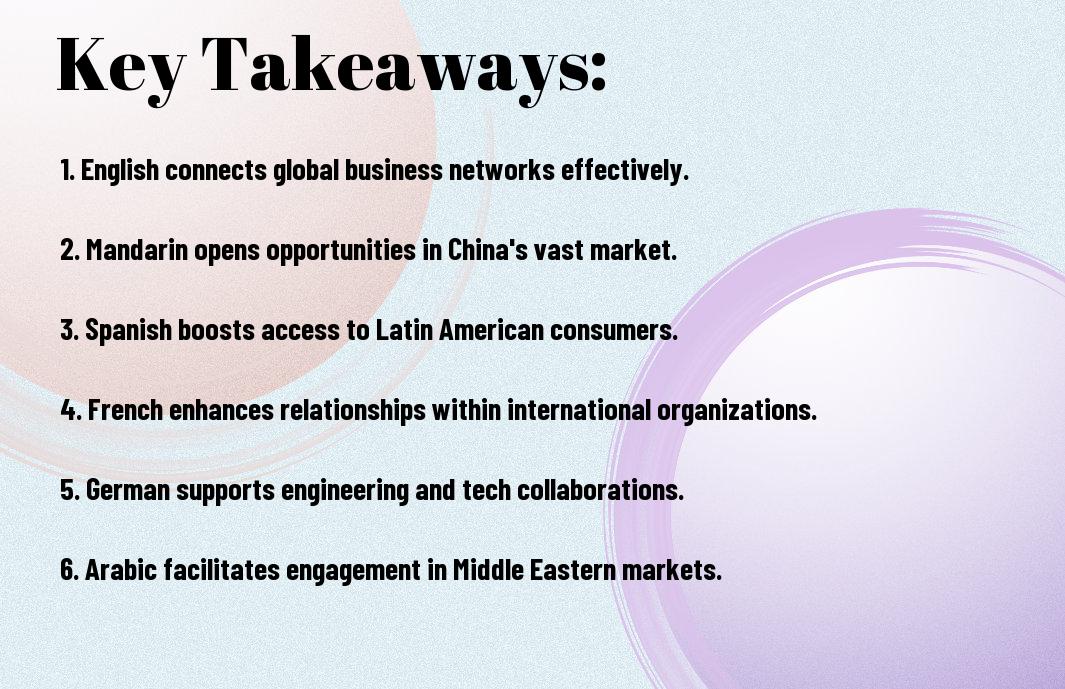
  • Learning Mandarin Chinese can give entrepreneurs a competitive edge, especially when doing business in Asia, due to China’s large and growing economy.
  • Spanish is another valuable language for entrepreneurs, as it can open up opportunities in Latin America and the United States, allowing for expansion into new markets.
  • Arabic is also a strategic language to learn, given the Middle East’s significant economic growth and the increasing importance of international trade in the region.

Choosing the Right Language

For entrepreneurs, selecting a language to learn can be a daunting task, but it’s important to consider your business goals and target market when making your decision. You’ll want to choose a language that aligns with your company’s objectives and helps you connect with your desired audience.

Language for Global Market

Linguistically, you’ll need to consider the languages spoken by your global customers, partners, and competitors, and choose one that will give you a competitive edge in the international market, allowing you to effectively communicate and expand your business worldwide.

Language for Specific Regions

About the regional languages, you should think about the areas where you want to establish or expand your business, and learn the dominant language of that region to better understand the local culture, customs, and consumer behavior.

Also, as you probe deeper into the specifics of regional languages, you’ll find that learning the local language can help you build stronger relationships with your customers, suppliers, and partners, ultimately leading to increased trust, loyalty, and business success in your target region, and you will be able to tailor your products or services to meet the unique needs of that market.
Top Languages for Entrepreneurs

Clearly, as an entrepreneur, speaking multiple languages can give you a competitive edge in the global market, allowing you to communicate with clients and customers from diverse backgrounds, and understand their needs more effectively, thus expanding your business opportunities.

English as a Global Language

Prior to exploring other languages, you should consider that English is widely spoken and widely used in international business, making it an vital language for you to learn if you want to succeed in the global market, facilitating your communication with people from different countries.

Mandarin for Asian Markets

Approximately, as you consider expanding your business to Asia, you will find that Mandarin is the most spoken language in the region, making it an attractive language for you to learn, enabling you to tap into the vast and growing Asian market, and connect with potential clients and partners.

But as you investigate deeper into the benefits of learning Mandarin, you will discover that it can open doors to new business opportunities, allowing you to navigate the complex Asian market with ease, understand the local culture, and build strong relationships with your Chinese counterparts, ultimately giving you a competitive advantage in the region and helping you to grow your business successfully.

Language of Business

Keep in mind that speaking the language of your target market can greatly benefit your business. As an entrepreneur, you need to understand your customers and communicate effectively with them. Your language skills can make or break your business deals, and being proficient in the right language can give you a competitive edge.

Spanish for Latin America

Similarly, Spanish is a vital language for entrepreneurs looking to expand into Latin America. You will be able to connect with over 400 million native speakers, opening up new markets and opportunities for your business. Your ability to speak Spanish will allow you to navigate the cultural and linguistic nuances of the region.

Arabic for Middle Eastern Markets

Behind the success of many international businesses lies the ability to communicate in Arabic. You can tap into the rapidly growing markets of the Middle East by learning Arabic, which will give you access to a vast and lucrative region. Your Arabic language skills will enable you to build strong relationships with your clients and partners.

Plus, as you research deeper into the Arabic language, you will discover a rich cultural heritage and history. You will be able to understand the nuances of the Middle Eastern market, including the importance of building trust and relationships. Your ability to speak Arabic will demonstrate your commitment to your clients and partners, setting you apart from your competitors and giving you a unique advantage in the region.

Emerging Markets

To succeed in the global market, you need to consider emerging markets. You can expand your business by learning languages spoken in these regions, increasing your chances of success.

Portuguese for Brazil

For entrepreneurs like you, learning Portuguese can open doors to the vast Brazilian market, allowing you to connect with over 212 million people and grow your business.

Russian for Eastern Europe

With Russian, you can tap into the massive Eastern European market, gaining a competitive edge and unlocking new opportunities for your business.

Also, as you explore the Russian language, you’ll discover a wealth of cultural and economic insights, enabling you to tailor your business strategy to the unique needs of the Eastern European market, and helping you build strong relationships with your Russian-speaking clients and partners.

Language Learning Strategies

Your approach to learning a language can significantly impact your progress, and as an entrepreneur, you need to be strategic about how you allocate your time and resources to achieve your goals.

Immersion Techniques

Linguistic exposure is key to rapid language acquisition, and you can achieve this by surrounding yourself with the language you want to learn, whether through TV shows, podcasts, or speaking with native speakers.

Online Courses

Only a few online courses are designed with the entrepreneur in mind, offering flexible scheduling and focused lessons on business-related topics, allowing you to quickly gain the language skills you need to succeed.

Also, when choosing an online course, consider your learning style and goals, and look for courses that offer interactive lessons, real-life scenarios, and opportunities to practice speaking and listening, as these will help you develop a more well-rounded set of language skills that you can apply in your business endeavors, enabling you to effectively communicate with clients, partners, and colleagues from diverse linguistic backgrounds.

Industry Specific Languages

All entrepreneurs should consider learning a language that caters to their specific industry, as it can give you a competitive edge. You can explore languages that are valuable for international business by visiting Excluding English, what are the most valuable languages to learn for international business to make informed decisions.

French for International Relations

Languages like French are highly valued in international relations, as you will encounter numerous French-speaking countries and organizations, making it beneficial for your business interactions.

German for Engineering

Along with other languages, German is a popular choice for engineering and technology, as many multinational companies are based in Germany, and speaking the language can enhance your career prospects.

It is worth noting that German is an official language in several countries, and your knowledge of the language will open doors to new business opportunities and collaborations in the engineering sector, allowing you to communicate effectively with your German-speaking clients and partners.

Final Words

So, as you consider expanding your business globally, you’ll find that learning languages like Mandarin, Spanish, or Arabic can greatly enhance your entrepreneurial pursuits. You’ll be able to connect with your target audience more effectively and gain a competitive edge in the market. By investing time in learning these languages, you’ll unlock new opportunities and take your business to the next level, allowing you to achieve your goals and increase your revenue. Your language skills will be a valuable asset to your business.

FAQ

Q: What are the most beneficial languages for entrepreneurs to learn in terms of business expansion and global market reach?

A: For entrepreneurs looking to expand their business globally, learning languages such as Mandarin Chinese, Spanish, Arabic, and Portuguese can be highly beneficial. Mandarin Chinese, spoken by over a billion people, offers access to a vast and growing market. Spanish, with its widespread use in the Americas and Europe, provides a significant edge in trade and commerce. Arabic, being the official language of many Middle Eastern countries, is vital for entrepreneurs aiming to tap into the region’s booming economies. Lastly, Portuguese, spoken in both Portugal and Brazil, opens doors to lucrative markets in Europe and South America, especially considering Brazil’s large and growing economy. Mastering any of these languages can significantly enhance an entrepreneur’s ability to navigate international markets and foster global business relationships.

Q: How does learning a foreign language impact an entrepreneur’s ability to innovate and stay competitive in the global market?

A: Learning a foreign language can profoundly impact an entrepreneur’s ability to innovate and stay competitive. It allows them to access a broader range of resources, including research, technologies, and innovations that may not be available in their native language. This can lead to novel business ideas and solutions that cater to the specific needs and preferences of foreign markets. Additionally, language proficiency enables entrepreneurs to engage directly with international clients and partners, fostering deeper understanding and more effective collaboration. This can lead to better-tailored products and services that meet the demands of a global customer base, thereby enhancing competitiveness. Moreover, being able to navigate foreign markets firsthand provides entrepreneurs with valuable insights into consumer behavior, market trends, and regulatory environments, further fueling innovation and strategic decision-making.

Q: What are the most effective ways for busy entrepreneurs to learn a foreign language, given their tight schedules and demanding work commitments?

A: For busy entrepreneurs, learning a foreign language requires a strategic and efficient approach. One effective method is to utilize online language learning platforms that offer flexible, self-paced courses, allowing entrepreneurs to study at their convenience. Mobile apps, such as Duolingo, Babbel, and Rosetta Stone, are particularly popular due to their accessibility and interactive learning experiences. Another strategy is to hire a private tutor who can tailor lessons to the entrepreneur’s schedule and specific needs, potentially focusing on business-related vocabulary and scenarios. Immersive experiences, such as short trips abroad or participation in language exchange programs, can also be highly effective, though they may require more time commitment. Lastly, incorporating language learning into daily routines, such as listening to podcasts or watching foreign-language content during commutes, can provide consistent exposure and practice without significantly impacting a busy schedule.

How to Learn Technical Terminology in Languages

As you initiate on learning a new language, you will encounter a multitude of technical terms that can seem daunting. Your goal is to grasp these specialized words and phrases, and with the right approach, you can overcome this hurdle. You will need to develop strategies to understand and retain this complex vocabulary, and this article will guide you through the process, providing you with practical tips and techniques to enhance your learning experience.

Key Takeaways:

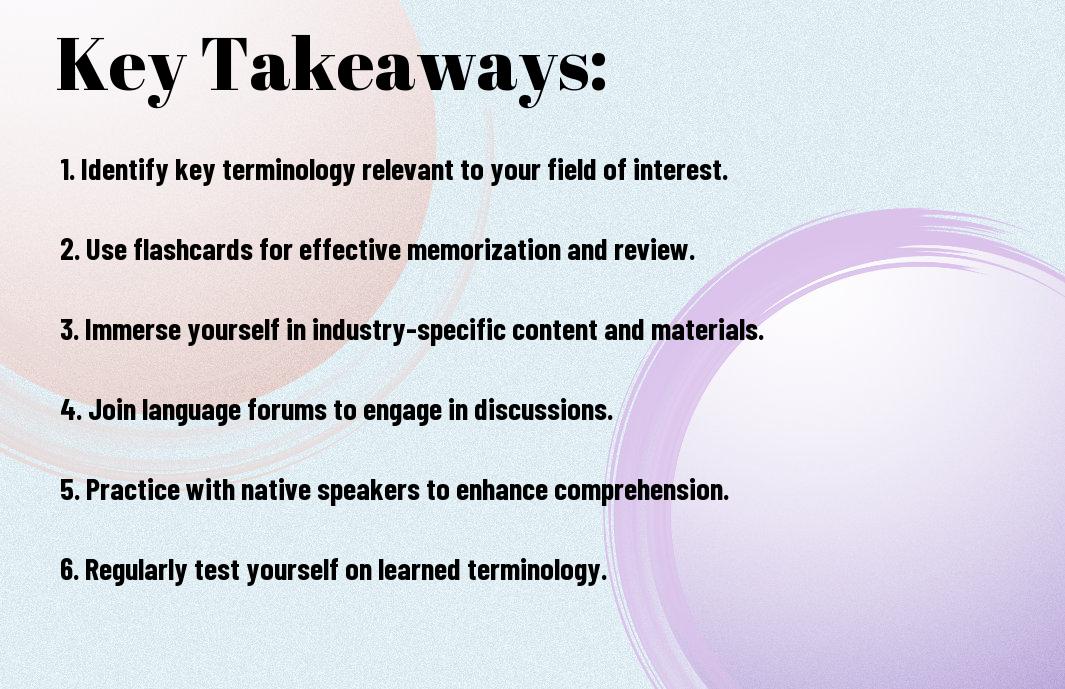
  • To effectively learn technical terminology in languages, it’s crucial to start by understanding the context in which these terms are used, as this will help you grasp their meanings and applications more easily.
  • Focusing on specialized dictionaries and glossaries can be highly beneficial, as they provide accurate definitions and explanations of technical terms, helping you to build a strong foundation in your chosen field.
  • Immersive learning techniques, such as reading industry publications and engaging with native speakers, can also be very effective in helping you learn and retain technical vocabulary, as they allow you to see how terms are used in real-world scenarios.

Section

The key to mastering a new language lies in understanding its technical terminology. You will encounter various terms that may seem unfamiliar at first, but as you progress, you will become more comfortable with their usage. Your goal is to learn these terms and use them effectively in your communication.

subsection: Defining Technical Terminology

Contrary to what you might think, technical terminology is not just a collection of complicated words. You will find that it is a systematic way of expressing ideas and concepts specific to a particular field or industry, and you can learn it by studying and practicing consistently.

subsection: Importance of Learning Technical Terms

Opposed to general language learning, learning technical terms requires a focused approach. You need to understand the context and the specific vocabulary used in your field of interest, as it will enable you to communicate more accurately and effectively with others.

Considering your career goals and interests, you will likely need to learn technical terms to succeed in your chosen field. You may start by identifying key terms and concepts, then proceed to learn their meanings and usage through practice and repetition. As you become more familiar with these terms, you will notice an improvement in your overall understanding and communication skills, allowing you to express your ideas with precision and clarity.

Section

Clearly, learning technical terminology in languages requires dedication and persistence. You will need to develop a strategy to tackle the complex vocabulary and concepts. Your approach should be tailored to your learning style and goals. As you progress, you will become more confident in your ability to understand and use technical terms.

subsection: Language Learning Strategies

Prior to begining on your learning journey, you should consider your current level of language proficiency and identify areas for improvement. You will need to find resources that cater to your needs, such as textbooks, online courses, or language learning apps. Your strategy should include regular practice and review to reinforce your understanding of technical terms.

subsection: Building a Strong Foundation

Around the time you start learning technical terminology, you will need to focus on building a strong foundation in the language. You should begin by learning the basic vocabulary and grammar rules, and then gradually move on to more complex concepts. Your foundation will serve as a basis for further learning, enabling you to understand and apply technical terms with ease.

Even as you probe deeper into technical terminology, you will find that your strong foundation serves you well. You will be able to recognize patterns and relationships between terms, and your comprehension will improve significantly. You should continue to practice and review regularly, using your foundation as a starting point to explore more advanced concepts and refine your understanding of technical terminology.

Section

For effective learning, you’ll need to understand technical terminology. You can start by consulting resources such as Identifying Technical Language to get familiar with the concepts.

subsection: Immersion and Contextual Learning

Any attempt to learn technical terminology should involve immersing yourself in the language, whether through reading, listening, or speaking, to grasp the context in which these terms are used.

subsection: Using Flashcards and Mnemonics

Before exploring into complex texts, you can use flashcards and mnemonics to help you memorize key terms and their meanings, making it easier to understand technical texts.

Indeed, using flashcards and mnemonics can be an effective way to reinforce your learning, as you can quiz yourself on the terms and associate them with memorable concepts or images, helping to solidify them in your long-term memory and making you more confident in your ability to use technical terminology accurately.

Section

Unlike other areas of language learning, technical terminology requires a focused approach. You will need to dedicate time to learning specific terms and phrases related to your field of interest. This can be achieved through various methods, including online courses, textbooks, and language learning apps.

subsection: Reading Technical Texts and Articles

By reading technical texts and articles in your target language, you can familiarize yourself with industry-specific vocabulary and gain a deeper understanding of complex concepts. You will encounter new terms and phrases in context, making it easier to grasp their meanings.

subsection: Engaging with Native Speakers

With native speakers, you can practice using technical terminology in conversation, helping you to improve your pronunciation and comprehension. You can engage with them through language exchange websites, social media, or professional networks.

But as you engage with native speakers, you will also have the opportunity to ask questions and clarify any doubts you may have about specific terms or concepts. You can gain valuable insights into how technical language is used in real-world situations, and develop a more nuanced understanding of your field, allowing you to communicate more effectively with colleagues and peers.

Section

Keep in mind that learning technical terminology in languages requires dedication and practice. You will need to stay focused and motivated to achieve your goals. Your progress will depend on the amount of time you devote to studying and reviewing the terminology.

subsection: Online Resources and Courses

Courses and tutorials can be a great way to learn technical terminology in languages. You can find numerous online resources that offer language lessons and exercises to help you improve your skills. Your goal is to find the resources that best fit your needs and learning style.

subsection: Joining Language Communities

At this stage, you are ready to immerse yourself in the language by joining online communities and forums. You will be able to interact with native speakers and learn from their experiences. Your participation will help you gain a deeper understanding of the terminology and its practical applications.

Understanding the nuances of technical terminology in languages is key to effective communication. As you join language communities, you will begin to notice the differences in how terms are used in various contexts. You will learn to appreciate the subtleties of language and develop your ability to express yourself accurately and confidently. Your engagement with native speakers will also help you stay up-to-date with the latest developments and trends in your field.

Section

After delving into the world of technical terminology, you will find it helpful to consult resources such as How to learn technical (or any specialized) language? to guide your learning process.

subsection: Overcoming Challenges and Obstacles

Challenges will inevitably arise as you learn technical terminology, but you can overcome them by breaking down complex concepts into manageable parts and seeking help when needed.

subsection: Staying Motivated and Consistent

With a clear plan and realistic goals, you will be able to stay motivated and make consistent progress in your learning journey, gradually building your confidence in using technical terminology.

subsection ‘Staying Motivated and Consistent’ is about maintaining your enthusiasm and commitment to learning technical terminology, and you can achieve this by celebrating small victories, finding a study buddy, and rewarding yourself for reaching milestones, which will help you to stay engaged and motivated throughout the process.

Conclusion

The key to mastering technical terminology in languages lies in your consistent practice and dedication. You will find that your understanding of complex terms improves as you encounter them in various contexts. By following the steps outlined, you can develop a robust vocabulary and enhance your communication skills in your chosen field, allowing you to express your ideas with precision and clarity.

FAQ

Q: What are the most effective ways to learn technical terminology in a foreign language?

A: Learning technical terminology in a foreign language can be achieved through various methods. Firstly, immerse yourself in the language by reading technical articles, research papers, and industry-specific texts. This exposure will help you become familiar with the specialized vocabulary and its usage. Additionally, utilize online resources such as language learning apps, dictionaries, and terminology databases to access a vast repository of technical terms. Finally, practice active learning by taking notes, summarizing technical texts, and engaging in conversations with native speakers or professionals in the field to reinforce your understanding and retention of the terminology.

Q: How can I improve my understanding of technical terms in context, especially when they are used in complex sentences or passages?

A: To improve your comprehension of technical terms in context, develop the habit of reading and analyzing technical texts regularly. Start by identifying the key terms and concepts in the passage, and then look up their definitions and explanations in a dictionary or online resource. It’s also helpful to break down complex sentences into simpler components, focusing on the relationships between the technical terms and other words. Furthermore, create concept maps or flashcards to visualize the connections between terms and reinforce your understanding. Lastly, join online forums or discussion groups where you can ask questions and engage in discussions with others who are also learning the technical terminology.

Q: Are there any specialized resources or tools that can aid in learning technical terminology, especially for beginners or those with limited background knowledge?

A: Yes, there are several specialized resources and tools designed to support individuals learning technical terminology. For instance, many professional organizations and industry associations offer glossaries, style guides, and terminology lists on their websites. Moreover, language learning platforms and apps often include technical vocabulary lessons, quizzes, and exercises tailored to specific fields or industries. You can also explore online courses, webinars, and tutorials that focus on teaching technical terminology and its application. Additionally, consider consulting with a language instructor or a subject-matter expert who can provide personalized guidance and feedback on your learning progress. By leveraging these resources, you can build a strong foundation in technical terminology and improve your overall language proficiency.

Jhere Skip to content