Mastery

The Role of Podcasts in Language Mastery

As you launch on your language learning journey, you’ll discover various tools to aid your progress. Your ability to grasp nuances and expressions can be significantly enhanced through an innovative medium: podcasts. You can leverage podcasts to immerse yourself in your target language, exposing your ears to native speakers and authentic conversations. By incorporating podcasts into your daily routine, you’ll find that your listening skills and vocabulary expand, bringing you closer to achieving language mastery.

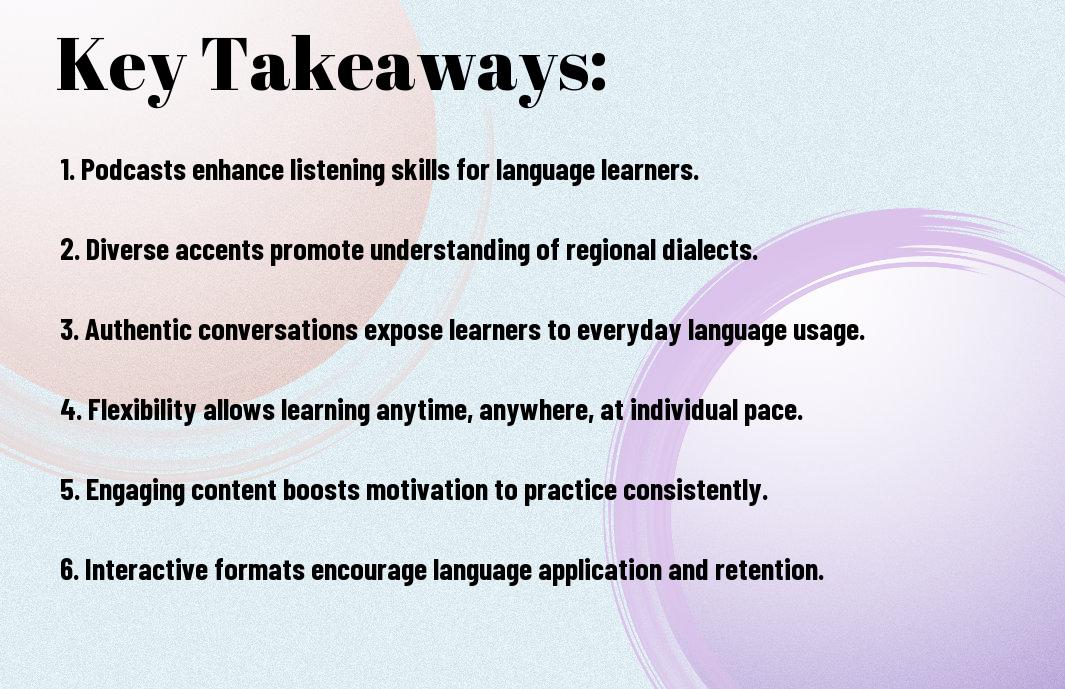
Key Takeaways:

  • Language Immersion is a key benefit of podcasts, as they provide listeners with the opportunity to hear native speakers and authentic conversations, helping to improve listening and speaking skills.
  • Podcasts offer a convenient and flexible way to learn a language, allowing listeners to learn at their own pace and on their own schedule, making them an ideal tool for language mastery.
  • Personalized learning is another advantage of podcasts, as listeners can choose from a wide range of topics and levels, selecting content that is relevant to their interests and language level, helping to keep them engaged and motivated in the learning process.

Section

The role of podcasts in language mastery is significant, as they provide you with a unique opportunity to improve your language skills in a convenient and enjoyable way. You can access a wide range of podcasts on various topics, allowing you to focus on areas that interest you the most.

subsection: Benefits of Podcasts for Language Learners

On the path to language mastery, you will find that podcasts offer numerous benefits, including exposure to native speakers, diverse accents, and real-life conversations. You can enhance your vocabulary, grammar, and pronunciation by listening to podcasts regularly.

subsection: How Podcasts Improve Listening Skills

Around the globe, language learners are using podcasts to improve their listening skills, and you can do the same. You will be able to tune in to podcasts that match your level and interests, helping you to stay motivated and engaged.

Learners like you can benefit greatly from podcasts, as they provide a relaxed and entertaining way to improve listening skills. You can listen to podcasts at your own pace, pause, and rewind to ensure you understand the content, making it an effective tool for language mastery. As you progress, you will find that your ability to comprehend various accents and speaking styles improves significantly, bringing you closer to achieving your language goals.

Section

If you’re looking to improve your language skills, podcasts can be a valuable resource. You can access a wide range of podcasts tailored to your level and interests, helping you to enhance your comprehension and vocabulary.

subsection: Vocabulary Building through Podcasts

Adept learners can use podcasts to expand their vocabulary, as they are exposed to various words and expressions in context, allowing you to understand their meanings and usage, and thus improve your language mastery.

subsection: Pronunciation Practice with Native Speakers

Alongside the benefits of listening to podcasts, you can also practice your pronunciation by mimicking native speakers, which helps you to develop an authentic accent and intonation, making your language sound more natural.

Plus, as you listen to native speakers in podcasts, you’ll become accustomed to their rhythm, stress, and intonation patterns, enabling you to pronounce words and sentences more accurately, and enhancing your overall language skills, so you can communicate more effectively in your target language.

Section

For language learners, podcasts offer a unique opportunity to improve your listening skills and expand your vocabulary. You can access a wide range of topics and genres, making it easier to find content that interests you and helps you stay motivated.

subsection: Language Immersion through Storytelling

Around the world, podcasts have become a popular way to experience immersive storytelling in your target language. You can listen to engaging narratives, interviews, and conversations that help you get used to the natural flow and rhythm of the language.

subsection: Cultural Insights and Contextual Learning

On a deeper level, podcasts provide you with cultural insights and contextual learning opportunities. You can learn about the customs, traditions, and values of the communities that speak your target language, giving you a more nuanced understanding of the language and its usage.

The cultural insights you gain from podcasts can be particularly valuable as you navigate real-life situations in your target language. You’ll be better equipped to understand the context and nuances of conversations, allowing you to communicate more effectively and build stronger relationships with native speakers. As you listen to podcasts, you’ll start to pick up on cultural references, idioms, and expressions that are often difficult to learn from textbooks or language classes alone, helping you to sound more natural and confident in your language skills.

Section

Once again, podcasts prove to be a valuable resource for language learners, as you can discover How Podcasts Can Enhance Language Learning: Insights for Language Learners and improve your skills. You can explore various topics and find the ones that suit your interests and level of proficiency.

subsection: Overcoming Language Barriers with Podcasts

Before entering into the world of podcasts, you may have felt overwhelmed by language barriers, but with the right resources, you can break through these obstacles and enhance your listening and speaking skills, allowing you to communicate more effectively in your target language.

subsection: Building Confidence in Language Skills

Above all, podcasts can help you build confidence in your language skills, as you become more comfortable with the sounds, rhythms, and nuances of the language, enabling you to express yourself more accurately and fluently.

With consistent practice and exposure to podcasts, you can develop a more natural flow in your speech and improve your comprehension, which will, in turn, boost your confidence and motivation to continue learning and improving your language skills, allowing you to achieve your goals and become a proficient language user.

Section

To effectively utilize podcasts for language mastery, you’ll want to explore various options and find the ones that suit your needs. You can discover new podcasts through online recommendations, ratings, and reviews from fellow language learners.

subsection: Popular Podcasts for Language Learners

Against the backdrop of numerous podcasts available, you’ll find some that stand out for their engaging content and effective teaching methods, offering you a valuable resource for improving your language skills.

subsection: How to Choose the Right Podcast for Your Level

After determining your language proficiency level, you can select podcasts that cater to your needs, ensuring you’re challenged enough to improve without feeling overwhelmed, and you can adjust your choices as your skills progress.

Another consideration when choosing a podcast is your learning style and goals; if you prefer conversational lessons, you might opt for a podcast focused on discussions, while those seeking structured lessons might prefer a more formal, instructional approach, allowing you to tailor your learning experience to your preferences and objectives.

Section

All language learners can benefit from podcasts, which provide an accessible and engaging way to improve your listening skills and learn new vocabulary. You can use podcasts to practice your language skills anywhere, at any time, making them an ideal tool for busy learners.

subsection: Creating a Study Routine with Podcasts

Alongside your regular study routine, podcasts can be a valuable addition, helping you to stay motivated and focused. You can incorporate podcasts into your daily commute, exercise routine, or downtime, making language learning a seamless part of your daily life.

subsection: Supplementing Language Courses with Podcasts

Without a doubt, podcasts can enhance your language learning experience, offering a unique perspective on the language and providing you with authentic listening materials. You can use podcasts to supplement your language courses, filling in gaps in your knowledge and gaining a deeper understanding of the language.

With podcasts, you can reinforce the concepts you learn in your language courses, and explore different accents, dialects, and speaking styles. You can also use podcasts to practice active listening, summarizing, and note-taking, which will help you to improve your comprehension and retention of the language, and ultimately, achieve your language mastery goals.

Final Words

Upon reflecting on your journey to language mastery, you will find that podcasts have played a significant role in your progress. You have utilized them to improve your listening skills, expand your vocabulary, and gain cultural insights. As you continue to learn, your reliance on podcasts will likely grow, providing you with a valuable tool to enhance your language abilities and stay motivated, ultimately helping you to achieve your goals in becoming proficient in your target language.

FAQ

Q: What is the significance of podcasts in language learning, and how can they contribute to language mastery?

A: Podcasts play a significant role in language learning as they provide learners with an opportunity to listen to and engage with native speakers, improve their listening skills, and enhance their vocabulary and pronunciation. By incorporating podcasts into their learning routine, language learners can expose themselves to various accents, expressions, and conversational styles, which can help them develop a more nuanced understanding of the language and improve their overall language proficiency.

Q: How can podcasts be used to improve specific language skills, such as listening, speaking, reading, and writing?

A: Podcasts can be utilized in a variety of ways to enhance specific language skills. For example, learners can use podcasts to improve their listening skills by listening to episodes with transcripts, practicing active listening, and repeating what they hear. To improve speaking skills, learners can engage in discussions about podcast topics, practice speaking by summarizing episodes, or participate in language exchange programs. Additionally, podcasts can be used to improve reading and writing skills by providing learners with resources and materials to practice reading and writing about topics discussed in the podcasts.

Q: What are some tips for effectively using podcasts to achieve language mastery, and how can learners maximize their benefits?

A: To effectively use podcasts for language mastery, learners should start by selecting podcasts that align with their interests and language level. They should also create a consistent listening schedule, take notes, and practice active listening. Moreover, learners can maximize the benefits of podcasts by exploring additional resources, such as podcast transcripts, vocabulary lists, and language learning apps. By combining podcasts with other language learning tools and techniques, learners can create a well-rounded learning routine that helps them achieve language mastery and improve their overall language proficiency.

What role does grammar play in mastering a new language

There’s a pivotal role that grammar plays in your journey to mastering a new language. Understanding the rules and structure of grammar not only helps you construct meaningful sentences but also allows you to effectively communicate thoughts and ideas. By grasping grammar, you cultivate a strong foundation for language proficiency, enabling you to navigate conversations with clarity and precision. Embrace the intricacies of grammar as a tool to unlock the full potential of your linguistic abilities.

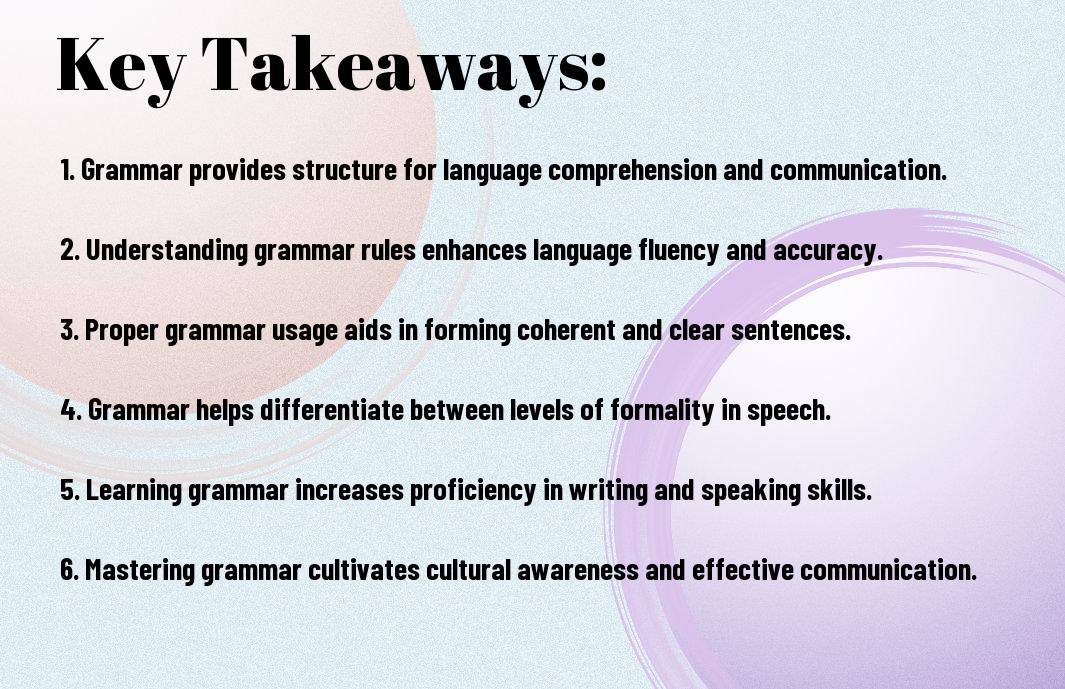
Key Takeaways:

  • Grammar is the backbone: Understanding grammar rules is crucial in mastering a new language as it provides the structure for meaningful communication.
  • Ensures clarity and accuracy: Proper grammar usage helps in conveying thoughts accurately and clearly, minimizing misunderstandings in conversations.
  • Boosts confidence: Proficiency in grammar gives language learners confidence in expressing themselves fluently and effectively in the target language.

The Foundation of Language

Grammar as the Building Blocks

For you to master a new language, you must understand that grammar serves as the foundation of any language. Just like building a house requires a strong foundation, mastering a language requires a solid understanding of grammar. Grammar provides the structure and rules that govern how words are put together to form sentences. By learning grammar, you will be able to construct meaningful and coherent sentences in the new language.

When you grasp the basic grammar rules, such as verb conjugation, sentence structure, and word order, you will be equipped with the building blocks needed to communicate effectively in the new language. While grammar may seem daunting at first, remember that it is imperative for you to progress and become fluent in the language.

The Importance of Syntax and Semantics

For you to truly master a new language, you must also understand the importance of syntax and semantics. Syntax refers to the arrangement of words in a sentence to convey meaning, while semantics focuses on the meaning of words and how they contribute to the overall understanding of a sentence. By grasping syntax and semantics, you will be able to express your thoughts clearly and accurately in the new language.

The way words are organized in a sentence can completely change the meaning of what you are trying to say. By paying attention to syntax and semantics, you will avoid misunderstandings and effectively convey your message to others. Understanding how syntax and semantics work together will make your language learning journey smoother and more successful.

The Role of Grammar in Communication

Clearly, grammar plays a crucial role in communication when mastering a new language. It serves as the foundation for effectively conveying your thoughts and ideas to others. By understanding the rules of grammar, you can structure your sentences in a way that makes sense and is coherent to the listener or reader.

Effective Expression of Ideas

An necessary aspect of grammar in communication is the effective expression of ideas. When you have a strong grasp of grammar, you can articulate your thoughts clearly and succinctly. Knowing how to use different tenses, word order, and sentence structure allows you to express yourself accurately, making it easier for others to understand you.

Avoiding Miscommunication

Miscommunication can easily arise when grammar rules are not followed correctly. Incorrect verb conjugation, misuse of punctuation, or improper word choice can lead to misunderstandings. By mastering grammar, you can minimize the risk of miscommunication and ensure that your message is conveyed accurately.

Miscommunication can hinder effective communication and create confusion between you and the listener. By paying attention to grammar rules, you can avoid potential pitfalls that may lead to misinterpretation of your intended meaning.

Grammar and Vocabulary Acquisition

All language learners have pondered the importance of grammar rules in the process of mastering a new language. Some argue that grammar rules serve as the backbone of a language, facilitating better understanding and communication. On the other hand, there are those who believe in a more natural approach, focusing on vocabulary acquisition and immersion. If you’re still unsure about the role grammar plays in your language learning journey, you can explore different perspectives on How important are grammar rules when learning a new language?

How Grammar Aids in Learning New Words

An vital aspect of grammar in language learning is its role in helping you understand and remember new words. Grammar rules provide a framework within which new vocabulary can be learned and applied correctly. For example, knowing the grammatical rules related to verb conjugation can help you understand how different words are used in various contexts, thus expanding your vocabulary more effectively.

The Interplay between Grammar and Lexicon

The relationship between grammar and vocabulary is symbiotic. While grammar rules offer the structure for language usage, vocabulary enriches the language with meaning. The interplay between grammar and lexicon is crucial for achieving fluency in a new language. By grasping grammar principles, you can better comprehend the nuances of vocabulary usage, and by expanding your lexicon, you enhance your ability to apply grammar rules accurately. This dynamic interaction between grammar and vocabulary is fundamental in your language acquisition journey.

Another important aspect to consider is that grammar provides the rules that govern how words are combined to form meaningful sentences. Without a solid understanding of grammar, it can be challenging to convey your thoughts accurately or comprehend the messages conveyed by others. Therefore, mastering grammar alongside vocabulary acquisition is vital for becoming proficient in a new language.

The Impact of Grammar on Reading and Writing Skills

Despite the challenges that grammar rules may present, mastering them is crucial for enhancing your reading and writing skills in a new language. Understanding grammar plays a significant role in both decoding and encoding text, which are important aspects of language acquisition.

Decoding and Encoding Text

Encoding text involves your ability to express your thoughts and ideas clearly in writing. By applying grammar rules correctly, you can construct sentences that effectively convey your message. Understanding the structure of a language, such as word order and verb conjugation, is vital for producing coherent written text.

Improving Comprehension and Fluency

Grammar also plays a crucial role in improving your comprehension and fluency when reading in a new language. By grasping grammar rules, you can better understand the relationships between words in a sentence and interpret the meaning of the text more accurately. This, in turn, enhances your reading fluency and overall language proficiency.

To enhance your reading and writing skills in a new language, it is important to dedicate time and effort to mastering grammar rules. By consistently practicing and applying these rules in your language learning journey, you will gradually improve your ability to decode and encode text effectively, as well as enhance your comprehension and fluency in the language.

Grammar and Cultural Nuances

Unlike The Importance of Grammar in English Language, where grammar is mainly viewed as a structural component of language, mastering grammar in a new language goes beyond just rules and syntax. It also involves understanding the cultural nuances that are embedded in the language.

Idiomatic Expressions and Colloquialisms

For a language learner, grasping idiomatic expressions and colloquialisms is crucial for effective communication. These expressions are unique to each language and often carry different meanings than their literal translations. By mastering these nuances, you not only blend in better with native speakers but also gain insights into the cultural context and humor of the language.

Cultural References and Allusions

For language mastery, it’s vital to probe into the cultural references and allusions present in the language. Understanding these references not only improves your language skills but also broadens your cultural knowledge. It enables you to connect more deeply with native speakers and facilitates a more nuanced understanding of the language.

Expressions that carry cultural significance may not have direct equivalents in your native language, so learning them expands your cultural literacy and enhances your ability to communicate effectively in a foreign language.

Overcoming Grammar Challenges

Common Pitfalls and Errors

To master a new language, you must be aware of common pitfalls and errors that learners often face when it comes to grammar. One of the most frequent mistakes is trying to translate directly from your native language, leading to awkward phrasing and incorrect word order. Additionally, incorrect verb conjugations and misuse of articles are common issues that can hinder your language learning progress.

Strategies for Improvement

For overcoming these challenges, it is important to immerse yourself in the language as much as possible. Practice regularly with native speakers or language exchange partners to get real-time feedback on your grammar usage. Additionally, utilizing language learning apps and resources that focus on grammar exercises can help you reinforce your understanding and application of grammar rules.

An effective strategy for improving your grammar skills is to break down complex grammar rules into smaller, more manageable parts. Instead of trying to learn everything at once, focus on one grammar concept at a time and practice it until you feel comfortable. This approach can prevent overwhelm and help you gradually build your grammatical proficiency.

Understanding

Understanding the importance of grammar in mastering a new language is crucial. Grammar serves as the foundation of a language, providing you with the structure and rules needed to effectively communicate. By identifying common pitfalls, implementing strategies for improvement, and breaking down complex grammar concepts, you can overcome grammar challenges and enhance your language learning journey.

Summing up

As a reminder, grammar plays a crucial role in mastering a new language. It provides you with the rules and structure necessary to communicate effectively and understand the language in its entirety. By familiarizing yourself with grammar rules, you can enhance your language skills and become more proficient in speaking, writing, and comprehending a new language.

Q: Why is grammar important when mastering a new language?

A: Grammar is crucial in language learning as it provides the structure and rules needed to form correct sentences and communicate effectively.

Q: How can grammar help in improving language skills?

A: Understanding grammar helps learners to construct sentences correctly, convey their thoughts accurately, and enhance their overall language proficiency.

Q: What are the consequences of neglecting grammar in language learning?

A: Neglecting grammar can lead to confusion, miscommunication, and inaccuracies in language usage, hindering the ability to fully grasp and master a new language.

Skip to content