As you initiate on your language learning journey, you’ll discover that retaining new vocabulary and grammar rules can be a challenge. Your ability to learn a language quickly depends on your capacity to associate new information with something familiar. You can significantly accelerate your learning process by utilizing mnemonics, a powerful tool that helps you connect new words and phrases to your existing knowledge, making it easier to recall them later, and you will learn how to do it in this post.
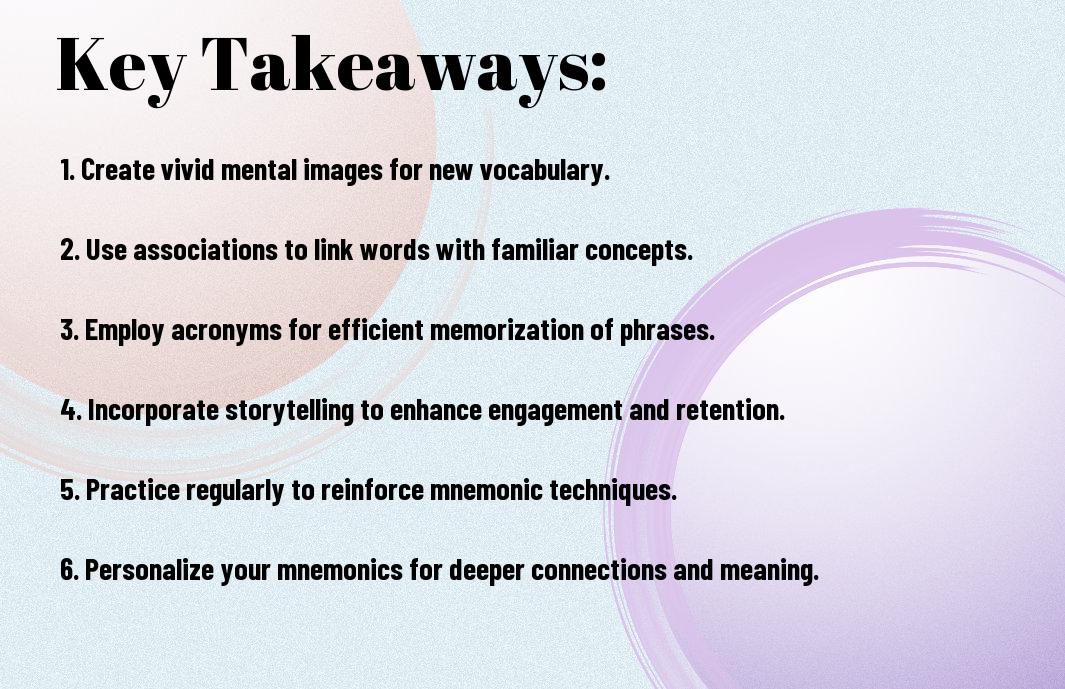
Key Takeaways:
- Using mnemonic devices can significantly improve your ability to learn a language faster by associating new vocabulary with visual images or rhyming phrases that help you decode and encode information more efficiently.
- Creating mental connections between new words and personal experiences or emotional events can enhance your retention and recall of the language, making the learning process more engaging and effective.
- Implementing spaced repetition techniques with mnemonics can further boost your language learning progress by optimizing the review schedule and helping you focus on the most challenging vocabulary and grammar rules.
Introduction to Language Learning with Mnemonics
While learning a language can be a challenging task, using mnemonics can make it more efficient and enjoyable. You can create associations between new words and your existing knowledge to aid in recall. This technique enhances your ability to learn and retain new information, making your language learning journey more effective.
subsection: The Power of Mnemonics in Language Learning
About the time you start using mnemonics, you’ll notice a significant improvement in your language learning process. You can link new vocabulary to personal experiences, making it easier for you to recall words and phrases. This technique allows you to tap into your creative potential, making learning more engaging and fun.
subsection: Benefits of Using Mnemonics for Language Acquisition
On the subject of language acquisition, using mnemonics offers numerous benefits. You can improve your retention rates, reduce study time, and increase your confidence in using the target language. As you progress, you’ll find that mnemonics help you to internalize grammar rules and vocabulary more effectively.
Also, as you continue to use mnemonics in your language learning, you’ll discover that it enhances your ability to think creatively and make connections between different pieces of information. You’ll be able to apply this skill to various aspects of language learning, such as pronunciation, reading comprehension, and conversation. By incorporating mnemonics into your study routine, you’ll be able to learn a language faster and more efficiently, achieving your goals in a shorter amount of time.
Introduction to Mnemonics
Any language learner can benefit from using mnemonics to improve their skills. You can use mnemonics to associate new words with something you already know, making it easier to learn and retain new information.
subsection: Creating Effective Mnemonics for Vocabulary
Vocabularily building is a key part of language learning, and you can create mnemonics to help you learn new words by associating them with a word or phrase in your native language.
subsection: Using Associations and Visualizations
Efficiently using associations and visualizations can help you create powerful mnemonics that stick in your mind, allowing you to recall new vocabulary and grammar rules with ease, as you practice using them to learn new language skills.
This technique involves using vivid mental images to associate with new words or phrases, helping you to create a lasting connection in your mind, and as you practice using associations and visualizations, you will find that your ability to learn and retain new language information improves dramatically, allowing you to become proficient in the language you are learning.
Learning with Mnemonics
Many language learners have discovered that mnemonics can significantly improve their learning speed and retention. You can use mnemonics to associate new words with memories, making them easier to recall. By applying mnemonics to your language learning, you can enhance your vocabulary and comprehension.
Practical Tips for Implementing Mnemonics in Daily Study
Along with other study techniques, you can use mnemonics to aid your learning. Here are some tips:
- Create mental images to Associate with new words
Thou can improve your language skills by incorporating mnemonics into your daily study routine, making it more engaging and effective for you.
Incorporating Mnemonics into Language Learning Routines
Linguistically, you can use mnemonics to connect new language concepts to your existing knowledge. You can create flashcards or concept maps to visualize relationships between words and ideas, making it easier for you to learn and apply them in context.
The key to successfully incorporating mnemonics into your language learning routine is to make them a consistent part of your study practice. You can start by identifying areas where you struggle the most, such as vocabulary or grammar, and creating mnemonics to help you overcome those challenges. As you continue to use mnemonics, you will find that your ability to learn and retain new language information improves, allowing you to progress faster in your language learning journey.
Introduction to Mnemonics
All language learners can benefit from using mnemonics to improve their skills. You can use associations, acronyms, and rhymes to help you learn and retain new vocabulary and grammar rules. This technique can be applied to any language, making it a valuable tool for your language learning journey.
Overcoming Common Challenges with Mnemonics
Above all, mnemonics can help you overcome common challenges such as forgetting new words or phrases. You can create mental associations to link new information to something you already know, making it easier to recall.
Staying Motivated and Consistent
On top of using mnemonics, you need to stay motivated and consistent in your practice. You can set achievable goals and track your progress to help you stay on track and see the results of your efforts.
Indeed, staying motivated and consistent is key to seeing progress in your language learning. You can use mnemonics to make your practice sessions more engaging and fun, which will help you stay motivated to continue learning and improving your skills. You will be able to see the results of your efforts and feel a sense of accomplishment, which will keep you motivated to keep going.

Mnemonics Fundamentals
Unlike traditional learning methods, mnemonics can significantly accelerate your language learning journey. To understand how, you can visit What are mnemonics? And how to use mental techniques to learn a language for more insights.
subsection: Advanced Techniques for Mnemonic Mastery
Among the various strategies, you can use the following:
- Chain method
- Loci method
Technique Description Chain method Associating words in a story Loci method Visualizing locations subsection: Exploring Different Types of Mnemonics
About the types of mnemonics, you have:
- Acronyms
- Rhymes
Type Example Acronyms ROY G BIV for colors Rhymes Thirty days hath September Chain method Associating words Loci method Visualizing locations Mind palace Imagining a familiar place Knowing the different types will help you choose the best one for your learning style.
Also, as you explore mnemonics, you’ll find:
- Acoustic mnemonics
- Visual mnemonics
Type Description Acoustic Using sound associations Visual Using image associations Kinesthetic Using physical associations Semantic Using meaning associations Mixed Combining multiple types Knowing these variations will enhance your ability to learn a language faster with mnemonics.
Effective Mnemonic Techniques
After understanding the basics of mnemonics, you can start applying them to your language learning journey, leveraging associations, acronyms, and visualizations to boost your memory and retention.
subsection: Integrating Mnemonics with Other Language Learning Methods
With careful planning, you can combine mnemonics with other language learning methods, such as flashcards, language apps, and conversation practice, to create a well-rounded learning approach that suits your needs and style.
subsection: Maximizing Retention and Recall
Similarly, sectioning your study sessions into manageable chunks and reviewing them regularly will help solidify new vocabulary and grammar rules in your long-term memory, making it easier to recall them when needed.
In fact, as you practice using mnemonics to learn a language, you’ll find that your brain becomes more adept at creating connections between new and existing knowledge, allowing you to absorb and apply new information more efficiently, and ultimately, helping you to become a more proficient language learner.
To wrap up
So, you now have the tools to learn a language faster with mnemonics. You can apply these techniques to your language learning journey, enhancing your ability to absorb and retain new information. By using mnemonics, you will be able to improve your vocabulary and grammar skills, making your language learning process more efficient and effective. You will see significant progress in your language skills, and your efforts will be rewarded with improved communication abilities.
FAQ
Q: What is the most effective way to use mnemonics for language learning?
A: The most effective way to use mnemonics for language learning is to create associations between new vocabulary words and something you already know, such as a word in your native language, a personal experience, or a visual image. For example, if you’re trying to learn the French word “pomme” (apple), you could imagine a pom-pom on an apple tree. The more outrageous and personalized the association, the better it will stick in your long-term memory. Consistency is key, so try to set aside time each day to practice using mnemonics to learn new vocabulary.
Q: Can mnemonics be used for learning grammar rules in a foreign language?
A: Yes, mnemonics can be a powerful tool for learning grammar rules in a foreign language. One technique is to create acronyms or rhymes that help you recall key grammar rules. For instance, you could use the acronym “DDS” to recall the sentence structure for the present tense in Spanish: “Debe” (subject), “Dominio” (verb), and “Sujeto” (object). Another approach is to visualize a diagram or chart that illustrates the grammar rule, such as a flowchart for verb conjugation. By using mnemonics to encode grammar rules, you can reduce your reliance on rote memorization and develop a deeper understanding of the language.
Q: How can I use mnemonics to improve my pronunciation in a foreign language?
A: Mnemonics can be used to improve your pronunciation in a foreign language by creating associations between the sounds and intonation patterns of the language and your own physical sensations or visualizations. For example, if you’re trying to learn the correct pronunciation of a vowel sound, you could associate it with a specific facial expression or mouth position. Another technique is to use music or rhythm to help you internalize the intonation patterns of the language. Try listening to native speakers and mimicking their intonation, or create your own rhymes or songs that encode the pronunciation patterns you want to practice. With consistent practice and review, you can use mnemonics to develop more accurate and natural-sounding pronunciation in your target language.