
Multilingual.

What are the cognitive benefits of being bilingual or multilingual

Most of the time, when you think about being bilingual or multilingual, you probably focus on the practical benefits like being able to communicate with more people or having better job opportunities. However, did you know that being bilingual or multilingual also offers significant cognitive advantages? In this article, you will discover the fascinating ways in which speaking more than one language can positively impact your brain and cognitive abilities.

Key Takeaways:

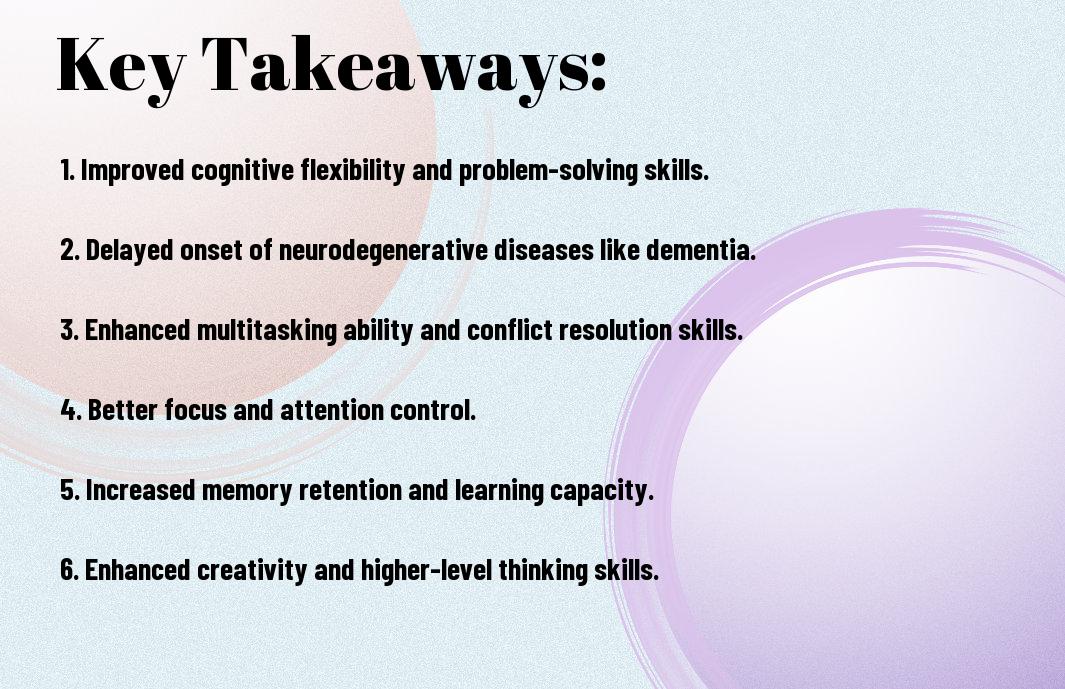
  • Enhanced cognitive abilities: Bilingual or multilingual individuals often show improved abilities in areas such as problem-solving, critical thinking, and multitasking due to constantly switching between languages.
  • Delay in cognitive decline: Research suggests that speaking multiple languages can help delay the onset of diseases like Alzheimer’s and dementia, and can also improve overall brain health and function as one ages.
  • Increased mental flexibility: Bilingual or multilingual individuals typically have greater mental flexibility, better memory, and an increased ability to adapt to new situations and environments, which may contribute to overall cognitive benefits.
Enhanced Cognitive Abilities

A The benefits of being bilingual, with Viorica Marian, PhD study conducted by the American Psychological Association suggests that being bilingual or multilingual can provide numerous cognitive benefits that can enhance your mental abilities.

Improved Memory and Attention

One of the key cognitive benefits of being bilingual or multilingual is improved memory and attention. Research has shown that individuals who speak more than one language have better working memory, allowing them to store and process information more efficiently. Additionally, being bilingual requires a constant management of two language systems, which strengthens your brain’s executive function and attention control.

Enhanced Problem-Solving Skills

Cognitive flexibility is another cognitive benefit that comes with being bilingual or multilingual. When you speak multiple languages, your brain is constantly switching between languages and inhibiting one language while using another. This mental agility can enhance your problem-solving skills and make you more adept at handling complex tasks that require creative thinking.

Another aspect of enhanced problem-solving skills linked to bilingualism is the ability to think outside the box. When you are fluent in multiple languages, you have exposure to different cultural perspectives and communication styles, which can enable you to approach problems from various angles and come up with innovative solutions.

Delayed Onset of Age-Related Cognitive Decline

Slowing Down Cognitive Aging

Some research suggests that being bilingual or multilingual can significantly delay the onset of age-related cognitive decline. An individual who speaks multiple languages may experience a slower decline in cognitive functions such as memory, attention, and problem-solving as they age. This delay is believed to be due to the constant mental workout that the brain receives when switching between languages and inhibiting one language while using another.

Reduced Risk of Dementia and Alzheimer’s

Dementia refers to a decline in cognitive function that interferes with daily life, while Alzheimer’s disease is a specific type of dementia characterized by memory loss and cognitive decline. Studies have shown that individuals who are bilingual or multilingual have a reduced risk of developing dementia and Alzheimer’s compared to monolingual individuals. The cognitive reserve built from speaking multiple languages appears to provide a buffer against the brain changes associated with these conditions, allowing for better preservation of cognitive abilities even in the face of neurodegenerative diseases.

Alzheimer’s disease is a progressive neurological condition that primarily affects memory and other cognitive functions. Being bilingual or multilingual has been linked to a lower risk of developing Alzheimer’s disease. The cognitive benefits of language learning and maintenance may help build a reserve that can provide protection against the brain changes associated with Alzheimer’s, delaying its onset or reducing its severity. By challenging your brain with multiple languages, you may be able to fortify its cognitive resources and resilience, potentially decreasing your susceptibility to this debilitating disease.

Increased Gray Matter

Keep exploring the Cognitive benefits of being bilingual by delving into the fascinating world of brain plasticity and how being bilingual or multilingual can impact the structure of your brain. Research has shown that bilingual individuals tend to have increased gray matter in areas of the brain related to language control and executive function. This growth in gray matter may be attributed to the constant cognitive effort required to switch between languages and inhibit one language while using another.

Brain Plasticity and Neurogenesis

Neurogenesis, the process of generating new neurons in the brain, is heightened in bilingual individuals. This phenomenon suggests that the act of speaking multiple languages may serve as a cognitive workout for your brain, promoting the growth of new neural pathways and enhancing overall brain health.

Enhanced Language Processing

Plasticity refers to the brain’s ability to reorganize itself by forming new neural connections throughout life. Being bilingual or multilingual enhances this plasticity, enabling you to adapt more easily to new language structures and rules.

This heightened plasticity not only improves your language learning abilities but also has broader implications on cognitive functions such as problem-solving and multitasking. Your brain becomes more adept at processing and interpreting information, making you a more efficient and effective communicator in all aspects of your life.

Better Academic Performance

Many studies have shown that being bilingual or multilingual can lead to better academic performance across various subjects. This cognitive advantage stems from the brain’s ability to switch between different languages, improving cognitive flexibility and problem-solving skills. As a result, bilingual individuals often exhibit higher levels of academic achievement compared to their monolingual peers.

Improved Reading Comprehension

Reading comprehension is a vital skill in academic success, and being bilingual can significantly enhance this ability. When you are fluent in multiple languages, you develop a deeper understanding of how languages work, such as grammar, syntax, and vocabulary. This heightened language awareness translates into improved reading comprehension skills, allowing you to comprehend complex texts more effectively and extract key information with ease.

Enhanced Math and Science Skills

Better cognitive skills acquired through bilingualism also extend to math and science subjects. Research has shown that bilingual individuals often outperform monolinguals in mathematical reasoning and problem-solving tasks. The cognitive benefits of being bilingual, such as enhanced executive functions and improved working memory, play a significant role in boosting your performance in math and science-related tasks. So, the next time you tackle a challenging math problem or a complex scientific concept, your bilingualism might give you a cognitive edge!

Skills in areas like math and science require strong analytical and problem-solving abilities, which are honed through the cognitive advantages that come with being bilingual or multilingual. These enhanced cognitive functions not only help you excel in academic settings but also equip you with valuable skills that can be applied in various aspects of your life, both academically and professionally.

Career Advantages

Increased Job Opportunities

Unlike monolingual individuals, being bilingual or multilingual opens up a world of increased job opportunities for you. Many companies today operate on a global scale, dealing with clients, partners, and customers from diverse linguistic backgrounds. Your ability to communicate in more than one language makes you a valuable asset in such environments. You can easily work in international markets, negotiate deals with foreign partners, and navigate cross-cultural communication with ease.

Enhanced Communication and Collaboration

One of the key cognitive benefits of being bilingual or multilingual is enhanced communication and collaboration skills. Your proficiency in multiple languages enables you to engage with a wider range of colleagues, clients, and stakeholders. You can effectively bridge language barriers, foster understanding between team members from different backgrounds, and facilitate smooth collaboration on projects that involve multicultural teams. Your adaptability in switching between languages also showcases your flexibility and resourcefulness in the workplace.

Opportunities for career advancement often arise from your ability to communicate effectively and collaborate efficiently with a diverse range of individuals. As a bilingual or multilingual professional, you are well-equipped to take on leadership roles that require strong interpersonal skills and the capacity to connect with people from varying linguistic and cultural contexts. Your linguistic abilities can set you apart in job interviews, networking events, and professional interactions, demonstrating your competence and cultural awareness to potential employers and colleagues.

Cultural Enrichment and Empathy

Your ability to speak multiple languages not only enhances your cognitive skills but also enriches your cultural perspective and empathy towards others.

Broader Cultural Perspective

Empathy is a crucial skill in today’s interconnected world, allowing you to understand and appreciate different cultures. Being bilingual or multilingual exposes you to diverse ways of thinking, communicating, and living. This exposure helps you develop a broader cultural perspective, enabling you to empathize with people from different backgrounds and understand their viewpoints.

Deeper Understanding of Different Cultures

To deepen your understanding of different cultures, you must immerse yourself in their languages. Language is intertwined with culture, and by speaking multiple languages, you gain insight into the values, beliefs, and customs of various societies. This deeper understanding fosters empathy and allows you to navigate cross-cultural interactions with sensitivity and respect.

Another benefit of speaking multiple languages is the ability to break down cultural barriers and foster meaningful connections with individuals from diverse backgrounds. By engaging with others in their native language, you show a willingness to bridge linguistic and cultural gaps, creating a sense of understanding and empathy that transcends borders.

Summing up

Conclusively, being bilingual or multilingual offers a multitude of cognitive benefits. Your brain becomes more efficient in problem-solving, multitasking, and decision-making as it continuously exercises its cognitive functions by switching between languages. Additionally, your ability to empathize and understand others improves as you develop a deeper appreciation for different cultures and perspectives through language.

Q: What are the cognitive benefits of being bilingual or multilingual?

A: Being bilingual or multilingual can improve cognitive abilities such as problem-solving skills, multitasking, and decision-making. It can also enhance creativity, memory, and overall brain function.

Q: How does being bilingual or multilingual affect the brain?

A: Studies have shown that bilingual or multilingual individuals have increased brain connectivity, which can lead to better cognitive function and a reduced risk of cognitive decline as they age. This constant switching between languages exercises the brain, making it more efficient and flexible.

What are some other cognitive benefits of being bilingual or multilingual?

A: In addition to improved cognitive abilities, being bilingual or multilingual has been linked to better academic performance, greater empathy, and a heightened ability to understand and appreciate different perspectives and cultures. It can also delay the onset of diseases like Alzheimer’s and dementia.

How can studying linguistics aid in learning new languages

There’s a substantial advantage to delving into linguistics when launching on the journey of learning a new language. Understanding the underlying structures, patterns, and rules that govern languages can significantly enhance your ability to grasp new linguistic concepts and apply them effectively. By studying linguistics, you’ll gain a deeper insight into how languages function, which will equip you with the tools to navigate the complexities of acquiring a new language with confidence and proficiency.

Key Takeaways:

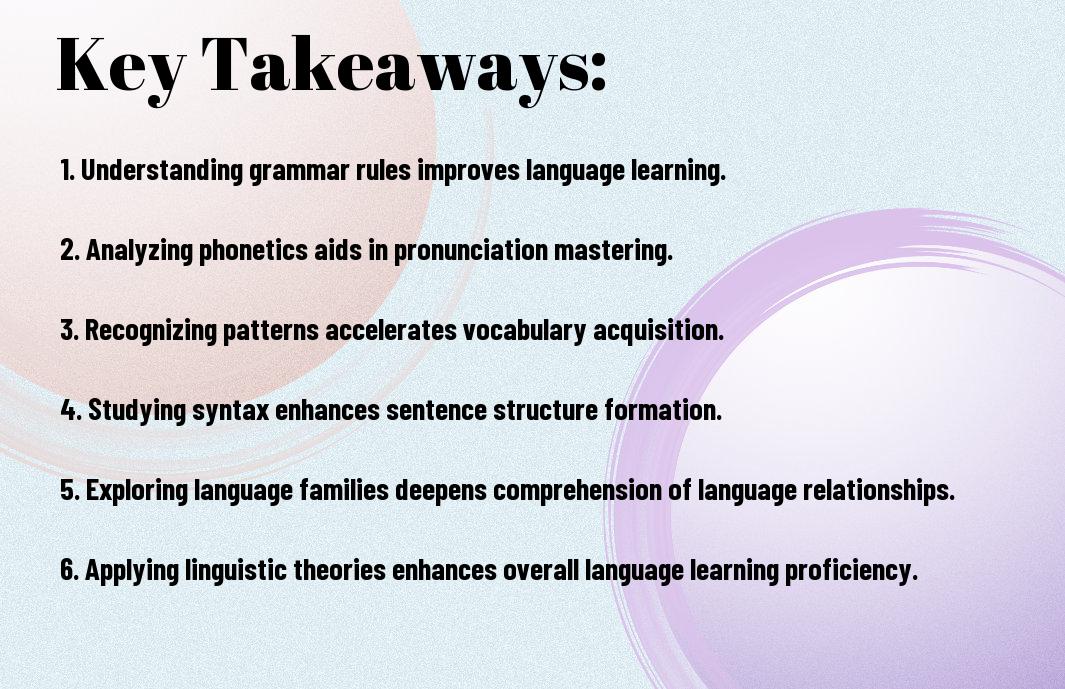
  • Understanding language structures: Studying linguistics can help learners recognize patterns in different languages, making it easier to understand and learn new languages.
  • Improving language learning strategies: Knowledge of linguistics concepts such as phonetics, syntax, and semantics can guide language learners in adopting effective study techniques and strategies.
  • Enhancing communication skills: Linguistics provides insights into how languages work, enabling learners to communicate more effectively and accurately in various languages.

The Building Blocks of Language

Phonetics and Phonology: Decoding Sounds

Language starts with sounds. Phonetics and phonology focus on the study of speech sounds and patterns. By understanding the intricacies of phonetics, you can improve your pronunciation and accent in a new language. Learning phonetics can help you differentiate between similar sounds that may not exist in your native language, giving you a better grasp of the language you are learning. Moreover, mastering phonetics can also enhance your listening skills, as you become more attuned to how words are pronounced.

Morphology: The Structure of Words

Structure is crucial in language. Morphology, the study of how words are formed and their internal structure, plays a significant role in language learning. By delving into morphology, you gain insights into how words are constructed, including prefixes, suffixes, and root words. Understanding morphology can help you decipher the meanings of unfamiliar words by breaking them down into their constituent parts. This knowledge allows you to expand your vocabulary more efficiently and comprehend the intricate connections between words in the language you are studying.

This deep examine morphology equips you with the tools to not only decipher new words but also to create your own. As you grasp the foundations of morphological rules and word formation, you can apply this knowledge to enhance your language skills and express yourself more effectively in the language you are trying to master.

Grammar and Syntax

Clearly, studying linguistics can greatly aid you in learning new languages. By understanding the principles of grammar and syntax, you can decipher the rules that govern how words are organized and structured in a sentence. This knowledge allows you to grasp the nuances of sentence construction and word order, which vary across languages. If you are interested in delving deeper into why studying linguistics is beneficial, you can check out Why Study Linguistics?

Sentence Structure and Word Order

With a foundation in linguistics, you can analyze the sentence structure and word order of different languages more effectively. This understanding enables you to comprehend how changing the arrangement of words can alter the meaning of a sentence. By comparing and contrasting the syntax of your native language with the language you are learning, you can identify patterns and draw parallels that aid in your language acquisition journey.

Tense, Aspect, and Mood: Unraveling Complexity

Word order is just the tip of the iceberg when it comes to grammar and syntax. Tense, aspect, and mood are crucial elements that influence how verbs function in a sentence. By studying linguistics, you can unravel the complexity of these aspects and understand how they impact the meaning and structure of sentences in different languages. This knowledge equips you with the skills to navigate the intricacies of verb conjugation and sentence formation.

Understanding the intricacies of tense, aspect, and mood can be challenging, but with a linguistic perspective, you can break down these concepts into digestible parts. By grasping the rules and patterns that govern these elements, you can enhance your ability to communicate accurately and fluently in a new language.

Semantics and Pragmatics

Now, let’s investigate into the fascinating fields of semantics and pragmatics in linguistics, which can greatly aid you in learning new languages.

Meaning-Making: Words, Context, and Culture

One of the fundamental aspects of semantics is understanding how meaning is constructed through words, context, and culture. By studying semantics, you will learn how words convey specific meanings based on linguistic structures and cultural norms. This knowledge will help you navigate the nuances of language use in different cultural settings, making your language learning journey more nuanced and effective.

Implicature and Inference: Beyond Literal Meaning

Words do not always convey just their literal meanings. In this subsection, you will explore implicature and inference, which are crucial aspects of pragmatics. Understanding implicatures – the implied meanings beyond the literal interpretations of words – and inferences – the logical deductions made based on the context – will elevate your language comprehension skills. By grasping these concepts, you will be able to decipher hidden meanings, jokes, and metaphors in a new language more effectively.

In the subsection on Implicature and Inference: Beyond Literal Meaning, you will learn how to look beyond the surface meaning of words and recognize the underlying messages conveyed through language use. This skill is crucial for becoming a proficient language learner, as it allows you to understand the subtle nuances and implied meanings in conversations and texts.

Language Acquisition and Development

Despite Why Study Linguistics? – Department of Linguistics, many people still underestimate the importance of linguistics in aiding language learning. Understanding how languages are acquired and developed can provide valuable insights for learners. By delving into the mechanisms that underlie language acquisition, you can gain a deeper appreciation of the complexity and nuances of the languages you are trying to learn.

How Children Learn Language: Insights for Adults

The process of language acquisition in children offers valuable lessons for adult language learners. Children effortlessly pick up languages through exposure and interaction with their environment. They learn to distinguish sounds, recognize patterns, and internalize grammar rules naturally. As an adult learner, observing and understanding these natural processes can help you adapt your learning strategies. Emulating the immersive environment that children experience can enhance your language learning journey.

Language Contact and Change: The Role of Environment

Acquisition of a new language is influenced by the environments in which you immerse yourself. The contact between languages in multilingual settings can lead to linguistic changes and adaptations. Exposure to diverse linguistic environments can enrich your understanding of language structures and facilitate language learning. By recognizing the role of environment in language contact and change, you can strategically choose environments that support your language learning goals.

Learn how language contact in multilingual settings can introduce new vocabulary, alter pronunciation, and shape grammatical structures. By engaging with diverse linguistic environments, you can expand your language repertoire and enhance your proficiency. The dynamic nature of language contact highlights the importance of cultural immersion and interaction in language learning.

Cognitive Benefits of Linguistic Knowledge

Improved Memory and Attention

Unlike studying other subjects, delving into linguistics can significantly improve your memory and attention. By learning the intricacies of different languages, you are constantly engaging your brain in recognizing patterns, memorizing vocabulary, and understanding complex grammar rules. This mental exercise helps strengthen your memory retention capacity and enhances your ability to focus on tasks.

Enhanced Problem-Solving and Critical Thinking

Improved linguistic knowledge can also lead to enhanced problem-solving and critical thinking skills. When you study linguistics, you analyze language structures, syntax, and semantics, which require you to think logically and critically. This analytical thinking can be applied to various real-life situations where you need to solve problems or make decisions.

Enhanced problem-solving and critical thinking skills acquired through the study of linguistics can benefit you in various aspects of your life, such as academic pursuits, professional endeavors, and even personal interactions. The ability to think analytically and solve complex issues is a valuable skill that can set you apart in many situations.

Applications in Language Learning

Identifying Patterns and Anomalies

On your language learning journey, studying linguistics can help you identify patterns and anomalies within the language you are learning. By understanding the underlying structures and rules of grammar, phonetics, and syntax, you can make connections that may not be immediately obvious. This analytical skill can assist you in recognizing common language patterns, which in turn can make learning new vocabulary and grammar rules more intuitive and efficient.

Developing Effective Language Learning Strategies

Language learning involves more than just memorizing vocabulary and grammar rules; it requires effective strategies to immerse yourself in the language and culture. By leveraging your understanding of linguistics, you can tailor your learning approach to suit your individual needs. Linguistics can provide insights into how languages are acquired and processed, enabling you to optimize your learning methods to enhance comprehension and retention.

Another benefit of incorporating linguistics into your language learning journey is the ability to better comprehend the nuances of a language. Learning about phonology, morphology, and semantics can deepen your understanding of how words are formed and interpreted in context. This advanced knowledge can give you a competitive edge in mastering new languages with accuracy and fluency.

Final Words

Presently, studying linguistics can greatly aid you in learning new languages. By understanding the structures, patterns, and rules of language, you will have a more solid foundation when approaching a new language. Linguistics can provide insights into how different languages are related, helping you recognize similarities and differences that can facilitate the learning process. Additionally, studying linguistics can enhance your phonetic awareness and help you grasp unfamiliar sounds more easily, enabling better pronunciation in your target language.

Overall, delving into linguistics can not only broaden your linguistic comprehension but also improve your language learning skills. So, if you are eager to explore new languages and expand your cultural horizons, consider incorporating linguistics into your language learning journey – the benefits are boundless. Happy learning!

Q: How can studying linguistics aid in learning new languages?

A: By studying linguistics, individuals can gain a deeper understanding of language structures, which can help them identify patterns and rules in the language they are trying to learn.

Q: What aspects of linguistics can be particularly helpful in language learning?

A: Phonetics and phonology can be beneficial in improving pronunciation, while syntax and morphology can assist in understanding sentence structure and word formation in the target language.

Q: Can studying linguistics enhance language learning strategies?

A: Yes, studying linguistics can provide learners with a toolkit of language learning strategies and techniques based on scientific principles, making the language learning process more efficient and effective.

Jhere Skip to content