As you navigate the complexities of language, you’ll encounter various styles that can impact your communication. You need to master both formal and informal language to effectively convey your message. Your ability to switch between these styles will depend on your understanding of their distinct features and appropriate usage. By learning these styles, you will be able to express yourself clearly and confidently in different situations, from professional settings to casual conversations, and adapt your language to suit your audience.
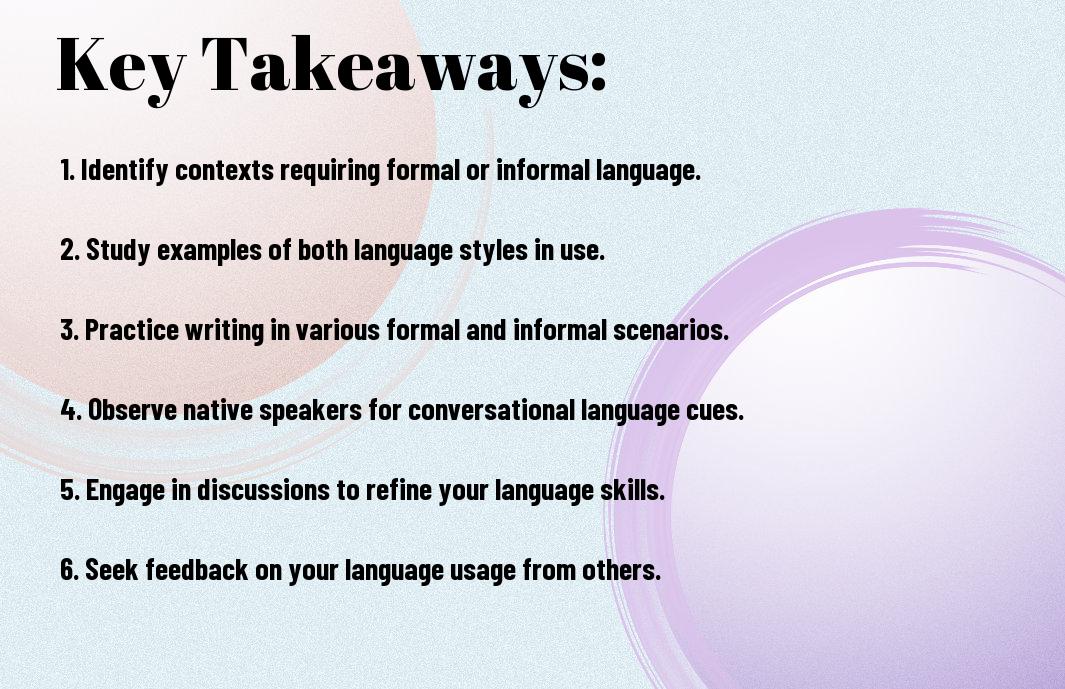
Key Takeaways:
To develop effective communication skills, it’s crucial to learn both formal and informal language styles. Here are three key points to consider:
- Understanding the context is vital in determining whether to use formal or informal language, as it helps to establish the tone and audience engagement.
- Vocabulary and grammar play a significant role in distinguishing between formal and informal language styles, with formal language often requiring more complex structures and sophisticated words.
- Practicing both written and spoken communication in different settings will help to improve your ability to switch between formal and informal language styles, making you a more effective and versatile communicator.
Mastering Formal Language
Your ability to express yourself in formal language is necessary for making a good impression in academic and professional settings. You will need to develop a strong command of grammar, syntax, and vocabulary to communicate effectively.
Learning Formal Vocabulary
With consistent practice, you will become familiar with words and phrases commonly used in formal language, enabling you to convey your ideas with precision and clarity. You should focus on learning words with formal connotations and practice using them in context.
Practicing Formal Writing
Any attempt to write in a formal style requires attention to detail and a commitment to using proper grammar and spelling. You should strive to write clear, concise sentences that effectively convey your message, avoiding colloquialisms and slang.
Hence, as you practice writing in a formal style, you will become more aware of your tone and language use, allowing you to adjust your writing to suit different audiences and purposes, and to convey your ideas with confidence and authority, which is vital for effective communication in formal settings.
Exploring Informal Language
Some languages have distinct formal and informal styles, and understanding these differences is vital for effective communication. You will need to learn the nuances of informal language to express yourself naturally in everyday conversations.
Familiarizing Yourself with Colloquialisms
About the time you start learning informal language, you will encounter colloquial expressions that are unique to a particular region or culture. You will find that these expressions add flavor to your language and help you connect with native speakers.
Using Informal Language in Context
The key to mastering informal language is to use it in the right context. You will need to consider your audience, the situation, and the topic of conversation to determine whether formal or informal language is more suitable.
But as you practice using informal language in different contexts, you will develop a sense of what sounds natural and what doesn’t. You will learn to use contractions, colloquial expressions, and everyday phrases to make your language more relatable and engaging, and you will become more confident in your ability to express yourself in informal settings.

Developing Language Flexibility
To become proficient in using formal and informal language styles, you need to practice and immerse yourself in different linguistic environments. This will help you develop the ability to adapt your language to various contexts and audiences.
Adapting to Different Audiences
Developing your awareness of the audience is key to effective communication. You should consider the social status, age, and background of your listeners or readers to adjust your language accordingly, using vocabulary and tone that resonate with them.
Switching Between Formal and Informal Styles
One of the most significant challenges you will face is switching between formal and informal language styles. You need to be able to adjust your tone, vocabulary, and syntax to suit the occasion, whether it’s a job interview or a casual conversation with friends.
Language flexibility is necessary when switching between formal and informal styles. You will need to assess the situation and adjust your language to convey your message effectively, taking into account the level of formality required and the audience’s expectations. As you practice, you will become more comfortable navigating these different styles, and your communication will become more effective and nuanced.
Overcoming Language Barriers
Keep in mind that mastering formal and informal language styles is vital to effective communication. You can learn more about adapting your language to different situations by visiting Formal and Informal English: Adapting Your Language to Different Situations for valuable insights.
Identifying Cultural Differences
Around the world, cultural nuances influence language use, and you must consider these variations to communicate successfully. You will find that understanding these differences helps you tailor your language style to your audience.
Building Confidence in Language Use
To build confidence, practice using formal and informal language in different contexts, and you will become more comfortable with your language skills. This practice will help you navigate various social situations with ease.
With consistent practice, you will develop a keen sense of when to use formal or informal language, allowing you to express yourself more effectively in your personal and professional life. You will become adept at adjusting your tone and language style to suit your audience, making you a more confident and articulate communicator.
Effective Communication Strategies
After developing your skills in formal and informal language, you will be able to adapt your tone and style to suit various contexts, ensuring your message is conveyed clearly and effectively.
Using Tone and Audience Awareness
On the path to mastering language styles, you will learn to recognize the significance of tone and audience awareness, enabling you to tailor your language to engage and persuade your audience.
Avoiding Ambiguity and Jargon
Across different communication channels, you will encounter various obstacles, including ambiguity and jargon, which can hinder the effectiveness of your message, and it is your task to overcome them.
Considering the potential pitfalls of ambiguous language and jargon, you should strive to use clear and concise language, avoiding technical terms or complex phrases that may confuse your audience, and instead, opt for simple and straightforward expressions that convey your intended meaning, allowing you to communicate your ideas with precision and clarity.
Applying Language Skills
Not until you practice using formal and informal language styles will you become proficient in applying them in various contexts, allowing you to communicate effectively with different audiences.
Real-Life Scenarios and Applications
Betwixt personal and professional relationships, you will encounter situations where using the appropriate language style is crucial, and being able to switch between them seamlessly will make you a more effective communicator.
Continuous Learning and Improvement
Similar to other skills, your language skills will evolve as you confront new situations, and by engaging with various materials, such as books and articles, you will refine your ability to use language styles appropriately.
In fact, as you continue to learn and improve, you will develop a keen sense of when to use formal or informal language, and your communication will become more nuanced and sophisticated, allowing you to express yourself with clarity and precision in any situation, which will serve you well in both personal and professional endeavors, and will ultimately make you a more confident and effective communicator.
Conclusion
Drawing together the lessons learned, you now have a foundation to develop your skills in formal and informal language styles. As you continue to practice, visit Examining and Using Formal and Informal Language Styles to refine your understanding. You will become adept at shifting between styles, enhancing your communication and expressing yourself effectively in various contexts, making your language skills more versatile and effective.
FAQ
Q: What is the difference between formal and informal language styles, and why is it important to learn both?
A: Formal language is used in professional, academic, or official settings, characterized by complex vocabulary, precise grammar, and a polite tone. Informal language, on the other hand, is used in casual conversations with friends, family, or social media, often featuring colloquial expressions, contractions, and a relaxed tone. Mastering both styles is crucial to effectively communicate in various contexts, convey the intended message, and build strong relationships. Understanding the nuances of formal and informal language enables individuals to adapt their communication approach to suit the audience, purpose, and setting.
Q: How can I improve my skills in using formal language, especially in writing and public speaking?
A: To enhance your formal language skills, start by reading literary works, academic journals, and professional articles, which will expose you to sophisticated vocabulary, sentence structures, and tone. Practice writing formal essays, reports, or emails, focusing on clarity, coherence, and proper grammar. For public speaking, join a debate club, take a speech course, or participate in presentations at work or school. Listen to TED talks, podcasts, or speeches by esteemed leaders to observe how they use rhetorical devices, body language, and tone to convey their message. Recording yourself and seeking feedback from others can also help you refine your formal communication style.
Q: Are there any tips for distinguishing between formal and informal language in everyday conversations, and how can I switch between the two seamlessly?
A: To differentiate between formal and informal language in conversations, pay attention to the context, audience, and purpose. In formal situations, use titles (e.g., Mr./Ms./Dr.), last names, and avoid slang, jargon, or profanity. In informal settings, use first names, colloquial expressions, and a more relaxed tone. To switch between the two styles, be mindful of your language usage and adjust your tone, vocabulary, and body language accordingly. Practice code-switching by engaging in conversations with people from diverse backgrounds, ages, or professions, which will help you develop the ability to navigate different language styles with ease and confidence. Additionally, being an active listener and observing the communication style of others can also aid in making a smooth transition between formal and informal language.