As you commence on your language learning journey, understanding the science behind it can significantly enhance your progress. Your brain’s ability to absorb and process new information plays a significant role in determining your learning pace. By grasping how your brain responds to new languages, you can tailor your approach to maximize your learning potential, making the process more efficient and effective. This knowledge will help you overcome common obstacles and achieve your language learning goals.
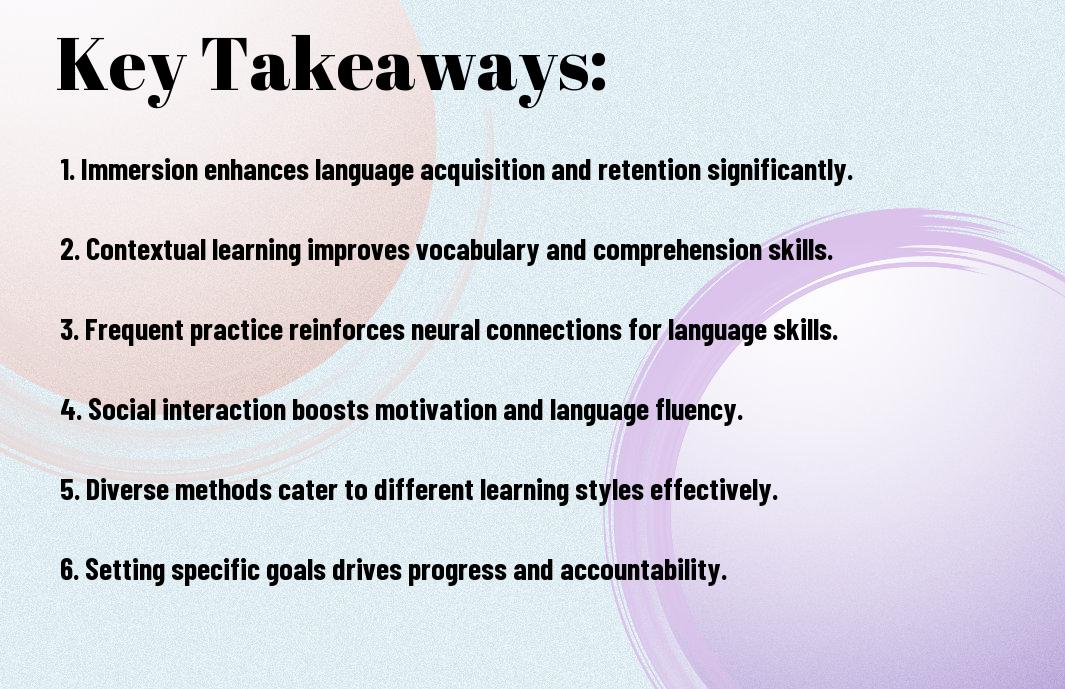
Key Takeaways:
- The brain’s ability to reorganize itself in response to new experiences is key to language learning, and this process can be facilitated through consistent practice and immersion.
- Spaced repetition is a powerful technique for language acquisition, as it helps to solidify new words and phrases in the learner’s long-term memory.
- Contextual learning is an effective way to learn a new language, as it allows learners to see how words and phrases are used in real-life situations and make connections between new and existing knowledge.
- Active engagement with the language is important for effective learning, and this can be achieved through activities such as speaking, writing, and listening to native speakers.
- Personalization is also important in language learning, as learners who are able to tailor their learning to their individual needs and interests are more likely to stay

The Power of Language
Your ability to learn a new language is a powerful tool that can open doors to new cultures, communities, and opportunities, and understanding how it works is vital to effective language learning.
The Brain’s Role in Language Acquisition
With the brain’s incredible ability to adapt and change, you can develop new neural pathways and connections that enable language learning, and by understanding how your brain processes language, you can optimize your learning approach.
The Importance of Consistency in Language Learning
Across various language learning methods, consistency is key to developing language skills, and as you establish a regular learning routine, you will begin to see significant improvements in your language abilities.
Due to the complex nature of language learning, maintaining consistency is vital to reinforcing new skills and preventing language erosion, and by committing to regular practice, you can develop a strong foundation in your target language and achieve your language learning goals more efficiently, allowing you to communicate effectively and confidently in your new language.
The Science of Memory
You will discover that the process of language learning is closely tied to your brain’s ability to form and recall memories, as explained in The Science of Language Is As Complex As Learning a New Language, which sheds light on the intricacies of language acquisition.
How We Form Memories
Among the various factors that influence your ability to learn a new language, the formation of memories plays a significant role, as your brain consolidates new information and connects it to your existing knowledge.
Retrieval Practice in Language Learning
By actively recalling and practicing language skills, you strengthen your ability to retain and apply them in real-life situations, which is an crucial aspect of the learning process.
Retrieval practice is a powerful tool in language learning, as it helps you to reinforce your understanding of grammar, vocabulary, and pronunciation, and to develop a more nuanced grasp of the language, allowing you to communicate more effectively and confidently in your target language.
Effective Language Learning Strategies
Now that you’re aware of the science behind language learning, it’s time to explore the most effective strategies. You can find more information on The Best Ways to Learn a Language According to Research to enhance your learning experience.
Immersion and Contextual Learning
About the most effective ways to learn a language, you’ll discover that immersion and contextual learning play a significant role in your progress, helping you to pick up the language naturally.
The Benefits of Spaced Repetition
By incorporating spaced repetition into your study routine, you can optimize your learning and improve retention of new vocabulary and grammar rules.
The benefits of spaced repetition are numerous, as it allows you to review material at increasingly longer intervals, helping to solidify it in your long-term memory and making it easier to recall when needed, thus streamlining your language learning process and making you more proficient in your target language.
The Impact of Technology
Keep in mind that technology has revolutionized the way you learn languages, providing you with various tools and resources to enhance your language learning experience.
Language Learning Apps and Software
About the numerous language learning apps and software available, you can explore options that cater to your learning style and goals, offering personalized lessons and interactive exercises.
Virtual Reality in Language Education
By leveraging virtual reality, you can immerse yourself in realistic environments that simulate real-life conversations and interactions, helping you develop your communication skills more effectively.
For instance, you can practice ordering food at a virtual café or engaging in a conversation with a virtual native speaker, which can help you build confidence in your language skills and prepare you for real-world situations, allowing you to learn from your mistakes in a risk-free environment, and you can track your progress and adjust your learning strategy accordingly.
Overcoming Obstacles
All language learners face obstacles, but you can overcome them by understanding the science behind effective learning. You can find helpful tips on What Does Research Say is the Best Way to Learn a Language to inform your approach.
Managing Motivation and Burnout
About halfway through your learning journey, you may encounter motivation and burnout challenges, but you can address them by setting realistic goals and tracking your progress to stay motivated.
Building a Supportive Learning Community
Along with a well-structured study plan, surrounding yourself with fellow learners can help you stay accountable and engaged, which is crucial for your progress, as you will be able to share your experiences and get valuable feedback from others.
Indeed, building a supportive learning community can be a game-changer for you, as it provides a platform to practice your language skills, get support, and learn from others, ultimately helping you to achieve your language learning goals more efficiently and effectively.
Measuring Progress
To effectively learn a language, you need to track your progress. This involves regularly assessing your skills and identifying areas for improvement. By doing so, you can adjust your learning strategy and stay motivated.
Assessment and Evaluation Methods
Against the backdrop of your language learning journey, you will encounter various assessment and evaluation methods. These tools help you gauge your proficiency and pinpoint weaknesses, enabling you to refine your approach and make informed decisions about your learning path.
Setting Realistic Goals and Benchmarks
Alongside your assessment and evaluation, you should set achievable targets. This involves establishing specific, measurable objectives that align with your learning style and goals, allowing you to monitor your advancement and make adjustments as needed.
A significant aspect of setting realistic goals and benchmarks is understanding your learning pace and abilities. As you progress, you will develop a better sense of what works best for you, enabling you to refine your approach and make steady progress towards fluency. You can then use this insight to adjust your goals and benchmarks, ensuring they remain challenging yet attainable, and that you stay motivated and engaged throughout your language learning journey.
Summing up
Taking this into account, you now have a deeper understanding of the science behind effective language learning. You can apply your knowledge of cognitive psychology and neuroscience to optimize your learning process. By leveraging your brain’s ability to adapt and change, you can improve your language skills and achieve your goals. Your approach to language learning will become more efficient, and you will be able to navigate the process with confidence and precision.
FAQ
Q: What are the key factors that influence the effectiveness of language learning?
A: The science behind effective language learning suggests that several factors contribute to successful language acquisition. These include setting achievable goals, consistent practice, and exposure to authentic language materials. Additionally, understanding individual learning styles, such as visual, auditory, or kinesthetic, can help tailor the learning approach to maximize effectiveness. Furthermore, learner motivation, be it intrinsic or extrinsic, plays a significant role in maintaining engagement and progress throughout the learning journey.
Q: How does the brain process and store new language information?
A: The brain processes new language information through a complex interplay of cognitive and neurological mechanisms. Initially, new language elements are stored in short-term memory, and through repetition and practice, they are consolidated into long-term memory. The process involves various parts of the brain, including areas responsible for phonology, syntax, semantics, and pragmatics. The more the learner is exposed to and engages with the language, the stronger the neural pathways become, facilitating easier access and use of the language in communication. Neuroplasticity, the brain’s ability to form new neural connections, is fundamental in adapting to and learning a new language.
Q: Can adults learn a new language as effectively as children, and what strategies can enhance their learning?
A: While children have an innate ability to absorb and learn languages quickly due to their developing brains, adults can also achieve high levels of proficiency with the right approach. Adults often have an advantage in terms of metacognitive skills, such as the ability to understand and apply grammar rules, and learning strategies. To enhance their learning, adults can benefit from structured learning programs, using language learning apps, engaging in conversations with native speakers, and immersing themselves in the language through media and literature. Additionally, focusing on meaningful interactions and real-life applications can increase motivation and accelerate the learning process.
