As you navigate the global business landscape, your ability to communicate effectively with international clients and colleagues is vital. You will encounter diverse languages and cultures, and speaking the right language can give you a competitive edge. Your career prospects and business opportunities can expand significantly when you possess language skills that are in high demand. You can enhance your professional profile by acquiring languages that are widely used in international trade and commerce, and this post will guide you in making an informed decision.
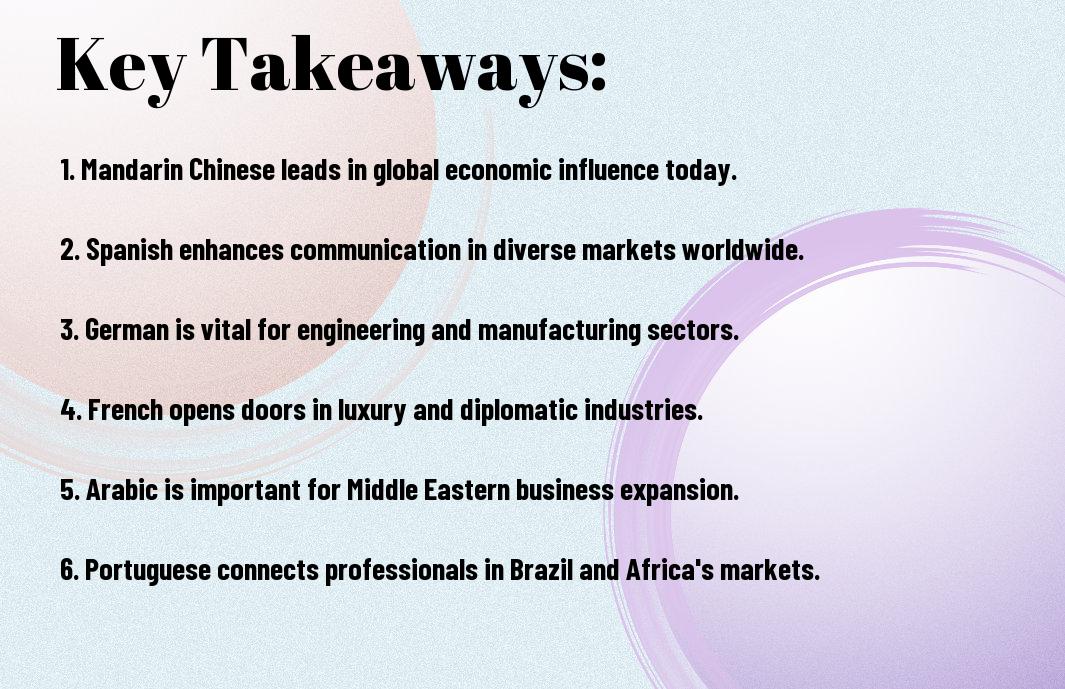
Key Takeaways:
To succeed in the global market, business professionals need to be proficient in languages that can open doors to new opportunities. Here are the key takeaways about the most useful languages for business professionals:
- Mastering English is necessary for any business professional, as it is the most widely used language in international business and commerce.
- Learning Mandarin Chinese can provide a competitive edge, given China’s growing economic influence and increasing trade relationships with other countries.
- Proficiency in Spanish can help business professionals tap into the large and growing markets of Latin America and the United States.
- Arabic is becoming an important language for business, particularly in the Middle East and North Africa, where many countries are experiencing rapid economic growth.
- Knowledge of Portuguese can be beneficial for business professionals interested in trading with Brazil, Portugal, and other Portuguese-speaking countries, which offer significant investment opportunities.
Language Selection
Your business expansion plans may involve communicating with clients and partners from diverse linguistic backgrounds, making language selection a vital decision for your company’s success.
Importance of Language in Business
Linguistic skills play a significant role in facilitating effective communication, thereby fostering strong business relationships and driving growth, as you navigate the global market.
Factors Influencing Language Choice
Between cultural differences and geographical considerations, you will need to weigh various factors, including:
- target market demographics
- industry-specific terminology
- regional language preferences
. The decision you make will significantly impact your business’s ability to thrive in a competitive environment.
Choice of language is a strategic move that can either make or break your business, as you consider the nuances of each language and its implications on your operations, including:
- translation costs
- cultural adaptation
- localization requirements
. The language you choose will ultimately determine your company’s reputation and credibility in the eyes of your international clients and partners.
Global Business Languages
Now, as you navigate the world of international business, you’ll find that certain languages can greatly enhance your career prospects and facilitate communication with global clients and partners.
English as a Global Language
Alongside other languages, English has become a dominant language in business, and you’ll likely encounter it frequently in your professional interactions, allowing you to connect with people from diverse cultural backgrounds.
Spanish and Mandarin Chinese
Globally, Spanish and Mandarin Chinese are increasingly important languages for business professionals, as they open doors to vast markets and opportunities in Latin America and Asia, enabling you to tap into these emerging economies.
Consequently, as you consider expanding your language skills, you should think about the regions and industries you’re interested in, and how learning Spanish or Mandarin Chinese can help you build stronger relationships with your target audience, ultimately driving your business forward and giving you a competitive edge in the global marketplace.
Regional Business Languages
Many businesses operate within specific regions, and speaking the local language can give you a competitive edge. You can expand your customer base and build stronger relationships with your clients and partners by communicating in their native language.
Arabic for Middle Eastern Markets
Behind the growing economies of the Middle East lies a wealth of opportunity for your business, and speaking Arabic can help you tap into this market. You can navigate the complexities of Middle Eastern business culture more effectively by learning Arabic.
Portuguese for South American Markets
Middle managers and executives who speak Portuguese have a significant advantage when doing business in South America, particularly in Brazil. You can communicate more effectively with your Brazilian partners and clients by learning Portuguese.
Markets in South America, particularly in Brazil, are growing rapidly, and speaking Portuguese can help you stay ahead of the competition. You can explore new business opportunities and build stronger relationships with your clients and partners by communicating in Portuguese, which can lead to increased sales and revenue for your company.
Language Skills for Career Advancement
Despite the demands of your profession, acquiring language skills can significantly boost your career prospects, enabling you to connect with clients, colleagues, and partners from diverse linguistic backgrounds, thereby enhancing your professional growth.
Improving Communication Skills
Alongside your technical expertise, proficiency in a foreign language can greatly improve your communication skills, allowing you to articulate your ideas, negotiate, and collaborate more effectively in a globalized business environment, which is important for your success.
Enhancing Job Prospects
Beneath the surface of your daily tasks, language skills can significantly enhance your job prospects, opening doors to new career opportunities, higher salary scales, and greater responsibilities, making you a more competitive candidate in the job market.
Indeed, as you pursue your career goals, you will find that language skills give you a distinctive edge, allowing you to tap into new markets, Understand cultural nuances, and make informed decisions that drive business growth, ultimately leading to greater professional satisfaction and success.

Industry-Specific Languages
To succeed in your business endeavors, you need to consider the languages that are prevalent in your industry, as this can significantly impact your ability to communicate with clients, partners, and colleagues.
German for Engineering and Manufacturing
Alongside other languages, German is a key language for engineering and manufacturing, allowing you to tap into the European market and work with German companies, which are known for their innovative technologies and high-quality products.
French for International Trade
Around the world, French is an official language in several international organizations, making it a valuable language for your business, particularly if you are involved in international trade, as it can help you navigate complex trade agreements and negotiations.
Another significant advantage of speaking French is that it can give you access to the African market, where French is widely spoken, and help you build strong relationships with French-speaking business partners, ultimately expanding your business opportunities and increasing your competitiveness in the global market, which can be highly beneficial for your career as you will be able to communicate effectively with clients and partners from diverse linguistic backgrounds.
Language Learning Resources
Once again, understanding the top languages to learn for international business is key to your success, and you can find more information on The top languages to learn for international business to make informed decisions.
Online Courses and Tutorials
For example, you can utilize online platforms that offer language courses and tutorials tailored to your business needs, helping you learn at your own pace.
Language Schools and Institutes
Beneath the surface of online learning, you will find that language schools and institutes provide immersive experiences, allowing you to practice your language skills in a real-world setting.
Also, attending a language school or institute can give you the opportunity to network with other professionals and gain insights into different business cultures, which can be beneficial for your career, as you will be able to understand your clients’ and colleagues’ needs more effectively.
To wrap up
Summing up, as you consider expanding your professional horizons, you’ll find that learning a new language can greatly benefit your career. You can explore the 9 Top Languages To Learn for International Business to determine which ones align with your goals. By doing so, you’ll enhance your skills and stay competitive in the global market, ultimately driving your business forward and increasing your chances of success.
FAQ
Q: What are the most in-demand languages for business professionals in the global market?
A: The most in-demand languages for business professionals include English, Mandarin Chinese, Spanish, Arabic, and Portuguese. English is the primary language of international business, while Mandarin Chinese is increasingly important due to China’s growing economic influence. Spanish and Arabic are also highly valued, given the significant trade relationships with Latin America and the Middle East. Portuguese, spoken in Brazil and several African countries, is also becoming more significant in the business world.
Q: How can learning a foreign language benefit a business professional’s career?
A: Learning a foreign language can significantly enhance a business professional’s career prospects. It can open up new job opportunities, especially in multinational corporations or companies looking to expand into foreign markets. Language skills can also improve communication with international clients, colleagues, and partners, facilitating stronger business relationships and negotiations. Furthermore, speaking multiple languages can increase a professional’s versatility and adaptability in a competitive job market, potentially leading to higher salaries and more senior roles.
Q: Are there any specific industries where knowledge of a second language is particularly advantageous for business professionals?
A: Yes, there are several industries where knowledge of a second language is especially beneficial for business professionals. The finance and banking sector, for example, values language skills highly due to the global nature of financial transactions and investments. The tourism and hospitality industry also greatly benefits from multilingual staff to cater to international clients. Additionally, careers in international trade, diplomacy, and logistics often require proficiency in multiple languages to navigate complex global supply chains and legal regulations. Knowledge of a second language can provide a competitive edge in these fields, leading to greater career advancement opportunities.

