simon weiner

The Most Beautiful Languages in the World

As you wander through the labyrinth of human communication, you may find yourself enchanted by the melodic sounds and poetic rhythms of certain languages. Your ears may perk up at the sound of a softly spoken phrase, and your heart may skip a beat at the beauty of a well-crafted sentence. In this exploration, you will begin on a journey to discover the languages that are often regarded as the most beautiful, and you will find that the concept of beauty is as subjective as it is captivating.

Key Takeaways:

  • The melody and phonetics of a language play a significant role in determining its beauty, with languages like Italian and Spanish being known for their musical quality.
  • Cultural and historical context can greatly influence the perception of a language’s beauty, with languages like Arabic and Chinese being highly valued for their rich cultural heritage.
  • Linguistic diversity and complexity can also contribute to a language’s beauty, with languages like Japanese and Korean having unique grammatical structures and writing systems.
  • The sound and rhythm of a language can be highly subjective, with different people finding different languages beautiful based on their personal preferences and experiences.
  • Ultimately, the beauty of a language is a matter of personal taste and can vary greatly from person to person, making it a fascinating and multifaceted topic to explore.

Sonic Beauty

For you, the sound of a language can be a powerful trigger, evoking emotions and memories that linger long after the words have faded away. As you listen to the melodic rhythms and cadences of different languages, you may find yourself drawn to certain sounds and accents that resonate with your own sense of beauty and harmony.

The Music of Italian

Beneath the surface of Italian lies a rich tapestry of sound, with its soft consonants and melodic vowels weaving a sonic spell that is hard to resist. As you listen to the musicality of Italian, you may find yourself enchanted by the way the words seem to sing and dance on the tongue.

The Cadence of Spanish

Around the world, you may have noticed the distinctive cadence of Spanish, with its rising and falling intonations that give the language a unique sense of passion and expressiveness. As you listen to the rhythmic flow of Spanish, you may find yourself swept up in the emotional tide of the language.

For instance, as you immerse yourself in the sounds and rhythms of Spanish, you may begin to appreciate the way the language seems to embody the fiery spirit of its native speakers, with its sharp consonants and melodic vowels conveying a sense of energy and vitality that is hard to match. As you listen to the cadence of Spanish, you may find yourself drawn into a world of passion and beauty, where the sounds and rhythms of the language seem to come alive in your very being.
Structural Elegance

One of the key aspects that makes a language beautiful is its structural elegance, which can evoke a sense of wonder in you as you research deeper into its intricacies, and you begin to appreciate the unique characteristics that set it apart from other languages.

The Grammar of Arabic

Prior to exploring the vast array of languages, you will find that the grammar of Arabic, with its complex system of consonants and vowels, presents a fascinating case, as you notice the way it weaves together to form a rich tapestry of sound and meaning that is distinctly its own.

The Syntax of Japanese

Elegant in its simplicity, the syntax of Japanese offers you a glimpse into a world where the placement of words can dramatically alter the meaning of a sentence, and you start to see the beauty in the subtle nuances of this language.

Considering the syntax of Japanese, you will discover that it is a language that values context and implication, often relying on the listener’s ability to infer meaning from the situation, and as you explore this language further, you will find that its unique blend of simplicity and complexity makes it a truly beautiful language to explore and understand.

Expressive Depth

Many languages boast a profound ability to convey complex emotions and ideas, drawing you into a world of nuanced expression. As you examine into the rhythms and cadences of these languages, you begin to appreciate the richness they bring to your understanding of the human experience.

The Idioms of French

Fascinatingly, French idioms often rely on poetic metaphors, allowing you to grasp the subtle shades of meaning that underlie everyday conversations, and inviting you to explore the cultural heritage that shapes your perception of the world.

The Nuances of Portuguese

Authentically, an appreciation for the melodic intonations of Portuguese can transport you to a realm of sonic beauty, where your senses are heightened and your emotional response is deeply felt, as you begin to unravel the intricate web of meanings that underlie this captivating language.

Idioms in Portuguese, as you will discover, are often imbued with a unique blend of passion and lyricism, enabling you to tap into the very essence of the culture, and to experience the full depth of your own emotional landscape, as you navigate the twists and turns of this expressive language.

Cultural Significance

Unlike other aspects of language, cultural significance is deeply personal, and you may find yourself drawn to a language for reasons that are unique to your experiences. As you explore the world of languages, you can visit what are the top ten most beautiful languages to discover the diversity of opinions on this topic.

The History of Mandarin

With the complexity of Chinese characters, you will find that Mandarin has a rich history that spans thousands of years, influencing your perception of its beauty and significance.

The Symbolism of Russian

For you, the Cyrillic alphabet may evoke a sense of mystery, and as you explore deeper, you will discover the intricate symbolism woven into the language, reflecting your own associations with Russian culture.

Symbolism in Russian is multifaceted, and as you explore its nuances, you will uncover the ways in which it resonates with your own emotional and aesthetic responses, drawing you into a world of depth and meaning that is uniquely your own, shaping your appreciation for the language’s beauty and significance.

Phonetic Appeal

Now, as you investigate into the world of languages, you’ll find that some have a certain melodic quality that sets them apart. The way words sound can be just as beautiful as the way they look on paper. Your ears will pick up on the rhythm and cadence of a language, and some will undoubtedly strike a chord with you.

The Sounds of Swedish

Beneath the surface of Swedish lies a treasure trove of sounds that will enchant your senses. You’ll discover a language that sings with a gentle lilt, its words tumbling out in a smooth, musical flow that’s a joy to listen to.

The Intonations of Greek

Among the languages that boast a rich phonetic heritage, Greek stands out for its distinctive intonations. You’ll notice how the pitch and stress of words convey meaning and emotion, drawing you into a world of expressive nuance.

But as you explore the intonations of Greek further, you’ll begin to appreciate the subtlety and complexity that underlies this beautiful language. You’ll find that the rise and fall of pitch, the emphasis on certain syllables, all combine to create a sense of drama and passion that’s hard to resist, and you’ll be swept up in the expressive power of Greek.

Linguistic Diversity

After exploring the world’s languages, you’ll discover a rich tapestry of sounds, structures, and expressions. Your journey will take you through a kaleidoscope of dialects, each with its unique character and beauty.

The Variations of English

For instance, as you probe into the English language, you’ll find a plethora of variations, from the Queen’s English to American slang, each with its own rhythm and cadence, shaping your perception of the world.

The Dialects of German

Between the standard German and its dialects, you’ll notice a fascinating spectrum of differences, with regional accents and vocabulary that reflect the country’s history and culture, inviting you to explore and appreciate its nuances.

Diversity is what makes the dialects of German so compelling, as you’ll encounter a wide range of expressions, from the melodic sound of Bavarian to the guttural tone of Hamburgisch, each one a testament to the language’s adaptability and your ability to connect with its speakers.

Final Words

Conclusively, as you ponder the melodic sounds and linguistic nuances, you’ll find that the most beautiful languages in the world are a matter of personal preference. You can explore more about the harmony of languages at And the most beautiful languages in the world are… ‹ GO Blog, and perhaps, you’ll discover the one that resonates with your soul, leaving an indelible mark on your perception of beauty.

FAQ

Q: What makes a language considered one of the most beautiful in the world?

A: A language can be considered one of the most beautiful in the world due to various factors such as its melodic sound, grammatical complexity, and cultural significance. For instance, languages like Italian and Spanish are often praised for their musicality and expressive nature, while languages like Arabic and Chinese are admired for their unique writing systems and historical importance. The beauty of a language is subjective, but it is often characterized by its ability to evoke emotions, convey complex ideas, and connect people across cultures.

Q: Which languages are commonly regarded as the most beautiful in the world?

A: There are several languages that are frequently considered to be among the most beautiful in the world, including French, known for its romantic connotations and poetic sound; Japanese, admired for its unique blend of simplicity and complexity; and Portuguese, praised for its melodic rhythm and expressive intonation. Other languages, such as Russian, Hindi, and Swedish, are also often cited as being particularly beautiful due to their distinctive grammatical structures, phonetic sounds, and cultural associations. Ultimately, the perception of a language’s beauty depends on personal taste and cultural context.

Q: Can learning a beautiful language have any benefits beyond its aesthetic appeal?

A: Yes, learning a language considered to be one of the most beautiful in the world can have numerous benefits beyond its aesthetic appeal. For example, learning a new language can improve cognitive abilities, enhance career opportunities, and broaden cultural understanding. Additionally, studying a language like Mandarin Chinese or Arabic can provide access to a vast array of literary and cultural works, while learning a language like French or Italian can facilitate travel and communication in diverse regions. Moreover, the process of learning a language can be a rewarding and enriching experience in itself, allowing individuals to develop new skills, challenge themselves, and connect with others who share similar interests and passions.

How to Choose the Right Language to Learn

As you consider expanding your linguistic abilities, you’ll face a daunting question: which language is right for you? With so many options available, selecting the perfect fit can be overwhelming. You’ll want to think about your motivations, goals, and interests when deciding. For guidance on narrowing down your options, you can explore resources like How to Decide Which Languages to Learn Next to inform your decision and choose a language that aligns with your needs and aspirations.

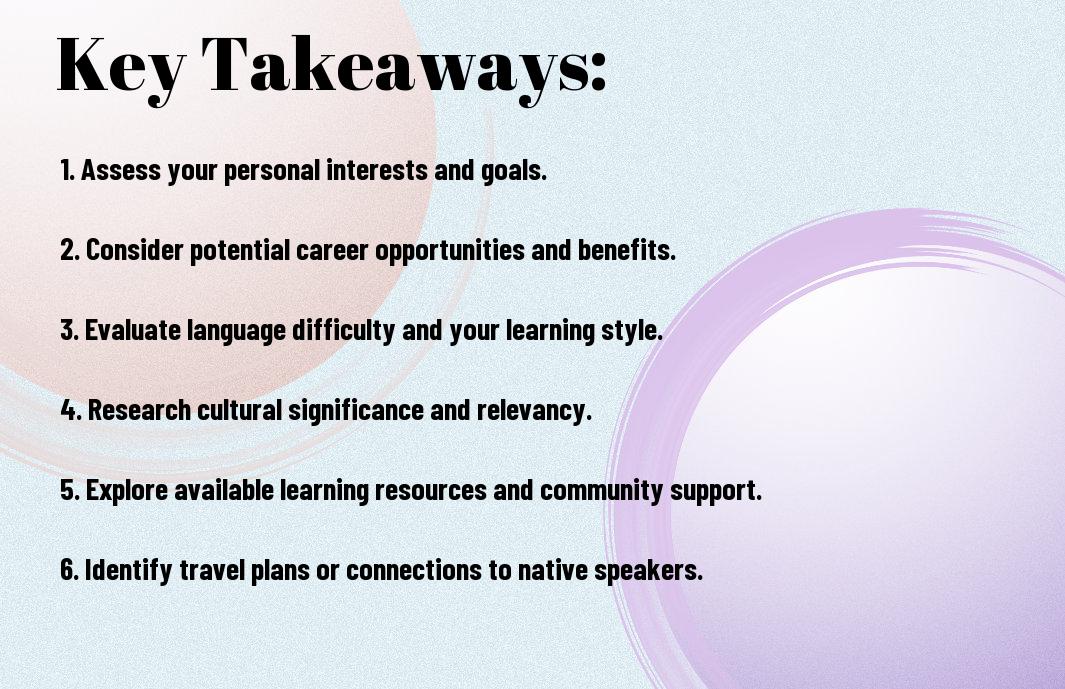
Key Takeaways:

  • Define your motivation for learning a new language, as it will help you stay focused and directed throughout the learning process.
  • Consider the practicality of the language you want to learn, including the number of native speakers, its use in international business, and its cultural significance.
  • Assess your learning style and choose a language that fits your preferences, such as a language with a simple grammar system or a language with a wide range of learning resources.
  • Evaluate the level of difficulty of the language you want to learn, taking into account factors such as grammar, vocabulary, and pronunciation.
  • Explore the resources available for learning the language, including language courses, textbooks, and online tools, to ensure you have the support you need to succeed.

Setting Goals

A clear understanding of your objectives is vital when choosing a language to learn. You need to consider what you want to achieve with your new language skills, whether it’s for personal or professional purposes.

Defining Motivation

After establishing your goals, you’ll need to reflect on what drives your motivation to learn a new language. You should ask yourself what sparked your interest in learning a new language and what you hope to gain from the experience.

Identifying Interests

One key factor in choosing the right language is identifying your interests and hobbies. You should consider which languages are spoken in the countries or cultures that fascinate you, as this can help you stay motivated and engaged in the learning process.

Setting your sights on a language that aligns with your passions and interests can make learning more enjoyable and effective. You will be more likely to dedicate time and effort to learning a language that has personal significance, allowing you to stay focused and driven throughout your learning journey. As you consider your interests, you can explore the languages spoken in the countries or cultures that resonate with you, and immerse yourself in the language and culture to gain a deeper understanding and connection.

Evaluating Options

If you’re considering learning a new language, you’ll need to evaluate your options carefully. You’ll want to think about your motivations, goals, and learning style to narrow down your choices.

Popular Languages

Contrary to what you might think, popular languages like Spanish, Mandarin, and Arabic may not be the best fit for you. You should consider what you want to achieve with your new language skills and whether a popular language aligns with your goals.

Language Families

Assessing language families can help you make a more informed decision. You can look at the grammar, syntax, and pronunciation of languages within a family to determine which one might be easiest for you to learn.

In addition, understanding language families can help you identify similarities and differences between languages, making it easier to choose one that suits your needs and interests. You can explore the Romance languages, Germanic languages, or Slavic languages, among others, to find the one that resonates with you and your learning style.

Considering Difficulty

Your language learning journey will be smoother if you consider the difficulty level of the language you want to learn. This includes grammar, writing systems, and pronunciation.

Grammar Complexity

Grammatically, some languages have simpler structures, while others have more complex rules, which can affect your learning pace. You need to evaluate how different grammar systems will impact your progress.

Writing Systems

Beneath the surface of a language lies its writing system, which can be alphabetic, logographic, or syllabic. You should consider how familiar you are with the writing system of your desired language.

Consequently, you will find that some writing systems are more intuitive for you to learn, while others may require more time and effort to master. You can start by looking at the scripts and characters of your target language to get an idea of what to expect, and plan your learning strategy accordingly, taking into account your own strengths and weaknesses.

Exploring Resources

For your language learning journey, you’ll need to explore various resources. You can start by reading articles like How to Choose a Language to Learn to get an idea of what to expect.

Language Courses

Between the numerous options available, you’ll find that language courses are an excellent way to start learning, offering structured lessons and a clear learning path tailored to your needs.

Study Materials

For your study materials, you’ll have a wide range of options, including textbooks, language learning apps, and online resources that cater to your learning style and goals.

Another aspect of study materials to consider is the level of interactivity they offer, as engaging with the language through practice exercises and quizzes can significantly enhance your learning experience, allowing you to practice your skills and track your progress effectively, helping you stay motivated and focused on your language learning journey.

Assessing Opportunities

Unlike other factors, assessing opportunities is a significant step in choosing a language to learn, as it affects your future prospects and interests.

Career Prospects

Along the lines of your profession, you should consider the languages spoken in your industry and the countries you’d like to work with, as this will enhance your career opportunities and increase your market value.

Cultural Immersion

Above all, you may find that learning a language allows you to connect with a new culture, and as a result, you’ll have the chance to immerse yourself in customs, traditions, and ways of life that are different from your own.

Further exploration of cultural immersion will lead you to discover that speaking the local language is key to truly experiencing a culture, as you’ll be able to engage with locals, understand their perspectives, and appreciate the nuances of their customs and traditions, ultimately enriching your travel experiences and broadening your understanding of the world.

Making a Decision

Many factors will influence your choice of language to learn, and you can find helpful guidance at What language should I learn? Here’s how to decide. ‹ GO Blog.

Weighing Factors

Weighting the pros and cons, you’ll consider several aspects, including:

  • personal interests
  • career goals

The decision will ultimately depend on your priorities.

Trusting Instincts

Betwixt the various options, you may feel drawn to a particular language, and it’s necessary to consider this instinct.

But as you trust your instincts, you’ll also want to think about how they align with your motivations for learning a language, and whether your gut feeling is supported by practical considerations, such as the availability of resources to help you learn, and the potential opportunities that speaking the language could bring to your life.

Conclusion

Following this guide, you can make an informed decision about which language to learn. You will consider your goals, interests, and learning style to choose the right language for your needs. By weighing the factors discussed, you can set yourself up for success and enjoy the process of learning a new language, ultimately achieving your goals and expanding your linguistic and cultural knowledge, and enhancing your personal and professional opportunities with your new language skills.

FAQ

Q: What factors should I consider when choosing a language to learn?

A: When choosing a language to learn, consider your personal interests, career goals, and the language’s relevance to your future plans. Think about the cultures and countries you’re interested in, as well as the languages spoken in your desired field of work. Additionally, evaluate the difficulty level of the language and the resources available for learning it, such as language courses, tutors, and study materials. Assessing these factors will help you make an informed decision and increase your motivation to learn the language.

Q: How do I determine the difficulty level of a language and its suitability for me as a beginner?

A: To determine the difficulty level of a language, analyze its grammar, syntax, and pronunciation in comparison to your native language. You can find numerous language learning resources and studies that categorize languages by difficulty for English speakers. For instance, the US Foreign Service Institute (FSI) provides a language difficulty ranking. Moreover, consider factors such as the availability of language learning materials, the similarity of the language to your native language, and the language’s writing system. As a beginner, it’s advisable to start with a language that has a relatively simpler grammar system and is widely spoken, ensuring you have access to various learning tools and communities.

Q: What role does personal interest play in choosing a language to learn, and how can it impact my learning experience?

A: Personal interest plays a significant role in choosing a language to learn, as it can greatly impact your motivation and enjoyment throughout the learning process. Learning a language can be a long and challenging journey, and having a genuine interest in the language and its associated culture can make it more engaging and rewarding. When you’re interested in a language, you’re more likely to stay motivated, explore various aspects of the language, and practice consistently. This, in turn, can lead to faster progress, a deeper understanding of the language, and a more enjoyable learning experience. Therefore, it’s important to choose a language that aligns with your hobbies, passions, or career aspirations to ensure a positive and successful learning experience.

The Role of Movies and TV Shows in Language Learning

As you initiate on your language learning journey, you’ll discover that your learning materials extend far beyond textbooks and language learning apps. You can leverage your favorite movies and TV shows to improve your language skills, exposing yourself to native speakers, accents, and conversational dialogue. By doing so, you’ll enhance your listening and speaking abilities, and gain a deeper understanding of your target language and its cultural context, making your learning experience more engaging and effective.

Key Takeaways:

  • The authenticity of movies and TV shows makes them an excellent resource for language learners, as they provide a realistic representation of how people communicate in everyday life.
  • Watching movies and TV shows with subtitles can improve vocabulary and listening skills, as learners can see the words and phrases being used in context.
  • Cultural immersion is another benefit of using movies and TV shows for language learning, as they provide a window into the customs and traditions of the target language and culture.
  • Movies and TV shows can also help learners develop their pronunciation and intonation skills, as they can mimic the speech patterns and accent of native speakers.
  • Using movies and TV shows as a supplement to traditional language learning methods can make the learning process more engaging and enjoyable, increasing motivation and retention of new language skills.

The Power of Visual Aids

Before delving into the specifics, you’ll find that visual aids like movies and TV shows play a significant role in language learning, making it more engaging and effective for you.

Subtitles and Captions

With the help of subtitles and captions, you can improve your reading and listening skills simultaneously, allowing you to follow the dialogue and storyline more easily.

Authentic Dialogue and Accents

Similarly, captions provide you with the opportunity to hear authentic dialogue and accents, exposing you to the natural flow of the language.

In fact, as you watch movies and TV shows, you’ll be able to pick up on idiomatic expressions, slang, and colloquialisms that are often used in everyday conversations, helping you to sound more natural and fluent in your language learning journey, and you’ll find that your comprehension and pronunciation improve significantly over time.

Cultural Immersion

Clearly, watching movies and TV shows in the target language can provide you with a unique opportunity to immerse yourself in the culture. You can gain a deeper understanding of the customs, traditions, and ways of life of the native speakers.

Exposure to Idioms and Colloquialisms

Contrary to what you might think, exposure to idioms and colloquialisms through movies and TV shows can help you sound more natural and fluent in the target language. You will be able to pick up phrases and expressions that are commonly used in everyday conversations.

Insights into Social Norms and Values

Valuably, you can gain insights into social norms and values by observing how characters interact with each other in movies and TV shows. You will be able to understand what is considered polite, respectful, and appropriate in different social situations.

Immersion in the culture through movies and TV shows can also help you navigate complex social situations and avoid unintentionally offending someone. As you watch your favorite shows, you can observe how characters greet each other, use body language, and engage in conversations, which can help you develop your own social skills and adapt to the culture more easily. You can apply these insights to your own interactions with native speakers, making your language learning experience more authentic and effective.

Language Patterns and Reinforcement

After watching movies and TV shows, you will start to notice patterns in language use, such as grammar, vocabulary, and pronunciation, which can help you improve your language skills.

Repetition and Memorization

Any exposure to authentic language use can help you memorize new words and phrases, and repetition is key to language learning, as you will be able to practice your listening and speaking skills.

Contextual Learning and Application

An important aspect of language learning is applying language in context, and movies and TV shows provide you with the opportunity to see how language is used in real-life situations, making it easier for you to understand and use language effectively.

This type of learning allows you to develop your ability to comprehend and communicate in your target language, as you will be able to learn idiomatic expressions, colloquialisms, and cultural references that are often difficult to learn from textbooks alone, and you will be able to apply them in your own conversations, making your language skills more authentic and natural.

Overcoming Language Barriers

Many language learners face difficulties when trying to overcome language barriers, but with the help of movies and TV shows, you can improve your skills. You can learn more about How Language Learning with TV Will Lead to Fluency! and discover new ways to enhance your language abilities.

Improved Listening and Speaking Skills

By watching TV shows and movies in the target language, you can improve your listening and speaking skills, as you’ll be exposed to different accents, tones, and speaking styles, helping you to better understand and mimic native speakers.

Enhanced Vocabulary and Pronunciation

Between the lines of dialogue and the context of each scene, you’ll pick up new words, phrases, and expressions, expanding your vocabulary and improving your pronunciation, which will help you to communicate more effectively in your target language.

A significant advantage of learning through movies and TV shows is that you’ll be able to learn vocabulary in context, which will help you to understand how to use words and phrases in different situations, making your language learning more effective and enjoyable, and enabling you to express yourself more confidently and accurately.

Choosing Appropriate Content

Unlike other language learning methods, watching movies and TV shows can be an enjoyable way to learn a new language. You can find tips on how to use movies and TV to practice your language skills, making the experience even more effective.

Selecting Shows and Movies by Language Level

Betwixt the various options available, you need to select content that matches your language level to avoid frustration and maximize learning. You should opt for shows and movies with subtitles in your native language or the language you are learning.

Considering Genres and Interests

One of the key factors in choosing the right content is considering your personal interests and genres you enjoy. You will be more motivated to watch and learn from content that aligns with your hobbies or favorite topics.

Content that resonates with your interests will not only make the learning process more enjoyable but also help you stay engaged and retain information better. You can explore different genres, such as comedy, drama, or documentary, to find what works best for your language learning journey, making it a more personalized and effective experience.

Integrating Media into Language Curriculum

Now that you have considered the benefits of using movies and TV shows in language learning, it’s time to think about how to effectively integrate media into your curriculum. You can use media to supplement your teaching, providing students with engaging and interactive learning experiences.

Classroom Activities and Discussions

About to create a rich learning environment, you will find that media can be a valuable tool, allowing you to design activities and discussions that promote language skills and cultural understanding, helping you to assess your students’ progress.

Homework and Project Ideas

Above all, assigning homework and projects related to the media you’ve used in class can help reinforce language skills, and you will find that it encourages students to think creatively about the material they’ve covered.

Activities such as writing reviews, creating dialogues, or making videos can help you assess your students’ language proficiency, and as you design these assignments, you can tailor them to meet the needs and interests of your students, allowing you to track their progress and adjust your teaching accordingly.

To wrap up

Now, as you reflect on the impact of movies and TV shows on language learning, you can see how they enhance your understanding and pronunciation. You can leverage this medium to improve your language skills by watching shows in the target language. For more information, visit English Through Films and TV Shows: Benefits of Learning to discover how you can maximize your language learning experience.

FAQ

Q: What is the impact of watching movies and TV shows on language learning?

A: Watching movies and TV shows can have a significant effect on language learning. It exposes learners to authentic language usage, diverse accents, and various speaking styles, which can improve listening and speaking skills. Additionally, it provides context to new vocabulary and grammatical structures, making them more memorable and easier to understand. This immersive experience can also foster cultural awareness and understanding, which is an crucial aspect of language acquisition.

Q: How can movies and TV shows be effectively used as a language learning tool?

A: To use movies and TV shows as a language learning tool, learners can start by choosing content that matches their language level and interests. They can begin with subtitles in their native language and gradually switch to subtitles in the target language. Pausing the video to look up unknown words, repeating phrases out loud, and summarizing the plot in their own words can enhance the learning experience. Furthermore, discussing the content with others, either in person or online, can provide opportunities for practicing speaking and writing skills.

Q: Are there any specific movie or TV show genres that are more beneficial for language learning than others?

A: While any genre can be useful for language learning, some may be more beneficial than others depending on the learner’s goals and preferences. For example, sitcoms and comedies often feature everyday conversations and slang, which can be helpful for improving informal language skills. Dramas and historical series, on the other hand, may provide more formal language and complex vocabulary. Documentaries can offer a wide range of topics and formal language, making them suitable for learners interested in specific subjects or academic language. Ultimately, the most effective genre is one that keeps the learner engaged and motivated to continue learning.

The History of Language Learning Through the Ages

As you begin on your own linguistic journey, you may wonder how language learning has evolved over time. You’ll discover that the art of acquiring a new tongue has been a cornerstone of human culture for centuries, with ancient civilizations employing innovative methods to master the languages of their peers. Your curiosity will be piqued as you research into the fascinating history of language learning, from traditional apprenticeships to modern technological advancements, and uncover the remarkable ways in which our ancestors learned to communicate across linguistic boundaries.

Key Takeaways:

To understand the evolution of language learning, it’s vital to explore its history and development over time. Here are the main points to consider:

  • The ancient civilizations, such as Egypt, Greece, and Rome, laid the foundation for language education by developing writing systems and teaching methods that are still influential today.
  • The Middle Ages saw the rise of Latin as a lingua franca, which dominated language instruction and literary works for centuries, shaping the cultural heritage of many countries.
  • The Renaissance and Enlightenment periods brought significant advances in language teaching, with the introduction of new methods and materials that focused on conversation and practical application.
  • The 20th century introduced modern language learning techniques, including the use of audio-visual materials, immersion programs, and computer-assisted language learning, which have revolutionized the way people learn languages.
  • The digital age has further transformed language learning, with the rise of online courses, language learning apps, and social media, providing access to a wide range of resources and communities for language learners worldwide, emphasizing the importance of technology in language acquisition.

Ancient Civilizations

To explore the history of language learning, you must examine into the past, where ancient civilizations laid the groundwork for modern linguistic discoveries. You will find that language played a significant role in the development of these cultures.

Language Learning in Mesopotamia

Across the fertile plains of Mesopotamia, you will discover a rich history of language learning, where writing and speaking were highly valued skills, and you can see the influence of language on the region’s cultural and economic growth.

The Role of Language in Ancient Egypt

The sophistication of ancient Egyptian language is evident in its intricate hieroglyphics, which you can decipher to uncover the secrets of this enigmatic civilization, and you will appreciate the significance of language in their daily life and spiritual practices.

Ancient Egyptians, as you will notice, placed a high value on language, using it to convey complex ideas, tell stories, and pass down knowledge through generations, and you can learn much about their lives by studying the languages they spoke and wrote.

Classical Antiquity

Even as you investigate into the history of language learning, you’ll discover that the ancient civilizations laid the groundwork for modern methods. In this era, you’ll find the roots of language instruction, which would eventually influence the way you learn languages today.

The Emergence of Language Schools in Greece

Characteristically, the Greeks established language schools, where you could study rhetoric, philosophy, and poetry, laying the foundations for Western intellectual traditions. As you explore these schools, you’ll see how they emphasized the importance of language in shaping your thoughts and ideas.

Roman Language Learning and Rhetoric

Around the time of the Roman Empire, you’ll notice a significant emphasis on language learning, particularly in the art of rhetoric. As you examine Roman language instruction, you’ll find that it focused on persuasive speech and writing, skills that you still value today.

At the heart of Roman language learning was the practice of imitation, where you would study and mimic the styles of renowned orators and writers. As you look closer, you’ll see how this approach helped you develop your own voice and express your ideas with clarity and conviction, much like the great Roman statesmen and philosophers who came before you.

The Middle Ages

All throughout this period, you’ll discover that language learning was shaped by various factors, including a fascinating exploration of 2/27: A brief history of language learning, which informs your understanding of the subject.

Monastic Schools and Language Education

Before delving into the specifics, you’ll find that monastic schools played a significant role in language education, providing you with a foundation for further study.

The Influence of the Church on Language Learning

Around the time of the Middle Ages, you’ll notice that the Church’s influence on language learning was profound, shaping your perception of the subject.

Further investigation into the Church’s influence reveals that Latin was the dominant language, and you’ll see how it affected your understanding of language learning during this period, as you explore the ways in which the Church’s power and reach impacted the development of language education, shaping your knowledge of the subject.

The Renaissance and Beyond

For your journey through the history of language learning, the Renaissance marks a significant era. You can research into The History of Language Learning and Teaching I to explore this period in depth.

The Revival of Classical Languages

Upon entering this era, you’ll notice the resurgence of classical languages, which greatly influenced your understanding of language learning.

The Development of Modern Language Teaching Methods

On the heels of this revival, modern language teaching methods began to emerge, shaping your approach to language acquisition.

Another significant development in this area is the focus on pronunciation and conversation, allowing you to engage more effectively with the language you’re learning, and making your language learning journey more immersive and interactive.

Modern Era

Not surprisingly, the modern era has brought about significant advancements in language learning, and you are now spoiled for choice when it comes to methods and tools. You can learn a language at your own pace, in your own time, and in a way that suits your learning style.

The Rise of Language Laboratories and Audio-Visual Aids

For instance, you may have noticed that language laboratories and audio-visual aids have become increasingly popular, allowing you to practice your listening and speaking skills in a more immersive and interactive way. You can engage with native speakers, watch videos, and listen to podcasts, all of which help to bring the language to life.

The Impact of Technology on Language Learning

Learning a language has never been easier, thanks to the plethora of online resources and tools at your disposal. You can access language learning apps, websites, and social media platforms, all of which provide you with a wealth of information, exercises, and opportunities to practice your language skills.

But as you investigate deeper into the world of online language learning, you begin to realize the true extent of technology’s impact. You can connect with native speakers from all over the world, join online language exchange communities, and even take virtual classes with qualified teachers. You can also use speech recognition software to improve your pronunciation, and access a vast library of language learning materials, including e-books, videos, and podcasts, all of which can be tailored to your individual needs and learning style.

Contemporary Perspectives

Your understanding of language learning has evolved significantly over the years, and today, you have a plethora of resources at your disposal to learn any language you desire.

Globalization and Language Learning

By virtue of technological advancements, you can now access language learning materials from all over the world, making it easier for you to stay connected with diverse cultures and communities.

The Future of Language Education

On the cusp of a new era in language learning, you are poised to experience innovative methods and tools that will revolutionize the way you acquire new languages.

Language learning is becoming increasingly personalized, and you will soon have the ability to tailor your learning experience to your individual needs and preferences, making the process more enjoyable and effective, allowing you to explore the vast expanse of human expression and connect with people from all walks of life, as you continue to navigate the complex and fascinating world of languages.

Conclusion

Presently, as you reflect on the journey of language learning through the ages, you’ll find that your understanding of the subject has been enriched by the historical context. You’ve seen how various civilizations have contributed to the evolution of language instruction, shaping the methods and materials you use today. Your appreciation for the complexity and diversity of language learning has likely grown, and you may even find yourself pondering the future of this timeless pursuit.

FAQ

Q: What were the earliest methods of language learning, and how did they evolve over time?

A: The earliest methods of language learning date back to ancient civilizations, where languages were learned through immersion and apprenticeship. For example, in ancient Greece and Rome, language learning was deeply rooted in rhetoric and philosophy. As societies became more complex, language learning methods evolved to include written texts, such as the development of grammars and dictionaries in the Middle Ages. The modern era saw the introduction of new methodologies, including the direct method, which emphasized spoken language, and the grammar-translation method, which focused on reading and writing. Today, language learning incorporates a wide range of approaches, from technological tools to interactive classrooms, reflecting the diverse needs and preferences of learners worldwide.

Q: How did the invention of the printing press influence language learning, and what were its lasting impacts?

A: The invention of the printing press in the 15th century had a profound impact on language learning by making written materials, including textbooks, grammars, and dictionaries, widely available. This accessibility led to a standardization of languages, as common spellings and grammatical rules could be disseminated on a large scale. The printing press also enabled the mass production of language learning materials, such as phrasebooks and language manuals, which were used by travelers, traders, and diplomats. The spread of literature and educational materials contributed to the development of linguistic studies and helped establish language learning as a formal discipline. Furthermore, the printing press facilitated the creation of bilingual and multilingual texts, enhancing language learners’ access to authentic materials and contributing to linguistic and cultural exchange.

Q: What role has technology played in the evolution of language learning, and how is it shaping the future of this field?

A: Technology has revolutionized language learning by providing learners with unprecedented access to resources, tools, and communities. The advent of the internet, social media, and mobile devices has made it possible for people to learn languages at their own pace, anywhere, and at any time. Digital platforms offer a myriad of learning materials, including interactive lessons, language exchange opportunities, and real-time feedback mechanisms. Furthermore, advancements in artificial intelligence and machine learning are enabling the development of personalized learning pathways, adaptive assessments, and virtual language tutors. The integration of technology in language learning is not only enhancing the efficiency and effectiveness of the learning process but also expanding the reach of language education to underserved populations and contributing to the preservation of endangered languages through digital archiving and online learning resources.

How Social Media Can Help You Learn Languages

You can leverage social media to enhance your language learning experience. Your social media platforms can be a valuable resource, providing you with a wide range of language learning tools and opportunities. You will discover how to utilize social media to access language lessons, connect with native speakers, and practice your language skills, making your learning journey more engaging and effective.

Key Takeaways:

  • Using language learning apps on social media platforms can provide an interactive and engaging way to learn a new language, with features such as gamification, quizzes, and interactive lessons.
  • Native speaker connections can be made through social media, allowing learners to practice their language skills with fluent speakers and gain insights into cultural nuances and expressions.
  • Language exchange websites and social media groups can connect learners with others who share similar interests and language goals, facilitating practice and improvement through regular conversations.
  • Social media platforms can offer a wide range of authentic materials, such as videos, podcasts, and articles, which can help learners improve their listening and reading comprehension skills.
  • Joining online communities and forums related to language learning can provide learners with and support, as well as access to valuable resources and tips from experienced language learners.

Language Learning Basics

For beginners, understanding the fundamentals of language learning is crucial to make the most of social media resources. You need to know your learning style, goals, and the type of resources that suit you best.

Setting Goals

Basically, establishing clear objectives helps you stay focused and motivated throughout your language learning journey. You can set achievable goals, such as dedicating a certain amount of time each day to practice or reaching a specific level of proficiency.

Finding Resources

Beneath the surface of social media platforms, you can discover a wealth of language learning materials, including podcasts, videos, and language exchange communities. You can explore these resources to find what works best for your learning style and goals.

This wealth of resources can be overwhelming, but you can start by searching for hashtags related to your target language, following language learning accounts, and joining online communities to connect with other learners and native speakers, which can help you stay motivated and engaged in your language learning process.

Social Media as a Learning Tool

You can leverage social media to enhance your language learning experience, and as discussed in The Role of Social Media in Online Languages Learning, it offers numerous resources to support your journey. By utilizing social media platforms, you can access a vast array of language learning materials and connect with native speakers.

Online Communities

Online, you can find various social media groups dedicated to language learners, where you can practice your language skills, ask questions, and get feedback from others. These communities provide a supportive environment for you to learn and improve your language abilities.

Language Exchange Platforms

After joining language exchange platforms, you can connect with native speakers of your target language and practice your speaking and writing skills. This will help you to improve your pronunciation, grammar, and vocabulary, and you can also help others learn your native language in return.

Communities like these provide you with opportunities to engage in conversations, share resources, and learn from others. As you participate in language exchange platforms, you can track your progress, set goals, and stay motivated to continue learning and improving your language skills, making the most out of your social media language learning experience.

Effective Strategies

Your approach to learning a language on social media can make all the difference, and with the right techniques, you can improve your skills significantly.

Immersion Techniques

Previously, language learners had to rely on traditional methods, but now you can immerse yourself in a new language by following native speakers and joining language groups on social media.

Interactive Practices

Efficiently, you can practice your language skills by engaging with others on social media, such as participating in discussions and sharing your thoughts and opinions.

The interactive nature of social media allows you to get feedback on your language skills, helping you to identify areas for improvement and track your progress over time, enabling you to refine your skills and become a more confident language user.

Popular Social Media Platforms

All social media platforms can be used to learn languages, as you can find language learning resources and communities on most of them. You can visit Using Social Media to Boost Students’ Understanding of World Languages to learn more.

Facebook Groups

One of the most effective ways to use social media for language learning is by joining Facebook groups dedicated to language learners, where you can practice with other learners and native speakers.

Twitter Chats

Against the backdrop of a busy online environment, Twitter chats offer a focused space for language learners to engage with each other and practice their language skills in real-time.

Even if you’re a beginner, you can benefit from participating in Twitter chats, as you can learn from others, get feedback on your language usage, and stay motivated to continue learning, which can help you achieve your language learning goals.

Overcoming Challenges

To effectively learn a language using social media, you need to be aware of the potential obstacles that may hinder your progress and have strategies in place to overcome them.

Staying Motivated

Between social media platforms and language learning apps, you have access to a wide range of tools to help keep you motivated and engaged in the learning process, allowing you to track your progress and set achievable goals.

Dealing with Distractions

Any language learner knows that social media can be a significant distraction, but with discipline and the right mindset, you can use these platforms to your advantage and minimize distractions that might hinder your learning.

Challenges such as procrastination and lack of focus can be overcome by setting specific study schedules, using website blockers, and joining online language learning communities that provide support and accountability, helping you stay on track and achieve your language learning goals.

Implementation and Consistency

Keep in mind that consistent practice is key to language learning. You can use social media to create a schedule and stick to it, making language learning a part of your daily routine.

Creating a Routine

Regularly, you will need to set aside time to practice your language skills, and social media can help you do so by providing you with a variety of resources and tools to stay on track.

Tracking Progress

Besides using social media to learn a language, you can also use it to track your progress, by joining language learning groups or using language learning apps that allow you to monitor your progress.

Tracking your progress is an vital part of the language learning process, and social media can help you do so by providing you with a variety of tools and resources, such as language learning apps, podcasts, and videos, that allow you to monitor your progress and adjust your learning strategy accordingly, helping you to stay motivated and focused on your language learning goals, and you can use this information to make adjustments to your learning strategy and achieve your goals more effectively.

Final Words

Taking this into account, you can leverage social media to enhance your language learning experience. You can engage with native speakers, access a wealth of language resources, and track your progress. By utilizing social media effectively, you can make your language learning journey more engaging, interactive, and successful, helping you to achieve your goals and improve your language skills, making you a proficient communicator in your target language.

FAQ

Q: How can social media platforms assist in language learning?

A: Social media can help you learn languages by providing a vast array of language learning resources, including online courses, language exchange websites, and educational videos. Additionally, social media platforms allow you to connect with native speakers, practice your language skills, and get feedback on your pronunciation and grammar. You can also follow language learning accounts and join online communities to stay motivated and engaged in the learning process.

Q: What are some effective ways to use social media for language learning?

A: To effectively use social media for language learning, you can start by following language learning accounts and influencers who share tips, resources, and language lessons. You can also participate in online language exchange groups, where you can practice speaking and writing with native speakers. Moreover, you can use social media to listen to podcasts, watch educational videos, and access online language courses. Another effective way is to change your social media settings to the target language, which can help you get used to seeing and reading the language in context.

Q: Can social media be a replacement for traditional language learning methods, or is it better used as a supplement?

A: While social media can be a valuable tool for language learning, it is generally best used as a supplement to traditional language learning methods. Social media can provide additional practice, exposure to the language, and opportunities to connect with native speakers, but it may not provide the structured learning and feedback that a traditional language course or tutor can offer. A combination of both traditional methods and social media can help you stay engaged, motivated, and consistent in your language learning journey, leading to more effective and efficient progress.

Skip to content