simon weiner

How to Create Your Own Language Learning System

To tackle the challenge of language learning, you will need a tailored approach that suits your needs. As you begin on this journey, you will discover that a personalized system is important for achieving fluency. You can start by exploring existing methods and tools, such as learning how to Create Your Own Language App That Stands Out and Succeeds, and then adapt them to fit your goals and learning style, allowing you to stay focused and motivated throughout the process.

Key Takeaways:

To develop an effective language learning system, consider the following points:

  • Set clear goals and define your motivation for learning a new language, as this will help you stay focused and motivated throughout the learning process.
  • Develop a personalized learning plan that incorporates a variety of resources, such as textbooks, language learning apps, and immersion activities, to keep your learning engaging and dynamic.
  • Establish a consistent learning routine and track your progress regularly, using tools like flashcards and language journals to monitor your improvement and make adjustments as needed.

Setting Goals

The first step in creating your own language learning system is to set realistic and achievable goals. You need to define what you want to accomplish and by when. This will help you stay focused and motivated throughout the learning process.

Defining Language Proficiency

Beneath the surface of language learning lies the need to define your desired level of proficiency. You must determine what level of fluency you aim to achieve, whether it’s basic, intermediate, or advanced, and tailor your goals accordingly.

Creating a Personalized Learning Plan

Generally, your goals will serve as the foundation for your learning plan. You will use these objectives to create a customized plan that suits your learning style, schedule, and preferences, ensuring that you make the most of your time and effort.

Considering your learning style, schedule, and preferences, you will be able to create a personalized plan that allows you to make steady progress towards your goals. You will be able to identify the most effective methods and materials for your needs, and make adjustments as necessary to stay on track and overcome any obstacles that may arise during the learning process.

Choosing Learning Materials

It is important to select materials that fit your learning style and goals. You will need to consider what resources are available and which ones will help you achieve your objectives.

Textbooks and Language Courses

Beneath the surface of language learning lies a wealth of textbooks and courses. You can find these at your local bookstore or library, and they often provide a comprehensive introduction to your target language.

Online Resources and Apps

Alongside traditional learning methods, you have a vast array of online resources and apps at your disposal. You can utilize these to supplement your learning and practice your language skills in a more interactive way.

Apps like language learning platforms and podcasts offer you a convenient and engaging way to learn a new language. You can use them to practice listening, speaking, reading, and writing, and they often provide personalized feedback and tracking tools to help you monitor your progress. As you explore these resources, you will find that they can be a valuable addition to your language learning system, helping you to stay motivated and consistent in your studies.

Developing a Study Routine

Now that you have set your language learning goals, it’s time to create a study routine that suits your needs. Your routine should be realistic and allow for consistent progress.

Scheduling and Time Management

By allocating specific times for study, you can ensure that language learning becomes an integral part of your daily life. You should schedule your study sessions in your calendar and commit to them.

Setting Achievable Milestones

Milestones are necessary to track your progress and stay motivated. You will need to set specific, achievable milestones that align with your language learning goals, allowing you to measure your progress.

Another key aspect of setting achievable milestones is to make them challenging yet attainable. You should break down your long-term goals into smaller, manageable tasks that you can accomplish on a daily or weekly basis, giving you a sense of accomplishment and encouraging you to continue with your language learning journey.

Immersion and Practice

After laying the foundation of your language learning system, it’s time to focus on immersion and practice. You’ll need to surround yourself with the language as much as possible to improve your skills.

Surrounding Yourself with the Language

Prior to making significant progress, you should expose yourself to the language daily, listening to music, watching TV shows, and speaking with native speakers to get used to its rhythm and pronunciation.

Finding Language Exchange Partners

Exchanging languages with someone is an effective way to practice your speaking skills, and you can find language exchange partners online or in your community, allowing you to engage in conversations and learn from each other.

Yourself immersed in the language, you’ll start to notice improvements in your comprehension and ability to express yourself, and finding a language exchange partner will help you to stay motivated and accountable, as you’ll have someone to share your progress with and learn from their experiences, making the learning process more enjoyable and rewarding for you.

Tracking Progress

Unlike other language learning methods, creating your own system allows you to monitor your progress effectively. You can identify areas that need improvement and adjust your approach accordingly, making your learning process more efficient.

Keeping a Language Learning Journal

Besides regular assessments, keeping a language learning journal helps you track your progress over time. You can write down new vocabulary, grammar rules, and reflections on your learning experience, enabling you to see how far you’ve come.

Using Language Learning Metrics

Alongside your journal, using language learning metrics provides valuable insights into your progress. You can measure your proficiency in reading, writing, speaking, and listening, giving you a clear picture of your strengths and weaknesses.

Plus, by using metrics such as fluency ratings, vocabulary acquisition, and grammar mastery, you can set realistic goals and celebrate your achievements, motivating you to continue improving your language skills. You can also use these metrics to compare your progress over time, identifying patterns and areas where you need to focus your efforts, and making adjustments to your learning system as needed.

Overcoming Obstacles

Not every obstacle you will face while creating your language learning system will be straightforward, but with persistence, you can overcome them and continue making progress.

Dealing with Motivation and Burnout

Along the way, you will encounter periods where your motivation wanes, and you may feel like giving up, but it’s vital to push through these challenging times to achieve your goals.

Seeking Help and Support

Among the resources available to you, online communities and language exchange partners can provide valuable assistance and encouragement when you need it most, helping you stay on track with your language learning system.

Seeking help from others can be a significant factor in your success, as it allows you to gain new insights, practice your language skills, and stay motivated, and you should not hesitate to reach out to others when you need guidance or support, as this will ultimately help you to refine your language learning system and achieve your objectives more efficiently.

Conclusion

With this in mind, you now have the tools to create your own language learning system. You can tailor your approach to suit your needs, using a combination of methods to achieve your goals. Your system will be unique, reflecting your learning style and preferences. As you proceed, you will refine your approach, making adjustments as needed, and ultimately, you will become proficient in your target language. You will have taken control of your learning, and the sense of accomplishment will be yours.

FAQ

Q: What are the key steps to create a personalized language learning system?

A: To create your own language learning system, start by setting specific, achievable goals and identifying your learning style. This involves understanding how you absorb information best, whether through visual, auditory, or kinesthetic means. Next, gather a variety of resources such as textbooks, language learning apps, podcasts, and TV shows or movies in the target language. Organize these resources into a structured schedule, ensuring a balance between grammar, vocabulary, listening, speaking, reading, and writing skills. Finally, practice consistently and track your progress to make adjustments as needed.

Q: How can I effectively incorporate practice and feedback into my language learning system?

A: Incorporating practice and feedback into your language learning system is important for improvement. Seek out language exchange partners, either in person or online, to practice speaking and listening. Writing journals or blogs in the target language can help improve writing skills, while reading materials such as news articles, books, or social media posts can enhance reading comprehension. For feedback, utilize online resources like language learning communities or hire a tutor who can correct grammar, pronunciation, and provide constructive feedback on your progress. Regular self-assessment and adjustment of your learning materials and strategies based on feedback will help tailor your system to your evolving needs.

Q: What role does immersion play in creating an effective language learning system, and how can it be achieved?

A: Immersion is a powerful tool in language learning, as it simulates the experience of living in a country where the target language is spoken. To achieve immersion, surround yourself with the language as much as possible. Listen to music, watch TV shows and movies without subtitles, and try to think in the target language. Change the language settings on your phone and computer to the language you’re learning, and spend time in environments where the language is spoken, such as language meetups or cultural events. Immersion helps to build instinctive comprehension and fluent expression, making it a key component of a successful language learning system.


How to Use Language to Build Professional Networks

You can leverage language to expand your professional circle and unlock new opportunities. As you navigate your career, your ability to communicate effectively will be key to forming meaningful connections. By developing your language skills, you can enhance your professional image and build a strong network. To learn more about enhancing your career through language, visit 🌍 Accelerate Your Career in Expert Networking through Language Skills, and discover how you can take your professional relationships to the next level.

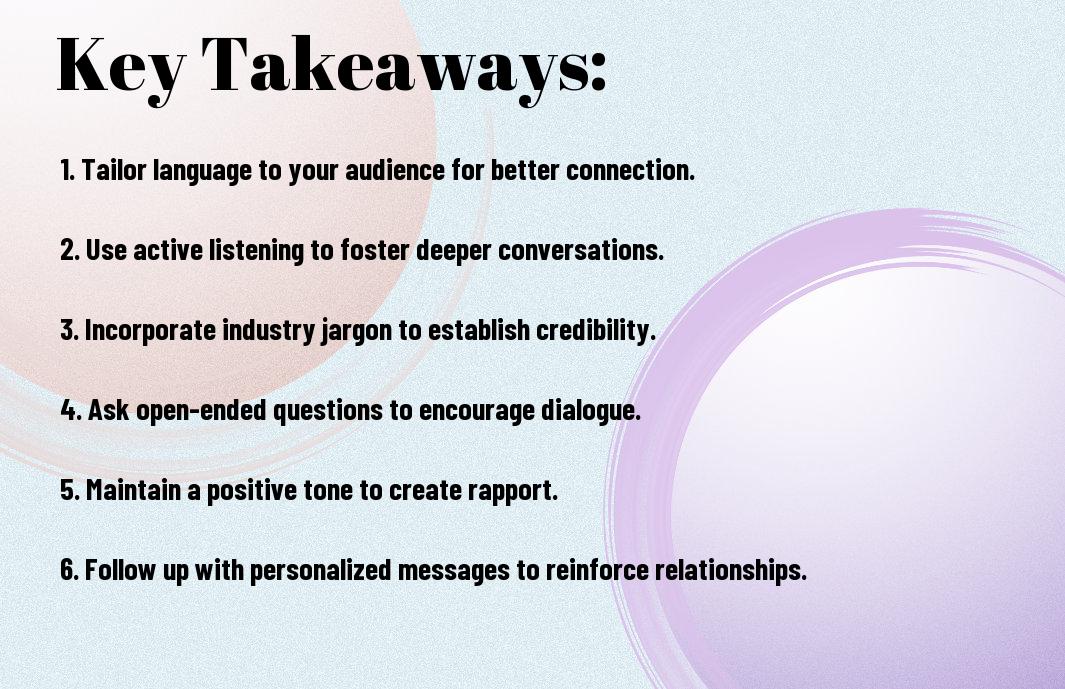
Key Takeaways:

To effectively build professional networks through language, consider the following points:

  • Using active listening skills is necessary to engage with others and show genuine interest in their work, which can help establish meaningful connections and foster a strong network.
  • Developing a clear and concise communication style can help you effectively convey your ideas and needs to others, making it easier to build relationships and collaborate with colleagues and peers.
  • Practicing authentic and respectful communication can help you build trust and credibility with others, leading to stronger, more lasting professional relationships and a more extensive network of contacts.

    Establishing a Foundation

    While building a professional network, you need to focus on creating a strong foundation. This involves being genuine, approachable, and clear in your communication. Your goal is to establish a connection with others in your industry, and this starts with how you present yourself and your ideas.

    Building trust through clear communication

    To effectively build trust, you should prioritize clarity in your language. When you communicate clearly, you show that you value the other person’s time and attention, which can help establish a strong foundation for your professional relationship. You will be seen as reliable and competent.

    Active listening in professional settings

    Along with clear communication, active listening is important in professional settings. You should focus on fully understanding the other person’s perspective, asking questions, and responding thoughtfully. This helps to build trust and rapport, which are key components of a strong professional network.

    Active listening involves more than just hearing the words that are being spoken. You need to pay attention to nonverbal cues, such as body language and tone of voice, and respond in a way that shows you are engaged and interested in the conversation. By doing so, you can create a safe and supportive environment where others feel comfortable sharing their thoughts and ideas, which can lead to meaningful connections and opportunities in your professional network.

    Crafting Your Professional Voice

    Assuming you want to establish a strong professional presence, your language should reflect your expertise and personality. You need to develop a voice that is consistent across all platforms, making you recognizable and trustworthy to your audience.

    Developing a strong and concise writing style

    With clarity and precision, you can convey your message effectively, making your writing engaging and easy to understand. You should aim to use simple language, avoiding jargon and technical terms that might confuse your readers.

    Effective verbal communication techniques

    About the way you speak, it’s important to be confident and clear, varying your tone and pitch to keep your audience interested. You can achieve this by practicing your presentations and paying attention to your body language.

    Due to the significance of verbal communication in professional settings, you should focus on improving your public speaking skills, learning how to articulate your thoughts and ideas in a concise and persuasive manner, which will help you build strong relationships with your network and establish your authority in your field.

    Networking Strategies

    Not all professionals are natural networkers, but with the right approach, you can build a strong professional network. You need to identify the best strategies to connect with others in your industry, and practice your communication skills to make a good impression.

    Identifying and attending relevant industry events

    Strategically, you should look for events that align with your career goals and attend them regularly, as they provide valuable opportunities to meet people in your field and learn about new developments.

    Leveraging social media for professional connections

    Besides face-to-face interactions, you can also use social media to expand your network, by joining professional groups and engaging with others in your industry, which can help you stay connected and up-to-date on industry news.

    But as you leverage social media for professional connections, you should be mindful of your online presence and ensure that your profiles are professional and consistent with your personal brand, as this will help you make a good impression on potential contacts and maintain a strong network over time.

    Navigating Professional Relationships

    Many professionals struggle to establish and maintain effective relationships in their network. You will need to develop skills to navigate these relationships successfully, which will help you build trust and credibility with your colleagues and peers.

    Building rapport with colleagues and peers

    Among the key factors in building strong professional relationships is establishing common ground and shared interests. You can do this by engaging in conversations, asking questions, and showing genuine interest in your colleagues’ work and experiences.

    Managing conflicts and difficult conversations

    At times, you will encounter conflicts or difficult conversations in your professional network. You should approach these situations with empathy and an open mind, seeking to understand the other person’s perspective and finding a resolution that works for everyone.

    In fact, managing conflicts and difficult conversations effectively can actually strengthen your relationships and build trust with your colleagues and peers. You will be able to navigate these challenging situations with confidence and professionalism, and your network will respect you for it, which will lead to more opportunities and a stronger professional reputation.

    Maintaining and Expanding Your Network

    Despite the initial effort of building a professional network, you must continue to nurture and grow your connections to achieve long-term benefits, and consistently using language to convey your professionalism is key to this process.

    Regularly updating your professional profile

    By keeping your online profiles up-to-date, you showcase your current skills and experiences, making it easier for others to find and connect with you, and effectively utilize language to build a strong professional image.

    Engaging in ongoing professional development

    Professionally, you are expected to stay current with industry trends and developments, and engaging in ongoing learning opportunities allows you to expand your knowledge and network, using language to demonstrate your expertise and build trust with your connections.

    Even as you continue to develop your skills and expand your network, you will find that using language effectively becomes second nature, enabling you to articulate your thoughts and ideas with clarity and confidence, and ultimately, build a strong and lasting professional network that benefits your career.

    Overcoming Common Challenges

    Your ability to build a professional network can be hindered by various obstacles, but with the right strategies, you can overcome them, visit 7 Tips for Building a Strong Professional Network to learn more.

    Addressing cultural and linguistic barriers

    Behind every successful networker is a willingness to adapt to different cultures and languages, and you can do the same by being open-minded and taking language courses to improve your communication skills.

    Dealing with rejection and setback

    Behind the setbacks you may face when building your network, lies an opportunity to learn and improve, and you can use these experiences to refine your approach and achieve your goals.

    Further, dealing with rejection and setback requires a growth mindset, and you can develop this by focusing on your strengths, learning from your mistakes, and persevering through challenges, which will help you to stay motivated and committed to building a strong professional network.

    Conclusion

    With this in mind, you can effectively use language to build professional networks by being authentic and clear in your communication. You will find that your professional relationships grow stronger as you engage in meaningful conversations, actively listen to others, and articulate your thoughts with precision. By doing so, you will establish your credibility and build trust with your peers, ultimately expanding your professional network and opening doors to new opportunities. Your thoughtful approach to language will serve as a foundation for your ongoing success.

    FAQ

    Q: What is the importance of language in building professional networks, and how can I use it effectively?

    A: Language plays a significant role in building professional networks as it enables effective communication, conveys professionalism, and helps establish trust with potential connections. To use language effectively, focus on being clear, concise, and respectful in your interactions. Practice active listening, ask thoughtful questions, and be genuinely interested in others’ work and experiences. This will help you build strong relationships and expand your professional network.

    Q: How can I tailor my language to appeal to different professional audiences and build meaningful connections?

    A: To tailor your language and build meaningful connections with different professional audiences, it’s vital to understand their interests, needs, and preferences. Research the industry, company, or organization you’re targeting, and adjust your vocabulary, tone, and style accordingly. Use storytelling techniques to share relevant experiences and highlight your skills, and be prepared to discuss current trends and challenges in your field. By speaking their language, you’ll be able to establish common ground and build rapport with potential connections.

    Q: What are some common language-related mistakes to avoid when building professional networks, and how can I improve my communication skills?

    A: Common language-related mistakes to avoid when building professional networks include using jargon or overly technical language, dominating conversations, and failing to listen actively. To improve your communication skills, practice articulating your thoughts clearly and concisely, and focus on asking open-ended questions that encourage meaningful discussions. Additionally, seek feedback from others, and be open to constructive criticism to help you refine your language and communication style. By being mindful of these potential pitfalls and continually working to improve your skills, you’ll be able to build stronger, more effective professional networks.

How to Learn the Nuances of Politeness in Languages

As you explore new languages, you’ll discover that politeness is a vital aspect of communication. You’ll need to understand the subtle differences in tone, vocabulary, and grammar that convey respect and courtesy. Your ability to master these nuances will significantly enhance your language skills, allowing you to interact more effectively with native speakers and avoid unintended offense. By learning the intricacies of politeness, you’ll become a more confident and efficient communicator in your target language.

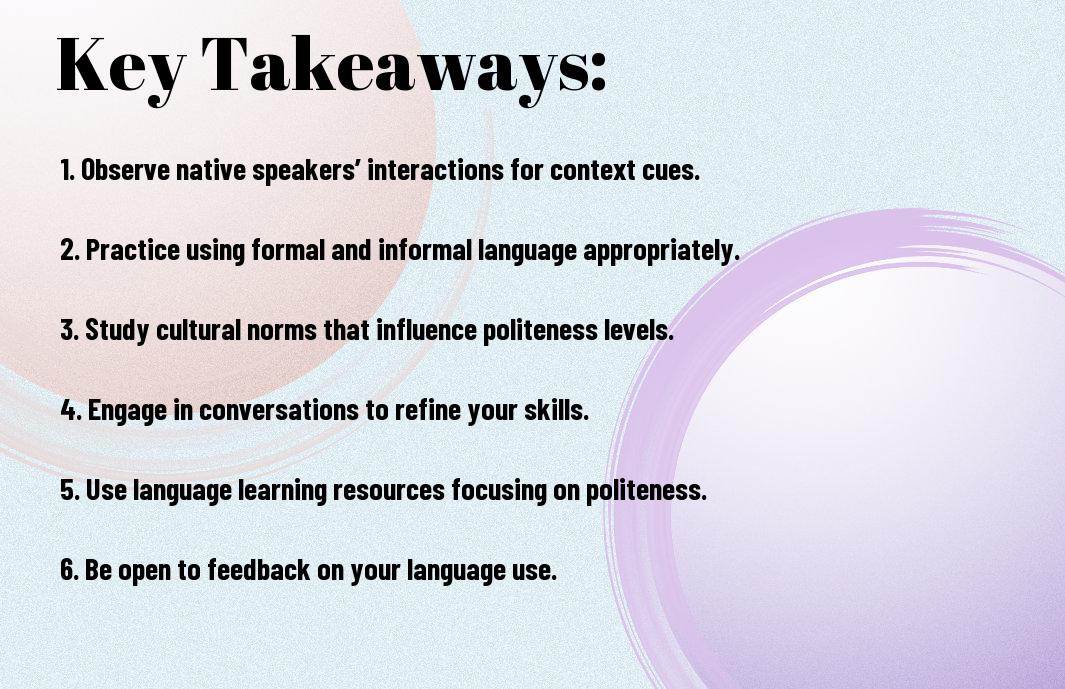
Key Takeaways:

  • Understanding the cultural context is vital to mastering the nuances of politeness in languages, as what is considered polite in one culture may be seen as rude in another.
  • Language patterns and idiomatic expressions play a significant role in conveying politeness, and learning these expressions can help you sound more natural and respectful in your interactions.
  • Practice and immersion are key to developing a sense of politeness in a language, as they allow you to learn from native speakers and adapt to different social situations, enabling you to communicate effectively and avoid unintended offense.

    Language Fundamentals

    Before venturing into the nuances of politeness in languages, you need to understand the basics of language structure and grammar. You will learn how to use language effectively to convey your message and show respect to others.

    General Principles of Politeness

    Following your introduction to language fundamentals, you will discover the general principles of politeness that apply to most languages, including the use of formal and informal language, and how to address people with respect.

    Language-Specific Etiquette

    Along with general principles, you will also learn about language-specific etiquette, which varies across cultures and languages, and how to apply these rules to communicate effectively and avoid unintentionally offending others.

    In fact, as you explore deeper into language-specific etiquette, you will find that each language has its unique set of rules and customs that dictate how to interact with native speakers, and mastering these nuances will help you to build stronger relationships and navigate different social situations with confidence, allowing you to tailor your approach to your audience and context, and ensuring that your message is conveyed with respect and sensitivity to the cultural norms of your listeners.

    Cultural Considerations

    Any language learner knows that cultural background plays a significant role in shaping your understanding of politeness in a language. As you investigate into the nuances of a language, you will discover that cultural considerations are important in effective communication.

    Regional Variations in Politeness

    Culturally, different regions may have distinct norms and expectations when it comes to politeness, and you need to be aware of these variations to avoid unintended offense or misunderstandings.

    Impact of Cultural Background on Language Use

    Variations in cultural background can significantly influence your language use, and as you learn a new language, you will need to consider the cultural context in which you are communicating to ensure that your message is conveyed effectively.

    Also, as you become more aware of the impact of cultural background on language use, you will be able to tailor your communication style to your audience, taking into account their cultural norms and expectations, and this will enable you to build stronger relationships and communicate more effectively in your target language.

    Verbal Communication

    Now that you’re learning a new language, verbal communication is an imperative aspect to focus on. You’ll need to understand the various nuances of speech to convey your message effectively. Your ability to communicate verbally will greatly impact your relationships and interactions with native speakers.

    Formal and Informal Language

    Across different cultures, you’ll encounter various forms of language, including formal and informal tone. You’ll need to understand when to use each to avoid unintended offense or confusion. Your grasp of formal and informal language will help you navigate social situations with ease.

    Tone and Pitch in Speech

    Before delving into the intricacies of tone and pitch, you should understand their significance in verbal communication. You’ll notice that your tone and pitch can convey emotions and attitudes, making it imperative to use them appropriately. Your tone and pitch can make or break the impact of your message.

    Plus, as you practice speaking, pay attention to how your tone and pitch vary in different situations. You’ll find that your tone can be firm, gentle, or sarcastic, while your pitch can be high, low, or moderate. Your awareness of these variations will help you convey your intended message more effectively, allowing you to communicate with confidence and clarity.

    Nonverbal Cues

    All languages have nonverbal cues that convey politeness, and understanding these is key to effective communication. You will find that nonverbal cues can vary greatly across cultures, and being aware of these differences is imperative to avoid unintended offense.

    Body Language and Facial Expressions

    Behind every polite phrase, there are nonverbal signals that reinforce your intentions, and you can use body language and facial expressions to convey respect and friendliness, making your interactions more positive and productive.

    Proximity and Physical Contact

    To navigate different social situations, you need to consider proximity and physical contact, as these can greatly impact how your politeness is perceived, and you should be mindful of personal space and physical contact norms in different cultures.

    This aspect of nonverbal communication can be particularly challenging, as what is considered polite in one culture may be seen as intrusive or aggressive in another, and you will need to adjust your behavior accordingly to avoid misunderstandings and build strong relationships with people from diverse backgrounds.

    Learning Strategies

    After understanding the basics of politeness in languages, you can explore various learning strategies. You can find insights on How do languages vary in terms of politeness strategies and speech registers to develop your skills.

    Immersion and Practice

    For effective learning, surround yourself with native speakers and engage in conversations to practice politeness in context, which will help you develop your language skills.

    Feedback and Self-Assessment

    With consistent practice, you’ll become more aware of your language use and can assess your progress, identifying areas for improvement in your politeness expression.

    This process of self-assessment allows you to refine your language skills, enabling you to communicate more effectively and politely in your target language, as you continue to learn and adapt to new situations and cultural nuances.

    Common Challenges

    Despite the importance of politeness in language, you will encounter numerous obstacles as you learn to navigate its nuances. You will find that politeness can be culturally-specific and context-dependent, making it difficult to master.

    Idiomatic Expressions and Colloquialisms

    Obviously, one of the main hurdles you will face is understanding the idiomatic expressions and colloquialisms that are unique to each language and culture, which can be confusing and lead to unintended offense.

    Politeness in Different Social Contexts

    Essentially, expressions of politeness vary greatly depending on the social context in which you find yourself, and you must be able to adapt your language to suit different situations and audiences.

    But as you examine deeper into the complexities of politeness in different social contexts, you will discover that your ability to convey respect, empathy, and consideration is not just about using the right words, but also about being aware of nonverbal cues, tone of voice, and cultural norms, all of which can significantly impact how your message is perceived by others.

    Conclusion

    Following this guide, you will be well on your way to mastering the nuances of politeness in languages. As you continue to learn, you can find more resources, such as the article on TEACHING HOW TO BE POLITE IN ENGLISH, to help you improve your skills. Your ability to understand and apply polite language will enhance your communication and relationships in your target language.

    FAQ

    Q: What is the best way to learn the nuances of politeness in languages?

    A: Learning the nuances of politeness in languages requires a combination of language classes, cultural immersion, and practice. Start by enrolling in a language course that focuses on the cultural aspects of the language, and try to engage with native speakers as much as possible. Watching local TV shows, movies, and social media can also help you pick up on polite expressions, tone, and body language. Additionally, try to practice speaking with native speakers, either in person or online, to get feedback on your pronunciation and politeness.

    Q: How can I avoid unintentionally offending someone due to cultural or linguistic differences in politeness?

    A: To avoid unintentionally offending someone, it’s important to understand the cultural norms and values of the language you’re learning. Research the customs, traditions, and etiquette of the culture, and try to be sensitive to differences in communication styles. For example, some cultures place a strong emphasis on direct communication, while others value indirectness and subtlety. Being aware of these differences can help you navigate complex social situations and avoid unintended offense. Furthermore, if you’re unsure about how to express yourself in a particular situation, it’s always better to err on the side of caution and ask for clarification or feedback from a native speaker.

    Q: Can I learn the nuances of politeness in languages through self-study, or do I need to work with a language teacher or tutor?

    A: While it’s possible to learn some aspects of politeness in languages through self-study, working with a language teacher or tutor can be highly beneficial. A qualified teacher can provide personalized feedback on your language usage, help you understand nuanced cultural references, and correct any misunderstandings or mistakes. Additionally, a teacher can help you practice conversational scenarios and role-plays, which can help you develop your language skills in a more interactive and immersive way. However, self-study can still be a valuable supplement to language classes, and using online resources, such as language learning apps, podcasts, and YouTube channels, can help you learn polite expressions, phrases, and vocabulary on your own.

How to Master Verb Conjugations in Foreign Languages

As you examine into learning a foreign language, you’ll encounter the complex world of verb conjugations. You’ll discover that mastering these conjugations is important to expressing yourself effectively. Your ability to communicate depends on understanding how to use verbs in different tenses and contexts. You’ll learn to navigate the nuances of language and improve your speaking and writing skills by focusing on verb conjugations, and this blog post will guide you through the process.

Key Takeaways:

To master verb conjugations in foreign languages, consider the following points:

  • Focus on understanding the grammar rules that govern verb conjugations, as this will help you to decode and apply the correct forms in different contexts.
  • Practice consistent immersion in the language by engaging with native speakers, watching TV shows or movies, and listening to music, which will help you to get used to the sound and structure of the conjugated verbs.
  • Use flashcards and language learning apps to drill verb conjugations and test your knowledge, allowing you to track your progress and identify areas that need more practice, and ultimately achieve mastery of verb conjugations in your target language.

Fundamentals of Verb Conjugations

Before submerging into the specifics of verb conjugations, you need to understand the basics of how verbs function in a sentence. You will learn about the different tenses, moods, and aspects that affect verb conjugations, allowing you to build a strong foundation for your language learning journey.

Basic Rules and Patterns

Along the lines of understanding verb conjugations, you will discover that many languages follow similar patterns. You will identify the typical verb endings and prefixes that indicate tense, mood, and subject agreement, making it easier for you to conjugate verbs correctly.

Common Irregularities

Upon examining verb conjugations, you will encounter irregular verbs that deviate from standard patterns. You will learn to recognize these irregularities and develop strategies to memorize and apply them correctly in different contexts.

And as you examine deeper into common irregularities, you will find that many languages have verbs that change their stem or follow unique conjugation patterns. You will develop techniques to tackle these irregularities, such as creating flashcards, practicing with exercises, and using language learning apps to reinforce your understanding of verb conjugations, ultimately helping you to master them in your target language.

Mastering Tenses and Moods

Some languages have complex verb conjugation systems, but you can learn to master them with practice. You can find helpful resources, such as How to Conjugate Verbs Like a Pro (in Any Language), to guide you through the process.

Present, Past, and Future Tenses

For instance, you will need to understand the present, past, and future tenses, which can be irregular in some languages, making it challenging to learn, but with consistent practice, you will get familiar with your target language’s verb conjugation patterns.

Imperative, Subjunctive, and Conditional Moods

Mastering the imperative, subjunctive, and conditional moods will help you express yourself more effectively in your target language, allowing you to give commands, express doubt, or talk about hypothetical situations with ease and confidence.

Moods are used to express attitudes or emotions towards an action, and as you explore deeper into the imperative, subjunctive, and conditional moods, you will be able to convey your thoughts and feelings in a more nuanced and precise way, which is vital for effective communication in your target language, enabling you to express yourself clearly and accurately.

Practicing Conjugations

After learning the rules of conjugation, you can start practicing them to reinforce your understanding. You will find that consistent practice helps you to commit the conjugations to memory, making it easier to use them in context.

Exercises and Drills

One effective way to practice conjugations is through targeted exercises and drills, which help you to focus on specific tenses and verb forms. You can find these exercises in language learning textbooks or online resources, and they will help you to build your skills and confidence.

Using Flashcards and Language Learning Apps

Between language learning apps and flashcards, you have a variety of tools at your disposal to practice conjugations. You can use these resources to test your knowledge and track your progress over time, identifying areas where you need to focus your efforts.

In addition, using flashcards and language learning apps can be an efficient way to practice conjugations, as they often include interactive exercises and quizzes that make learning more engaging and fun. You can use them to practice conjugating verbs in different tenses and contexts, and you will find that your proficiency improves with consistent practice.

Overcoming Common Challenges

Many language learners struggle with verb conjugations, but with practice and persistence, you can overcome these challenges and master them. You will encounter various obstacles, but by understanding the patterns and rules, you can improve your skills and become more confident in your language abilities.

Dealing with Homophones and Homographs

By analyzing the context in which words are used, you can better understand the differences between homophones and homographs, and avoid confusion when conjugating verbs. You will learn to recognize the subtle distinctions and apply them correctly in your language usage.

Managing Verb Conjugation Exceptions

Above all, it’s crucial to be aware of the exceptions to the rules, as they can be tricky to navigate. You need to study and practice these exceptions to ensure you understand how to apply them in different situations, which will help you to improve your overall language skills.

For instance, when you encounter irregular verbs, you should focus on memorizing their conjugations, as they don’t follow the usual patterns. You can use flashcards or create your own exercises to practice these verbs, and soon you will be able to use them correctly in your sentences, which will enhance your language proficiency and enable you to communicate more effectively.

Immersion and Contextual Learning

For effective verb conjugation mastery, surround yourself with the language you’re learning, using authentic materials and real-life interactions to build your skills.

Reading and Listening to Native Materials

By exposing yourself to native speakers, media, and texts, you’ll develop an intuitive sense of verb conjugations and improve your comprehension of nuances in the language.

Engaging in Conversations and Discussions

Listening to native speakers and engaging in conversations, you’ll pick up on verb conjugations used in context, helping you to better understand their application and usage.

Conversations with native speakers will help you learn to use verb conjugations naturally, as you’ll be forced to think on your feet and respond appropriately, allowing you to practice your skills in a realistic setting and receive feedback on your pronunciation and grammar from your conversation partner, helping you to refine your skills and improve your mastery of verb conjugations in the language you’re learning.

Review and Reinforcement

To master verb conjugations, consistent practice is key. You will need to reinforce your learning through regular review sessions and track your progress.

Regular Review Sessions

Besides dedicating time to learn new conjugations, you should also schedule regular review sessions to reinforce what you have learned, helping to solidify your understanding of verb conjugations.

Tracking Progress and Setting Goals

By monitoring your progress and setting achievable goals, you will be able to identify areas where you need improvement and stay motivated to continue learning and practicing verb conjugations.

But as you track your progress, you will also begin to notice patterns and areas where you struggle, allowing you to adjust your practice sessions and focus on the most challenging conjugations, ultimately helping you to master verb conjugations in the foreign language you are learning.

Summing up

Presently, you have acquired the skills to tackle verb conjugations in foreign languages. You can now apply your knowledge to improve your language skills. With consistent practice, you will master verb conjugations, enabling you to communicate effectively in your target language. Your progress will be noticeable, and your confidence will grow as you become more proficient in using verbs in context, facilitating your overall language learning journey.

FAQ

Q: What is the most effective way to learn verb conjugations in a foreign language?

A: To master verb conjugations, it’s vital to start by understanding the grammar rules and patterns of the language. Begin by learning the present, past, and future tenses, and then practice, practice, practice. Use online resources, language learning apps, and flashcards to help you memorize the different conjugations. Try to practice verb conjugations in context by using them in sentences and conversations, which will help you develop a deeper understanding of how they are used in everyday language.

Q: How can I overcome the difficulty of memorizing many different verb conjugations?

A: One approach to make memorizing verb conjugations more manageable is to focus on the most commonly used verbs and tenses first. Create a list of the top verbs you want to learn and practice their conjugations regularly. You can also try breaking down the verbs into smaller groups based on their conjugation patterns, which can make it easier to identify and learn the different endings. Additionally, using music, rhymes, or other mnemonic devices can help make the learning process more engaging and fun, and improve your ability to retain the information.

Q: Are there any tools or resources that can help me practice and improve my verb conjugation skills?

A: Yes, there are many tools and resources available to help you practice and improve your verb conjugation skills. Online language learning platforms, such as Duolingo and Babbel, offer interactive exercises and quizzes to help you practice verb conjugations in context. You can also use language exchange websites and apps to practice speaking and writing with native speakers, which will help you get feedback on your conjugation skills. Furthermore, many language learning podcasts and YouTube channels provide lessons and explanations on verb conjugations, which can be a great supplement to your learning process.

How to Learn Languages for Interpreting Careers

As you consider a career in interpreting, you’ll need to develop strong language skills to succeed. Your ability to understand and communicate effectively in multiple languages will be crucial. You’ll want to focus on building your proficiency in both your native and target languages, and learn to navigate cultural nuances and technical terminology. By following the right strategies and techniques, you can acquire the language skills necessary to excel in this rewarding field and take your career to the next level.

Key Takeaways:

To pursue a career in interpreting, it’s necessary to develop strong language skills. Here are the key points to consider:

  • Developing proficiency in multiple languages is vital for a career in interpreting, as it enables you to understand and convey complex information accurately.
  • Immersion in the language and culture is an effective way to learn, as it allows you to pick up nuances and expressions that may not be taught in a classroom setting.
  • Focusing on specialized vocabulary and terminology related to your area of interest, such as law or medicine, can help you become a skilled interpreter in a specific field and increase your job prospects.

Choosing the Right Language

A key step in becoming an interpreter is selecting a language that aligns with your career objectives. You will need to consider various factors, including your native language, the demand for certain languages, and your personal interests. This decision will impact your future career opportunities and the level of competition you will face.

Identifying Your Interpreting Goals

Beneath the surface of your decision to become an interpreter lies a set of goals that will guide your language choice. You should assess your motivation for pursuing an interpreting career and what you hope to achieve, as this will help you narrow down your options and choose a language that is in demand and aligns with your aspirations.

Researching Language Demand

Guided by your goals, you will need to investigate the demand for different languages in the interpreting industry. You can explore job listings, industry reports, and professional organizations to determine which languages are most sought after and where the opportunities are greatest.

To further your understanding of language demand, you will want to examine the specific industries and settings where interpreters are needed, such as healthcare, law, or international business. You can also look into the growth prospects of different languages and the level of competition in each field, allowing you to make an informed decision about which language to pursue and how to position yourself for success in your interpreting career.

Language Learning Fundamentals

Assuming you have a passion for languages, your journey to becoming an interpreter starts with building a strong foundation. You will need to develop your language skills to accurately convey messages between languages.

Grammar and Syntax Basics

The key to understanding any language is mastering its grammar and syntax. You will need to study the rules that govern sentence structure, verb conjugation, and tense to express yourself effectively in your target language.

Vocabulary Building Techniques

Learning new words and phrases is important for expanding your language skills. You can start by learning common phrases, idioms, and expressions used in everyday conversations, and gradually move on to more specialized terminology relevant to your interpreting career.

Plus, as you continue to build your vocabulary, you will find that your comprehension and communication skills improve significantly, enabling you to interpret complex ideas and nuances with precision and accuracy, which is vital for a successful interpreting career, and you will be able to tailor your learning to focus on the specific areas of specialization you are interested in, such as legal, medical, or business interpreting.

Immersion and Practice

For aspiring interpreters, consistent practice is imperative to develop your language skills and gain proficiency in a target language.

Surrounding Yourself with the Language

Across various platforms, you can access language learning materials, such as TV shows, podcasts, and social media, to immerse yourself in the language and get accustomed to its rhythm and nuances.

Finding Language Exchange Partners

Before you start searching, consider what you hope to achieve from a language exchange and what you can offer in return, to find a suitable partner who shares your goals and motivated to help you improve.

Practice conversing with your language exchange partner regularly, focusing on your weakest areas, and you will see significant improvement in your language skills over time, allowing you to become a proficient interpreter and achieve your career goals.

Interpreting Skills Development

Your journey to becoming a skilled interpreter involves developing a range of skills, including note-taking, memory techniques, and active listening, all of which are important for effective communication in your interpreting career.

Note-taking and Memory Techniques

After mastering language fundamentals, you will need to focus on developing your note-taking and memory skills to accurately capture and convey information during interpreting assignments, helping you to effectively process and retain large amounts of information.

Improving Active Listening

Interpreting requires you to focus intensely on the speaker, concentrating on their words, tone, and body language to ensure that you convey their message accurately, and developing your active listening skills will enable you to pick up on nuances and subtleties that might otherwise be missed.

Indeed, as you work on improving your active listening skills, you will find that your ability to interpret effectively also improves, allowing you to better understand the speaker’s intended meaning and convey it in a way that is clear and accurate, which is important for building trust and credibility with your clients and stakeholders, and you will become a more confident and competent interpreter.

Specialized Training and Certification

Unlike other language careers, interpreting requires highly specialized training and certification to ensure your success. You will need to acquire specific skills and knowledge to become a competent interpreter.

Enrolling in Interpreting Courses

Interpreting courses will provide you with the foundation you need to develop your language skills and learn about the interpreting process. You will learn about different interpreting modes, such as consecutive and simultaneous interpreting, and practice your skills in a supportive environment.

Obtaining Professional Certification

Above all, certification is imperative to demonstrate your proficiency as an interpreter. You will need to meet specific requirements and pass a certification exam to obtain professional certification, which will open up more job opportunities for you.

Even if you have completed your training, obtaining professional certification can be a challenging process. You will need to prepare thoroughly for the certification exam, practicing your interpreting skills and learning about industry standards and ethics. By investing time and effort into your certification, you will be able to demonstrate your expertise and enhance your career prospects as an interpreter.

Staying Motivated and Focused

Keep your motivation levels high by tracking your progress, celebrating small victories, and rewarding yourself for milestones achieved. This will help you stay focused on your goal of becoming an interpreter.

Setting Achievable Goals and Deadlines

Once you have set your overall goal, break it down into smaller objectives, creating a roadmap to success. Outline specific tasks and timelines, making sure they are realistic and achievable, allowing you to stay on track and monitor your progress.

Using Technology to Enhance Learning

Similarly to deadlines, utilizing digital tools can significantly enhance your learning experience. You can access language learning apps, online courses, and practice interpreting with multimedia resources, making your learning more engaging and efficient.

Even with a busy schedule, you can fit in language practice using your smartphone or computer, accessing a wide range of language learning resources and tools, such as podcasts, videos, and interactive exercises, to help you improve your interpreting skills and stay motivated.

Final Words

With these considerations, you will be well-prepared to begin on your journey to learn languages for interpreting careers. You can develop your skills through practice, dedication, and persistence. As you progress, your proficiency will improve, enabling you to effectively communicate and interpret in your chosen language. By following these guidelines, you will enhance your chances of success in this rewarding field, and your career as an interpreter will flourish. Your hard work will pay off, and you will become a skilled language interpreter.

FAQ

Q: What are the best language learning methods for a career in interpreting?

A: To become a skilled interpreter, it’s imperative to focus on developing your language proficiency through a combination of formal education, self-study, and practice. Enroll in language courses that emphasize speaking, listening, reading, and writing skills. Utilize online resources, such as language learning apps and podcasts, to supplement your learning. Additionally, engage in conversations with native speakers, watch TV shows and movies in the target language, and read books and news articles to improve your comprehension and vocabulary.

Q: How can I improve my interpretation skills and gain practical experience?

A: Improving your interpretation skills requires consistent practice and exposure to real-world scenarios. Start by interpreting for friends, family, or volunteers, and gradually move on to more complex situations. You can also participate in language exchange programs, attend workshops and conferences, and join online communities of interpreters to learn from their experiences. Consider volunteering or internships with organizations that provide interpretation services to gain hands-on experience and build your professional network.

Q: What are the most important skills and certifications required for a successful interpreting career?

A: To succeed as an interpreter, you’ll need to possess excellent language skills, cultural knowledge, and the ability to think on your feet. Focus on developing your note-taking, concentration, and public speaking skills, as well as your ability to work well under pressure. Consider obtaining certifications, such as the Certified Interpreter (CI) or the Diplomas in Public Service Interpreting (DPSI), to demonstrate your expertise and commitment to the profession. Staying up-to-date with industry developments and continually improving your skills through ongoing education and training is also vital for a successful interpreting career.

Skip to content