simon weiner

The Benefits of Being Multilingual in Today's World

You live in a globalized world where language skills can significantly impact your career and personal growth. As you navigate different cultures and communities, your ability to communicate in multiple languages can open doors to new opportunities. Your language skills can enhance your travel experiences, expand your social network, and increase your job prospects, making you a more competitive candidate in the job market. You can gain a deeper understanding of diverse perspectives and cultures.

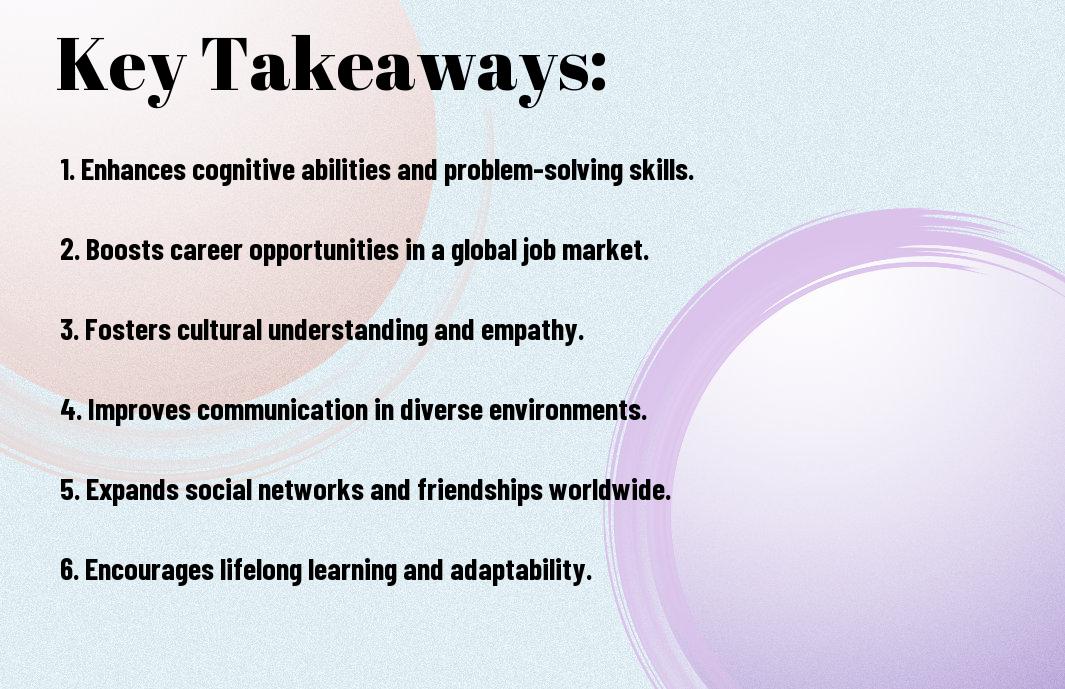
Key Takeaways:

  • Being multilingual in today’s world offers numerous career opportunities and financial benefits, as it allows individuals to communicate effectively with people from diverse cultural backgrounds.
  • Language skills can significantly enhance travel experiences, enabling individuals to navigate foreign countries with ease, appreciate local customs, and forge meaningful connections with native speakers.
  • Cognitive abilities, such as memory and problem-solving, can be improved through the process of learning and maintaining multiple languages.
  • In an increasingly globalized economy, being multilingual can provide a competitive edge in the job market, particularly in fields like international business, diplomacy, and translation.
  • Personal growth and cultural enrichment are also significant benefits of being multilingual, as it broadens one’s perspective and fosters a deeper understanding of the world’s diverse cultures and communities.

Benefits of Multilingualism in Career Advancement

The ability to speak multiple languages can significantly enhance your career prospects, as you can access a broader range of job opportunities and connect with a more diverse client base. According to a study on The Benefits of Multilingualism to the Personal and Professional Development of Individuals, being multilingual can open doors to new career paths and industries.

Enhanced Job Opportunities

Today, you can leverage your language skills to apply for jobs that require multilingual candidates, increasing your chances of getting hired by a global company or organization that operates in multiple countries.

Increased Earning Potential

Before you start applying for multilingual jobs, you should consider the potential salary increase that comes with being able to communicate in multiple languages, as companies are often willing to pay a premium for employees who can interact with clients and customers in their native language.

But as you progress in your career, you will find that your multilingual skills will become a valuable asset, allowing you to take on more responsibilities, such as leading international projects or negotiating with foreign clients, which can lead to significant increases in your earning potential and career advancement opportunities.
Cognitive Advantages of Multilingualism

There’s a significant benefit to being multilingual, as it enhances your cognitive abilities, allowing you to process information more efficiently and effectively. As you navigate through different languages, your brain becomes more adept at adapting to new situations, making you more mentally agile.

Improved Memory and Concentration

Following extensive research, it’s clear that speaking multiple languages improves your memory and concentration, enabling you to stay focused and retain information better. As you switch between languages, you train your brain to prioritize and filter out irrelevant information, sharpening your mental clarity.

Delayed Onset of Age-Related Cognitive Decline

Contrary to what you might expect, being multilingual can actually protect you against age-related cognitive decline, as the constant mental exercise helps build cognitive reserve. This reserve acts as a buffer, shielding your brain from the effects of aging, and allowing you to stay sharper for longer.

Cognitive decline is a natural part of aging, but as a multilingual individual, you have the power to delay its onset. By continually challenging your brain with multiple languages, you build a strong foundation for cognitive health, enabling you to maintain your mental acuity and stay engaged in activities you love, well into old age. This, in turn, can lead to a more fulfilling and independent life, as you continue to learn, grow, and thrive.

Cultural Enrichment through Multilingualism

Your ability to speak multiple languages can significantly enhance your cultural experiences, allowing you to engage with diverse communities and explore new perspectives.

Deeper Appreciation of Diverse Cultures

Through the lens of multilingualism, you gain a more nuanced understanding of cultural norms, values, and traditions, fostering a deeper appreciation for the diversity that surrounds you.

Broader Perspectives and Empathy

Multilingually, you develop the capacity to see the world from different viewpoints, cultivating empathy and broadening your understanding of the complexities that shape human experiences.

Consequently, as you navigate the complexities of multilingual communication, you become more adept at finding common ground with people from diverse backgrounds, allowing you to build more meaningful relationships and connect with others on a deeper level, ultimately enriching your personal and professional life.

Social Benefits of Multilingualism

After acquiring multiple languages, you can experience a significant improvement in your social interactions. Check out the Benefits of Multilingualism Infographic – NCELA to learn more.

Improved Communication with People from Diverse Backgrounds

Along with language skills, you gain a deeper understanding of different cultures, enabling you to connect with people from diverse backgrounds more effectively.

Increased Travel and Exploration Opportunities

The ability to speak multiple languages opens doors to new travel experiences, allowing you to engage with locals and appreciate their customs.

Social benefits of multilingualism extend to your travel experiences, as you can navigate foreign countries with ease, making your journeys more enjoyable and immersive, and you can fully appreciate the local culture, food, and history, making your travels a more enriching experience for you.

Language Learning and Brain Development

Unlike other skills, language learning has a profound impact on your brain development, enhancing your cognitive abilities and improving your overall mental agility. As you learn a new language, your brain undergoes significant changes, adapting to the new information and forming new connections.

Neuroplasticity and Language Acquisition

Acquiring a new language stimulates your brain’s neuroplasticity, allowing it to reorganize and refine its connections. As you learn, your brain creates new pathways, enabling you to process and understand the new language more efficiently.

The Role of Multilingualism in Shaping the Brain

Above all, being multilingual has a profound impact on your brain’s structure and function. As you switch between languages, your brain develops greater flexibility and adaptability, enabling you to think more creatively and solve problems more effectively.

In fact, studies have shown that multilingual individuals have a greater density of grey matter in areas of the brain responsible for language processing, executive control, and attention. This means that, as a multilingual person, you will have a cognitive advantage, being able to switch between languages and tasks with greater ease and accuracy, making you a more effective communicator and problem solver in today’s globalized world.

Challenges and Opportunities in a Multilingual World

Not surprisingly, navigating a multilingual world can be complex.

Overcoming Language Barriers and Stereotypes

You face several challenges, including:

  • Language barriers
  • Cultural differences

. Any multilingual individual can attest to the value of overcoming these obstacles.

Benefits Opportunities
Cultural understanding Global connections
Language skills New experiences
Personal growth Networking
Social awareness Career advancement

Fostering Global Communication and Cooperation

Similarly, stereotypes can hinder effective communication. As you engage with people from diverse backgrounds, you will encounter various perspectives.

Further, fostering global communication and cooperation requires you to be open-minded and adaptable, allowing you to navigate complex cultural and linguistic landscapes, and to leverage your language skills to build bridges between different communities, ultimately enriching your personal and professional life.

Conclusion

So, as you consider your language skills, you’ll find that being multilingual opens doors to new opportunities. You can explore the benefits of speaking multiple languages by visiting what are the advantages of being multilingual to learn more. Your ability to communicate in multiple languages will enhance your personal and professional life, making you a more competitive and adaptable individual in today’s globalized world.

FAQ

Q: What are the career benefits of being multilingual in today’s globalized world?

A: Being multilingual can significantly enhance one’s career prospects in today’s globalized world. With the ability to communicate in multiple languages, individuals can access a broader range of job opportunities, both domestically and internationally. Multilingual employees are highly valued by companies that operate globally, as they can facilitate communication with clients, customers, and colleagues from diverse linguistic backgrounds. This can lead to increased job security, higher salaries, and greater career advancement opportunities.

Q: How does being multilingual impact travel and cultural experiences?

A: Being multilingual can greatly enrich one’s travel and cultural experiences. When individuals can communicate in the local language, they can engage more deeply with the culture, people, and customs of the places they visit. Multilingual travelers can navigate unfamiliar environments with greater ease, read signs and menus, and interact with locals in a more meaningful way. This can lead to a more authentic and immersive travel experience, as well as a deeper understanding and appreciation of different cultures.

Q: What are the cognitive and social benefits of being multilingual?

A: Being multilingual has been shown to have numerous cognitive and social benefits. Multilingual individuals have been found to possess improved memory, problem-solving, and multitasking skills, as well as enhanced cognitive flexibility and creativity. Additionally, being multilingual can foster greater empathy, tolerance, and understanding of diverse perspectives, leading to stronger social connections and a more open-minded worldview. Multilingual individuals can also delay the onset of age-related cognitive decline and even develop a greater sense of identity and belonging to multiple cultural communities.

How Language Learning Improves Cognitive Skills

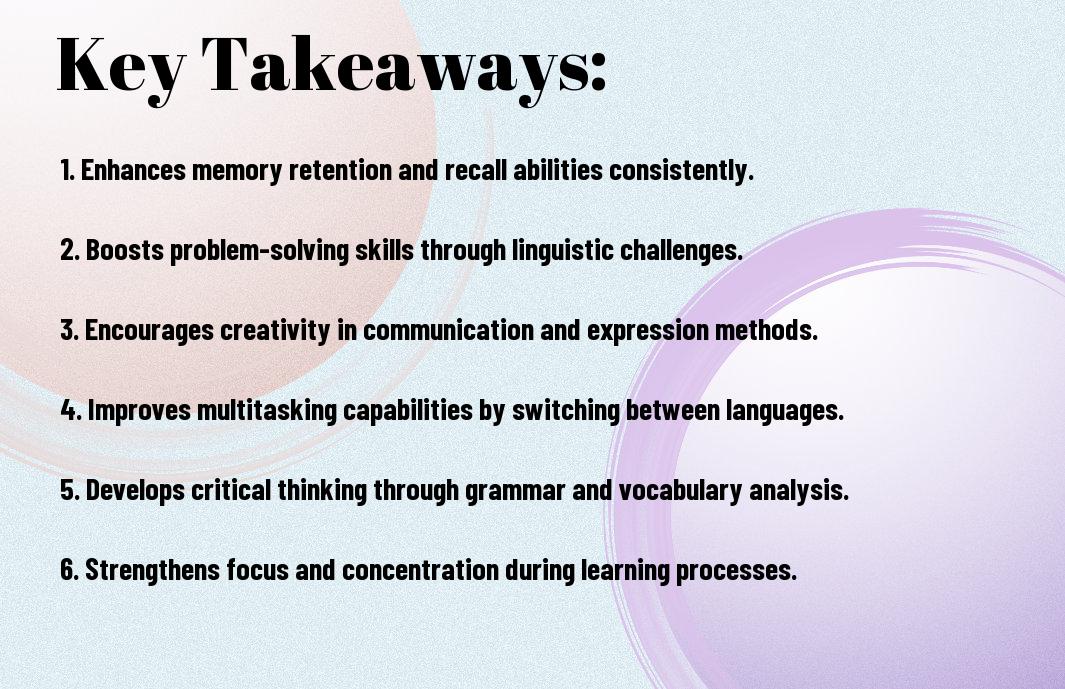
As you launch on learning a new language, you’ll notice improvements in your cognitive skills. Your brain will become more adept at processing information, enhancing your problem-solving abilities and memory. You’ll develop a stronger ability to focus and concentrate, allowing you to tackle complex tasks with ease. By challenging your brain with a new language, you’ll experience significant cognitive benefits that extend beyond language proficiency, influencing your overall mental agility and sharpness.

Key Takeaways:

  • Learning a new language can significantly enhance cognitive flexibility, allowing individuals to switch between different mental tasks more efficiently and adapt to new situations.
  • Memory improvement is another significant benefit of language learning, as it requires the ability to absorb and retain new vocabulary, grammar rules, and sentence structures.
  • Language learning can also boost problem-solving skills by promoting analytical thinking and the ability to approach problems from different angles.
  • The process of learning a new language can delay the onset of cognitive decline and even prevent age-related memory loss by building cognitive reserve.
  • Additionally, language learning can improve multitasking abilities by enabling individuals to process and integrate multiple sources of information simultaneously, leading to better overall cognitive performance.

Enhancing Memory

The process of learning a new language has a significant impact on your cognitive skills, particularly when it comes to memory. As you learn new vocabulary, grammar rules, and sentence structures, your brain creates new connections and strengthens existing ones, leading to improved memory retention.

Improving Vocabulary Retention

Along with the benefits of enhanced memory, you will also experience improved vocabulary retention. As you learn and practice new words, you will find that you are better able to recall and use them in context, helping to expand your language skills.

Developing Better Learning Strategies

Adeptly, you will develop better learning strategies as you navigate the challenges of language learning. You will learn to approach problems from different angles, analyze complex information, and adapt to new situations, all of which will serve you well in your language learning journey.

At this point, you will start to notice that your ability to learn and absorb new information is improving, and you will be able to apply these skills to other areas of your life. As you continue to develop better learning strategies, you will become a more effective and efficient learner, able to tackle complex tasks with confidence and accuracy.

Boosting Problem-Solving Skills

If you learn a new language, you’ll improve your problem-solving abilities. As you navigate unfamiliar grammar and vocabulary, you’ll develop your analytical mind. For more information on how language learning affects brain development, visit How learning a new language helps brain development to discover the benefits for yourself.

Analyzing Language Patterns

Similar skill sets are required to analyze language patterns, as you identify and apply grammatical rules to communicate effectively. Your brain becomes adept at recognizing patterns, making connections between words and ideas, and applying this knowledge to solve problems.

Enhancing Critical Thinking

Skillful thinkers are developed through language learning, as you evaluate information, consider different perspectives, and make informed decisions. You become a more discerning and nuanced thinker, able to approach problems from multiple angles.

Hence, as you develop your critical thinking skills through language learning, you’ll become more adept at tackling complex problems and finding innovative solutions. You’ll be able to break down complex information, identify key issues, and develop well-reasoned arguments, making you a more effective problem-solver in all areas of your life.

Improving Concentration

Many language learners experience improved concentration as they progress in their studies. You will find that focusing on language learning requires attention to detail, which can enhance your overall ability to concentrate.

Focusing on Language Structure

Enhancing your understanding of language structure helps you develop your cognitive skills, including concentration. You will learn to identify patterns and relationships between words, which can improve your ability to focus.

Reducing Distractions

Around the time you start language learning, you may notice that you become more aware of your surroundings and better at filtering out distractions. You will be able to concentrate more effectively, even in noisy environments.

Also, as you continue to learn a new language, you will develop strategies to minimize distractions and stay focused on your goals. You will learn to prioritize tasks, manage your time, and create a conducive learning environment, all of which will help you improve your concentration and achieve your language learning objectives.

Developing Multitasking Abilities

Not only does language learning improve your focus, but it also enhances your ability to switch between tasks efficiently. As you become more proficient in a new language, you’ll find that your brain becomes better at handling multiple tasks simultaneously, making you a more effective multitasker.

Balancing Language and Non-Language Tasks

With newfound language skills, you’ll be able to balance language-related tasks, such as reading and writing, with non-language tasks, like problem-solving and decision-making, more effectively, allowing you to tackle complex projects with ease.

Enhancing Overall Productivity

Productively, you’ll find that language learning helps you prioritize tasks and manage your time more efficiently, leading to increased productivity in all areas of your life, including work, study, and personal projects.

Plus, as your multitasking abilities improve, you’ll be able to take on more responsibilities and achieve your goals faster, which will have a positive impact on your overall well-being and confidence, enabling you to tackle even more challenging tasks and continue growing as a person.

Enhancing Creativity

To improve your cognitive skills, learning a new language can have a significant impact on your creative abilities, allowing you to think outside the box and explore new ideas.

Exploring Linguistic Expression

Along with acquiring new vocabulary, you will discover various linguistic expressions that can broaden your perspective, enabling you to convey your thoughts and ideas more effectively.

Fostering Innovative Thinking

Enhancing your language skills can also stimulate your mind, encouraging you to approach problems from unique angles and develop innovative solutions, which can benefit your personal and professional life.

Due to the complex nature of language learning, you will develop your ability to think creatively, making connections between seemingly unrelated concepts and ideas, and applying this skill to various aspects of your life, leading to increased innovative thinking and problem-solving capabilities.

Supporting Academic Achievement

For students, learning a new language can have a significant impact on academic performance, as you can discover more about the Cognitive Benefits of Learning a Second Language. This skill can enhance your overall learning experience.

Improving Test Scores

Before you take any exam, your language skills can help you better understand the questions and answer them more accurately, leading to improved test scores and a stronger academic record.

Enhancing Research Skills

Below the surface of language learning lies a wealth of research opportunities, as you learn to analyze and evaluate information in multiple languages, expanding your knowledge and understanding of various subjects.

Achievement in language learning can also enhance your research skills by allowing you to access a broader range of academic resources, including books, articles, and primary sources in the target language, thereby deepening your understanding of the subject matter and enabling you to produce more informed and nuanced work.

Summing up

From above, you can see that learning a new language enhances your cognitive abilities, improving your memory, problem-solving skills, and concentration. As you acquire a new language, your brain develops neuroplasticity, allowing you to adapt to new situations and process information more efficiently. This, in turn, boosts your overall cognitive function, enabling you to tackle complex tasks with greater ease and precision, ultimately benefiting your personal and professional life. You will find that your mental agility and focus improve significantly.

FAQ

Q: How does language learning impact cognitive abilities in adults?

A: Language learning has been shown to have a profound impact on cognitive abilities in adults, improving memory, attention, and problem-solving skills. As adults learn a new language, they exercise their brain, building cognitive reserve and developing a stronger ability to focus and multitask. This, in turn, can lead to improved performance in various aspects of life, including work and personal relationships. Furthermore, language learning has been linked to a delayed onset of age-related cognitive decline, making it an excellent activity for adults looking to stay mentally agile.

Q: Can language learning improve cognitive skills in children, and if so, how?

A: Yes, language learning can significantly improve cognitive skills in children. When children learn a new language, they develop their brains’ ability to process and analyze complex information, leading to enhanced cognitive flexibility and adaptability. Language learning also fosters improved metalinguistic awareness, enabling children to better understand the structure and nuances of language, which can transfer to improved performance in other subjects, such as reading and writing. Additionally, bilingual or multilingual children often exhibit advanced social and emotional intelligence, as they learn to navigate different cultural contexts and communicate effectively with diverse groups of people.

Q: What specific cognitive skills are improved through language learning, and how can these skills be applied in everyday life?

A: Language learning improves a range of cognitive skills, including executive functions, such as planning, decision-making, and error correction. It also enhances linguistic skills, like phonological awareness, syntax, and semantics, which are important for effective communication. These skills can be applied in everyday life in various ways, such as improved public speaking, enhanced writing abilities, and more effective communication in personal and professional settings. Moreover, the cognitive skills developed through language learning can transfer to other areas, such as improved mathematical problem-solving, increased creativity, and better time management, making language learners more well-rounded and competent individuals.

Top Strategies for Mastering Language Grammar

You are about to unlock the secrets to perfecting your language skills by focusing on grammar. As you investigate into the world of language learning, you will discover that mastering grammar is vital to effective communication. Your ability to express yourself clearly and accurately depends on your understanding of grammatical rules and concepts. By applying the right strategies, you can improve your language proficiency and enhance your overall learning experience, allowing you to convey your thoughts and ideas with confidence and precision.

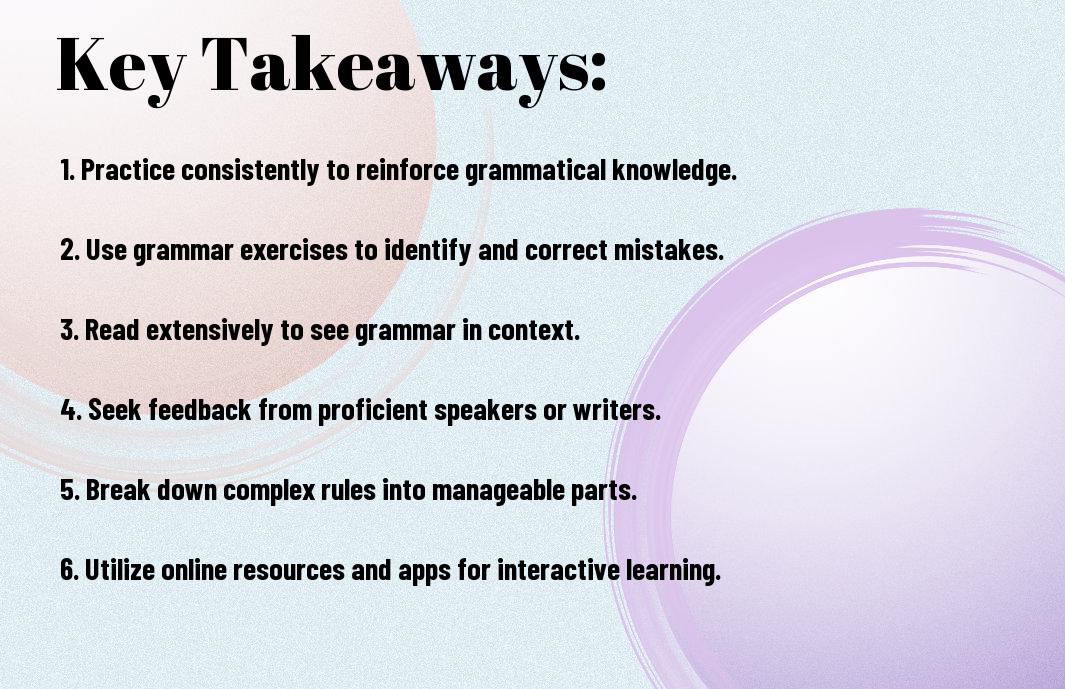
Key Takeaways:

To improve your language skills, consider the following strategies for mastering language grammar:

  • Focus on understanding the rules and exceptions of the language to develop a strong foundation in grammar.
  • Practice consistent exposure to the language through reading, writing, and speaking to reinforce your knowledge of grammar.
  • Use contextual learning methods, such as immersion and real-life examples, to help you apply grammatical concepts in practical situations.
  • Develop a routine of regular practice and review to reinforce your understanding of grammar and identify areas for improvement.
  • Utilize resources such as language learning apps, tutors, and study groups to provide support and feedback on your grammar skills.

Fundamentals of Grammar

The foundation of language learning is built on understanding the basics of grammar, and you can find valuable resources, such as 10 Tips for Mastering English Grammar, to help you get started.

Parts of Speech

Beneath the surface of language lies the parts of speech, which you will need to familiarize yourself with in order to construct meaningful sentences and convey your thoughts effectively.

Sentence Structure

Among the key elements of grammar, sentence structure stands out as a fundamental aspect that you must grasp to communicate clearly and accurately.

Structure is imperative to forming sentences that convey your intended message, and as you explore deeper into the world of grammar, you will discover that understanding sentence structure is vital to enhancing your language skills, allowing you to express yourself with precision and confidence, and enabling you to navigate complex linguistic situations with ease, which is something you will find indispensable in your journey to master language grammar.

Building Blocks of Language

Any language learner knows that understanding the basics is key to mastering a language. You can find useful Tips for Mastering English Grammar for New Learners to improve your language skills.

Verbs and Tenses

Constructing sentences with verbs and tenses helps you express yourself effectively, and as you learn, you will see improvement in your language proficiency.

Nouns and Pronouns

Surrounding your language learning with knowledge of nouns and pronouns will help you to better understand sentence structure and grammar rules.

Plus, as you research deeper into nouns and pronouns, you will discover how they work together to create meaningful expressions, enabling you to communicate your thoughts and ideas with clarity and precision, which will help you to enhance your overall language skills and become a more confident learner.

Mastering Clauses and Phrases

Keep in mind that mastering clauses and phrases is imperative to constructing effective sentences. You will be able to express your thoughts more clearly and accurately, which is key to improving your language skills.

Independent and Dependent Clauses

By understanding the difference between independent and dependent clauses, you can create more complex and nuanced sentences, allowing you to convey your ideas with precision and clarity.

Phrase Structure and Usage

Before submerging into phrase structure, you should familiarize yourself with the various types of phrases, including noun phrases and verb phrases, to improve your sentence construction.

Phrases are groups of words that function as a unit, and you can use them to add depth and variety to your writing and speaking, helping you to convey your intended meaning and engage your audience more effectively.

Effective Sentence Construction

Unlike other aspects of language learning, mastering sentence construction is a skill that takes time and practice to develop. You will need to understand the rules of grammar and syntax to construct sentences that are clear and effective in conveying your message.

Active and Passive Voice

Efficiently using active and passive voice is necessary to create sentences that are engaging and easy to understand. You can use active voice to convey a sense of action and responsibility, while passive voice can be used to emphasize the recipient of the action.

Sentence Variation and Style

Altogether, varying your sentence structure and style is key to keeping your writing or speech interesting. You can use short and long sentences, as well as different grammatical structures, to create a sense of rhythm and flow.

And as you experiment with different sentence variations, you will find that your writing and speech become more engaging and effective in conveying your message. You will be able to convey complex ideas in a clear and concise manner, and your audience will appreciate the effort you put into crafting your sentences.

Common Grammar Mistakes

Now that you’re on your way to mastering language grammar, it’s important to identify the common mistakes that can hinder your progress. You’ll encounter various errors, but being aware of them is the first step to improvement.

Errors in Subject-Verb Agreement

At this stage, you need to ensure that your subjects and verbs agree in number, as inconsistencies can lead to confusing sentences. You should pay close attention to pronoun and verb endings to avoid these errors.

Misuse of Modals and Conditionals

Among the various grammar mistakes, the incorrect use of modals and conditionals is prevalent. You often struggle with using the correct modal verbs, such as “can,” “could,” and “may,” in context, which can alter the sentence’s meaning.

Common mistakes in using modals and conditionals can significantly impact your ability to express yourself effectively. You need to understand the nuances of each modal and conditional, and practice using them in different contexts to improve your grammar skills and convey your intended message accurately. As you practice, you’ll become more comfortable using modals and conditionals correctly, enhancing your overall language proficiency.

Advanced Grammar Techniques

Despite the challenges, you can master advanced grammar techniques by following these steps:

  1. Practice consistently
  2. Focus on nuances
Technique Description
Clause structure Study complex sentence structures

Subjunctive Mood and Conditional Tenses

Betwixt the lines of language, you’ll find subtleties that set your writing apart, such as mastering the subjunctive mood and conditional tenses to convey nuance.

Idiomatic Expressions and Colloquialisms

Any effort you put into learning idiomatic expressions and colloquialisms will enhance your language skills, allowing you to communicate more effectively.

This understanding of idiomatic expressions and colloquialisms will help you to better comprehend native speakers and express yourself more naturally, making your language more engaging and authentic, as you become more familiar with your chosen language’s unique expressions and idioms.

To wrap up

As a reminder, you now have the tools to improve your language grammar skills. You can enhance your understanding by practicing consistently and applying your knowledge in context. By following the top strategies, you will be able to refine your grammar and take your language skills to the next level, making your communication more effective and effortless, and allowing you to express your thoughts with clarity and precision in your writing and speech.

FAQ

Q: What are the most effective ways to improve my language grammar skills?

A: To master language grammar, it is crucial to practice consistently and immerse yourself in the language. Start by reading books, articles, and news in the target language to get a feel for how grammar is used in context. Listening to podcasts, audiobooks, or watching TV shows and movies with subtitles can also help you understand how native speakers use grammar in everyday conversations. Additionally, practice writing and speaking as much as possible, and seek feedback from language exchange partners or tutors to identify and correct your mistakes.

Q: How can I overcome common grammar mistakes and develop a solid understanding of language rules?

A: Overcoming common grammar mistakes requires a combination of knowledge and practice. Begin by studying the grammar rules of the language, focusing on the most common mistakes made by learners. Use online resources, such as grammar guides and exercises, to practice and reinforce your understanding of these rules. It is also helpful to keep a journal or log of your mistakes, tracking the errors you make and reviewing them regularly to avoid repetition. Moreover, engaging in conversations with native speakers or language exchange partners can help you identify areas where you need improvement and provide you with opportunities to practice using grammar correctly in context.

Q: What role does practice and consistency play in mastering language grammar, and how can I stay motivated?

A: Practice and consistency are key to mastering language grammar. Setting aside time each day to practice, even if it’s just for a few minutes, is more effective than practicing for long periods once a week. Create a study routine that includes a mix of reading, writing, listening, and speaking, and stick to it as much as possible. To stay motivated, set achievable goals and track your progress, celebrating your successes along the way. Find a language learning community or partner to share tips and advice, and don’t be afraid to make mistakes – they are an integral part of the learning process. By staying committed and consistent, you will see significant improvement in your grammar skills over time.

How to Practice Speaking a New Language Daily

You are about to initiate on a journey to improve your language skills, and your daily practice will be the key to success. Your ability to speak a new language confidently hinges on consistent effort. As you start this process, you will find that your pronunciation, vocabulary, and grammar will gradually improve. You will learn how to make speaking a new language a part of your daily routine, helping you to stay motivated and achieve your goals.

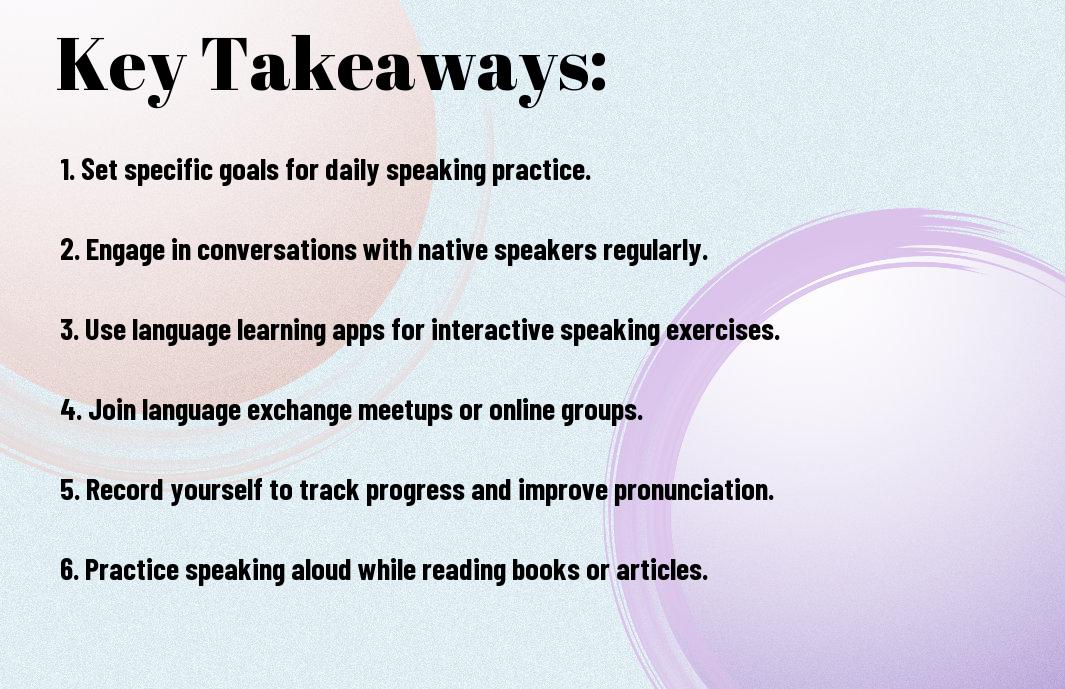
Key Takeaways:

To improve your speaking skills in a new language, follow these daily practice tips:

  • Set aside a dedicated time each day to practice speaking, even if it’s just for a few minutes, to build consistency and make it a habit.
  • Use language learning apps or online resources to access a variety of speaking exercises, such as audio recordings, videos, and interactive conversations, to improve your pronunciation and intonation.
  • Practice speaking with a language exchange partner or tutor to get feedback on your speaking skills and to learn from a native speaker, which can help you improve your fluency and confidence.
  • Listen to native speakers and try to mimic their speech patterns, including their tone, pitch, and rhythm, to improve your accent and comprehension.
  • Record yourself speaking and listen to the recordings to identify areas that need improvement, such as grammar, vocabulary, and pronunciation, and to track your progress over time.

Setting Goals

A key aspect of improving your language skills is to establish a clear plan, which begins with setting achievable goals. You need to determine what you want to accomplish and how you intend to get there. This will help you stay focused and motivated throughout your language learning journey.

Defining Language Learning Objectives

To tailor your approach, you should define your language learning objectives, considering what aspects of the language you want to improve, such as speaking, writing, or listening. You will then be able to design a strategy that meets your specific needs.

Creating a Daily Practice Schedule

Beside mapping out your long-term goals, you must create a daily practice schedule to ensure consistent progress. You should allocate a specific time each day to practice speaking, even if it’s just for a few minutes.

Goals for your daily practice schedule should be specific, measurable, and attainable. You will find that dedicating a few minutes each day to speaking practice, whether through speaking with a language exchange partner, using a language learning app, or watching TV shows in the target language, will significantly enhance your speaking skills over time. As you follow your schedule, you will become more confident in your ability to express yourself in the new language.

Immersion Techniques

If you want to improve your speaking skills, surrounding yourself with the language is imperative. You can do this by incorporating immersion techniques into your daily routine, such as listening to native speakers and watching foreign language media.

Listening to Native Speakers

Natively spoken language can be found in various forms of media, and you can use it to your advantage by listening to podcasts, radio shows, or audiobooks in your target language.

Watching Foreign Language Media

Between TV shows and movies, there are plenty of options to choose from, and you can start with subtitles in your native language to help you understand the dialogue, then gradually switch to subtitles in the target language.

Watching foreign language media can be an entertaining way to improve your listening and comprehension skills, and you can even pause and replay scenes to catch any phrases or words you didn’t understand, allowing you to learn at your own pace and repeat phrases to practice your pronunciation.

Speaking Exercises

For effective language practice, you should engage in speaking exercises daily. This can be done by speaking with native speakers, recording yourself, or using online resources. Your goal is to improve your pronunciation, intonation, and fluency in the target language.

Finding a Language Partner

Almost anyone can find a language partner through local language exchange events or online communities. You can practice speaking with your partner for a set amount of time each day, discussing various topics and correcting each other’s mistakes. Your language partner can provide you with valuable feedback on your pronunciation and grammar.

Using Online Language Learning Platforms

Almost anything you need to learn a language can be found on online platforms. You can use these platforms to access language lessons, practice speaking with native speakers, and track your progress. Your online language learning experience can be tailored to your needs and goals.

Plus, many online language learning platforms offer interactive speaking exercises, such as voice recordings and conversations with chatbots or real people. You can use these resources to practice your speaking skills at any time, from anywhere, and receive instant feedback on your performance. This will help you to identify areas for improvement and work on developing your speaking skills more effectively.

Vocabulary Building

Unlike other aspects of language learning, vocabulary building requires consistent practice to see significant improvement. You will need to make a conscious effort to learn new words daily and use them in context to reinforce your understanding.

Learning New Words Daily

To take your language skills to the next level, you should strive to learn a set number of new words each day, using them in sentences to help solidify their meaning and usage in your mind.

Using Flashcards and Language Learning Apps

For effective vocabulary building, you can utilize flashcards and language learning apps, which provide an efficient way to learn and revise new words, phrases, and their meanings, allowing you to track your progress and identify areas for improvement.

Learning a new language with the help of flashcards and apps can be an engaging experience, as you can access a vast library of words, phrases, and expressions, and practice them at your own pace, helping you develop a robust vocabulary and enhance your communication skills in the target language, enabling you to express yourself more confidently and accurately, and you will find that your vocabulary expands rapidly as you continue to practice and learn new words daily.

Pronunciation Practice

Keep practicing your pronunciation by listening to native speakers and mimicking their intonation and rhythm. You can find numerous resources online, including audio clips and videos, to help you improve your pronunciation skills.

Recording Yourself

One effective way to track your progress is by recording yourself speaking the new language. You can use your smartphone or computer to record your voice and identify areas that need improvement, allowing you to adjust your pronunciation accordingly.

Receiving Feedback from Others

Feedback from others is vital to enhancing your pronunciation. You can join language exchange programs or practice with a language partner who can provide you with constructive feedback on your pronunciation.

In fact, receiving feedback from others can help you pinpoint specific sounds or intonations that you struggle with, enabling you to focus your practice on those areas and make significant improvements in your pronunciation over time, as you continue to work on your language skills, you will find that your ability to communicate effectively in the new language will greatly improve.

Overcoming Challenges

After encountering obstacles, you will find that learning a language requires perseverance. You can find helpful tips on learning a new language efficiently to aid in your progress.

Dealing with Self-Doubt and Fear

Against the feeling of uncertainty, you must push forward and focus on your goals, allowing yourself to make mistakes and learn from them.

Staying Motivated and Consistent

Across the journey of language learning, you will face various challenges, but maintaining a consistent practice routine will help you stay on track.

Due to the complexity of language learning, it is necessary to break down your goals into smaller, achievable tasks, and celebrate your progress along the way, which will help you stay motivated and committed to your daily practice, ultimately leading to significant improvement in your speaking skills over time, as you continue to challenge yourself and push beyond your comfort zone, adapting to new situations and conversations with increased confidence and fluency.

Final Words

Now that you have learned various methods to practice speaking a new language daily, you can start implementing them in your routine. You will see improvement in your speaking skills if you consistently practice using your target language in daily conversations, whether with native speakers or language exchange partners. Your dedication and persistence will ultimately lead to confidence in speaking your new language.

FAQ

Q: What are some effective ways to practice speaking a new language daily?

A: Practicing speaking a new language daily can be achieved through various methods. One way is to engage in conversations with native speakers, either in person or online, for at least 15-20 minutes. Another method is to use language learning apps that offer speaking exercises and interactive lessons. Additionally, watching TV shows or movies in the target language with subtitles, speaking with yourself in the mirror, or recording yourself and listening to the recordings can also help improve your speaking skills.

Q: How can I overcome my fear of speaking a new language and improve my pronunciation?

A: To overcome the fear of speaking a new language, start by practicing in low-stakes situations, such as speaking with a language exchange partner or recording yourself. Focus on listening to native speakers and try to mimic their pronunciation, intonation, and rhythm. You can also listen to podcasts, radio shows, or audiobooks in the target language to get accustomed to its sound and structure. Furthermore, try to speak as much as possible, even if it’s just for a few minutes a day, and don’t be afraid to make mistakes – it’s a natural part of the learning process.

Q: What are some tips for creating a daily routine to practice speaking a new language consistently?

A: To create a daily routine, set a specific time and goal for speaking practice, such as 30 minutes in the morning or 15 minutes during your lunch break. Use a planner, calendar, or app to schedule your practice sessions and track your progress. You can also find a language learning buddy or accountability partner to motivate you and provide feedback. Consistency is key, so try to practice at the same time every day, even if it’s just for a short period. Additionally, mix up your practice activities, such as switching between speaking, listening, and reading, to keep your routine engaging and prevent boredom.

The Most Common Mistakes in Language Learning

As you launch on your language learning journey, you’ll inevitably encounter obstacles that hinder your progress. Your efforts to communicate effectively can be thwarted by simple, yet persistent mistakes. To avoid falling into these traps, it’s worth exploring the pitfalls that many learners face. For instance, you can find insights into 10 Common Mistakes ESL Students Make, which can serve as a cautionary guide to help you navigate the complexities of language acquisition and improve your skills more efficiently.

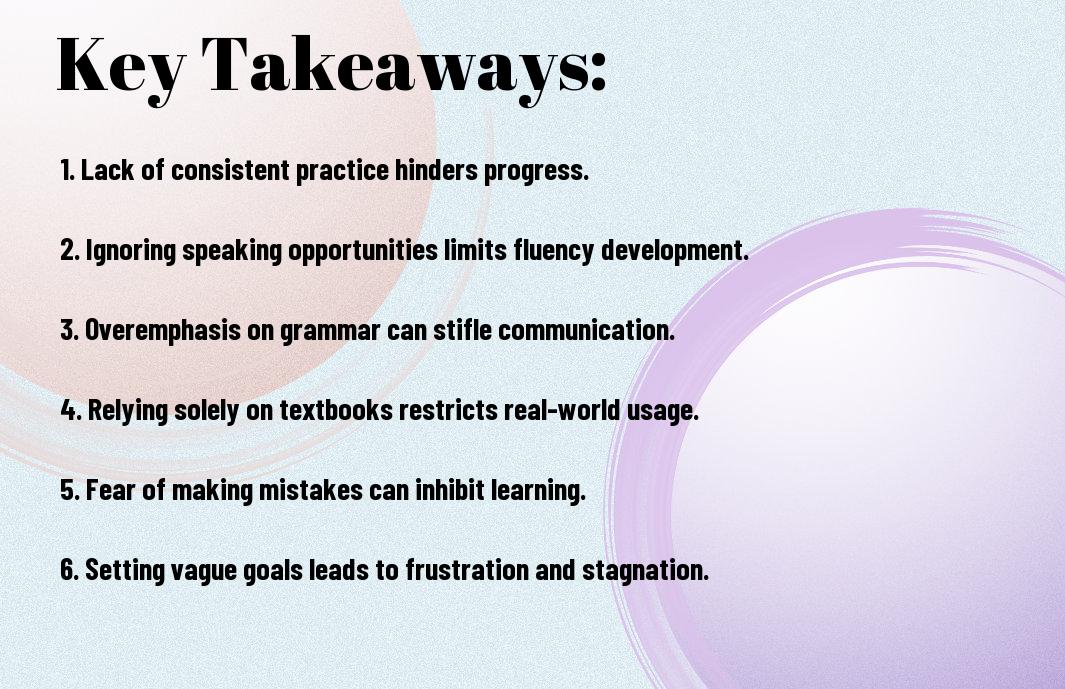
Key Takeaways:

The process of learning a language can be complex and nuanced, with various pitfalls that can hinder progress. Here are some key points to consider:

  • Insufficient Practice is a major obstacle for many language learners, as consistent application and reinforcement are necessary for long-term retention and fluency.
  • Grammar rules and exceptions can be overwhelming, but understanding the underlying structure of the language is vital for effective communication and expression.
  • Focusing too much on Vocabulary acquisition without contextual understanding can lead to a lack of comprehension and application in real-world scenarios.
  • Neglecting to develop Listening and Speaking skills can result in a significant imbalance in language abilities, making it difficult to engage in conversations and understand native speakers.
  • Setting unrealistic Goals and expectations can lead to frustration and burnout, as language learning is a gradual process that requires patience, dedication, and persistence.

Preparation Mistakes

The path to language learning is often paved with good intentions, but poor planning can lead to frustration and stagnation. As you begin on this journey, it’s crucial to be aware of the pitfalls that can hinder your progress.

Lack of Clear Goals

Across the spectrum of language learners, a common mistake is failing to define what you want to achieve, making it difficult to focus your efforts and measure success.

Insufficient Resource Allocation

The scarcity of quality resources, such as textbooks, tutors, or language exchange partners, can severely impede your progress, leaving you struggling to find adequate support.

To effectively allocate your resources, you should prioritize your needs, considering factors like budget, time commitment, and learning style, to ensure you’re getting the most out of your language learning experience, and avoiding the frustration that comes with inadequate support, allowing you to make steady progress towards your goals.

Learning Process Errors

One of the most significant hurdles you’ll face in language learning is falling into common pitfalls. To avoid this, it’s advisable to familiarize yourself with the Top 5 Language Learning Mistakes that can hinder your progress.

Ineffective Immersion Techniques

Among the various strategies you might employ, ineffective immersion techniques can be particularly detrimental. You may find yourself struggling to make progress if your approach to immersion is flawed.

Poor Practice Habits

Techniques such as inconsistent practice and poor time management can severely impede your language learning journey. You must be diligent in your approach to practice.

In addition, your practice habits can make or break your language learning experience. You should strive to create a schedule that allows for consistent and engaging practice, incorporating a variety of activities to keep your learning fresh and exciting, and preventing the stagnation that can occur with dull, repetitive exercises, which will help you to stay motivated and make steady progress in your language learning endeavors.

Grammar and Vocabulary Mistakes

To master a language, you must pay attention to grammar and vocabulary. Your understanding of these elements will make or break your proficiency.

Common Grammar Errors

Around the time you start learning, you will notice that grammar mistakes are abundant. You will struggle with verb tenses, subject-verb agreement, and sentence structure, but practice will help you improve.

Vocabulary Building Pitfalls

Following your initial progress, you will encounter pitfalls in vocabulary building. You might find it challenging to learn new words and phrases, and your progress may slow down.

The vocabulary building process can be daunting, but you can overcome the challenges by developing a study routine and immersing yourself in the language. You should focus on learning words in context, rather than just memorizing lists of words, and engage in conversations with native speakers to improve your understanding and usage of vocabulary.

Pronunciation and Fluency Issues

Despite your best efforts, you may still struggle with pronunciation and fluency issues in your target language. This can hinder your ability to communicate effectively and undermine your confidence in speaking.

Accent and Intonation Problems

Prior to mastering the nuances of language, you will likely encounter accent and intonation problems that can significantly impact your overall pronunciation.

Fluency Practice Mistakes

Before you achieve fluency, you will need to avoid common mistakes such as speaking too slowly or hesitantly, which can impede your progress and make you feel self-conscious about your language skills.

A key aspect of overcoming fluency practice mistakes is to engage in regular, spontaneous conversations with native speakers or fellow learners, allowing you to develop your ability to think and express yourself quickly and naturally in your target language, and you will find that your fluency and confidence will improve over time with consistent practice and dedication.

Motivation and Consistency

For language learners, motivation and consistency are imperative to achieving fluency. You must find ways to maintain your enthusiasm and dedication, as these factors greatly impact your progress.

Maintaining Motivation

About the time you start learning a language, you are likely to feel a surge of excitement and motivation. You should harness this energy to set realistic goals and celebrate your achievements, no matter how small.

Consistency in Practice

Similar to motivation, drive is what propels you to practice regularly. You need to establish a routine that works for you, allowing your brain to absorb and process new information effectively.

Understanding that consistency is key to language learning, you should prioritize making practice a habitual part of your daily routine. As you progress, you will find that consistent practice helps solidify new language skills, making them feel more natural and intuitive, and this, in turn, will help you stay motivated to continue learning.

Technology and Resource Utilization

Now, as you explore into the world of language learning, you’ll encounter numerous resources, including a LinkedIn article on The Most Common Mistakes Language Learners Make and How to Avoid Them. This highlights the importance of utilizing technology effectively.

Underutilization of Language Learning Apps

Underestimating the potential of language learning apps can hinder your progress, as you may miss out on valuable practice exercises and interactive lessons that can enhance your skills.

Misuse of Online Resources

Behind the vast array of online resources lies a potential pitfall: relying too heavily on a single method, such as watching videos without engaging in speaking or writing activities, can lead to an imbalance in your language skills.

Also, as you navigate the multitude of online resources, be cautious not to waste time on defeating or old-fashioned methods that may not cater to your learning style, and instead, focus on finding a balanced approach that suits your needs and complements your learning journey.

Conclusion

Upon reflecting on your language learning journey, you will likely identify patterns of mistakes that hindered your progress. You may have prioritized grammar over vocabulary or neglected to practice speaking and listening. Your approach, though well-intentioned, may have been misdirected, leading to frustration and stagnation. By acknowledging these common pitfalls, you can adjust your strategy and forge a more effective path to language mastery, one that leverages your strengths and addresses your weaknesses with clarity and purpose.

FAQ

Q: What is the most common mistake language learners make when starting to learn a new language?

A: One of the most common mistakes language learners make is setting unrealistic goals and expecting to become fluent in a short amount of time. This can lead to frustration and disappointment when they do not see progress as quickly as they had hoped. Setting achievable goals and celebrating small milestones along the way can help to stay motivated and focused throughout the learning process.

Q: How can language learners avoid the mistake of not practicing consistently?

A: To avoid the mistake of not practicing consistently, language learners can create a schedule and stick to it, setting aside a specific time each day or week to practice speaking, writing, and listening in the target language. Additionally, using language learning apps, joining a language exchange program, or finding a language learning partner can provide accountability and help to stay on track. Consistency is key to developing language skills and making progress over time.

Q: What is the mistake of not immersing oneself in the language, and how can language learners avoid it?

A: The mistake of not immersing oneself in the language refers to not surrounding oneself with the target language as much as possible, which can limit opportunities for practice and exposure. To avoid this mistake, language learners can try watching TV shows or movies in the target language, listening to music or podcasts, reading books or articles, and speaking with native speakers as much as possible. Immersion helps to get used to the sounds, rhythms, and grammar of the language, making it easier to learn and retain new vocabulary and phrases.

Jhere Skip to content