Mastery

The Role of Visualization in Language Mastery

As you initiate on your language learning journey, you’ll discover that visualization plays a significant role in mastering a new language. You’ll find that associating words and phrases with mental images helps reinforce your understanding and retention of the language. By leveraging the power of visualization, you can enhance your ability to recall vocabulary, comprehend complex grammar, and even improve your pronunciation, ultimately leading to a more effective and engaging language learning experience for you.

Key Takeaways:

  • The use of Visualization techniques can significantly enhance Language Learning by creating mental images that aid in Memory Retention and Comprehension.
  • Mental Imagery plays a significant role in Vocabulary Acquisition, allowing learners to associate words with Visual Cues and improve their ability to recall new words and phrases.
  • Graphic Organizers and Concept Maps are effective Visualization Tools that help learners to organize and connect new language concepts, promoting Deeper Understanding and Better Retention.
  • Multimedia Resources, such as videos and images, can be used to create Engaging and Interactive language lessons, making the learning process more Enjoyable and Effective.
  • By incorporating Visualization Strategies into language instruction, educators can help learners to develop a more Nuanced understanding of language structures and Improve their overall Communication Skills.

Fundamentals of Language Mastery

The foundation of language mastery lies in understanding the complex interactions between cognitive, social, and cultural factors that influence your learning process, and as you examine into the world of language acquisition, you will discover the significance of visualization in enhancing your comprehension and retention abilities.

The Importance of Visualization

Visualizing the relationship between words, concepts, and contexts is imperative for you to develop a deeper understanding of the language, and as you practice visualizing, you will find that your ability to recall and apply language rules improves significantly, enabling you to communicate more effectively.

Language Acquisition Methods

Across various language learning approaches, you will find that visualization plays a vital role in facilitating your understanding and retention of new language patterns, and by incorporating visualization techniques into your learning routine, you can enhance your overall language mastery.

Indeed, as you explore different language acquisition methods, you will discover that visualization can be applied in numerous ways, such as imagining scenarios to practice vocabulary, visualizing grammar rules to clarify concepts, or picturing conversations to improve pronunciation, and by doing so, you can create a more engaging and effective learning experience that caters to your unique learning style and preferences.
Cognitive Processes

Some of the most significant advantages of visualization in language learning are found in the cognitive processes that occur when you engage with visual aids, such as those discussed in The Language Comprehension Side of Things- Visualization, which can greatly enhance your understanding of complex concepts.

Memory and Recall

Retrieving information from your memory is a fundamental aspect of language mastery, and visualization can significantly improve your ability to do so, as you will find that associating words and phrases with images helps you to better encode and retain information in your long-term memory.

Language Processing

Processing language visually allows you to see the relationships between different components of a sentence or text, enabling you to better understand the nuances of language and how to use them effectively in your own communication.

But as you probe deeper into the role of visualization in language processing, you will discover that it also enables you to analyze and interpret complex linguistic structures, such as grammar and syntax, and to develop a more sophisticated understanding of how language works, which in turn will help you to express yourself more accurately and confidently in your target language.

Effective Visualization Techniques

Your ability to visualize is a powerful tool in language mastery, enabling you to connect new words and phrases to memories and emotions, making them more memorable and easier to recall.

Imagery and Association

By leveraging imagery and association, you can create vivid mental pictures that link new language to your existing knowledge, facilitating faster learning and improved retention.

Mind Mapping and Diagrams

About the use of mind maps and diagrams, you can harness their organizational power to visually structure your language learning, making relationships between concepts clearer and more accessible.

Indeed, mind mapping and diagrams allow you to break down complex language concepts into manageable, interconnected components, enabling you to see the bigger picture and navigate your learning journey with greater ease, as you work towards achieving your language mastery goals.

Overcoming Language Barriers

Keep in mind that visualization plays a significant role in overcoming language barriers. You can use mental images to associate with new words and phrases, making them easier to recall and understand.

Building Vocabulary

Typically, the most effective way to build your vocabulary is through visualization techniques, such as creating flashcards with images and words, helping you to learn and retain new terms more efficiently, and thus expanding your language skills.

Improving Pronunciation

At the heart of language mastery is the ability to pronounce words correctly, and you can achieve this by listening to native speakers and mimicking their intonation, which helps you to develop your speaking skills.

Improving your pronunciation takes time and practice, but with visualization, you can imagine yourself speaking fluently and confidently, which can help you to stay motivated and focused on your language learning goals, allowing you to communicate more effectively in your target language.

Technology and Visualization

Despite the many benefits of traditional teaching methods, technology has revolutionized the way you approach language learning, making visualization more accessible and effective. You can now utilize various tools to enhance your language skills, from interactive videos to immersive simulations.

Language Learning Apps

Betwixt the numerous options available, you will find apps that cater to your unique learning style, offering personalized lessons and exercises to improve your language proficiency. You can explore different apps to discover which ones work best for your needs.

Multimedia Resources

Towards enhancing your language skills, you can leverage multimedia resources, such as videos, podcasts, and interactive quizzes, to create a more engaging and visual learning experience. You can access these resources online, making it convenient for you to learn at your own pace.

It is worth noting that multimedia resources can be tailored to your interests and learning objectives, allowing you to focus on specific areas of improvement. You can use these resources to practice your listening, reading, and speaking skills, making your language learning journey more enjoyable and effective.

Practical Applications

Unlike other language learning methods, visualization offers a unique approach to mastering a new language, allowing you to connect words and phrases with vivid mental images, enhancing your understanding and retention.

Classroom Instruction

To effectively integrate visualization into your classroom learning, you can work with your instructor to incorporate visual aids, such as images and videos, into your lessons, helping you to better comprehend complex concepts and retain new vocabulary.

Self-Study and Autonomous Learning

Similarly, you can apply visualization techniques to your self-study routine, utilizing online resources and language learning apps that incorporate visual elements to facilitate your autonomous learning, enabling you to learn at your own pace and reinforce your understanding of the language.

The beauty of self-study and autonomous learning lies in the flexibility it offers, allowing you to explore various visualization techniques, such as creating mental flashcards or watching TV shows and movies in the target language, to find what works best for your learning style, and making steady progress towards achieving your language mastery goals, with you being in control of your learning journey.

Conclusion

The effective use of visualization in language mastery enables you to enhance your learning experience. As you explore the benefits of visualization, you can discover how it improves your language skills. You can learn more about the impact of visualization techniques on student’s learning outcomes and apply these strategies to optimize your language learning journey, ultimately leading to your success.

FAQ

Q: What is the significance of visualization in language mastery, and how does it enhance the learning process?

A: Visualization plays a vital role in language mastery as it enables learners to connect words and phrases with images, making them more memorable and easier to recall. By creating mental pictures, learners can better understand complex grammar rules, vocabulary, and sentence structures, ultimately leading to improved comprehension and retention. This multisensory approach helps to engage learners on multiple levels, making the learning process more effective and enjoyable.

Q: How can learners effectively utilize visualization techniques to improve their language skills, particularly in areas such as reading and listening comprehension?

A: Learners can utilize visualization techniques by creating mental images while reading or listening to texts, imagining the scenes, characters, and actions described. They can also use diagrams, charts, and mind maps to organize and visualize new vocabulary, grammar rules, and concepts. Furthermore, watching videos, films, or TV shows with subtitles in the target language can help learners associate sounds, words, and phrases with visual representations, enhancing their comprehension and language mastery. Additionally, learners can practice describing pictures or images in the target language to improve their speaking and writing skills.

Q: Can visualization techniques be adapted to suit different learning styles and preferences, and how can teachers or instructors incorporate visualization into their language lessons?

A: Yes, visualization techniques can be tailored to suit various learning styles and preferences. For instance, learners who are more visual-spatial can benefit from using images, diagrams, and videos, while those who are more kinesthetic can use gestures and acting to visualize language in action. Teachers and instructors can incorporate visualization into their lessons by using authentic materials such as pictures, videos, and real-life scenarios to illustrate language concepts, providing opportunities for learners to create and share their own visual representations, and encouraging learners to use visualization as a tool for self-study and practice. By doing so, teachers can create a more engaging, interactive, and effective language learning environment that caters to diverse learning needs and preferences.

The Importance of Consistency in Language Mastery

As you begin on your journey to master a language, you will encounter numerous challenges that test your resolve and dedication. Your progress will be influenced by various factors, but one aspect stands out as a significant determinant of your success: consistency. By maintaining a consistent approach to language learning, you will be able to track your progress, identify areas for improvement, and develop a deeper understanding of the language, ultimately paving the way for effective communication and lasting proficiency.

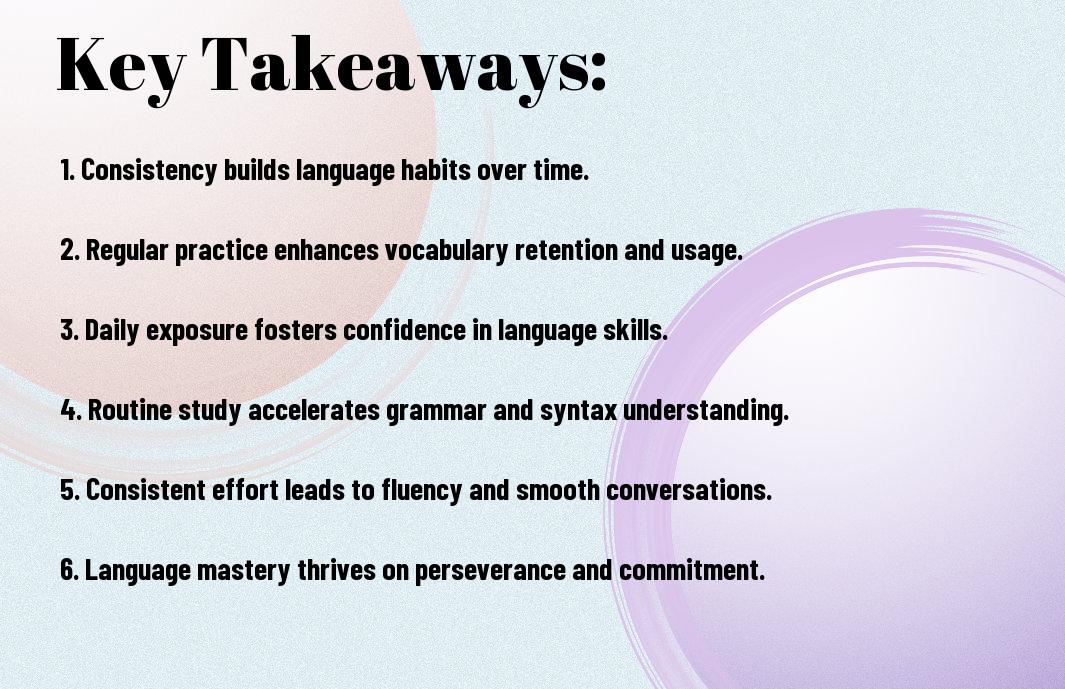
Key Takeaways:

  • Establishing Habits is key to language mastery, as it allows learners to make progress and develop a sense of routine in their learning process.
  • Consistency in practice helps to build momentum, enabling learners to stay motivated and engaged in the learning process.
  • Developing a regular study schedule can help learners to reinforce new language skills and prevent forgetting.
  • Continuous exposure to the target language is crucial for improving fluency and accuracy.
  • Maintaining discipline and commitment to a consistent learning routine can lead to significant improvements in language proficiency over time.

Fundamentals

While establishing a strong foundation in language is vital, consistency plays a significant role in reinforcing your learning. You will find that consistent practice helps solidify your understanding of language structures, making it easier to communicate effectively.

Language Patterns

Obviously, one of the key aspects of language mastery is recognizing patterns in language usage, and you will notice that consistent exposure to these patterns enhances your ability to use language accurately.

Grammar Rules

Above all, understanding grammar rules is crucial for effective communication, and you will see that applying these rules consistently helps you convey your message with clarity and precision.

In fact, as you examine deeper into grammar rules, you will discover that consistency in applying these rules enables you to express yourself with greater confidence and fluency, allowing your message to resonate with your audience more effectively, and you will find that your language skills improve significantly over time with dedicated practice.

Effects

It is evident that consistency plays a significant role in language mastery, affecting various aspects of your learning process. You will notice improvements in your language skills, leading to a stronger foundation for further development.

Cognitive Development

Among the benefits of consistent language practice, you will find enhanced cognitive abilities, such as improved memory and problem-solving skills, which will aid your overall learning experience.

Communication Skills

An important aspect of language mastery is the ability to communicate effectively, and consistency will help you achieve this goal, enabling you to express your thoughts and ideas more clearly.

Considering your communication skills, you will find that consistent practice helps you to develop a more nuanced understanding of the language, allowing you to convey your intended message with greater precision and confidence, which is important for effective communication in various contexts, including academic, professional, and social settings, and you will be able to engage in conversations more effortlessly, adapting to different situations and audiences.

Strategies

Once again, developing a consistent approach to language learning is vital, and you can find more information on this topic in The Importance of Consistency in Language Learning guide, which provides valuable insights to help you achieve your goals.

Practice and Repetition

Around this time, you will notice that consistent practice and repetition are important for language mastery, as they help solidify new skills and build confidence in your abilities.

Immersion and Exposure

After establishing a routine, you will find that immersion and exposure to the language are key to improving your comprehension and speaking skills, allowing you to engage with native speakers and authentic materials.

Another significant aspect of immersion and exposure is the opportunity to learn colloquial expressions, idioms, and cultural nuances that may not be taught in traditional classroom settings, enabling you to communicate more effectively and sound more natural in your target language, which in turn, will help you to better understand the language and its complexities, as you progress in your language learning journey, you will become more aware of the importance of consistency in language mastery.

Benefits

All language learners can benefit from consistency in their practice, as it enables you to develop a strong foundation in your target language. You can learn more about Language and Consistency and its role in language mastery.

Improved Comprehension

Improving your language skills through consistent practice helps you better understand the language, enabling you to grasp complex concepts and nuances with ease, as you progress in your language learning journey, you will find that your comprehension skills improve significantly.

Enhanced Expression

About the benefits of consistency in language learning, it’s clear that it enhances your ability to express yourself effectively, as you become more proficient in using the language, you will be able to convey your thoughts and ideas with clarity and precision.

Even as you examine deeper into the language, you will notice that your expressions become more natural and fluent, allowing you to communicate with native speakers with confidence, and your writing skills will also improve, enabling you to produce well-structured and coherent texts that effectively convey your message to your audience.

Challenges

Unlike other skills, mastering a language requires dedication and perseverance, as you will inevitably face obstacles that hinder your progress, and consistency is key to overcoming these challenges.

Language Barriers

Around the world, you will encounter various language barriers that can impede your learning, such as limited resources, confusing grammar rules, and unfamiliar vocabulary, which can make it difficult for you to achieve consistency in your language practice.

Cultural Differences

One of the significant challenges you will face is navigating cultural differences that affect language usage, and you must be aware of these differences to communicate effectively and maintain consistency in your language skills.

For instance, as you probe deeper into the nuances of a language, you will discover that cultural references, idioms, and expressions can vary greatly, and being sensitive to these differences is important to developing your language mastery, as it allows you to adapt your communication style to different contexts and audiences, thereby ensuring consistency in your language use.

Implementation

Now that you understand the importance of consistency in language mastery, it’s time to put it into practice. You must develop a routine that incorporates consistent language practice, setting aside time each day to study and review.

Educational Systems

Accordingly, you’ll find that educational institutions often prioritize consistency in their language curriculum, providing a structured environment for your language learning journey. You can take advantage of these systems to support your goals.

Personal Development

Prior to achieving fluency, you need to establish a consistent personal practice, using language learning tools and resources to supplement your education. You’ll see progress as you stick to your routine.

Systems of personal development are necessary for your growth as a language learner. You’ll need to track your progress, identifying areas where you struggle and focusing your efforts on improvement, ultimately leading to a higher level of proficiency in your target language.

Conclusion

From above discussions, you see that consistency is vital to your language mastery. You will improve your language skills by practicing consistently. Your progress will be steady, and you will be able to communicate effectively. As you continue to practice, you will develop a strong command of the language, allowing you to express your thoughts with clarity and precision, making your message understood by your audience.

FAQ

Q: What role does consistency play in language mastery, and how does it impact the learning process?

A: Consistency is a vital component of language mastery as it enables learners to develop a routine and make steady progress. By setting aside a specific time each day or week to practice, individuals can reinforce new language skills, build momentum, and solidify their understanding of complex concepts. Regular practice helps to prevent the forgetting of newly acquired knowledge, allowing learners to focus on more advanced topics and refine their language proficiency.

Q: How can consistency in language learning help to improve pronunciation and fluency?

A: Consistency in language learning is vital for improving pronunciation and fluency. Regular practice allows learners to develop muscle memory, enabling them to produce sounds, intonations, and rhythms more accurately and naturally. As learners consistently engage with the language, they become more comfortable with its rhythm and flow, which in turn enhances their ability to express themselves fluently and effectively. Moreover, consistent practice helps to identify and correct errors, ultimately leading to more polished and native-like pronunciation.

Q: What strategies can language learners use to maintain consistency in their practice and make lasting progress towards language mastery?

A: To maintain consistency in language practice, learners can employ several strategies. Setting achievable goals and tracking progress can help learners stay motivated and focused. Creating a schedule and sticking to it is also vital, as it allows learners to make language practice a habitual part of their daily or weekly routine. Additionally, learners can vary their practice activities to avoid boredom and prevent plateaus, incorporating a mix of speaking, listening, reading, and writing exercises to keep their practice engaging and challenging. By combining these strategies, language learners can maintain consistency and make steady, lasting progress towards achieving language mastery.

The Importance of Grammar in Language Mastery

As you strive to become proficient in a language, you will realize that your understanding and use of grammar is vital to effective communication. Your ability to construct sentences, convey meaning, and express yourself accurately depends on your grasp of grammatical rules and principles. You will find that mastering grammar helps you to better comprehend and appreciate the language, enabling you to express your thoughts and ideas with clarity and precision, which is vital for successful communication in both personal and professional settings.

Key Takeaways:

To achieve language mastery, understanding the role of grammar is important. Here are some key points to consider:

  • Effective Communication is greatly influenced by the correct application of grammar rules, as it helps convey meaning and context accurately in written and spoken language.
  • Clear Expression of thoughts and ideas depends on a strong foundation in grammar, allowing individuals to articulate their opinions and engage in meaningful discussions.
  • Language Precision is enhanced by the knowledge of grammatical structures, enabling speakers and writers to distinguish between subtle shades of meaning and convey nuances effectively.
  • Cohesive Writing and speaking are supported by grammar, as it provides the framework for organizing ideas, linking sentences, and creating a logical flow of information.
  • Language Learning is facilitated by a solid understanding of grammatical principles, which serves as a building block for further language development and fluency in communication.

Foundations of Language

Your understanding of language begins with its fundamental elements, and to investigate deeper, you can explore The Importance of Grammar in Language Teaching and Learning research for more insights.

Role of Grammar in Communication

Anyone familiar with language learning knows that grammar plays a significant role in effective communication, enabling you to express your thoughts clearly and correctly.

Importance of Syntax and Semantics

Before exploring advanced linguistic concepts, you must grasp the basics of syntax and semantics, which form the core of language structure and meaning.

At this stage, you are building a strong foundation in language mastery, and understanding syntax and semantics is imperative to convey your intended message accurately, as it helps you comprehend how words are arranged to form meaningful sentences and how meaning is derived from these sentences, allowing you to communicate effectively and efficiently in your target language.

Effective Expression

Some of the most significant benefits of strong grammar skills are seen in your ability to express yourself effectively. When you use grammar correctly, your message is conveyed clearly and concisely, allowing your audience to understand your intended meaning.

Clarity and Precision in Writing

Following proper grammar rules, you ensure that your writing is free of errors, making it easier for your readers to follow your train of thought and grasp your ideas.

Avoiding Ambiguity and Confusion

Across various forms of communication, good grammar helps you avoid misunderstandings and misinterpretations, which can lead to confusion and conflict.

Effective communication is the foundation of building strong relationships, and grammar plays a significant role in achieving this. When you use grammar correctly, you can convey your thoughts and ideas with precision, avoiding ambiguity and confusion, and ensuring that your message is understood as intended, which is crucial for your personal and professional success.

Language Mastery

All language learners strive for language mastery, and grammar is a fundamental component of achieving this goal. You will be able to effectively communicate your thoughts and ideas when you have a strong grasp of grammar. Your language skills will improve significantly as you continue to practice and refine your grammar.

Developing Grammar Skills

Prior to becoming proficient in a language, you need to develop your grammar skills. You can do this by immersing yourself in the language, practicing with native speakers, and studying grammar rules. Your grammar skills will improve as you continue to practice and learn from your mistakes.

Overcoming Common Grammar Mistakes

Generally, grammar mistakes can hinder your ability to communicate effectively. You can overcome these mistakes by being aware of common errors and practicing correct grammar usage. Your language skills will become more sophisticated as you learn to avoid common grammar mistakes.

For instance, when you learn to identify and correct common grammar mistakes, such as subject-verb agreement and tense consistency, you will be able to express yourself more clearly and confidently. You will be able to communicate more effectively in writing and speaking, and your overall language proficiency will improve significantly as you continue to practice and refine your grammar skills.

Language in Context

Keep in mind that grammar is vital to understanding language in its social and cultural context. As you explore the role of grammar, you can learn more about The Importance & Benefits of English Grammar and its significance in effective communication.

Grammar in Different Cultures

Along with variations in language, grammar rules also differ across cultures, and you will encounter unique characteristics as you explore each one, discovering how grammar shapes your understanding of diverse cultural contexts.

Adapting Grammar to Audience and Purpose

Language usage varies depending on your audience and purpose, and you need to consider these factors when communicating to ensure your message is conveyed effectively, taking into account the level of formality and the relationship with your listeners or readers.

A key aspect of mastering grammar is adapting it to your audience and purpose, and as you develop your skills, you will learn to adjust your language to suit different situations, using your knowledge of grammar to convey your message with clarity and precision, making your communication more engaging and effective, and allowing you to connect with your audience on a deeper level, thereby achieving your desired outcome.

Improving Language Skills

Despite the challenges, you can improve your language skills by learning more about grammar, as discussed in The Importance of Grammar in English Language. This will help you to communicate effectively and accurately express your thoughts.

Practice and Reinforcement

Among the various methods to improve your language skills, consistent practice is key to mastering grammar rules and applying them in your daily conversations. You will see significant improvement in your language skills as you practice regularly.

Using Grammar Resources and Tools

For instance, you can utilize online resources and tools to learn and practice grammar rules, which will help you to identify and correct your mistakes, making you a proficient user of the language.

Reinforcement of grammar rules through practice exercises and quizzes will help you to develop a strong foundation in language, enabling you to express your thoughts and ideas with clarity and precision, which is necessary for effective communication, and you will be able to apply this in your daily life, making your language skills more proficient.

Advanced Grammar Techniques

Many language learners strive to improve their grammar skills. You can achieve this by:

  1. Studying verb tenses
  2. Practicing sentence structure
Grammar Concept Description
Conditional sentences Used to express uncertain events

Nuances of Language and Idioms

Beneath the surface of language lies a complex web of nuances. You will discover that mastering idioms and expressions is key to sounding natural in your speech and writing.

Mastering Complex Grammar Concepts

By dedicating time to practice, you will be able to tackle complex grammar concepts with ease. You can start by focusing on one concept at a time, and gradually build your way up to more challenging topics.

Due to the complexity of grammar, you will need to be patient and persistent in your studies. As you examine deeper into the world of grammar, you will find that your understanding of language becomes more sophisticated, and your ability to express yourself improves significantly. You will be able to convey your thoughts and ideas with precision and clarity, and your communication skills will become more effective.

To wrap up

Taking this into account, you now understand the significance of grammar in language mastery. You see, your ability to communicate effectively depends on your grasp of grammar rules. As you continue to learn and practice, your language skills will improve, enabling you to express yourself with confidence and clarity. By prioritizing grammar, you will enhance your overall language proficiency, unlocking new opportunities for personal and professional growth. Your efforts will pay off, and you will become a proficient language user.

FAQ

Q: What role does grammar play in effective communication?

A: Grammar serves as the foundation of language, enabling individuals to express themselves clearly and convey their intended message. It provides the rules and structures that govern how words are used to form meaningful sentences, facilitating comprehension and avoiding misunderstandings. By mastering grammar, individuals can enhance their ability to communicate complex ideas, nuances, and subtleties, ultimately leading to more effective and efficient interaction with others.

Q: How does grammar impact the accuracy and clarity of written and spoken language?

A: Grammar has a significant impact on the accuracy and clarity of both written and spoken language. Proper grammar ensures that the intended meaning is conveyed, and the message is free from ambiguity. Correct use of grammar helps to avoid confusion, misinterpretation, and errors, which can lead to misunderstandings and miscommunications. Moreover, good grammar skills contribute to the overall coherence and logical flow of language, making it easier for the audience to follow and understand the message being conveyed.

Q: Can mastering grammar improve overall language proficiency and open up new opportunities?

A: Mastering grammar can significantly enhance overall language proficiency, as it provides a solid base for language learning and usage. When individuals have a strong grasp of grammar, they are better equipped to understand, interpret, and produce language in various contexts. This, in turn, can open up new opportunities, both personally and professionally. For instance, proficient grammar skills can improve writing and speaking abilities, increase confidence in communication, and even enhance career prospects, as clear and effective communication is highly valued in most industries and social interactions.

Top Strategies for Mastering Language Grammar

You are about to unlock the secrets to perfecting your language skills by focusing on grammar. As you investigate into the world of language learning, you will discover that mastering grammar is vital to effective communication. Your ability to express yourself clearly and accurately depends on your understanding of grammatical rules and concepts. By applying the right strategies, you can improve your language proficiency and enhance your overall learning experience, allowing you to convey your thoughts and ideas with confidence and precision.

Key Takeaways:

To improve your language skills, consider the following strategies for mastering language grammar:

  • Focus on understanding the rules and exceptions of the language to develop a strong foundation in grammar.
  • Practice consistent exposure to the language through reading, writing, and speaking to reinforce your knowledge of grammar.
  • Use contextual learning methods, such as immersion and real-life examples, to help you apply grammatical concepts in practical situations.
  • Develop a routine of regular practice and review to reinforce your understanding of grammar and identify areas for improvement.
  • Utilize resources such as language learning apps, tutors, and study groups to provide support and feedback on your grammar skills.

Fundamentals of Grammar

The foundation of language learning is built on understanding the basics of grammar, and you can find valuable resources, such as 10 Tips for Mastering English Grammar, to help you get started.

Parts of Speech

Beneath the surface of language lies the parts of speech, which you will need to familiarize yourself with in order to construct meaningful sentences and convey your thoughts effectively.

Sentence Structure

Among the key elements of grammar, sentence structure stands out as a fundamental aspect that you must grasp to communicate clearly and accurately.

Structure is imperative to forming sentences that convey your intended message, and as you explore deeper into the world of grammar, you will discover that understanding sentence structure is vital to enhancing your language skills, allowing you to express yourself with precision and confidence, and enabling you to navigate complex linguistic situations with ease, which is something you will find indispensable in your journey to master language grammar.

Building Blocks of Language

Any language learner knows that understanding the basics is key to mastering a language. You can find useful Tips for Mastering English Grammar for New Learners to improve your language skills.

Verbs and Tenses

Constructing sentences with verbs and tenses helps you express yourself effectively, and as you learn, you will see improvement in your language proficiency.

Nouns and Pronouns

Surrounding your language learning with knowledge of nouns and pronouns will help you to better understand sentence structure and grammar rules.

Plus, as you research deeper into nouns and pronouns, you will discover how they work together to create meaningful expressions, enabling you to communicate your thoughts and ideas with clarity and precision, which will help you to enhance your overall language skills and become a more confident learner.

Mastering Clauses and Phrases

Keep in mind that mastering clauses and phrases is imperative to constructing effective sentences. You will be able to express your thoughts more clearly and accurately, which is key to improving your language skills.

Independent and Dependent Clauses

By understanding the difference between independent and dependent clauses, you can create more complex and nuanced sentences, allowing you to convey your ideas with precision and clarity.

Phrase Structure and Usage

Before submerging into phrase structure, you should familiarize yourself with the various types of phrases, including noun phrases and verb phrases, to improve your sentence construction.

Phrases are groups of words that function as a unit, and you can use them to add depth and variety to your writing and speaking, helping you to convey your intended meaning and engage your audience more effectively.

Effective Sentence Construction

Unlike other aspects of language learning, mastering sentence construction is a skill that takes time and practice to develop. You will need to understand the rules of grammar and syntax to construct sentences that are clear and effective in conveying your message.

Active and Passive Voice

Efficiently using active and passive voice is necessary to create sentences that are engaging and easy to understand. You can use active voice to convey a sense of action and responsibility, while passive voice can be used to emphasize the recipient of the action.

Sentence Variation and Style

Altogether, varying your sentence structure and style is key to keeping your writing or speech interesting. You can use short and long sentences, as well as different grammatical structures, to create a sense of rhythm and flow.

And as you experiment with different sentence variations, you will find that your writing and speech become more engaging and effective in conveying your message. You will be able to convey complex ideas in a clear and concise manner, and your audience will appreciate the effort you put into crafting your sentences.

Common Grammar Mistakes

Now that you’re on your way to mastering language grammar, it’s important to identify the common mistakes that can hinder your progress. You’ll encounter various errors, but being aware of them is the first step to improvement.

Errors in Subject-Verb Agreement

At this stage, you need to ensure that your subjects and verbs agree in number, as inconsistencies can lead to confusing sentences. You should pay close attention to pronoun and verb endings to avoid these errors.

Misuse of Modals and Conditionals

Among the various grammar mistakes, the incorrect use of modals and conditionals is prevalent. You often struggle with using the correct modal verbs, such as “can,” “could,” and “may,” in context, which can alter the sentence’s meaning.

Common mistakes in using modals and conditionals can significantly impact your ability to express yourself effectively. You need to understand the nuances of each modal and conditional, and practice using them in different contexts to improve your grammar skills and convey your intended message accurately. As you practice, you’ll become more comfortable using modals and conditionals correctly, enhancing your overall language proficiency.

Advanced Grammar Techniques

Despite the challenges, you can master advanced grammar techniques by following these steps:

  1. Practice consistently
  2. Focus on nuances
Technique Description
Clause structure Study complex sentence structures

Subjunctive Mood and Conditional Tenses

Betwixt the lines of language, you’ll find subtleties that set your writing apart, such as mastering the subjunctive mood and conditional tenses to convey nuance.

Idiomatic Expressions and Colloquialisms

Any effort you put into learning idiomatic expressions and colloquialisms will enhance your language skills, allowing you to communicate more effectively.

This understanding of idiomatic expressions and colloquialisms will help you to better comprehend native speakers and express yourself more naturally, making your language more engaging and authentic, as you become more familiar with your chosen language’s unique expressions and idioms.

To wrap up

As a reminder, you now have the tools to improve your language grammar skills. You can enhance your understanding by practicing consistently and applying your knowledge in context. By following the top strategies, you will be able to refine your grammar and take your language skills to the next level, making your communication more effective and effortless, and allowing you to express your thoughts with clarity and precision in your writing and speech.

FAQ

Q: What are the most effective ways to improve my language grammar skills?

A: To master language grammar, it is crucial to practice consistently and immerse yourself in the language. Start by reading books, articles, and news in the target language to get a feel for how grammar is used in context. Listening to podcasts, audiobooks, or watching TV shows and movies with subtitles can also help you understand how native speakers use grammar in everyday conversations. Additionally, practice writing and speaking as much as possible, and seek feedback from language exchange partners or tutors to identify and correct your mistakes.

Q: How can I overcome common grammar mistakes and develop a solid understanding of language rules?

A: Overcoming common grammar mistakes requires a combination of knowledge and practice. Begin by studying the grammar rules of the language, focusing on the most common mistakes made by learners. Use online resources, such as grammar guides and exercises, to practice and reinforce your understanding of these rules. It is also helpful to keep a journal or log of your mistakes, tracking the errors you make and reviewing them regularly to avoid repetition. Moreover, engaging in conversations with native speakers or language exchange partners can help you identify areas where you need improvement and provide you with opportunities to practice using grammar correctly in context.

Q: What role does practice and consistency play in mastering language grammar, and how can I stay motivated?

A: Practice and consistency are key to mastering language grammar. Setting aside time each day to practice, even if it’s just for a few minutes, is more effective than practicing for long periods once a week. Create a study routine that includes a mix of reading, writing, listening, and speaking, and stick to it as much as possible. To stay motivated, set achievable goals and track your progress, celebrating your successes along the way. Find a language learning community or partner to share tips and advice, and don’t be afraid to make mistakes – they are an integral part of the learning process. By staying committed and consistent, you will see significant improvement in your grammar skills over time.

The Importance of Active Listening in Language Mastery

You’re on a mission to master a new language, and you know that speaking and writing are just half the battle. As you probe into the world of language learning, you’ll find that your ability to listen is what sets you apart. By developing your active listening skills, you’ll unlock a deeper understanding of your target language. Check out Mastering Language Learning: The Key Role of Listening to discover how your ears can become your greatest asset in language mastery, helping you to absorbs nuances and dialects with ease, and taking your language skills to the next level.

Key Takeaways:

  • Effective communication is significantly enhanced by active listening, which involves fully concentrating on and comprehending the message being conveyed, rather than just passively hearing the words.
  • Language mastery can be rapidly achieved through focused attention and dedication to understanding the nuances of the language, including its idioms, colloquialisms, and cultural references.
  • By practicing mindful listening, individuals can improve their comprehension and retention of new vocabulary, grammatical structures, and pronunciation, ultimately leading to more confident and accurate language use.

The Foundations of Language Mastery

A strong understanding of language fundamentals is crucial for effective communication, and you’ll find that active listening plays a vital role in this process, helping you to grasp nuances and contexts that might otherwise be lost on you.

The Role of Listening in Language Acquisition

Prior to submerging into the complexities of language, you need to appreciate the significance of listening in acquiring a new language, as it allows you to pick up on pronunciation, intonation, and rhythm, all of which are crucial for your language mastery journey.

The Difference Between Hearing and Listening

Tuning in to the subtle distinction between hearing and listening is key, as you’ll discover that hearing is merely the physical act of perceiving sound, whereas listening involves actively interpreting and understanding the message being conveyed to you.

Language learners like you often overlook the distinction between these two concepts, but it’s crucial to understand that listening is an active process that requires your full attention and engagement, whereas hearing is a passive act that doesn’t necessarily involve comprehension, and as you investigate deeper into language mastery, you’ll find that your ability to listen effectively will greatly impact your progress and overall proficiency.

Effective Listening Strategies

If you want to improve your language skills, you need to understand the value of active listening. You can learn more about it by visiting What Is Active Listening? to discover the techniques that will take your listening to the next level.

Focus on the Speaker

Above all, your attention should be on the speaker, trying to grasp their message and emotions, which will help you to better understand the context and respond accordingly.

Avoiding Distractions and Interruptions

About the time you start listening, you should eliminate any distractions, such as turning off your phone or finding a quiet place, to fully concentrate on the conversation.

Plus, by avoiding interruptions, you show respect for the speaker and allow yourself to fully absorb the information, which is crucial for effective communication and language mastery, as you will be able to pick up on nuances and subtleties that might otherwise be lost on you.

Benefits of Active Listening

Now that you’ve started to understand the concept of active listening, it’s time to explore its benefits. Active listening can help you master a language by improving your comprehension, retention, and communication skills. You’ll find that your language skills will improve significantly as you practice active listening.

Improved Comprehension and Retention

Around the time you start actively listening, you’ll notice a significant improvement in your comprehension and retention of the language. You’ll be able to understand complex conversations and retain new vocabulary more effectively, which will help you to communicate more confidently.

Enhanced Communication Skills

At the heart of language mastery is effective communication, and active listening is vital for this. You’ll be able to respond appropriately to conversations and engage with native speakers more effectively, which will help you to improve your speaking skills and build stronger relationships.

To take your communication skills to the next level, you need to practice active listening consistently. As you listen more attentively to native speakers, you’ll pick up on nuances of the language, such as idioms, expressions, and dialects, which will help you to sound more natural and fluent in your speech. You’ll be able to express yourself more clearly and confidently, and your conversations will become more engaging and meaningful.

Overcoming Barriers to Active Listening

To become a masterful listener, you must first identify the obstacles that stand in your way. Your ability to listen actively is hindered by a multitude of factors, including personal biases, distractions, and physical barriers.

Managing Personal Biases and Assumptions

Between your own thoughts and the speaker’s words, a gap often exists. Beneath the surface of your awareness, biases and assumptions can influence your perception, leading you to misinterpret or misunderstand the message being conveyed to you.

Dealing with Noise and Other Distractions

The environment in which you listen can significantly impact your ability to focus. You find yourself surrounded by distractions, from the chatter of others to the incessant buzz of notifications on your phone, all competing for your attention.

Active listening requires you to be mindful of these distractions and take steps to mitigate their impact. You can start by finding a quiet space to listen, free from distractions, and making a conscious effort to focus on the speaker’s words, rather than letting your mind wander to other things. As you practice this skill, you will find that your ability to discern and understand the message being conveyed to you improves dramatically, allowing you to engage more fully with the speaker and deepen your understanding of the subject matter. You will be able to pick up on nuances and subtleties that might have otherwise gone unnoticed, and your conversations will become more meaningful and productive as a result.

Practicing Active Listening in Real-Life Scenarios

Once again, you’ll find that active listening is a skill that can be honed in various situations, making your language mastery journey more effective and engaging.

Conversations and Discussions

By engaging in conversations with native speakers, you’ll be able to pick up nuances and expressions that will enhance your listening skills and overall language proficiency.

Audio and Video Materials

Any language learner can benefit from listening to podcasts, audiobooks, or watching TV shows and movies in the target language, as these materials provide a wealth of listening opportunities.

Further, as you listen to or watch these materials, you’ll start to notice your ability to understand different accents, vocabulary, and grammar structures improving, which will help you become a more confident language user, able to hold your own in conversations and comprehend various types of content with ease, taking your language skills to the next level.

Measuring Progress and Improvement

After dedicating time to active listening, you’ll want to evaluate your growth. Tracking your progress helps you identify areas for improvement, allowing you to refine your skills and become a more effective communicator.

Self-Assessment and Reflection

Mirroring your learning journey, assessing your own progress is key. You can do this by recording yourself, taking notes, and evaluating your understanding of conversations and audio materials.

Seeking Feedback from Others

Besides self-evaluation, receiving feedback from others is vital. You can ask language exchange partners, tutors, or friends to provide constructive criticism on your listening skills, helping you pinpoint areas that need work.

SelfAssessment is necessary, but seeking feedback from others takes your learning to the next level. When you ask for feedback, you open yourself up to new perspectives and insights that can help you overcome challenges and achieve language mastery. You’ll be able to identify patterns and mistakes you weren’t aware of, and make targeted improvements to become a more proficient listener.

To wrap up

With this in mind, you now see that active listening is the key to unlocking your language mastery. You’ll find that your comprehension and speaking skills will improve dramatically when you focus on truly hearing what’s being said. Your ability to engage with others and convey your thoughts will become more effective, and you’ll be well on your way to becoming a master of the language, able to express yourself with ease and confidence.

FAQ

Q: What is the role of active listening in language mastery, and how does it impact overall language proficiency?

A: Active listening plays a significant role in language mastery as it enables learners to comprehend and interpret spoken language more effectively. By fully concentrating on the speaker, learners can pick up on nuances such as tone, pitch, and rhythm, which are vital for understanding the context and intended meaning of the message. This, in turn, enhances vocabulary acquisition, grammar understanding, and pronunciation skills, ultimately leading to improved overall language proficiency.

Q: How does active listening facilitate effective communication in a foreign language, and what skills are developed through this practice?

A: Active listening facilitates effective communication in a foreign language by allowing learners to engage more deeply with the speaker and the message. Through active listening, learners develop skills such as the ability to identify main ideas, supportive details, and the speaker’s intent. Additionally, it enhances the ability to respond appropriately, which is vital for effective communication. Skills developed through active listening include improved concentration, better comprehension of different accents and speaking styles, and the ability to differentiate between similar sounds and words, all of which are vital for successful communication in a foreign language.

Q: Can active listening be improved through practice, and if so, what strategies can language learners use to enhance their active listening skills?

A: Yes, active listening can be significantly improved through practice. Language learners can enhance their active listening skills by employing several strategies. One effective approach is to start with short listening exercises and gradually increase the duration as concentration and comprehension improve. Another strategy involves listening to a variety of materials, such as podcasts, speeches, and conversations, to expose oneself to different speaking styles, accents, and speeds. Furthermore, summarizing what has been heard, either verbally or in writing, can help reinforce understanding and check comprehension. Using subtitles or transcripts initially and then gradually moving to listening without them can also be beneficial. Engaging in discussions or responding to what has been listened to can further reinforce learning and improve active listening skills.

Jhere Skip to content