As you launch on the journey to obtain a language certification, you will need to develop a strategic approach to prepare for the exams. Your goal is to demonstrate proficiency in a specific language, and to achieve this, you must focus on improving your reading, writing, listening, and speaking skills. You will need to familiarize yourself with the exam format, content, and timing to ensure your success. By following a structured plan, you can effectively prepare for the challenge ahead and boost your confidence in your language abilities.
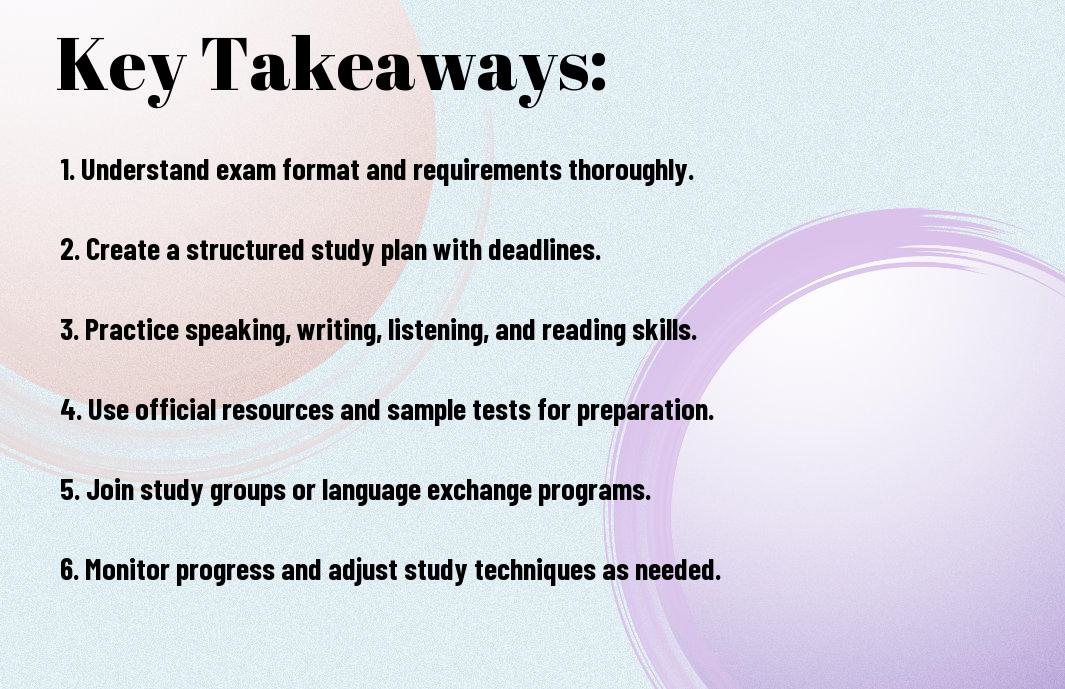
Key Takeaways:
To prepare for language certification exams, consider the following points:
- Develop a study plan that outlines your goals, schedule, and resources to help you stay organized and focused on achieving language proficiency.
- Practice reading comprehension, writing skills, and listening techniques to improve your overall language skills and become more confident in your ability to communicate effectively.
- Familiarize yourself with the exam format and content to understand what to expect on the test day, and use practice tests to simulate the actual exam experience and identify areas for improvement.

Getting Familiar with the Exam Format
A thorough understanding of the exam format is vital to your success. You will need to acquaint yourself with the structure and content of the exam.
Overview of the Exam Structure
About the exam, you should know that it is divided into sections, each testing a specific skill. You will be assessed on your reading, writing, listening, and speaking abilities.
Types of Questions and Tasks
You will encounter various types of questions and tasks, including:
- Multiple-choice questions
- Essay writing
- Oral presentations
Thou will need to practice these tasks to feel comfortable with the exam format.
| Section | Time |
|---|---|
| Reading | 60 minutes |
| Writing | 90 minutes |
| Listening | 40 minutes |
| Speaking | 20 minutes |
| Break | 10 minutes |
Structure your study plan according to the exam format, and you will be well-prepared. You will encounter various types of questions and tasks, including:
- Multiple-choice questions
- Essay writing
- Oral presentations
Thou will need to practice these tasks to feel comfortable with the exam format.
| Section | Content |
|---|---|
| Reading | Comprehension and vocabulary |
| Writing | Essay and grammar |
| Listening | Auditory comprehension |
| Speaking | Oral communication |
| Break | Rest and relaxation |
Building Vocabulary and Grammar Skills
It is crucial to develop a strong foundation in vocabulary and grammar to excel in language certification exams. You will need to focus on expanding your word list and understanding the nuances of grammar rules.
Effective Strategies for Learning New Words
Vocabularily speaking, you should prioritize learning words in context, as this will help you grasp their meanings and usage more effectively. You can achieve this by reading extensively and making flashcards to aid your memorization.
Grammar Rules and Exceptions to Focus On
Analytically, you should concentrate on mastering the most common grammar rules and exceptions, as these will be heavily tested in your exam. You should pay attention to verb tenses, subject-verb agreement, and sentence structure.
And as you investigate deeper into grammar rules and exceptions, you will notice that practice is key to reinforcing your understanding. You should engage in regular writing and speaking exercises to apply your knowledge of grammar rules and develop your language skills further, which will ultimately boost your confidence and performance in the exam.
Improving Reading and Listening Comprehension
Unlike other skills, improving your reading and listening comprehension takes consistent practice and dedication, and as you engage with various materials, you will develop your ability to understand and interpret complex texts and conversations.
Techniques for Enhancing Reading Speed and Accuracy
Around the time you start preparing for your language certification exam, you will find that practicing active reading techniques, such as skimming and scanning, will help you to quickly identify main ideas and supporting details in a text, allowing you to manage your time more effectively.
Tips for Better Listening and Note-taking
Reading through the exam format and content in advance, you will be better prepared to tackle the listening section, and some tips to keep in mind include:
- focus on the speaker’s main idea
- identify key supporting details
Thou will be able to improve your listening and note-taking skills with consistent practice, which is necessary for success in your language certification exam.
Plus, as you practice listening to various types of audio materials, such as lectures, conversations, and news broadcasts, you will develop your ability to identify main ideas, supporting details, and the speaker’s tone and purpose, and some additional tips to consider include:
- take notes on key points
- practice active listening by summarizing what you hear
Thou will find that your listening and note-taking skills will improve significantly with dedicated practice and review.
Developing Writing and Speaking Skills
After dedicating time to learning grammar and vocabulary, you will need to focus on developing your writing and speaking skills to excel in language certification exams.
Essay Writing and Response Techniques
Across various language certification exams, your ability to express yourself in writing will be tested, so it’s imperative to practice essay writing and develop effective response techniques to tackle different question types.
Conversation Practice and Pronunciation Tips
Responding to conversational prompts will help you improve your speaking skills, and you can achieve this by:
- engaging in conversations with native speakers
- practicing with language exchange partners
After consistent practice, you will notice significant improvement in your speaking abilities.
It is also important to focus on pronunciation, as clear and accurate pronunciation will boost your confidence and enhance your overall performance in the speaking section of the exam. You can improve your pronunciation by:
- listening to native speakers and mimicking their intonation
- recording yourself and identifying areas for improvement
After mastering the pronunciation tips, you will be able to express yourself more effectively in spoken language, which will contribute to your success in the language certification exam.
Practicing with Sample Questions and Tests
Despite the challenges, practicing with sample questions and tests will help you prepare for your language certification exam. You can find resources online, such as Official English exams: 5 tips to prepare them at your center, to guide your preparation.
Where to Find Reliable Study Materials
Around your local library or bookstore, you can find study materials to aid your preparation, including textbooks and practice exams that cater to your needs.
How to Simulate the Actual Test Experience
Find a quiet space to simulate the actual test experience, minimizing distractions and allowing you to focus on your performance under timed conditions.
Sample tests are an effective way to assess your knowledge and identify areas for improvement. You can use these tests to simulate the actual test experience, timing yourself and evaluating your performance under pressure, which will help you build confidence and develop the endurance needed to complete the exam successfully, and you will be able to navigate the format and content of the test with ease, allowing you to concentrate on demonstrating your language skills.
Managing Exam Day Stress and Anxiety
All aspiring language learners know that exam day can be a daunting experience. You can find advice from others who have been in your shoes by checking out discussions such as What is your strategy when studying for a certificate or diploma, which may help you feel more prepared.
Time Management and Pacing Strategies
With careful planning, you can minimize your stress levels on exam day. You should arrive early, and make sure you have all the necessary materials, allowing you to focus on the task at hand.
Relaxation Techniques for Peak Performance
Performing at your best requires a clear and focused mind. You can achieve this by using techniques such as deep breathing, which can help calm your nerves and improve your concentration.
Anxiety can be overwhelming, but there are ways to manage it. You can try visualization techniques, such as imagining yourself succeeding, or use positive self-talk to boost your confidence. By incorporating these relaxation techniques into your exam day routine, you can optimize your performance and achieve your goals.
Summing up
Conclusively, as you approach your language certification exam, you have a clear roadmap to follow. You have learned how to assess your skills, create a study plan, and practice with sample tests. By dedicating time to your weaknesses and staying consistent, you will improve your language proficiency. Your preparation will pay off, and you will be well-equipped to tackle the exam with confidence, ultimately achieving your desired certification.
FAQ
Q: What are the first steps I should take to prepare for a language certification exam?
A: To prepare for a language certification exam, start by familiarizing yourself with the exam format, content, and requirements. Understand the different sections of the exam, such as reading, writing, listening, and speaking, and the time allocated to each section. Additionally, set achievable goals and create a study schedule to help you stay on track. It’s also important to gather study materials, such as textbooks, language learning apps, and practice exams, to aid in your preparation. By taking these initial steps, you’ll be well-prepared to tackle the exam and achieve your desired score.
Q: How can I improve my language skills to perform well in the certification exam?
A: Improving your language skills is vital to performing well in the certification exam. Focus on developing your reading, writing, listening, and speaking skills by practicing regularly. Read books, articles, and news in the target language to enhance your reading comprehension. Listen to podcasts, audiobooks, and watch TV shows or movies in the target language to improve your listening skills. Engage in conversations with native speakers or language exchange partners to boost your speaking skills. Furthermore, practice writing in the target language by keeping a journal, writing short stories, or composing essays. Consistent practice will help you build confidence and fluency in the language.
Q: What are some effective strategies for managing my time during the language certification exam?
A: Effective time management is key to success in the language certification exam. Develop a time-management strategy by allocating specific time slots to each section of the exam. Practice taking timed practice exams to simulate the actual test experience and improve your speed and accuracy. Identify your strengths and weaknesses, and focus on the sections that require the most attention. During the exam, take a few minutes to read the instructions carefully, and plan your approach before starting to answer the questions. Manage your time wisely, and avoid spending too much time on a single question. By staying calm, focused, and using your time efficiently, you’ll be able to complete the exam within the allotted time and achieve your desired score.


