simon weiner

How to Learn a Language by Yourself Successfully

You want to learn a new language, and you’re determined to do it on your own. Your motivation is strong, and you’re ready to put in the work. You’ll need a solid plan and the right tools to stay focused. Your journey will require discipline and practice, but with the right approach, you can achieve your goal and become proficient in your target language. You’ll start by setting realistic goals and creating a schedule that suits your lifestyle.

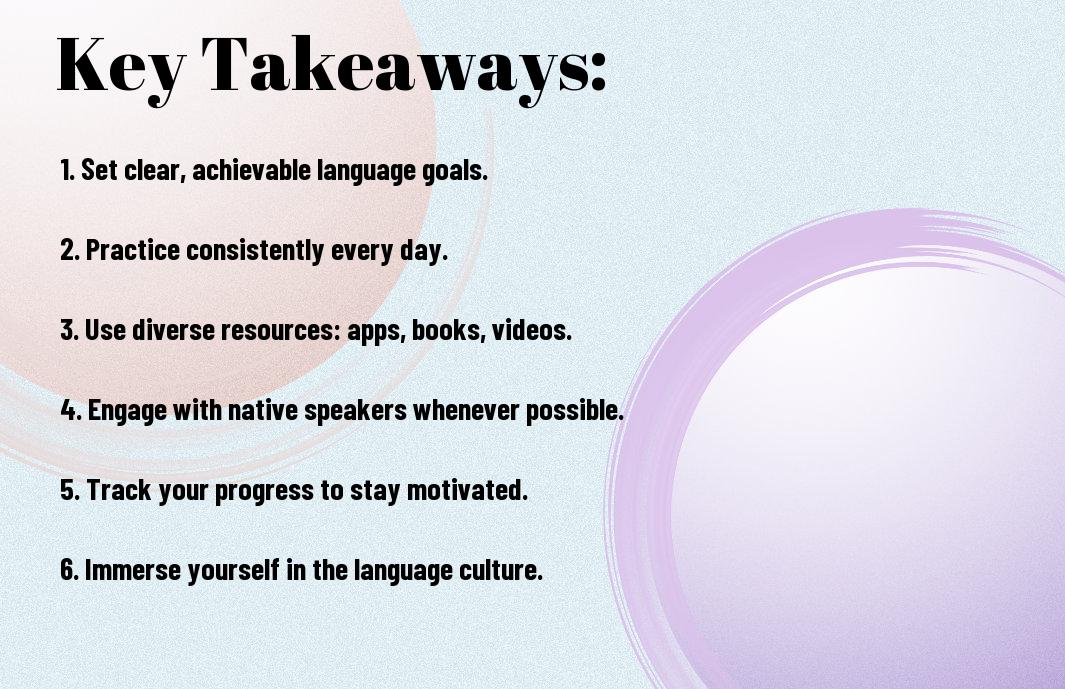
Key Takeaways:

To learn a language by yourself successfully, consider the following points:

  • Set Realistic Goals and define what you want to achieve, whether it’s basic conversation skills or advanced fluency, to help guide your learning process.
  • Establish a Study Routine that fits your schedule and lifestyle, ensuring consistent practice and progress in your language learning journey.
  • Utilize Language Learning Resources such as online courses, apps, and language exchange websites to access a variety of study materials and interactive tools.
  • Practice Active Listening and Speaking by engaging with native speakers, watching TV shows or movies, and listening to music in the target language to improve pronunciation and comprehension.
  • Immerse yourself in the Language Environment by reading books, articles, and news in the target language to expand your vocabulary and get familiar with different contexts and expressions.

Setting Goals

A clear plan is crucial to learn a language by yourself. You need to define what you want to achieve and how you will get there. Your goals will guide your learning process and help you stay motivated.

Defining Your Motivation

Against the backdrop of your daily life, you must identify why you want to learn a language. Your motivation will be the driving force behind your learning. You will be more likely to stick to your plan if you have a strong reason for learning.

Creating a Learning Schedule

At the outset, you should create a schedule that suits your lifestyle. You will need to allocate time for learning and stick to it. Your schedule should be realistic and achievable.

This schedule will be the backbone of your learning process. You will use it to plan your daily lessons, set deadlines, and track your progress. By following your schedule, you will make steady progress and stay on track to achieving your language learning goals. You will be able to manage your time effectively and make the most of your learning experience.
Language Fundamentals

Now that you’ve decided to learn a language by yourself, it’s time to focus on the basics. You’ll need to understand the building blocks of the language to progress effectively.

Learning the Alphabet and Pronunciation

Above all, you must start with the alphabet and pronunciation. You can find numerous resources online to help you learn the correct pronunciation of each letter and sound.

Basic Grammar and Vocabulary

Along with learning the alphabet, you’ll need to understand basic grammar and vocabulary. You can begin by learning common phrases, verb conjugations, and basic sentence structures.

It is crucial to practice regularly, using your newfound knowledge to construct simple sentences and engage in basic conversations. You can use flashcards, language learning apps, or watch videos to help you learn and practice your grammar and vocabulary skills, and as you progress, you’ll become more confident in your ability to communicate in your new language.

Language Acquisition Methods

For effective language learning, you’ll need to explore various methods. You can try different approaches to find what suits you best, and combine them for optimal results. Your goal is to find a method that keeps you motivated and engaged in the learning process.

Immersion Techniques

Along with traditional learning methods, immersion techniques can be highly effective. You can surround yourself with the language you’re trying to learn by watching TV shows and movies, listening to music, and speaking with native speakers. This will help you get used to the sound and rhythm of the language.

Language Learning Apps and Software

Across the wide range of language learning tools, you’ll find many apps and software that can aid your learning. You can use them to practice grammar, vocabulary, and pronunciation, and to track your progress. They often offer interactive exercises and quizzes to make learning more enjoyable.

Language learning apps and software provide you with flexibility and convenience, allowing you to learn at your own pace, whenever and wherever you want. You can access a vast amount of learning materials, from beginner to advanced levels, and tailor your learning to your needs and interests. This will help you stay focused and motivated on your path to language proficiency.

Practicing Language Skills

Keep in mind that practicing language skills is necessary to your progress. You can find valuable tips on how to teach yourself a language at How To Teach Yourself a Language: 10 Key Strategies For Success, which will guide you through the process.

Speaking and Listening Exercises

Around this time, you’ll want to focus on speaking and listening exercises to improve your pronunciation and comprehension. You can start by listening to podcasts or audiobooks in your target language and speaking with native speakers or language exchange partners.

Reading and Writing Activities

About now, you should be developing your reading and writing skills. You can start by reading simple texts, such as news articles or blogs, and writing short essays or journal entries in your target language.

Also, as you progress, you can move on to more complex texts, such as literature or academic papers, and write longer, more structured pieces, like short stories or even a diary. This will help you to develop your vocabulary, grammar, and style, and to express yourself more effectively in your target language.

Overcoming Challenges

Many language learners face obstacles on their journey to fluency. You will encounter setbacks, and your progress may slow down. But with persistence and the right mindset, you can overcome these hurdles and continue to improve your language skills.

Managing Motivation and Discipline

The key to successful language learning is establishing a routine and sticking to it. You need to set achievable goals and track your progress to stay motivated and disciplined in your learning journey.

Dealing with Language Learning Plateaus

Like learning any new skill, language acquisition has its ups and downs. Linguistic growth can be slow and frustrating at times, making you feel like you’re not improving.

Hence, when you hit a plateau, you should reassess your learning strategy and make necessary adjustments. You can try new study materials, practice with a language exchange partner, or focus on a specific area of difficulty. By doing so, you can break through the plateau and continue to make progress in your language learning journey.

Staying Motivated

All language learners face a challenge in staying motivated. You will encounter setbacks, but perseverance is key. Your goal is to make progress, no matter how small, every day.

Finding Language Learning Communities

With like-minded individuals, you can share your experiences and learn from theirs. You’ll find online forums, social media groups, and local meetups where you can practice your language skills and get support.

Tracking Progress and Celebrating Successes

Any progress you make is a step in the right direction. You can use a journal or a mobile app to track your progress and celebrate your achievements, no matter how small they seem.

In fact, tracking your progress helps you see how far you’ve come and motivates you to continue learning. You’ll be able to identify areas where you need improvement and focus on those, making your learning more efficient and effective. By celebrating your successes, you’ll stay positive and encouraged to keep moving forward with your language learning journey.

Final Words

With this in mind, you’ve got the tools to learn a language by yourself. You can find valuable advice on How do I teach myself a new language? : r/languagelearning. Stay focused, stick to your plan, and your progress will be steady. You will see improvement in your language skills, and that’s what keeps you moving forward. Your hard work and dedication will pay off, and you’ll become proficient in your target language.

FAQ

Q: What are the most effective methods for learning a language by myself?

A: To learn a language by yourself successfully, you should combine various learning methods. Start by setting achievable goals and creating a schedule to stay motivated and organized. Utilize online resources such as language learning apps, podcasts, and YouTube channels that offer a structured approach to language acquisition. Additionally, engage in active learning by practicing speaking and writing through tasks like journaling, speaking with native speakers, and participating in language exchange programs. Immersing yourself in the language by watching TV shows and movies, listening to music, and reading books in the target language can also significantly enhance your learning experience.

Q: How can I overcome the challenges of learning grammar and vocabulary on my own?

A: Overcoming the challenges of learning grammar and vocabulary requires consistent practice and the use of diverse learning tools. For grammar, focus on understanding the rules and then practice applying them through exercises found in textbooks or online. For vocabulary, use flashcards, either physical or through apps like Anki, to memorize new words. Learning vocabulary in context, such as through reading or listening to stories, can also help solidify new words in your memory. Furthermore, using spaced repetition, a technique where you review material at increasingly longer intervals, can be highly effective in retaining grammar rules and vocabulary over time.

Q: What role does consistency and self-motivation play in successfully learning a language by myself?

A: Consistency and self-motivation are key factors in learning a language by yourself. Establishing a daily routine, even if it’s just 15-20 minutes of practice, is more effective than practicing for long hours once a week. Self-motivation can be maintained by celebrating small achievements, finding a language learning community for support, and rewarding yourself upon reaching milestones. It’s also important to understand that learning a language is a marathon, not a sprint, and it’s normal to encounter plateaus. Staying positive and reminding yourself of your reasons for learning the language can help you stay motivated and committed to your goal.

How to Learn Regional Dialects of a Language

As you explore a new language, you’ll discover that dialects vary greatly from region to region. Your language learning journey will be more effective if you focus on the dialect spoken in your desired location. You will gain a deeper understanding of the local culture and enhance your communication skills by learning regional dialects. By following the right approach, you can master the nuances of regional dialects and improve your overall language proficiency.

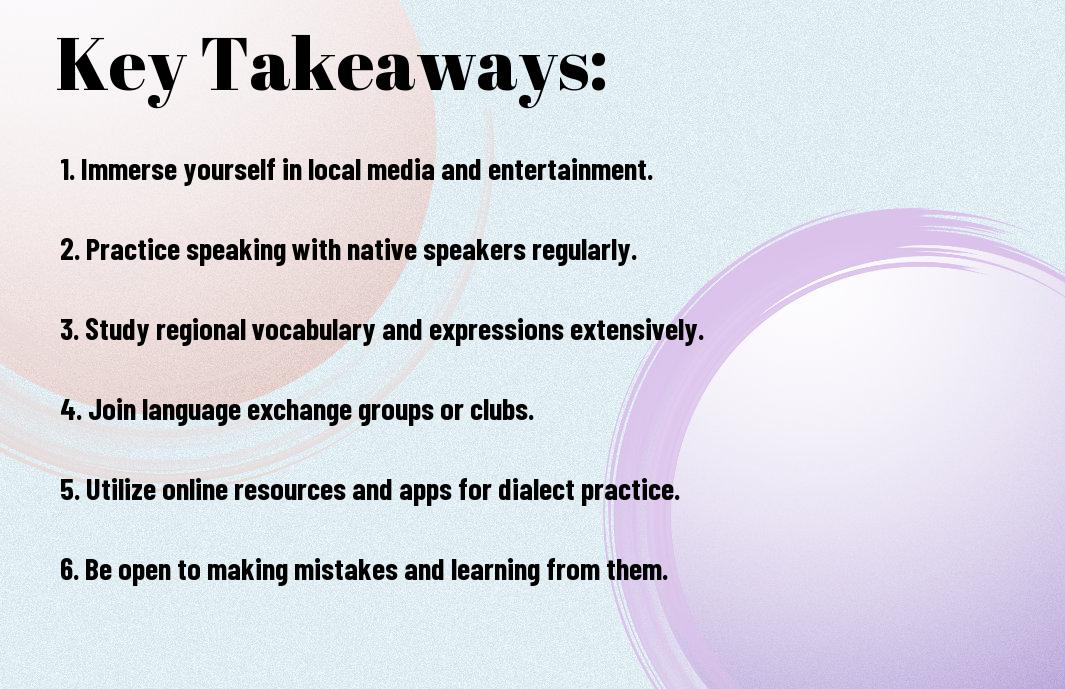
Key Takeaways:

To effectively learn regional dialects of a language, consider the following points:

  • Immerse yourself in the local culture by listening to music, watching movies, and engaging with native speakers from the specific region you’re interested in.
  • Focus on phonetic differences and vocabulary variations that distinguish one dialect from another, as these can significantly impact communication and understanding.
  • Practice active listening and try to mimic the pronunciation and intonation patterns of native speakers to improve your speaking skills in the dialect.
  • Seek out language exchange partners or tutors who are familiar with the dialect you want to learn, as they can provide personalized feedback and guidance.
  • Be patient and persistent in your efforts, as learning a regional dialect can be a challenging but rewarding experience that enhances your overall language proficiency and connection to the local community.

Preparation

Before venturing into learning regional dialects, you need to understand the importance of preparation. You must assess your current language skills and identify the dialects you want to learn. This will help you create a focused learning plan, tailored to your needs and goals.

Setting goals for dialect learning

Among the first steps in learning a dialect, you’ll need to set specific, achievable goals. You should consider what you want to accomplish with your newfound dialect skills, such as communicating with native speakers or understanding local media. This will help you stay motivated and directed throughout the learning process.

Finding resources for dialect study

Before starting your dialect learning journey, you’ll need to find reliable resources. You can look for language learning apps, online courses, or language exchange programs that cater to your desired dialect. This will provide you with a solid foundation for your studies.

At this stage, you’ll have access to a wide range of materials, including audio and video recordings, textbooks, and online forums. You can use these resources to learn the unique grammar, vocabulary, and pronunciation of your target dialect, and practice your skills with native speakers or language exchange partners. You’ll be able to immerse yourself in the dialect and gain a deeper understanding of the language and its cultural context.

Immersion

Some of the most effective ways to learn regional dialects involve surrounding yourself with the language, which can be achieved by visiting the official Dialect Differences webpage to get insights on language variations.

Surrounding yourself with native speakers

Yourself immersed in the dialect, you’ll start picking up nuances and expressions that are unique to the region, allowing you to develop a more authentic accent and understanding of the language.

Engaging with local media and culture

Against the backdrop of local traditions and customs, you’ll find that engaging with local media, such as TV shows, movies, and music, can help you get a feel for the dialect and its idiomatic expressions.

Understanding the local media and culture will help you to better grasp the dialect’s context and usage, enabling you to use the language more effectively in everyday conversations, and as you continue to immerse yourself in the language, you’ll become more comfortable with its unique characteristics and rhythms, ultimately improving your overall language skills.

Language Patterns

Your ability to learn regional dialects of a language depends on understanding its unique patterns, including grammar, vocabulary, and pronunciation.

Identifying unique dialectical features

Identifying distinct characteristics of each dialect will help you recognize and replicate them, enabling you to communicate more effectively with native speakers.

Practicing pronunciation and intonation

Pattern recognition is key to mastering dialects, and you can achieve this by listening to and mimicking native speakers, focusing on pronunciation and intonation.

Intonation is a vital aspect of dialects, and as you practice, you will become more aware of the subtle variations in pitch and tone that distinguish one dialect from another, allowing you to convey meaning and emotions more accurately.

Vocabulary Building

Unlike other aspects of language learning, vocabulary building for regional dialects requires a nuanced approach, as you’ll encounter unique words and phrases that may not be used in standard language instruction.

Learning regional expressions and idioms

Vocabularily, you’ll find that regional dialects have distinct expressions and idioms that are imperative to mastering the dialect, and you can learn these by listening to native speakers and engaging with local media.

Expanding vocabulary through context

Idiomatically, you’ll discover that context plays a significant role in understanding regional vocabulary, and you can expand your knowledge by reading local literature, watching regional TV shows, and participating in conversations with native speakers.

Building on your knowledge of regional vocabulary, you’ll find that understanding the context in which words and phrases are used is key to effective communication, and you can achieve this by immersing yourself in the dialect, either by living in the region or engaging with authentic materials, allowing you to develop a deeper understanding of the language and its nuances, and enabling you to express yourself more accurately and confidently in your target dialect.

Practice and Feedback

Keep practicing your regional dialect by engaging with native speakers and seeking feedback on your progress, as this will help you refine your skills and gain confidence in using the dialect.

Engaging in conversations with native speakers

Alongside other language learners, you can find native speakers to converse with, either in person or online, which will help you get accustomed to the dialect’s nuances and pronunciation.

Receiving feedback and correcting mistakes

Besides improving your speaking skills, receiving feedback from native speakers will also help you identify areas where you need to focus your efforts to master the regional dialect.

Feedback is necessary to your growth as you learn a regional dialect, and you should use it to adjust your pronunciation, vocabulary, and grammar, allowing you to sound more natural and authentic in your use of the dialect, and you will find that your skills improve significantly over time with consistent practice and feedback.

Cultural Context

All language learners know that understanding the cultural context is vital to mastering regional dialects. You will gain a deeper understanding of the language and its nuances by studying the culture.

Appreciating the history and customs of the region

Prior to entering into a regional dialect, you should investigate the local history and customs that have shaped the language, allowing you to better understand the dialect’s unique characteristics and expressions.

Avoiding cultural miscommunication

Along with learning the dialect, you must also be mindful of cultural differences to avoid misunderstandings, as certain words or phrases may have different connotations in different regions, and you will need to be sensitive to these differences.

Avoiding cultural miscommunication requires you to be aware of the local norms and values, and to approach language learning with an open mind and a willingness to learn from your mistakes, allowing you to navigate complex cultural situations with confidence and precision, and to effectively communicate with native speakers in their regional dialect.

To wrap up

To wrap up, you have now gained insight into the process of learning regional dialects of a language. As you proceed with your language learning journey, you will need to consider the specifics of the dialects you want to master. You can determine which dialects to focus on by visiting Deciding Which Dialects to Learn to help tailor your learning approach to your goals, and enhance your understanding of the language’s diverse variations, benefiting your overall proficiency.

FAQ

Q: What is the best way to get started with learning regional dialects of a language?

A: To begin learning regional dialects of a language, it’s important to first have a solid foundation in the standard form of the language. Once you have a good grasp of the language basics, you can start exploring the different regional dialects. Start by listening to music, watching TV shows or movies, and talking to native speakers from various regions. This exposure will help you become familiar with the unique sounds, vocabulary, and grammar of each dialect. You can also use online resources such as language learning apps, podcasts, and YouTube channels that focus on regional dialects.

Q: How can I improve my pronunciation when learning a regional dialect?

A: Improving your pronunciation when learning a regional dialect requires practice and dedication. One effective way to do this is to mimic the pronunciation of native speakers. Listen to how they pronounce words and phrases, and then repeat them out loud. You can also record yourself speaking and compare your pronunciation to that of a native speaker. Additionally, focus on learning the specific intonation patterns, rhythm, and stress of the dialect, as these can vary significantly from the standard language. Practice speaking with native speakers as much as possible, and don’t be afraid to make mistakes – it’s all part of the learning process.

Q: Are there any specific tips for learning regional dialects when you’re not immersed in the culture or don’t have access to native speakers?

A: While being immersed in the culture and speaking with native speakers is ideal, it’s not always possible. In this case, there are still several ways to learn regional dialects. You can use online language exchange websites or social media platforms to connect with native speakers and practice your language skills. You can also use language learning software or apps that include regional dialects, such as Rosetta Stone or Babbel. Furthermore, look for online forums or communities dedicated to language learning, where you can ask questions and get feedback from others who are also learning the dialect. Lastly, try to find local language meetups or cultural events in your area, where you can meet people who speak the dialect and practice your language skills in person.

The Role of Podcasts in Language Learning

As you launch on the journey of language learning, you begin to uncover the myriad of tools at your disposal, each one a thread in the intricate tapestry of linguistic discovery. Your mind, a fertile ground for new sounds, syllables, and syntax, awaits the nurture of immersive experiences. You find yourself drawn to the gentle cadence of podcasts, where native speakers’ voices transport you to the very heart of the language, inviting you to partake in conversations that unfold like a rich narrative, woven with nuances and idioms that lodge deep within your understanding.

Key Takeaways:

  • Podcasts play a significant role in language learning by providing learners with an opportunity to improve their listening skills and get exposed to various accents and pronunciations.
  • One of the main advantages of using podcasts for language learning is their convenience and flexibility, allowing learners to access and listen to episodes at any time and from any location.
  • Podcasts can also help learners to improve their vocabulary and grammar by providing them with contextualized examples of how words and phrases are used in everyday conversations.
  • The authenticity of podcasts is another key factor that makes them an effective tool for language learning, as they often feature native speakers discussing real-life topics and issues.
  • Ultimately, podcasts can be a valuable supplement to traditional language learning methods, offering learners a unique and engaging way to improve their language skills and gain a deeper understanding of the culture associated with the target language.

Benefits of Podcasts

The advantages of podcasts in language learning are numerous, and as you examine into the world of audio content, you will discover a wealth of opportunities to enhance your linguistic skills.

Improved Listening Skills

Enhanced by the rhythmic flow of natural speech, your ability to decipher meanings and contexts will become more refined, allowing you to better comprehend the nuances of the language.

Enhanced Vocabulary

Refined through exposure to a vast array of expressions and terminology, your vocabulary will expand, enabling you to convey your thoughts and ideas with greater precision and clarity.

Even as you navigate the complexities of language, you will find that podcasts offer a unique opportunity to encounter words and phrases in context, thereby deepening your understanding of their usage and connotations, and empowering you to incorporate them into your own speech and writing with ease and confidence.

Language Learning Strategies

One of the key benefits of podcasts in language learning is their ability to facilitate effective language learning strategies, allowing you to improve your skills in a engaging and immersive way, as you navigate the complexities of a new language, you begin to develop a deeper understanding of its nuances and rhythms.

Active Listening

Beneath the surface of podcasting lies a powerful tool for active listening, as you tune in to the sounds, intonations, and cadences of native speakers, you start to pick up on subtle differences in pronunciation and grammar, allowing you to refine your own language skills, and you find yourself drawn into a world of sound and meaning.

Interactive Engagement

Beyond the initial stage of listening, podcasts offer a wealth of opportunities for interactive engagement, as you begin to respond, reflect, and participate in the conversation, you start to build a sense of connection with the language, and you find yourself drawn into a dynamic process of learning and growth, where you are no longer just a passive listener, but an active participant.

Learning through interactive engagement with podcasts, you start to develop a sense of agency and autonomy in your language learning journey, as you explore different topics, themes, and styles, you begin to create your own path, tailored to your interests and needs, and you discover that the language is not just a set of rules and grammar, but a living, breathing entity that you can shape and mold to express your own unique voice and perspective, and in this way, you find that your language skills flourish, as you engage with the world around you, in all its complexity and beauty.

Popular Language Learning Podcasts

Now, as you examine into the world of language learning podcasts, you’ll discover a wealth of options to suit your needs. With so many podcasts available, you can explore various topics, formats, and levels of difficulty to find what works best for you.

News-based Podcasts

By tuning into news-based podcasts, you can stay informed about current events while improving your listening skills. These podcasts often feature discussions on news stories, debates, and interviews, providing you with valuable insights into different cultures and perspectives.

Conversational Podcasts

Like a gentle breeze on a summer’s day, conversational podcasts can transport you to a world of effortless dialogue, where you can absorb the rhythms and cadences of a language. You’ll find yourself immersed in conversations that flow like a river, carrying you along with their natural pace and spontaneity.

Another aspect of conversational podcasts that you may find particularly appealing is the way they recreate the experience of chatting with a native speaker. As you listen, you’ll pick up on nuances of language, idioms, and expressions that might elude you in more formal lessons, and you’ll begin to grasp the subtleties of language that make communication so rich and multifaceted.

Effective Integration

Not surprisingly, podcasts can be a valuable tool in your language learning journey. You can find more information on why podcasts are an excellent choice for language learners, and discover the benefits they offer. As you explore the world of podcasts, you will find a wealth of listening materials to aid your progress.

Supplementing Traditional Methods

Beneath the surface of traditional language learning methods, you will find that podcasts can be a useful supplement, adding depth and variety to your studies. You can use them to fill gaps in your knowledge and practice your listening skills in a more engaging way.

Reinforcing Language Practice

Inline with your goals, podcasts can help reinforce your language practice, providing you with a consistent and accessible way to immerse yourself in the language. As you listen to native speakers, you will become more familiar with the rhythms and nuances of the language.

Due to the format of podcasts, you can listen to them at your convenience, pausing and rewinding as needed, allowing you to absorb the material at your own pace. This flexibility makes podcasts an excellent way to reinforce your language practice, helping you to build confidence and fluency in your target language, and enabling you to make steady progress towards your goals, as you continue to learn and grow.

Challenges and Limitations

Many language learners find podcasts to be a valuable resource, but you may also encounter several challenges that hinder your progress, and it is vital to acknowledge these limitations to make the most of your learning experience.

Variability in Quality

Across the vast array of podcasts available, you will notice discrepancies in quality, which can impact your learning experience, as some podcasts may lack clarity, coherence, or cultural relevance, making it difficult for you to engage with the material.

Limited Feedback Opportunities

Feedback is vital for language improvement, and you may find that podcasts often lack the interactive element, leaving you without the opportunity to practice speaking or receive corrections on your pronunciation, which can be a significant drawback in your language learning journey.

Indeed, as you examine deeper into the world of podcast-based language learning, you will begin to appreciate the importance of feedback in refining your language skills, and you may need to supplement your podcast listening with other language learning tools or activities that provide more opportunities for interaction and feedback, allowing you to gauge your progress and make adjustments to your learning strategy.

Future Directions

Despite the growing popularity of podcasts in language learning, there is still much to be explored. You can examine into studies like Exploring The Use of Podcasts on Students’ Language Learning Motivation and Anxiety to uncover the impact of podcasts on your learning experience.

Technological Advancements

Before we explore the potential of podcasts, you notice that advancements in technology have made it easier for you to access and create your own language learning content, paving the way for a more personalized experience.

Increased Accessibility

Across the globe, you find that podcasts have become an integral part of language learning, allowing you to learn at your own pace and convenience, with a vast array of topics and levels to choose from.

Another aspect of increased accessibility is the ability to access podcasts offline, making it possible for you to learn in any environment, whether you have a stable internet connection or not, and with features like speed control and transcripts, you can tailor your learning experience to suit your needs and preferences, enabling you to make the most out of your language learning journey.

Summing up

With this in mind, you begin to appreciate the profound impact of podcasts on your language learning journey. As you explore into the world of audio content, you discover how podcasts can reshape your approach to language acquisition. For a deeper understanding of Podcasts’ effects on the EFL classroom: a socially relevant perspective, you may find the insights enlightening, and your perception of language learning will undoubtedly shift, as you explore the vast possibilities that podcasts offer to enhance your skills.

FAQ

Q: What is the role of podcasts in language learning, and how can they benefit students?

A: Podcasts play a significant role in language learning as they provide students with an opportunity to improve their listening skills, enhance their vocabulary, and get accustomed to the natural flow and rhythm of the target language. By listening to podcasts, students can expose themselves to various accents, dialects, and speaking styles, making them more proficient and confident in their language skills. Moreover, podcasts often cover a wide range of topics, from news and culture to science and entertainment, allowing students to learn about different subjects while improving their language abilities.

Q: How can podcasts be used to improve speaking and writing skills in language learning?

A: While podcasts are primarily an audio medium, they can still be used to improve speaking and writing skills. Students can start by listening to podcasts and then summarizing what they heard in their own words, either orally or in writing. This exercise helps to reinforce their understanding of the material and develops their ability to express themselves in the target language. Additionally, students can use podcasts as a prompt for discussions or writing assignments, allowing them to practice their speaking and writing skills in a more interactive and engaging way. Many podcasts also provide transcripts or show notes, which can be used as a resource for writing and speaking activities.

Q: Can podcasts be used as a self-study tool for language learners, and what are some tips for getting the most out of them?

A: Yes, podcasts can be an excellent self-study tool for language learners. To get the most out of podcasts, students should start by selecting podcasts that match their level and interests. They can then create a study routine that involves listening to podcasts regularly, taking notes, and reviewing the material. Students can also use podcasting apps that provide features such as speed control, transcripts, and vocabulary lists to enhance their learning experience. Furthermore, students can use podcasts in conjunction with other language learning resources, such as language exchange apps or online courses, to create a well-rounded and effective self-study plan. By leveraging podcasts in this way, students can take control of their language learning and make progress at their own pace.

How Learning Multiple Languages Expands Worldviews

As you initiate on the fascinating journey of learning multiple languages, you’ll discover that your perception of the world undergoes a profound transformation. Your linguistic palette expands, and with it, your understanding of diverse cultures and perspectives. By acquiring new languages, you’ll gain a deeper insight into the complexities of human communication, allowing you to navigate the world with increased empathy and nuance. For instance, as noted in Learn a language, expand your worldview – Appalachian Today, your worldview will broaden, enabling you to engage with people from diverse backgrounds in a more meaningful way.

Key Takeaways:

  • Learning multiple languages can broaden one’s perspective and understanding of different cultures, allowing individuals to connect with people from diverse backgrounds and communities.
  • Acquiring multiple languages can enhance one’s cognitive abilities, such as memory and problem-solving skills, as it requires the brain to adapt and process new information.
  • Being multilingual can expand one’s career opportunities and travel experiences, enabling individuals to communicate effectively with people from various countries and industries.
  • Learning multiple languages can also foster empathy and tolerance by exposing individuals to different worldviews and cultural norms, promoting a more open-minded and inclusive attitude.
  • Overall, learning multiple languages can enrich one’s personal and professional life, providing a competitive edge in an increasingly globalized world and diverse society.

Broadening Cultural Horizons

Before delving into the world of multilingualism, you may wonder how it can impact your perspective. You can explore this question further by visiting discussions on how a second language changes your worldview, and discover the diverse insights shared by language learners. As you begin on this journey, your understanding of the world will undergo a significant transformation.

Discovering New Perspectives

Honestly, broadening your linguistic abilities will introduce you to fresh viewpoints, enabling you to perceive the world from different angles. You will begin to see that your native language is not the only lens through which to view reality, and this realization will be truly enlightening.

Appreciating Cultural Nuances

Together with your newfound language skills, you will develop a deeper appreciation for the cultural subtleties that shape human interaction. You will become more aware of the nuances that distinguish one culture from another, allowing you to navigate diverse social situations with greater ease and sensitivity.

Plus, as you learn to appreciate these cultural nuances, you will find that your interactions with people from different backgrounds become more meaningful and authentic. You will be able to pick up on subtle cues, understand idiomatic expressions, and engage in conversations that foster lasting connections, ultimately enriching your personal and professional relationships.

Enhancing Cognitive Abilities

The ability to learn multiple languages has a profound impact on your cognitive abilities, allowing you to navigate complex mental tasks with greater ease and agility. As you become proficient in multiple languages, you’ll notice improvements in your overall mental acuity, which can have a lasting impact on your personal and professional life.

Improving Memory and Concentration

Among the many benefits of learning multiple languages, enhanced memory and concentration are two of the most significant advantages you’ll experience. As you learn to switch between languages, your brain develops a heightened sense of focus, allowing you to concentrate on tasks for longer periods and retain information with greater accuracy.

Boosting Creativity and Problem-Solving

Around the world, polyglots are known for their innovative thinking and ability to approach problems from unique angles. As you learn multiple languages, you’ll find that your creative faculties are expanded, allowing you to think outside the box and develop novel solutions to complex problems.

Due to the cognitive flexibility that comes with learning multiple languages, you’ll be able to navigate complex mental landscapes with greater ease, making connections between seemingly disparate ideas and concepts. This, in turn, will enable you to approach problems with a fresh perspective, often finding creative solutions that might have eluded you otherwise, and enriching your personal and professional life in the process.

Facilitating Global Communication

Now, as you begin on the journey of learning multiple languages, you’ll discover that it opens doors to a world of unparalleled communication, enabling you to connect with people from diverse cultural backgrounds and fostering a deeper understanding of their perspectives.

Bridging Language Gaps

Around the globe, language barriers often hinder meaningful interactions, but as you acquire new languages, you’ll find that you can traverse these gaps with ease, facilitating dialogue and exchange between people who would otherwise be unable to communicate.

Fostering International Relationships

Among the many benefits of language learning, the ability to form lasting bonds with individuals from other countries is perhaps the most significant, allowing you to navigate complex social dynamics and build strong, lasting relationships that transcend linguistic and cultural divides.

Indeed, as you explore deeper into the world of language learning, you’ll realize that fostering international relationships is not just about communicating effectively, but also about understanding the nuances of different cultures, from customs and traditions to history and values, and it is this nuanced understanding that will enable you to build bridges between your own culture and those you encounter, enriching your life and broadening your perspectives in the process, and as you do so, you’ll find that your worldview expands, becoming more kaleidoscopic and multifaceted, reflecting the diversity and complexity of the world we live in.

Career Opportunities and Advantages

Many individuals who speak multiple languages find that their career prospects expand significantly, as they become more attractive to potential employers. Your language skills can open doors to new job opportunities and industries, allowing you to pursue a career that aligns with your passions and interests.

Expanding Professional Horizons

Professionally, speaking multiple languages can elevate your status in the workplace, enabling you to communicate effectively with colleagues and clients from diverse backgrounds. You will be able to navigate complex cultural situations with ease, making you a valuable asset to your organization.

Gaining Competitive Edge

Behind the scenes, your language skills are working to give you a competitive advantage in the job market. You will be able to tap into global networks and markets, accessing opportunities that may not be available to those who speak only one language.

Expanding your language repertoire allows you to stand out in a crowded job market, as you demonstrate your ability to adapt to new situations and communicate across cultural boundaries. You will be able to leverage your language skills to negotiate, persuade, and collaborate with people from diverse backgrounds, giving you a distinct edge in your chosen career.

The Joy of Language Learning

Once again, you find yourself on a fascinating journey, as learning multiple languages expands your worldviews and broadens your perspectives. The pleasure of discovering new languages is unparalleled, offering a unique glimpse into diverse cultures and ways of thinking.

Exploring Linguistic Diversity

Besides the obvious benefits, exploring linguistic diversity allows you to investigate into the intricacies of language, weaving a rich tapestry of expression and communication. You begin to appreciate the nuances of each language, and your understanding of the world becomes more multifaceted.

Developing Language Skills

Contrary to what you might think, developing language skills is a highly rewarding experience, as it challenges your mind and broadens your horizons. You start to see the world from different angles, and your ability to communicate effectively improves significantly.

Skills such as active listening, grammar, and vocabulary building are imperative components of language development, and as you master them, you become more confident in your ability to express yourself. You start to notice the similarities and differences between languages, and your brain becomes more adept at switching between them, allowing you to navigate complex linguistic situations with ease, and your worldviews continue to expand as a result.

Overcoming Language Barriers

After initiateing on the journey of learning multiple languages, you will find that your perception of the world expands exponentially. Your ability to communicate with people from diverse backgrounds breaks down cultural walls, allowing you to research deeper into the nuances of human experience.

Building Confidence in Language Use

By mastering the grammar and vocabulary of a new language, you become more adept at expressing yourself, and your confidence grows, enabling you to engage in meaningful conversations with native speakers, and thereby broadening your understanding of their worldviews.

Navigating Multilingual Environments

Akin to acquiring a new skill, you will find that navigating multilingual environments becomes second nature, as you learn to switch between languages effortlessly, picking up on subtle cues and expressions that reveal the complexities of human communication.

Navigating the complexities of multilingual environments, you will discover that your brain becomes increasingly adept at processing multiple linguistic signals, allowing you to move seamlessly between different cultural contexts, and in doing so, you will uncover new perspectives, fostering a deeper appreciation for the diversity of human experience, and enabling you to engage with people from all walks of life on a more profound level, thereby enriching your life and broadening your understanding of the world.

Summing up

Hence, as you explore into multiple languages, you’ll find that your worldview expands, allowing you to appreciate diverse perspectives and nuances. Your understanding of cultures deepens, and you become more empathetic and open-minded. By acquiring new languages, you’re not only gaining a skill, but also broadening your horizon, enabling you to engage with the world in a more sophisticated and enlightened manner, ultimately enriching your life and fostering a more global outlook.

FAQ

Q: How does learning multiple languages broaden one’s perspective on the world?

A: Learning multiple languages expands one’s worldviews by exposing individuals to diverse cultural contexts, histories, and ways of thinking. As people acquire new languages, they gain access to the literature, media, and conversations of the corresponding cultures, allowing them to understand different perspectives and nuances that might be lost in translation. This, in turn, fosters empathy and a deeper appreciation for the complexities of human experience, enabling individuals to navigate a globalized world with greater sensitivity and insight.

Q: Can learning multiple languages influence the way people perceive and understand global issues?

A: Yes, learning multiple languages can significantly influence the way individuals perceive and understand global issues. By accessing information and news from various language sources, people can obtain a more comprehensive and balanced view of international events, unfiltered by the biases of a single language or culture. This multilingual approach helps to identify and challenge assumptions, facilitating a more nuanced understanding of complex global problems and encouraging more effective participation in international discussions and collaborations.

Q: How does the ability to communicate in multiple languages impact personal and professional relationships in a global context?

A: The ability to communicate in multiple languages profoundly impacts both personal and professional relationships in a global context. On a personal level, it enables individuals to form deeper connections with people from diverse linguistic backgrounds, fostering meaningful friendships and a sense of belonging to global communities. Professionally, multilingualism opens up a wide range of career opportunities in international business, diplomacy, education, and more, by allowing individuals to communicate effectively with clients, colleagues, and partners from around the world, thereby enhancing collaboration, trust, and mutual understanding.

Top Tips for Learning Languages at Any Age

As you consider learning a new language, you may wonder if your age will hinder your progress. However, with the right approach, you can overcome any obstacle and achieve your goal. Your ability to learn a language depends on your dedication and the strategies you employ. You will discover that learning a language can be a rewarding experience, and with our expert guidance, you will be well on your way to becoming proficient in no time, regardless of your age or background.

Key Takeaways:

  • Setting realistic goals is vital for language learners of any age, as it helps to maintain motivation and track progress over time.
  • Language learning at any age can be facilitated by immersion, which involves surrounding oneself with the language through various media, such as TV shows, music, and conversations with native speakers.
  • Using language learning apps can be an effective way to learn a new language, as they offer interactive lessons, quizzes, and exercises tailored to individual learning styles and levels.
  • Practice with a language exchange partner can significantly enhance language skills, especially speaking and listening, by providing opportunities for regular conversation and feedback.
  • Embracing consistency is key to successful language learning, as regular practice helps to reinforce new language skills and build confidence in using the language in everyday situations.

Setting Goals

To get started with learning a language, you need to set realistic goals. You can find helpful tips on language learning at How to learn a language | 8 top tips and advice, which will guide you through the process.

Defining Your Motivation

Your motivation for learning a language is key to your success. You should identify what drives you to learn, whether it’s for travel, work, or personal growth, to help you stay focused and motivated.

Creating a Learning Schedule

Between your work and personal life, you need to find time to dedicate to language learning. You should create a schedule that suits your lifestyle, allowing you to make consistent progress.

Learning a language requires consistent practice, so it’s crucial to allocate specific timeslots for learning and stick to them. You can use a planner, calendar, or app to stay organized and on track, ensuring that you make language learning a regular part of your routine, which will help you achieve your goals more effectively.

Choosing the Right Resources

You will find that there are numerous resources available to help you learn a language, and selecting the right ones can make a significant difference in your learning journey. Consider your learning style, goals, and preferences when choosing resources.

Language Learning Apps

The variety of language learning apps available can be overwhelming, but many offer interactive and engaging lessons, making learning a language fun and accessible. You can try out different apps to see which one works best for you.

Language Exchange Programs

Across the globe, language exchange programs provide opportunities for you to practice speaking with native speakers, helping you improve your pronunciation and comprehension. You can find language exchange programs online or in-person, depending on your preferences.

Even if you are a beginner, language exchange programs can be highly beneficial, as they allow you to learn from native speakers and get feedback on your language skills. You can use these programs to practice speaking, writing, and listening, and you will see improvement in your language abilities over time, helping you to achieve your language learning goals.

Effective Learning Techniques

Now that you’re ready to start learning, explore 7 Tips To Learn Any Language From An Expert for valuable insights. You’ll discover new methods to enhance your language skills and stay motivated throughout your journey.

Immersion Method

Besides traditional classroom learning, surrounding yourself with the language you want to learn can be highly effective. You can watch TV shows or movies, listen to music, and try to speak with native speakers to immerse yourself in the language.

Spaced Repetition

With the help of flashcards and language learning apps, you can utilize spaced repetition to reinforce new vocabulary and grammar rules. You can review material at increasingly longer intervals to help solidify it in your long-term memory.

But what makes spaced repetition so effective is its ability to help you learn new information in a way that’s tailored to your individual needs. As you practice, you’ll find that you’re able to recall words and phrases more easily, and your language skills will improve at a steady pace. You’ll be able to track your progress and adjust your learning schedule accordingly, making the most of your study time.

Overcoming Obstacles

For anyone learning a language, obstacles are inevitable, but with the right mindset, you can overcome them and achieve your goals, and it’s imperative to identify the challenges you’ll face and develop strategies to tackle them, allowing you to stay focused on your language learning journey.

Managing Time Constraints

Beneath the surface of a busy schedule, you can find moments to practice your language skills, such as listening to podcasts or language lessons during your daily commute, and making the most of your time will help you stay on track and make consistent progress.

Dealing with Self-Doubt

Before you begin to feel discouraged, take a step back and assess your progress, celebrating your achievements and identifying areas for improvement, and you’ll see that you’re making progress, even if it doesn’t feel like it, and this will help you build confidence in your abilities.

Achieving fluency in a language takes time and effort, and it’s normal to experience self-doubt, but you can overcome it by setting realistic goals, practicing consistently, and seeking support from language exchange partners, tutors, or online communities, and as you progress, you’ll become more confident in your language skills and more motivated to continue learning.

Practicing Consistently

Keep your language learning on track by setting aside time each day to practice. Consistency is key to developing language skills and making progress. You can start with short sessions, even 10-15 minutes a day, and gradually increase as your schedule allows.

Setting Achievable Milestones

Against the odds of getting discouraged, you set specific, attainable goals for your language learning journey. Break down larger goals into smaller, manageable milestones, and celebrate your achievements along the way. This will help you stay focused and motivated.

Staying Motivated

Around the challenges you may face, find ways to stay engaged and motivated. You can use language learning apps, watch TV shows or movies in the target language, or speak with native speakers to keep your interest alive.

Another way to stay motivated is to track your progress and reflect on how far you’ve come. You can use a language learning journal to note your achievements, identify areas for improvement, and adjust your practice schedule accordingly. This will help you stay motivated and encouraged throughout your language learning journey.

Seeking Feedback and Support

All language learners benefit from seeking feedback and support. You can find valuable resources, such as The Best Ways to Learn a Language According to Research, to guide your learning journey.

Finding a Language Partner

Between language exchange websites and apps, you can easily find a language partner to practice with, helping you improve your speaking and listening skills.

Joining a Language Learning Community

Joining online forums or social media groups dedicated to language learning can connect you with fellow learners and native speakers, providing opportunities for feedback and support.

Understanding the importance of community in language learning, you can leverage these platforms to ask questions, share your progress, and learn from others, ultimately enhancing your language learning experience and staying motivated to reach your goals.

Final Words

On the whole, you have now acquired the top tips for learning languages at any age. You can apply your knowledge to enhance your language skills, and your dedication will yield impressive results. As you progress, you will discover that learning a language is a rewarding experience, and your efforts will enrich your personal and professional life, allowing you to connect with diverse cultures and communities, and broaden your perspectives, making your language learning journey a success.

FAQ

Q: What are the most effective ways to start learning a new language as an adult?

A: As an adult, you can start learning a new language by setting achievable goals and creating a study schedule. Immersion is key, so try to surround yourself with the language as much as possible through listening to music, watching TV shows or movies, and speaking with native speakers. Additionally, using language learning apps and enrolling in a course can provide structure and support. Consistency is important, even 15-20 minutes of study per day can be more effective than one or two long sessions per week.

Q: How can I overcome the fear of speaking a new language and improve my pronunciation?

A: Overcoming the fear of speaking a new language requires practice and patience. Start by speaking as much as you can, even if it’s just with yourself or a language exchange partner. Listen to native speakers and try to mimic their intonation and rhythm. Pronunciation can be improved by listening to and repeating words and phrases, and by recording yourself to identify areas that need improvement. You can also practice speaking with a tutor or language exchange partner, which can help you become more confident and comfortable with speaking in the new language.

Q: What role does consistency and motivation play in successfully learning a new language at any age?

A: Consistency and motivation are vital for successfully learning a new language at any age. Setting specific, achievable goals and tracking progress can help maintain motivation. Finding a study buddy or joining a language learning community can also provide support and encouragement. Additionally, celebrating small victories along the way and rewarding yourself for milestones reached can help keep you motivated and engaged in the learning process. Staying consistent with your study routine, even when it’s challenging, will help you make steady progress and eventually become proficient in the new language.

Skip to content