simon weiner

How Learning Languages Enhances Social Connections

As you navigate the world, you’ll encounter diverse cultures and communities, and speaking their language can be a powerful tool. You’ll discover that learning languages opens doors to new relationships and deepens your understanding of different perspectives. By acquiring a new language, you’ll broaden your social circle and enhance your ability to connect with people from various backgrounds, fostering meaningful interactions and lasting bonds. Your language skills will become a valuable asset in personal and professional settings.

Key Takeaways:

To improve your understanding of how learning languages enhances social connections, consider the following points:

  • Learning a new language can broaden your social circle by enabling you to connect with people from diverse cultural backgrounds, fostering global understanding and friendships.
  • Language skills can enhance your travel experiences by allowing you to communicate effectively with locals, navigate unfamiliar environments, and fully immerse yourself in foreign cultures.
  • Developing linguistic abilities can also improve your professional network by opening up new career opportunities and enabling you to connect with colleagues and clients from around the world, thereby expanding your social connections.

Language as a Social Bridge

For you, learning a new language can be a powerful tool to connect with others across cultures. As you explore the relationship between language and social interaction, you can learn more about Social Interaction & Language Learning and how it can impact your daily life.

Breaking Cultural Barriers

Around the concept of cultural understanding, you’ll find that speaking a new language helps you navigate different social norms and customs, allowing you to build stronger relationships with people from diverse backgrounds.

Enhancing Travel Experiences

Building on your language skills, you’ll discover that communicating in a foreign language can greatly enhance your travel experiences, as you’re able to engage with locals and immerse yourself in their culture.

Another aspect of language learning is that it enables you to venture off the beaten path, exploring hidden gems and unexpected experiences that might have been inaccessible without your newfound language abilities, allowing you to create meaningful connections with the people you meet along the way.
The Power of Language in Building Relationships

You can establish a strong bond with others by learning their language, allowing you to communicate effectively and understand their culture. This connection enables you to build trust and rapport, leading to deeper and more meaningful relationships.

Deepening Connections with Native Speakers

For instance, when you speak with native speakers in their own language, you can engage in more nuanced conversations, sharing thoughts and ideas that might be lost in translation. This helps you build stronger connections and fosters a sense of belonging.

Fostering Empathy and Tolerance

Behind every language lies a unique perspective, and by learning a new language, you gain insight into the customs and traditions of its speakers. This understanding helps you become more open-minded and accepting of diverse cultures.

Plus, as you learn to see the world through the eyes of others, you develop a greater appreciation for the complexities of human experience, allowing you to navigate diverse social situations with ease and sensitivity, and ultimately enriching your personal and professional relationships.

Cognitive Benefits of Language Learning

Many cognitive benefits come with learning a new language, enhancing your mental abilities and improving your overall brain function. As you learn a new language, you’ll experience improvements in problem-solving, multitasking, and decision-making, making you a more effective and efficient thinker.

Improving Memory and Concentration

Mental faculty is strengthened as you learn new vocabulary, grammar, and syntax, helping you stay focused and retain information better, which benefits other areas of your life, such as work and study.

Delaying Cognitive Decline

For your long-term cognitive health, learning a new language can have a significant impact, building a strong foundation for a healthier brain as you age, and you’ll be better equipped to handle age-related cognitive changes.

Language Learning as a Social Activity

After enrolling in a language course, you will soon discover that language learning is not just about memorizing vocabulary and grammar rules, but also about interacting with others who share your interests and goals, thereby enhancing your social connections.

Joining Language Exchange Communities

Communities of language learners, such as online forums and social media groups, provide you with opportunities to practice your language skills with native speakers and fellow learners, helping you to build your confidence and improve your pronunciation.

Participating in Cultural Events

About the cultural events that are often organized by language schools and cultural institutions, you can attend festivals, concerts, and other events where you can meet new people and practice your language skills in a more informal setting, which can be a great way to enhance your social connections.

Events like these allow you to experience the culture associated with the language you are learning, and you can engage in conversations with native speakers, try traditional food, and learn about customs and traditions, all of which can help you to deepen your understanding of the language and its cultural context, and broaden your social circle.

Overcoming Language Barriers in the Workplace

All professionals know that language skills can greatly impact your career advancement. By learning languages, you can effectively communicate with colleagues, clients, and customers from diverse backgrounds, enhancing your overall work experience.

Enhancing Career Opportunities

Career advancement is often dependent on your ability to connect with people from different cultures. As you develop your language skills, you will find more opportunities opening up for you, allowing you to take on new challenges and grow professionally.

Facilitating International Communication

Any organization that operates globally needs employees who can communicate effectively across language barriers. As you learn new languages, you will be able to facilitate international communication, helping your company to expand its reach and build stronger relationships with international partners.

And as you become more proficient in multiple languages, you will find that your role in the company evolves, and you become a valuable asset in negotiations, meetings, and other business interactions with international clients and colleagues, enabling you to build trust and foster long-term relationships that benefit your organization.

The Joy of Language Learning

Now, as you initiate on your language learning journey, you’ll discover a newfound appreciation for the world around you. You’ll uncover the joy of communicating with others, making connections, and building relationships that transcend language barriers.

Discovering New Perspectives

Across cultures and languages, you’ll gain a deeper understanding of different viewpoints and ways of life. You’ll be able to engage with people from diverse backgrounds, broadening your knowledge and empathy.

Broadening Cultural Horizons

One of the most significant benefits of language learning is the opportunity to explore new cultures. You’ll be able to immerse yourself in the customs, traditions, and values of other countries, expanding your cultural awareness and understanding.

Also, as you investigate deeper into a new language, you’ll find that your cultural horizons broaden, and you’ll develop a more nuanced appreciation for the complexities of human communication. You’ll be able to navigate different social situations with confidence, forging meaningful connections with people from all walks of life, and enriching your personal and professional relationships.

To wrap up

Presently, you can see that learning languages enhances your social connections in various ways. You gain a deeper understanding of different cultures, allowing you to communicate effectively with people from diverse backgrounds. As you become more proficient, your confidence in social interactions grows, enabling you to form meaningful relationships and expand your social circle. By learning languages, you broaden your perspectives and foster greater empathy, ultimately enriching your personal and professional life.

FAQ

Q: How does learning a new language help me connect with people from diverse cultural backgrounds?

A: Learning a new language enables you to communicate effectively with individuals from different cultures, fostering deeper and more meaningful relationships. By speaking the language of your counterparts, you demonstrate respect for their culture and heritage, which can lead to stronger social bonds and a greater sense of belonging. This, in turn, can open up new opportunities for personal and professional growth, as you become more confident in navigating diverse social situations.

Q: Can learning a language really help me make friends in a foreign country or community?

A: Absolutely, learning the local language can significantly enhance your ability to make friends in a foreign country or community. When you speak the language, you can participate fully in social activities, understand cultural nuances, and express yourself freely, which helps to break down barriers and build trust. Moreover, locals tend to appreciate and admire those who make an effort to learn their language, which can lead to warmer welcomes and more genuine friendships. By learning a language, you can turn a foreign environment into a familiar and welcoming space.

Q: How does language learning impact my social connections in the digital age, where translation tools are readily available?

A: While translation tools have made communication across languages more accessible, learning a language still offers a unique set of benefits for social connections in the digital age. For instance, nuances of language and humor often get lost in translation, and speaking directly with others in their native language allows for more natural and spontaneous interactions. Furthermore, language learning demonstrates a level of commitment and interest in the culture, which can lead to more authentic and engaging online interactions. By combining language skills with digital connectivity, you can expand your social network globally and engage in richer, more multifaceted relationships that transcend linguistic and geographical boundaries.

How to Prepare for Language Certification Exams

As you launch on the journey to obtain a language certification, you will need to develop a strategic approach to prepare for the exams. Your goal is to demonstrate proficiency in a specific language, and to achieve this, you must focus on improving your reading, writing, listening, and speaking skills. You will need to familiarize yourself with the exam format, content, and timing to ensure your success. By following a structured plan, you can effectively prepare for the challenge ahead and boost your confidence in your language abilities.

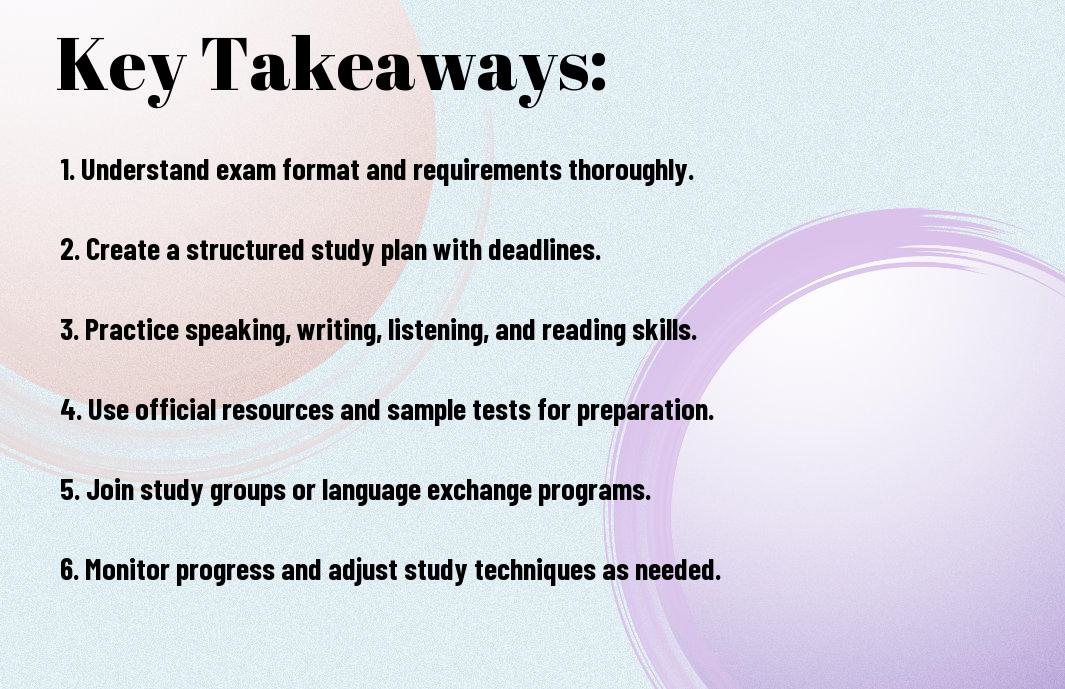
Key Takeaways:

To prepare for language certification exams, consider the following points:

  • Develop a study plan that outlines your goals, schedule, and resources to help you stay organized and focused on achieving language proficiency.
  • Practice reading comprehension, writing skills, and listening techniques to improve your overall language skills and become more confident in your ability to communicate effectively.
  • Familiarize yourself with the exam format and content to understand what to expect on the test day, and use practice tests to simulate the actual exam experience and identify areas for improvement.

Getting Familiar with the Exam Format

A thorough understanding of the exam format is vital to your success. You will need to acquaint yourself with the structure and content of the exam.

Overview of the Exam Structure

About the exam, you should know that it is divided into sections, each testing a specific skill. You will be assessed on your reading, writing, listening, and speaking abilities.

Types of Questions and Tasks

You will encounter various types of questions and tasks, including:

  • Multiple-choice questions
  • Essay writing
  • Oral presentations

Thou will need to practice these tasks to feel comfortable with the exam format.

Section Time
Reading 60 minutes
Writing 90 minutes
Listening 40 minutes
Speaking 20 minutes
Break 10 minutes

Structure your study plan according to the exam format, and you will be well-prepared. You will encounter various types of questions and tasks, including:

  • Multiple-choice questions
  • Essay writing
  • Oral presentations

Thou will need to practice these tasks to feel comfortable with the exam format.

Section Content
Reading Comprehension and vocabulary
Writing Essay and grammar
Listening Auditory comprehension
Speaking Oral communication
Break Rest and relaxation

Building Vocabulary and Grammar Skills

It is crucial to develop a strong foundation in vocabulary and grammar to excel in language certification exams. You will need to focus on expanding your word list and understanding the nuances of grammar rules.

Effective Strategies for Learning New Words

Vocabularily speaking, you should prioritize learning words in context, as this will help you grasp their meanings and usage more effectively. You can achieve this by reading extensively and making flashcards to aid your memorization.

Grammar Rules and Exceptions to Focus On

Analytically, you should concentrate on mastering the most common grammar rules and exceptions, as these will be heavily tested in your exam. You should pay attention to verb tenses, subject-verb agreement, and sentence structure.

And as you investigate deeper into grammar rules and exceptions, you will notice that practice is key to reinforcing your understanding. You should engage in regular writing and speaking exercises to apply your knowledge of grammar rules and develop your language skills further, which will ultimately boost your confidence and performance in the exam.

Improving Reading and Listening Comprehension

Unlike other skills, improving your reading and listening comprehension takes consistent practice and dedication, and as you engage with various materials, you will develop your ability to understand and interpret complex texts and conversations.

Techniques for Enhancing Reading Speed and Accuracy

Around the time you start preparing for your language certification exam, you will find that practicing active reading techniques, such as skimming and scanning, will help you to quickly identify main ideas and supporting details in a text, allowing you to manage your time more effectively.

Tips for Better Listening and Note-taking

Reading through the exam format and content in advance, you will be better prepared to tackle the listening section, and some tips to keep in mind include:

  • focus on the speaker’s main idea
  • identify key supporting details

Thou will be able to improve your listening and note-taking skills with consistent practice, which is necessary for success in your language certification exam.

Plus, as you practice listening to various types of audio materials, such as lectures, conversations, and news broadcasts, you will develop your ability to identify main ideas, supporting details, and the speaker’s tone and purpose, and some additional tips to consider include:

  • take notes on key points
  • practice active listening by summarizing what you hear

Thou will find that your listening and note-taking skills will improve significantly with dedicated practice and review.

Developing Writing and Speaking Skills

After dedicating time to learning grammar and vocabulary, you will need to focus on developing your writing and speaking skills to excel in language certification exams.

Essay Writing and Response Techniques

Across various language certification exams, your ability to express yourself in writing will be tested, so it’s imperative to practice essay writing and develop effective response techniques to tackle different question types.

Conversation Practice and Pronunciation Tips

Responding to conversational prompts will help you improve your speaking skills, and you can achieve this by:

  • engaging in conversations with native speakers
  • practicing with language exchange partners

After consistent practice, you will notice significant improvement in your speaking abilities.

It is also important to focus on pronunciation, as clear and accurate pronunciation will boost your confidence and enhance your overall performance in the speaking section of the exam. You can improve your pronunciation by:

  • listening to native speakers and mimicking their intonation
  • recording yourself and identifying areas for improvement

After mastering the pronunciation tips, you will be able to express yourself more effectively in spoken language, which will contribute to your success in the language certification exam.

Practicing with Sample Questions and Tests

Despite the challenges, practicing with sample questions and tests will help you prepare for your language certification exam. You can find resources online, such as Official English exams: 5 tips to prepare them at your center, to guide your preparation.

Where to Find Reliable Study Materials

Around your local library or bookstore, you can find study materials to aid your preparation, including textbooks and practice exams that cater to your needs.

How to Simulate the Actual Test Experience

Find a quiet space to simulate the actual test experience, minimizing distractions and allowing you to focus on your performance under timed conditions.

Sample tests are an effective way to assess your knowledge and identify areas for improvement. You can use these tests to simulate the actual test experience, timing yourself and evaluating your performance under pressure, which will help you build confidence and develop the endurance needed to complete the exam successfully, and you will be able to navigate the format and content of the test with ease, allowing you to concentrate on demonstrating your language skills.

Managing Exam Day Stress and Anxiety

All aspiring language learners know that exam day can be a daunting experience. You can find advice from others who have been in your shoes by checking out discussions such as What is your strategy when studying for a certificate or diploma, which may help you feel more prepared.

Time Management and Pacing Strategies

With careful planning, you can minimize your stress levels on exam day. You should arrive early, and make sure you have all the necessary materials, allowing you to focus on the task at hand.

Relaxation Techniques for Peak Performance

Performing at your best requires a clear and focused mind. You can achieve this by using techniques such as deep breathing, which can help calm your nerves and improve your concentration.

Anxiety can be overwhelming, but there are ways to manage it. You can try visualization techniques, such as imagining yourself succeeding, or use positive self-talk to boost your confidence. By incorporating these relaxation techniques into your exam day routine, you can optimize your performance and achieve your goals.

Summing up

Conclusively, as you approach your language certification exam, you have a clear roadmap to follow. You have learned how to assess your skills, create a study plan, and practice with sample tests. By dedicating time to your weaknesses and staying consistent, you will improve your language proficiency. Your preparation will pay off, and you will be well-equipped to tackle the exam with confidence, ultimately achieving your desired certification.

FAQ

Q: What are the first steps I should take to prepare for a language certification exam?

A: To prepare for a language certification exam, start by familiarizing yourself with the exam format, content, and requirements. Understand the different sections of the exam, such as reading, writing, listening, and speaking, and the time allocated to each section. Additionally, set achievable goals and create a study schedule to help you stay on track. It’s also important to gather study materials, such as textbooks, language learning apps, and practice exams, to aid in your preparation. By taking these initial steps, you’ll be well-prepared to tackle the exam and achieve your desired score.

Q: How can I improve my language skills to perform well in the certification exam?

A: Improving your language skills is vital to performing well in the certification exam. Focus on developing your reading, writing, listening, and speaking skills by practicing regularly. Read books, articles, and news in the target language to enhance your reading comprehension. Listen to podcasts, audiobooks, and watch TV shows or movies in the target language to improve your listening skills. Engage in conversations with native speakers or language exchange partners to boost your speaking skills. Furthermore, practice writing in the target language by keeping a journal, writing short stories, or composing essays. Consistent practice will help you build confidence and fluency in the language.

Q: What are some effective strategies for managing my time during the language certification exam?

A: Effective time management is key to success in the language certification exam. Develop a time-management strategy by allocating specific time slots to each section of the exam. Practice taking timed practice exams to simulate the actual test experience and improve your speed and accuracy. Identify your strengths and weaknesses, and focus on the sections that require the most attention. During the exam, take a few minutes to read the instructions carefully, and plan your approach before starting to answer the questions. Manage your time wisely, and avoid spending too much time on a single question. By staying calm, focused, and using your time efficiently, you’ll be able to complete the exam within the allotted time and achieve your desired score.

The Role of Language Schools in Fluency Development

Key Takeaways:
  • The immersion provided by language schools plays a significant role in fluency development, as it allows students to engage with the language in a more authentic way, surrounded by native speakers and real-life situations.
  • Language schools offer a variety of teaching methods and resources that cater to different learning styles, helping students to develop their listening, speaking, reading, and writing skills.
  • The supportive environment of language schools, which often includes feedback from instructors and interaction with peers, helps students build confidence in their language abilities and stay motivated to continue improving their fluency.

Importance of Language Schools

Before enrolling in a language school, you should understand the significance of language development. You can learn more about The importance of Language development in early childhood and its impact on your future. This understanding will help you make informed decisions about your language learning journey.

Role in Language Foundation

To build a strong language foundation, you need a solid understanding of the language’s grammar, vocabulary, and pronunciation. You will learn these fundamentals in a language school, which will help you develop your language skills and improve your communication abilities.

Qualified Instructors and Resources

Around the world, language schools offer qualified instructors and resources to support your language learning. You will have access to experienced teachers, language learning materials, and technology to enhance your learning experience.

Role of qualified instructors and resources is significant in your language development. You will benefit from their expertise and guidance, which will help you overcome language barriers and achieve your fluency goals. As you progress in your language learning journey, you will appreciate the value of qualified instructors and resources in a language school.

Language Immersion Programs

Some language schools offer language immersion programs that allow you to surround yourself with the language you’re learning, helping you to develop your fluency more effectively.

Cultural Exchange Opportunities

Along with language instruction, you’ll have opportunities to engage with native speakers and experience the culture, which will enhance your understanding of the language and its nuances, enabling you to communicate more confidently.

Interactive Learning Methods

The interactive learning methods used in language schools, such as role-plays and group discussions, help you to practice your language skills in a supportive environment, allowing you to build your fluency and improve your pronunciation.

It is through these interactive learning methods that you can develop a deeper understanding of the language, as you’re able to apply what you’ve learned in real-life situations, and your progress will be evident as you become more comfortable expressing yourself in the target language.

Fluency Development Strategies

Once again, you find yourself at the forefront of learning, and language schools play a significant role in this process, helping you enhance your language skills and achieve fluency.

Conversational Practice

For instance, engaging in conversations with native speakers or language exchange partners helps you develop your speaking skills and build confidence in using the language.

Grammar and Vocabulary Building

Strategies such as immersive learning, contextual learning, and spaced repetition can aid in building your grammar and vocabulary, enabling you to express yourself more effectively in the target language.

To further develop your grammar and vocabulary, you can focus on learning idiomatic expressions, phrasal verbs, and collocations, which are vital for sounding natural and fluent in your speech and writing, and language schools can provide you with the necessary guidance and support to achieve this goal, helping you to improve your overall language proficiency and communicate effectively in various social and professional contexts.

Overcoming Language Barriers

After breaking down the initial barriers, you can explore resources like A Comprehensive Guide to Language Fluency for Educators to further your understanding. This will help you navigate the complexities of language learning and develop effective strategies for your students.

Language School Support Systems

An vital aspect of language schools is the support system they provide, which enables you to address your students’ unique needs and foster a conducive learning environment.

Student Motivation and Engagement

The key to successful language acquisition lies in maintaining your students’ motivation and engagement, as this directly impacts their progress and overall fluency development.

With a well-structured approach to student motivation, you can create an environment that encourages active participation, boosts confidence, and helps your students stay focused on their goals, ultimately leading to improved language skills and a higher level of fluency.

Evaluation and Assessment

For effective fluency development, evaluation and assessment play a significant role in language schools. You will be able to track your progress and identify areas for improvement, allowing you to adjust your learning strategy.

Progress Monitoring

To monitor your progress, language schools use various assessment tools, enabling you to see how far you have come and what you need to work on, helping you stay motivated and focused on your goals.

Feedback and Improvement

Around the time of assessments, you can expect to receive constructive feedback from your instructors, which will help you refine your language skills and address any weaknesses, ultimately enhancing your overall fluency.

Further, when you receive feedback, you will be able to pinpoint specific areas that need improvement, and with the help of your instructors, you can develop a plan to tackle these challenges, leading to significant advancements in your language proficiency and fluency development.

Challenges and Future Directions

All language schools face challenges in balancing instruction with real-world application, and you will encounter various obstacles in your language learning journey. You can prepare yourself by understanding the potential hurdles and staying adaptable.

Accessibility and Affordability

Albeit language schools strive to be inclusive, you may find that certain programs are out of your budget or not easily accessible. Alongside these challenges, you will need to consider your own financial situation and location when selecting a language school.

Technological Integration

Accessible digital tools are becoming increasingly prevalent in language instruction, and you will likely encounter various technologies in your language learning process. Accessing these tools will help you stay connected with your instructors and peers, facilitating a more immersive experience.

This technological integration can greatly enhance your learning experience, as you will have the opportunity to engage with interactive materials, practice speaking with native speakers, and track your progress more efficiently. You can leverage these tools to supplement your in-class instruction and accelerate your fluency development, giving you a competitive edge in your language learning journey.

Final Words

Presently, you can see that language schools play a significant role in your fluency development. You will find that enrolling in a language school helps you achieve your goals, as your skills improve with practice and interaction. Your progress is supported by qualified instructors and a structured curriculum, allowing you to become a proficient speaker. By leveraging these resources, you can enhance your language skills and move closer to fluency.

FAQ

Q: What is the primary role of language schools in fluency development?

A: The primary role of language schools in fluency development is to provide students with a structured and supportive environment where they can learn and practice a new language. Language schools offer a range of programs and courses designed to help students improve their listening, speaking, reading, and writing skills, and to achieve fluency in the target language. Through a combination of classroom instruction, interactive activities, and real-life practice, language schools help students build confidence and develop the skills they need to communicate effectively in the target language.

Q: How do language schools help students develop fluency in a new language?

A: Language schools help students develop fluency in a new language by providing them with opportunities to practice speaking, listening, reading, and writing in the target language. Language schools offer a variety of activities and exercises designed to help students improve their pronunciation, vocabulary, and grammar, and to develop their ability to communicate effectively in real-life situations. Additionally, language schools often provide students with access to language exchange programs, conversation partners, and other resources that can help them practice their language skills and develop fluency. Language schools also use technology, such as language learning software and online resources, to support language learning and fluency development.

Q: What are the benefits of attending a language school for fluency development?

A: The benefits of attending a language school for fluency development are numerous. Language schools provide students with a comprehensive language learning experience that includes instruction, practice, and feedback from experienced teachers. Attending a language school can help students improve their language skills quickly and effectively, and can provide them with the confidence and fluency they need to communicate in the target language. Additionally, language schools offer students the opportunity to meet and practice with other language learners, which can be a fun and motivating way to learn a new language. Overall, attending a language school can be an excellent way to develop fluency in a new language and to achieve language learning goals.

How to Learn a Language While Studying Abroad

You’re about to commence on a journey to study abroad, and your goal is to become proficient in a new language. As you immerse yourself in a foreign culture, you’ll have the perfect opportunity to learn. Your language skills will improve dramatically when you’re surrounded by native speakers. To get started, check out this guide on How to Learn a Language Fast and Fluently While Abroad and discover tips to enhance your experience.

Key Takeaways:

To make the most out of your study abroad experience and effectively learn a language, consider the following points:

  • Immerse yourself in the local culture by engaging with native speakers, trying traditional food, and participating in community events to get a deeper understanding of the language and its nuances.
  • Take advantage of language classes or tutoring services offered by your university or local language schools to receive formal instruction and guidance on language learning.
  • Use language learning apps and online resources to supplement your learning, practice consistently, and track your progress, making the most out of your study abroad experience.

Setting Language Goals

Before you start learning a language while studying abroad, define what you want to achieve. Your goals will guide your learning process and help you stay motivated.

Defining Your Motivation

To determine your motivation, ask yourself why you want to learn the language. Your reasons will help you set specific and achievable goals, making the learning process more efficient.

Assessing Your Current Level

Any language learner should evaluate their current language proficiency. You can take a language test or assess your skills by speaking with native speakers to identify areas for improvement.

Understanding your current level is key to setting realistic goals. You will be able to identify the gaps in your language skills and create a plan to fill them, allowing you to make steady progress and stay on track with your language learning journey while studying abroad.

Immersing in the Language

Any opportunity to immerse yourself in the language will be beneficial. You’ll pick up phrases, nuances, and expressions that’ll help you communicate more effectively.

Surrounding Yourself with the Language

Across the city, you’ll find signs, menus, and advertisements in the local language. You can use these to practice your reading skills and get used to the language in context.

Finding Language Exchange Partners

Linguistically, you’ll find that speaking with native speakers is one of the best ways to improve your language skills. You can join language exchange groups or attend events where you can meet locals.

Plus, when you find a language exchange partner, you can practice speaking and listening in a more informal setting, which will help you build confidence in your language abilities. You’ll be able to ask questions, clarify doubts, and learn more about the culture and customs of the country you’re studying in, making your experience even more rewarding.

Effective Learning Strategies

After settling into your new surroundings, focus on developing a study routine. You’ll find that consistent practice helps your language skills improve quickly.

Language Learning Tips and Tricks

Learning a new language while abroad can be challenging, but with the right approach, you’ll succeed. Here are some tips:

  • Immerse yourself in the language
  • Practice regularly

. After applying these tips, your language skills will improve significantly.

Using Language Learning Apps

Below are some effective tools to aid your language learning. You can use apps like Duolingo to practice your vocabulary and grammar.
Effective language learning apps can help you stay on track and motivated. You’ll find that using these apps in conjunction with your daily practice will help you reach your language goals. Effective use of these tools will make your language learning journey more efficient and enjoyable. You’ll be able to track your progress and identify areas that need improvement, allowing you to adjust your study routine accordingly.

Balancing Language Learning with Studies

Your studies abroad can be a great opportunity to learn a language, but it requires balance between language learning and academic responsibilities.

Managing Your Time Effectively

AFTER settling into your routine, you’ll need to allocate time for language learning, studying, and other activities to make the most of your experience.

Prioritizing Your Tasks

Among your many tasks, you must identify what needs to be done and focus on the most important ones, such as completing assignments and attending classes.

But as you prioritize your tasks, you’ll find that dedicating specific times for language learning, such as speaking with native speakers or practicing grammar, will help you make steady progress and achieve your goals.

Overcoming Challenges

All students studying abroad face obstacles, and you’re no exception. You’ll encounter difficulties, but with the right mindset, you can overcome them.

Dealing with Language Barriers

By being proactive, you can bridge the gap between languages. You’ll find that carrying a dictionary or using a translation app helps you communicate effectively.

Staying Motivated

At times, you’ll feel like giving up, but your goal is within reach. You must stay focused and keep practicing your language skills.

Challenges will arise, but as you persist, you’ll see improvement. You’ll start to think in your target language, and your confidence will grow. Your hard work will pay off, and you’ll become proficient in no time, making your study abroad experience even more enjoyable.

Cultural Integration

Not only will you be learning a language, but you’ll also be immersed in a new culture. You can find valuable insights from people who have gone through a similar experience, such as the Experience of moving abroad to learn a language discussion.

Exploring the Local Culture

Behind the language, there’s a rich culture waiting to be discovered. You’ll find that exploring local customs, traditions, and way of life will enhance your language learning experience.

Engaging with Native Speakers

Along with language classes, engaging with native speakers is key to improving your language skills. You’ll pick up nuances and slang that you won’t find in textbooks.

Indeed, as you engage with native speakers, you’ll start to feel more confident in your ability to communicate. You’ll begin to understand the rhythm and flow of the language, and your pronunciation will improve dramatically. You’ll also gain valuable insights into the local culture and way of life, which will help you to better understand the language and its many expressions.

Conclusion

Considering all points, you now have a solid foundation to learn a language while studying abroad. You’ll immerse yourself in the local culture, practice with native speakers, and explore your new surroundings. Your language skills will improve dramatically as you navigate everyday situations, making your experience abroad even more rewarding. You’ll take away a valuable skill and a newfound appreciation for the language and culture, enriching your life in the process.

FAQ

Q: What are the benefits of learning a language while studying abroad?

A: Learning a language while studying abroad provides numerous benefits, including improved academic performance, enhanced cultural immersion, and increased job opportunities. By studying in a foreign country, you will be surrounded by the language and have ample opportunities to practice speaking, listening, reading, and writing. This immersion will help you develop a deeper understanding of the language and its nuances, allowing you to communicate more effectively with locals and navigate everyday situations with ease. Additionally, being able to speak the local language will open up more job opportunities and give you a competitive edge in the global job market.

Q: How can I balance language learning with my academic coursework while studying abroad?

A: Balancing language learning with academic coursework requires effective time management and prioritization. Set aside dedicated time each day or week to focus on language learning, whether it’s attending language classes, practicing with a language exchange partner, or using online resources. It’s also crucial to integrate language learning into your daily routine, such as watching TV shows or movies in the target language, listening to podcasts or music, or reading books and articles. By making language learning a part of your daily routine, you can make steady progress without compromising your academic performance. Furthermore, many universities offer language support services, such as language classes or tutoring, to help international students improve their language skills.

Q: What are some effective ways to practice a language while studying abroad, outside of the classroom?

A: There are numerous ways to practice a language while studying abroad, outside of the classroom. One effective way is to find a language exchange partner, either through a language exchange program or by joining a language meetup group. This will give you the opportunity to practice speaking and listening with a native speaker, while also helping them practice your native language. You can also join clubs or organizations that align with your interests, where you can interact with locals and practice your language skills in a natural setting. Additionally, you can try to avoid speaking your native language as much as possible, and instead, surround yourself with the target language by watching local TV, listening to local music, and using social media in the target language. By taking advantage of these opportunities, you can accelerate your language learning and become more confident in your ability to communicate in the target language.

The Importance of Context in Language Understanding

As you navigate the complexities of human communication, you begin to appreciate the significance of context in deciphering meaning. Your ability to understand language is deeply rooted in your capacity to consider the circumstances surrounding a message. When you encounter ambiguous phrases or words with multiple meanings, you rely on context to clarify their intention. For instance, Context in language comprehension plays a vital role in resolving ambiguities, enabling you to grasp the intended meaning behind the words.

Key Takeaways:

  • The accuracy of language understanding heavily relies on the consideration of context, as it provides the necessary background information to grasp the meaning and intent behind the words or phrases used.
  • Ambiguity can be resolved by taking into account the situation, culture, and environment in which the language is being used, allowing for a more precise interpretation of the message.
  • Effective communication depends on the ability to understand the nuances of language, which can only be achieved by considering the context in which the language is used, enabling a more informative and engaging exchange of ideas.

    The Significance of Context

    A deeper understanding of context is crucial for effective language comprehension, as it enables you to grasp the nuances and complexities of human communication, allowing your message to be conveyed accurately.

    Defining Context

    Around the concept of context, scholars have developed various theories, emphasizing its role in shaping the meaning of words and phrases, helping you to better understand the relationships between language and its environment.

    Importance in Communication

    Around every conversation, context plays a subtle yet significant role, influencing how you interpret and respond to messages, and enabling you to navigate social interactions with greater ease and precision.

    Due to the complexities of human communication, understanding the importance of context in conveying your intended message is vital, as it allows you to tailor your language to your audience and avoid misunderstandings, ensuring that your words are interpreted as you intended, and facilitating more effective and engaging interactions with others.

    Linguistic Nuances

    Even in everyday conversations, you encounter complex language structures that require careful consideration of context to decipher their meaning. Your ability to understand these nuances is vital to effective communication.

    Idioms and Colloquialisms

    Typically, you will find that idiomatic expressions and colloquialisms are used in informal settings, and their meanings can be unclear to non-native speakers or those unfamiliar with the local culture. Your understanding of these expressions is important to grasping the nuances of language.

    Cultural References

    Culturally, you are likely to encounter references that are specific to a particular region or community, and understanding these references is vital to appreciating the context of a conversation. Your knowledge of cultural references will help you navigate complex social situations.

    Colloquialisms and cultural references often intersect, and as you probe deeper into a culture, you will find that your understanding of these references becomes more nuanced, allowing you to better appreciate the subtleties of language and communicate more effectively with others. Your ability to recognize and interpret these references will enhance your language skills and foster deeper connections with others.

    Ambiguity and Misinterpretation

    Many language expressions can be interpreted in multiple ways, leading to confusion and miscommunication. You must consider the context in which you are using or interpreting language to avoid misunderstandings.

    Language Barriers

    Any attempt to communicate across linguistic or cultural boundaries can lead to errors, as you may not fully understand the nuances of the other language or culture.

    Semantic Ambiguity

    By analyzing language closely, you will find that words and phrases can have multiple meanings, making it vital to consider the context in which they are used to avoid misinterpretation.

    But as you explore deeper into semantic ambiguity, you will realize that even with careful consideration, language can still be open to multiple interpretations, and you must be aware of these possibilities to effectively communicate your intended meaning.

    Contextual Influence on Meaning

    Not until you consider the context of a sentence can you truly understand its meaning. The words and phrases you use take on different connotations and implications depending on the situation.

    Syntactic Context

    Contrary to what you might think, the order of words in a sentence significantly affects its meaning. You will find that a simple change in word order can alter the entire interpretation of a phrase.

    Pragmatic Context

    Above all, the context in which you use language influences how your message is received. You should be aware of your audience and the social norms surrounding your communication.

    It is important to consider the pragmatic context when conveying your ideas, as it can greatly impact how your message is perceived by others. You must take into account the social and cultural background of your audience to effectively convey your intended meaning and avoid misunderstandings.

    Real-World Applications

    Once again, you find yourself navigating the complexities of language, where context plays a vital role in deciphering meaning. Your ability to understand the nuances of language is vital in various fields, including business, education, and everyday communication.

    Effective Communication

    Approximately, at this point, you begin to appreciate the significance of context in conveying your message accurately. Your words, tone, and body language all contribute to effective communication, and considering the context ensures your intended meaning is conveyed.

    Language Teaching

    Around this stage, after gaining a deeper understanding of context, you can apply this knowledge to language teaching. Your approach to teaching languages becomes more nuanced, as you consider the context in which your students will use the language.

    But as you explore deeper into language teaching, you realize that context is not just limited to the immediate surroundings. Your students’ cultural backgrounds, prior knowledge, and learning objectives all influence how they interpret and use language, making it vital to consider these factors when designing your teaching approach.

    Challenges and Limitations

    Unlike other aspects of language, context poses significant challenges to your understanding. You can learn more about Understanding the Importance of Context in Grammar Usage to improve your language skills.

    Language Evolution

    Linguistically, your perception of context is shaped by the ever-changing nature of language, influencing how you interpret and understand the world around you.

    Technological Implications

    With the rise of technology, your interactions with language have become more complex, and context plays a significant role in deciphering meaning from digital communication.

    For instance, when you engage with online content, you must consider the context in which it was created to fully comprehend the intended message, taking into account factors such as the author’s intent, audience, and cultural background to avoid misinterpretation.

    Final Words

    Summing up, you now understand that context plays a significant role in shaping your interpretation of language. As you navigate through various texts, you will find that your comprehension is influenced by the surrounding words, tone, and situation. Your ability to consider context will enhance your grasp of nuanced expressions, allowing you to discern intended meanings and avoid misunderstandings, ultimately enriching your engagement with language.

    FAQ

    Q: What role does context play in language understanding?

    A: Context is vital in language understanding as it helps to disambiguate words and phrases that have multiple meanings. It provides the necessary background information to accurately interpret the intended meaning of a sentence or phrase. Without context, the same sentence can be interpreted in different ways, leading to confusion and miscommunication. For instance, the phrase “break a leg” can be interpreted literally or as a way of wishing someone good luck, depending on the context in which it is used.

    Q: How does context influence the interpretation of idioms and figurative language?

    A: Context plays a significant role in the interpretation of idioms and figurative language, as the meaning of these expressions often depends on the situation in which they are used. Idioms, such as “kick the bucket” or “bend over backwards,” have literal meanings that are different from their intended meanings. The context in which these expressions are used helps the listener or reader to understand the intended meaning, rather than the literal meaning. For example, if someone says “I’m feeling under the weather,” the context will help you understand that they are feeling unwell, rather than being physically under the weather.

    Q: Can artificial intelligence and machine learning models fully understand context in language, or are there limitations?

    A: While artificial intelligence and machine learning models have made significant progress in understanding natural language, there are still limitations to their ability to fully understand context. These models can be trained on large datasets and learn to recognize patterns and relationships between words, but they may struggle with nuanced or subtle aspects of context, such as sarcasm, irony, or implied meaning. Additionally, cultural and personal references can be difficult for AI models to understand, as they may not have the same level of cultural knowledge or personal experience as humans. Therefore, while AI models can be highly effective in many areas of language understanding, there are still limitations to their ability to fully grasp context.

Skip to content